

UAE competition law | Anti-competitive agreements | Abuse of dominance | Merger control | Economic concentration | Compliance safeguards
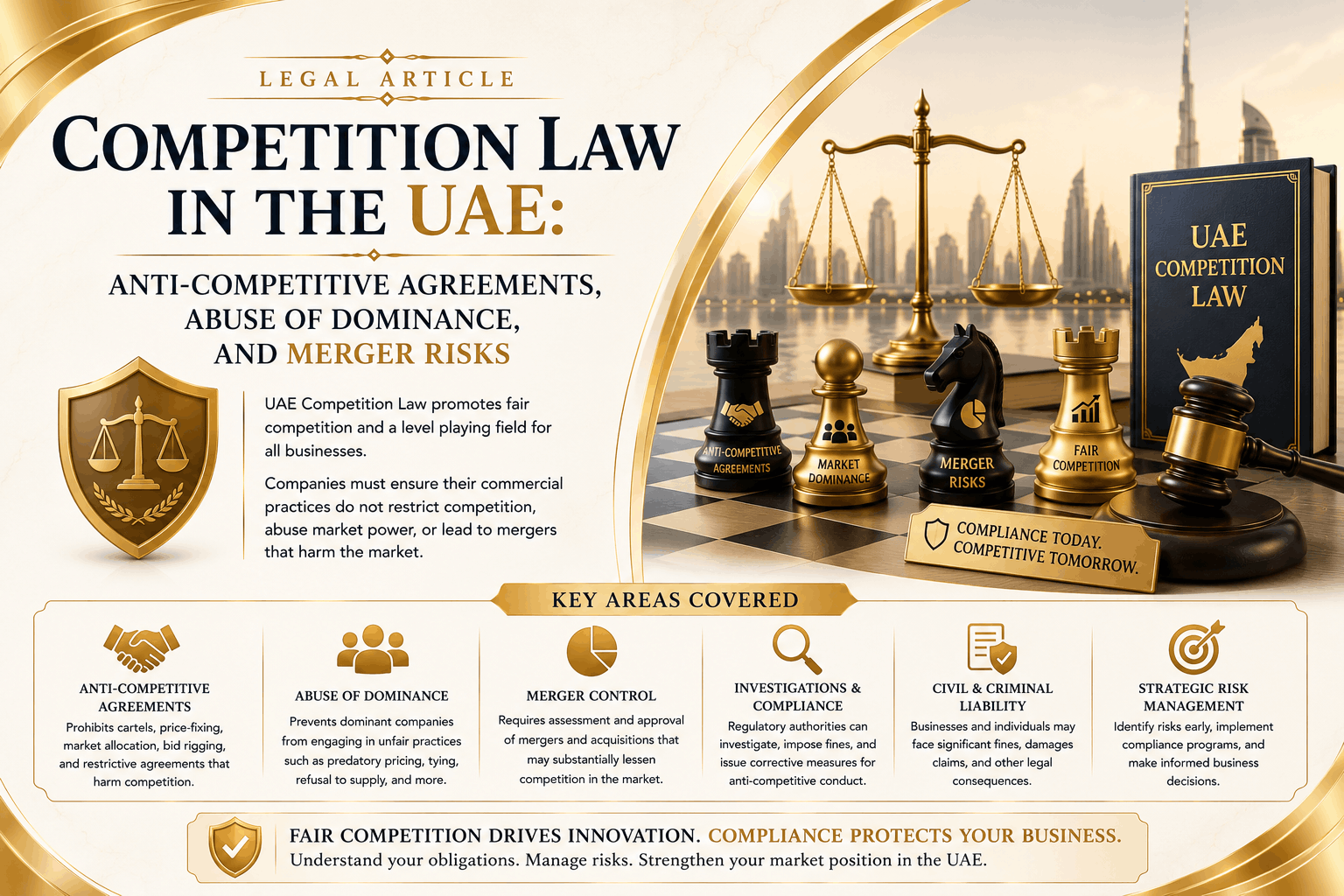 A practical UAE legal guide to anti-competitive agreements, abuse of dominance,
merger-control risks, commercial-team compliance, evidence, penalties, and legal strategy.
A practical UAE legal guide to anti-competitive agreements, abuse of dominance,
merger-control risks, commercial-team compliance, evidence, penalties, and legal strategy.
Competition law in the UAE affects pricing, distribution, exclusivity, market sharing, trade association conduct, dominant-market behaviour, merger control, commercial negotiations, and daily decisions by sales and procurement teams.
Key principle: Competition risk is not limited to written cartel agreements. Verbal understandings, informal messages, coordinated pricing, market allocation, and premature merger implementation may all create serious regulatory and commercial exposure.UAE Legal Framework for Competition Law
UAE competition law is primarily based on Federal Decree-Law No. 36 of 2023 Regarding Regulating Competition, supported by threshold and executive regulation decisions. Businesses should verify the latest Ministry of Economy procedures before making filings, responding to complaints, or completing transactions.
Official-source placeholders:Official UAE legislation portal | UAE Ministry of Economy | UAE Ministry of Justice | Relevant UAE authority website | Dubai Courts | Abu Dhabi Judicial Department | DIFC Courts | ADGM Courts
Key Legal Concepts and Definitions
Important concepts include undertaking, relevant market, anti-competitive agreement, dominant position, abuse of dominance, abuse of economic dependence, economic concentration, merger notification, exemption, market share, and competition compliance.
Who UAE Competition Law Applies To
Competition law may affect mainland companies, free zone companies, foreign businesses affecting UAE markets, distributors, suppliers, retailers, manufacturers, trade associations, joint venture partners, M&A buyers and sellers, private equity firms, and commercial teams.
Rights and Obligations of Businesses, Managers, and Commercial Teams
Businesses should avoid anti-competitive coordination, dominance abuse, and unlawful merger implementation. They may also defend complaints, seek exemptions, submit merger filings, challenge inaccurate market definitions, appeal decisions, and claim damages where harmed.
Anti-Competitive Agreements
Anti-competitive agreements may be horizontal between competitors or vertical between businesses at different supply-chain levels. Risky conduct includes price fixing, bid rigging, market sharing, output restrictions, resale price pressure, and unlawful exclusion.
Price Coordination and Information Exchange
Price coordination may include agreeing minimum prices, future price increases, discounts, margins, commissions, or sensitive commercial information. Trade associations, WhatsApp groups, informal meetings, and industry events can create evidence risk.
Market Sharing and Customer Allocation
Market sharing occurs where competitors divide territories, customers, tenders, channels, product lines, or accounts instead of competing independently. These arrangements are usually high risk and difficult to defend.
Distribution, Exclusivity, and Resale Restrictions
Distribution and exclusivity arrangements require legal review where they restrict reseller freedom, foreclose competitors, impose resale pricing, limit online sales, or block market access.
Abuse of Dominant Position
Dominance is not illegal by itself, but abuse may arise through unfair terms, unjustified refusal to supply, discriminatory treatment, tying, exclusive dealing, predatory pricing, or exclusionary rebate structures.
Abuse of Economic Dependence
Economic dependence risk may arise where a customer or distributor has no realistic alternative for supply or marketing and a powerful undertaking imposes unfair or restrictive conditions.
Predatory Pricing and Below-Cost Strategies
Below-cost pricing may be risky where it is designed to force competitors out of the relevant market or prevent entry. Legitimate discounts, promotions, and clearance sales should be documented.
Merger Control and Economic Concentration Risks
Economic concentration may include mergers, acquisitions, share transfers, asset transfers, joint control arrangements, and other transactions that transfer control. M&A teams should assess notification requirements before signing or closing and use clean-team controls for sensitive information.
Procedures in the UAE
- Conduct internal legal and market review.
- Assess relevant market, market share, sales, and conduct.
- Prepare exemption application or economic concentration filing where required.
- Submit complaint, defence, or regulatory filing to the competent authority.
- Respond to information requests accurately and preserve documents.
- Coordinate with sector regulators where relevant.
- Review decision, complaint, and appeal routes.
- Prepare court action, defence, damages claim, or settlement strategy where needed.
Complaints, Investigations, Appeals, and Court Actions
Competition complaints should identify the relevant market, conduct, evidence, parties, harm, and requested remedy. Defences should address market definition, lack of restriction, objective justification, efficiencies, evidence gaps, and procedural rights.
Required Documents and Evidence
- Commercial contracts and distribution agreements
- Pricing, rebate, discount, and resale policies
- Emails, WhatsApp messages, and meeting minutes
- Trade association agendas and minutes
- Market studies and market-share reports
- Sales data, turnover data, and financial statements
- Tender documents and bid submissions
- M&A agreements, integration plans, and clean-team protocols
- Compliance training records and internal policies
- Ministry or regulator correspondence
- Expert economic reports and legal submissions
Competition Compliance for Commercial Teams
Practical compliance should train sales, procurement, marketing, pricing, distribution, strategy, and M&A teams to avoid competitor coordination, preserve independent decision-making, control sensitive information, use clean teams, and escalate risks early.
Free Zones, Sector Regulators, DIFC, ADGM, and Cross-Border Issues
Mainland and free zone businesses may face UAE competition risk where conduct affects UAE markets. Sector-regulated businesses should also consider specialised regulatory rules and coordination with relevant authorities.
Common Misunderstandings
- Competition law only applies to large companies.
- There is no problem unless there is a written agreement.
- Trade association discussions are always safe.
- Exclusive distribution is always lawful.
- Dominant companies cannot compete aggressively.
- Merger control only applies to full mergers.
- A notifiable deal can close while approval is pending.
- WhatsApp messages are informal and do not matter.
Common Mistakes to Avoid
- Discussing prices with competitors
- Ignoring market definition
- Signing exclusivity without legal review
- Turning resale price recommendations into mandatory prices
- Failing to notify a notifiable transaction
- Sharing sensitive information during M&A
- Destroying or editing documents
- Responding casually to regulatory requests
- Relying on outdated competition-law assumptions
Practical Examples
Retailers Agree on Minimum Prices
Retailers using informal messages to agree minimum prices may create evidence of anti-competitive coordination even without a formal written contract.
Distributor Exclusivity Blocks Competitors
Long-term exclusivity across key distributors may require review of market share, foreclosure effect, duration, alternatives, and objective commercial justification.
Acquisition With 40% Market Share
M&A parties should assess whether an economic concentration filing is required before closing and should manage transaction documents, timing, and information sharing.
Trade Association Pricing Discussion
If a trade association meeting turns to future pricing, compliant participants should object, stop the discussion, leave if necessary, and seek legal advice.
Legal Risks and Consequences
Competition-law failures may result in investigations, penalties, merger delays, deal rejection, damages claims, suspension of conduct, contract disruption, reputation damage, management exposure, and business interruption.
How a Lawyer Evaluates a Competition Law Case
A lawyer reviews applicable law, relevant market, market share, contracts, actual conduct, emails, competitor communications, pricing behaviour, tender activity, exclusivity, dominance, economic dependence, merger thresholds, regulator procedure, evidence, penalties, court options, and commercial objectives.
How a Lawyer Builds a Stronger Legal Position
Legal support may include contract review, compliance audits, team training, merger-control analysis, exemption applications, economic concentration filings, regulatory responses, complaint defence, appeal submissions, expert coordination, and settlement strategy.
Settlement vs Litigation or Regulatory Defence
Settlement may resolve commercial disputes or contract restrictions, but formal defence may be necessary where complaints, Ministry requests, penalties, merger decisions, damages claims, or appeals are involved.
When Urgent Legal Action May Be Needed
- A competitor contacts your team about prices
- A trade association discussion turns to future strategy
- A Ministry information request is received
- A complaint is filed by a customer or competitor
- An acquisition is close to signing or closing
- A notifiable transaction may have been implemented
- Sensitive M&A information was shared without safeguards
- A court or appeal deadline may apply
Frequently Asked Questions
1. What is the main competition law in the UAE?
The main federal law is Federal Decree-Law No. 36 of 2023 Regarding Regulating Competition.
2. Does UAE competition law apply to verbal agreements?
Yes. Verbal, implicit, informal, public, confidential, and cooperation-based arrangements may create risk.
3. What is a dominant position?
It is the ability to control or influence the relevant market. UAE threshold rules include a 40% relevant-market transaction share threshold for dominance.
4. Is dominance illegal?
No. The risk arises when a dominant business abuses that position through exclusionary, exploitative, or unfair conduct.
5. What is economic concentration?
It includes mergers, acquisitions, control transfers, share transfers, asset transfers, and other arrangements that give direct or indirect control.
6. When is a UAE merger filing required?
Notification may be required where annual sales in the relevant UAE market exceed AED 300 million or combined share exceeds 40% of total transactions in that market.
7. Can parties close while approval is pending?
For notifiable economic concentrations, parties should not complete the transaction during the Ministry review period.
8. Can an injured party claim damages?
Yes. Injured parties may have court recourse for damages arising from competition-law violations.
9. Do trade associations create risk?
Yes. Pricing, customer allocation, production, tenders, and future strategy discussions between competitors can create serious risk.
10. What should a business do after risky competitor communications?
Preserve documents, stop the conduct, avoid further discussions, notify legal or compliance teams, and seek UAE competition-law advice.
Conclusion
Competition law in the UAE is a central compliance issue for pricing, distribution, exclusivity, trade associations, dominance, economic dependence, predatory pricing, and M&A transactions.
Early legal advice can help businesses review commercial arrangements, identify merger risks, train teams, preserve evidence, respond to complaints, prepare filings, and build a defensible compliance culture before the matter becomes more complicated.
Need Advice About UAE Competition Law?
Obtain tailored advice on anti-competitive agreements, pricing practices, market sharing, exclusivity, abuse of dominance, merger control, Ministry procedures, compliance safeguards, and regulatory defence.
Book a Legal ConsultationLegal Disclaimer: This article is for general information only and does not constitute legal advice. The correct legal position depends on the market, conduct, contracts, evidence, transaction structure, parties, regulator, and procedural stage.
Services | Legal Consultation | Contact Us | UAE Law Articles | About Us