Misleading Advertising and Consumer Rights in the UAE: Legal Risks for Brands and Retailers
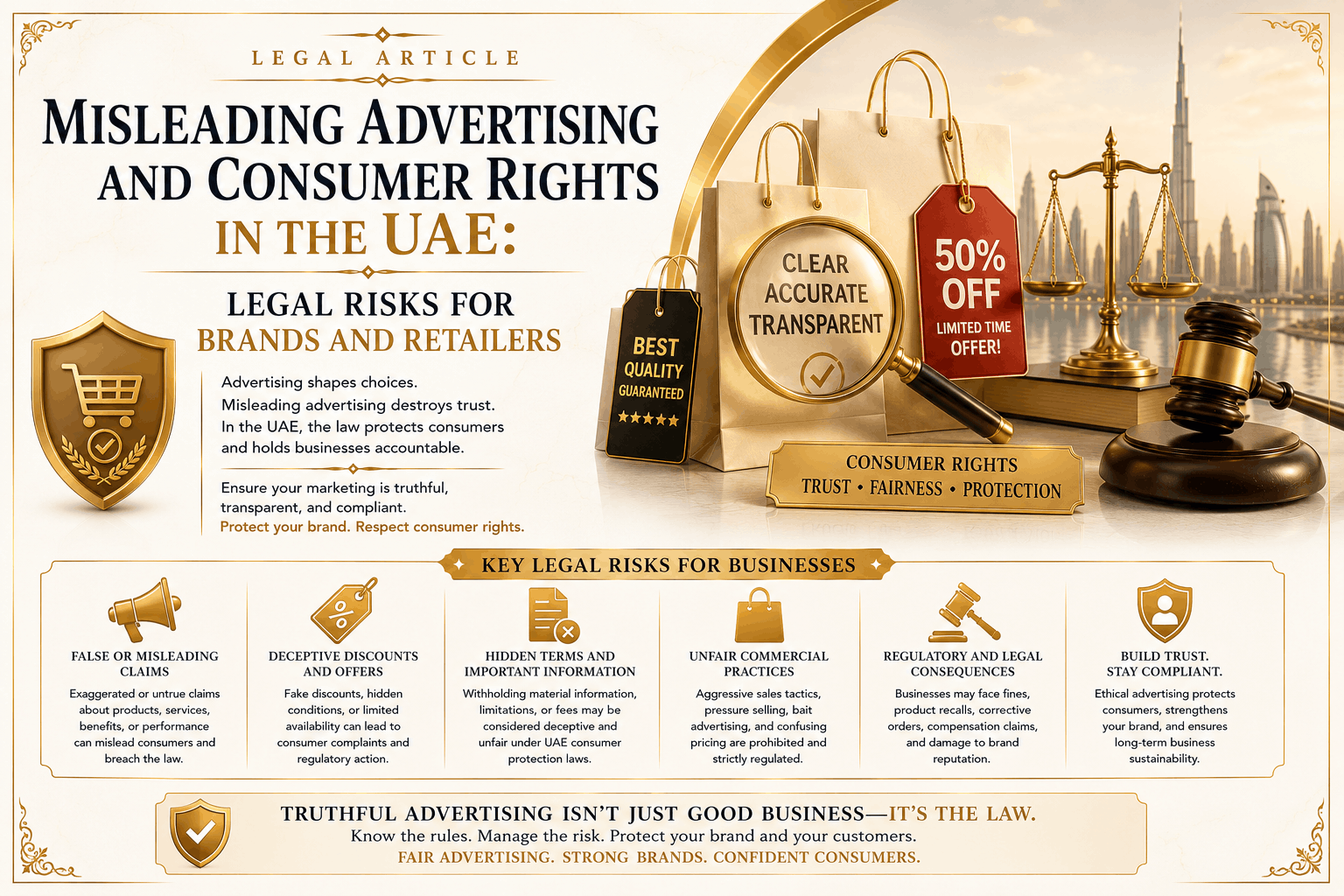
Misleading advertising in the UAE can arise from product descriptions, promotions, online listings, warranty promises, refund policies, influencer campaigns, pricing claims, and hidden conditions that affect a consumer’s decision to buy.
UAE Legal Framework for Misleading Advertising and Consumer Rights
UAE misleading advertising issues may involve Federal Law No. 15 of 2020 on Consumer Protection, later amendments, executive regulations, local consumer protection authorities, promotion approval requirements, media and influencer rules, civil claims, platform policies, and sector-specific regulations.
Official UAE legislation portal | UAE Ministry of Economy | UAE Ministry of Justice | UAE Media Council | Relevant UAE authority website | Dubai Courts | Abu Dhabi Judicial Department | DIFC Courts | ADGM Courts
Key Legal Concepts and Definitions
Important concepts include misleading advertising, false data, omitted material information, consumer, provider, supplier, advertiser, commercial agent, warranty, refund policy, promotional campaign, influencer advertising, complaint, corrective action, and regulatory defence.
Who UAE Consumer Protection and Advertising Rules Apply To
These rules may affect brands, retailers, e-commerce sellers, marketplaces, agencies, influencers, distributors, commercial agents, manufacturers, importers, service providers, free zone companies, mainland companies, and foreign businesses selling to UAE consumers.
Rights and Obligations of Consumers, Brands, Retailers, and Advertisers
Consumers may have rights to accurate information, declared prices, clear warranties, and complaint routes. Businesses should ensure accurate claims, clear terms, lawful promotions, proper refund policies, supported warranty promises, and compliant influencer campaigns.
Product Descriptions, Online Listings, and E-Commerce Claims
Online listings can be misleading where product titles, images, specifications, reviews, stock status, delivery promises, warranty statements, or return terms create an inaccurate impression.
Promotions, Discounts, Free Gifts, and Prize Campaigns
Discounts, free gifts, prize draws, cashback offers, coupon codes, bundle deals, loyalty promotions, and limited-time campaigns should be clear, genuine, properly authorised where required, and supported by records.
Refund Policies, Exchange Terms, and Warranty Claims
Refund and warranty wording should match the product page, invoice, warranty card, staff statements, and consumer protection requirements. Hidden exclusions or inconsistent staff responses can create dispute risk.
Influencer Campaigns and Social Media Advertising
Influencer campaigns should include clear approval processes, claim substantiation, permit checks, disclosure controls, takedown rights, and responsibility for unsupported or exaggerated claims.
Health, Beauty, Medical, and Performance Claims
Health, beauty, medical, slimming, fitness, cosmetic, wellness, education, investment, and performance claims require particular caution because unsupported claims may create consumer protection, media, health authority, licensing, and product safety risks.
Pricing Transparency and Hidden Charges
Advertised prices should be clear. Hidden charges, preselected add-ons, unclear subscription renewals, checkout surprises, unavailable starting prices, and misleading VAT or delivery fee treatment can create legal and reputational risk.
Procedures in the UAE
- Review the advertisement, product page, invoice, and complaint.
- Preserve screenshots, campaign records, and approval documents.
- Assess whether the claim is false, incomplete, ambiguous, or unsupported.
- Respond to the consumer clearly and professionally.
- Consider refund, replacement, correction, takedown, or settlement.
- Respond to authority requests with organised evidence.
- Prepare legal defence or civil claim strategy where needed.
- Update internal compliance processes to prevent recurrence.
Consumer Complaints and Regulatory Escalation
Consumer complaints should be supported by screenshots, invoices, payment proof, product descriptions, warranty records, refund policy, communication history, and requested remedy. Businesses should respond with evidence, legal analysis, and a practical resolution proposal.
Required Documents and Evidence
- Advertisement copy, screenshots, videos, and campaign files
- Product pages, marketplace listings, and website archives
- Invoices, payment receipts, warranty cards, and refund policies
- Promotion licence or approval where applicable
- Price history and discount calculation records
- Influencer contracts, permits, scripts, captions, and approvals
- Supplier certificates, product tests, and authority approvals
- Customer service emails, WhatsApp messages, and complaint records
- Agency briefs, internal approvals, and corrective action records
Brand, Retailer, Agency, and Influencer Liability
Liability may involve the brand, retailer, distributor, agency, influencer, platform seller, or commercial agent depending on who controlled the claim, approved the campaign, supplied the information, benefited from the advertisement, or dealt with the consumer.
Common Misunderstandings
- If a claim is common in marketing, it is safe.
- Small print solves every problem.
- Influencers are always solely responsible for their posts.
- A discount is legal as long as the final price is lower.
- Online listings are not formal advertising.
- Refund policies can say anything.
- Deleting a post removes all risk.
- Only consumers can complain.
Common Mistakes to Avoid
- Launching campaigns without legal review
- Using fake scarcity or resetting countdown timers
- Advertising discounts without price evidence
- Allowing influencers to improvise legal claims
- Hiding key conditions in unclear terms
- Ignoring consumer complaints
- Giving inconsistent refund responses
- Copying foreign claims without UAE review
- Failing to keep campaign records
Practical Examples
Fake Discount Campaign
A retailer advertises a large discount after raising the original price. The better approach is to keep price history, campaign approvals, promotion permits, screenshots, invoices, and clear terms.
Influencer Beauty Product Claim
An influencer claims permanent results without evidence. The brand should review the contract, stop the campaign, preserve evidence, correct the claim, and assess consumer complaint risk.
E-Commerce Product Misdescription
A product is advertised as genuine leather but delivered as synthetic material. The product page, invoice, label, supplier documents, photos, and return request become essential evidence.
Warranty Promise Not Honoured
A seller advertises a two-year warranty but later applies hidden exclusions. The advertisement, invoice, warranty card, repair records, and staff communications should be compared.
Legal Risks and Consequences
Misleading advertising may lead to consumer complaints, refunds, replacements, campaign takedowns, regulatory investigation, administrative penalties, civil claims, influencer disputes, platform suspension, product recall risk, reputational damage, and business disruption.
How a Lawyer Evaluates a Misleading Advertising Case
A lawyer reviews the advertisement, consumer pathway, product description, omitted information, pricing evidence, promotion approvals, refund policy, warranty terms, influencer role, federal and local rules, complaint route, evidence, penalty exposure, settlement options, and corrective action plan.
How a Lawyer Builds a Stronger Legal Position
Legal support may include campaign review, compliant terms, influencer contract drafting, promotion approval checks, product description review, complaint responses, evidence preservation, settlement negotiation, regulatory defence, corrective notices, and staff training.
Settlement vs Litigation or Regulatory Defence
Settlement may resolve consumer loss quickly, while regulatory defence or litigation may be needed where complaints are exaggerated, a regulator requests documents, a competitor complains, or wider consumer harm is alleged.
When Urgent Legal Action May Be Needed
- A misleading campaign is live
- A social media post is going viral
- A regulator contacts the business
- A product safety issue exists
- An influencer refuses to remove content
- A promotion was launched without approval
- Refund complaints are increasing
- A product recall may be needed
- Evidence may be deleted
Frequently Asked Questions
1. What is misleading advertising in the UAE?
It includes advertising based on deceptive information or omitting essential information that affects a consumer’s decision to buy.
2. Does UAE law prohibit false product descriptions?
Yes. Advertisers, providers, and commercial agents should not describe goods or services with false data or advertise them in a misleading way.
3. Can fake discounts create legal liability?
Yes. Fake discounts, unreal prizes, inflated reference prices, or hidden conditions may create misleading advertising risk.
4. Can consumers complain about misleading advertising?
Yes. Consumers can complain about misleading advertising, unfair business practices, breach of warranty, defective products, and poor service quality through the relevant authority route.
5. Are influencers regulated?
Yes. Social media advertising may require an Advertiser Permit and compliance with UAE media and advertising rules.
6. Can small print protect a misleading advertisement?
Not always. Material terms should be clear and visible, and the main message should not mislead consumers.
7. What evidence is important?
Screenshots, invoices, product pages, campaign terms, price history, warranties, refund policies, influencer approvals, and complaint records are usually important.
8. Can a brand be liable for an influencer’s claim?
Potentially, if the brand instructed, approved, paid for, controlled, or benefited from the misleading claim.
9. What should a business do after discovering misleading content?
Preserve evidence, stop or correct the campaign, assess affected consumers, review regulatory exposure, prepare a response plan, and seek legal advice.
10. Can misleading advertising lead to penalties?
Yes. Misleading advertising may lead to complaints, regulatory action, civil claims, fines, and in serious cases criminal exposure.
Conclusion
Misleading advertising in the UAE is a serious risk for brands, retailers, e-commerce sellers, agencies, influencers, and service providers.
Early legal advice can help businesses review campaigns before launch, correct risky content, respond to complaints, preserve evidence, manage regulators, protect consumers, and reduce the risk of penalties, reputational harm, and costly disputes.
Need Advice About UAE Advertising or Consumer Rights?
Obtain tailored advice on misleading advertising, consumer complaints, promotions, product descriptions, warranties, refund policies, influencer campaigns, regulatory exposure, settlement, and legal defence.
Book a Legal Consultation