

UAE insurance disputes | Claim rejections | Policy interpretation | Bad faith arguments | Evidence | Recovery options
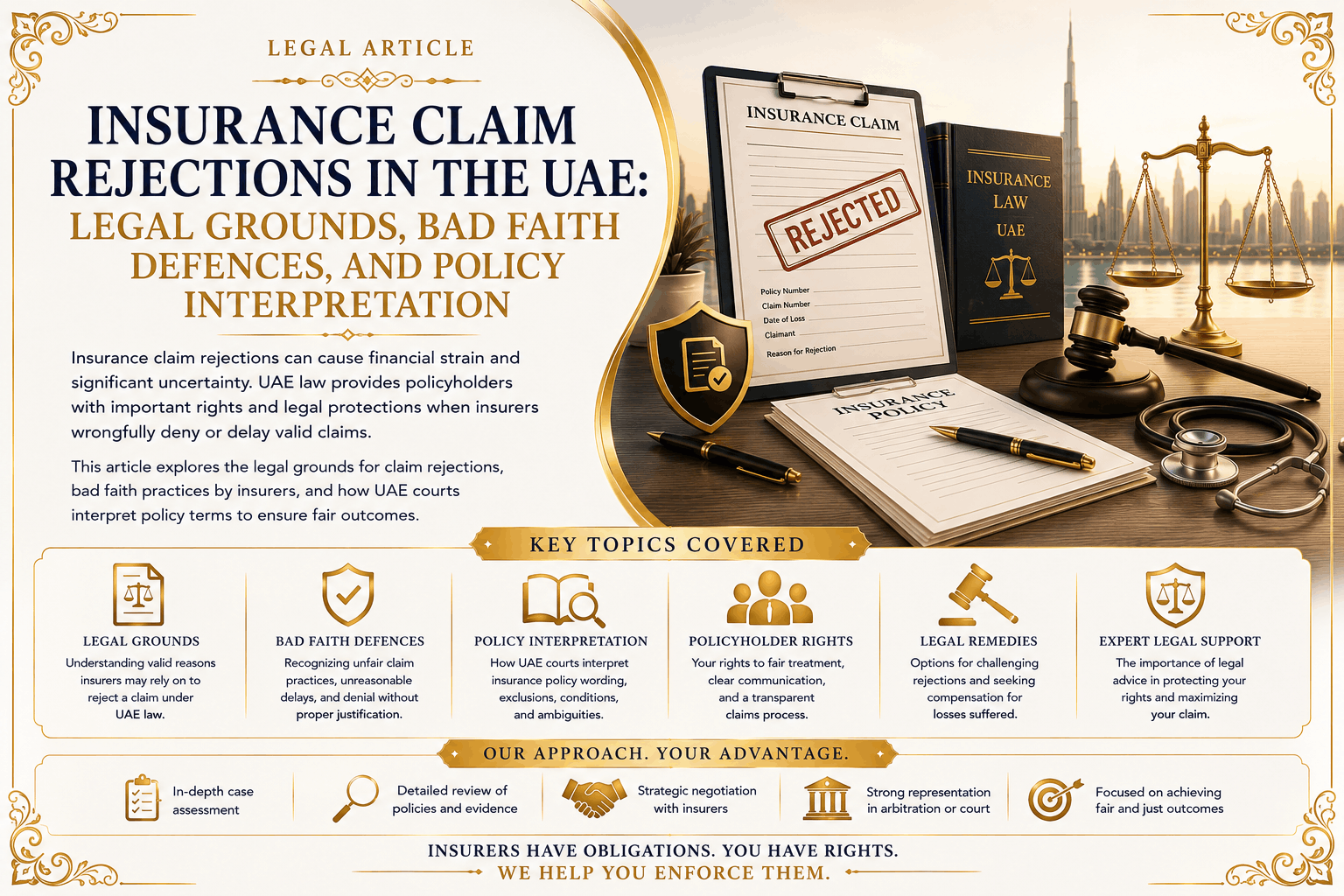 A practical guide to UAE insurance claim rejections, policy
interpretation, evidence, complaint procedures, settlement, and litigation
strategy.
A practical guide to UAE insurance claim rejections, policy
interpretation, evidence, complaint procedures, settlement, and litigation
strategy.
Insurance litigation in the UAE requires careful review of the policy wording, rejection reasons, evidence, complaint procedure, and available recovery options.
Key principle: A rejected insurance claim is not always final, but it must be challenged with policy wording, documents, expert evidence, and the correct procedural route.UAE Legal Framework for Insurance Litigation
UAE insurance disputes may involve federal insurance regulation, Central Bank supervision, Sanadak complaint procedures, insurance dispute committees, civil courts, arbitration clauses, policy interpretation, and expert evidence.
Official-source placeholders:Official UAE legislation portal | UAE Central Bank | Sanadak | UAE Ministry of Justice | Dubai Courts | Abu Dhabi Judicial Department | DIFC Courts | ADGM Courts
Key Legal Concepts and Definitions
Important concepts include policy wording, insured person, beneficiary, rejection, exclusion, deductible, policy limit, loss adjuster, expert report, and bad faith or unfair claim handling arguments.
Who Insurance Law Applies To
Insurance litigation may affect policyholders, beneficiaries, companies, insurers, brokers, agents, hospitals, vehicle owners, property owners, contractors, professionals, employees, directors, reinsurers, and free-zone entities.
Rights and Obligations of Policyholders and Insurers
Policyholders may submit claims, request written reasons, challenge rejection, and pursue recovery. Insurers may investigate, request documents, rely on valid exclusions, and defend unsupported or fraudulent claims.
Common Types of Insurance Claim Rejections
- No coverage under the policy
- Exclusion applies
- Late notification
- Non-disclosure or misrepresentation
- Unpaid premium or policy lapse
- Insufficient evidence
- Alleged fraud or exaggeration
- Loss outside territorial scope
Policy Interpretation in UAE Insurance Disputes
A policy should be read as a whole, including definitions, coverage clauses, exclusions, endorsements, schedules, deductibles, limits, jurisdiction clauses, and claim conditions.
Exclusions, Conditions, Warranties, and Endorsements
Exclusions and conditions must be applied to the facts. Endorsements may expand or restrict coverage and can be decisive in a dispute.
Disclosure, Misrepresentation, and Non-Disclosure
Insurers may rely on non-disclosure or misrepresentation, while insureds may argue that the fact was not material, the question was unclear, or the rejection is disproportionate.
Delay, Late Notification, and Claim Cooperation
Late notice may create a defence, but the policy wording, reason for delay, prejudice to the insurer, and insurer conduct should be examined.
Bad Faith Arguments and Unfair Claim Handling
Bad faith arguments should be framed through UAE contract principles, regulatory duties, written reasons, evidence ignored, unreasonable delay, inconsistent rejection grounds, and unfair claim handling.
Claim Rejection Letters and Written Reasons
Rejection letters should identify the claim, policy clauses, evidence considered, missing documents, rejection basis, and appeal or complaint options where applicable.
Procedures in the UAE
- Submit the claim.
- Respond to insurer document requests.
- Review any surveyor or expert findings.
- Obtain the insurer’s written decision.
- File an internal complaint.
- Escalate through Sanadak or the relevant route where eligible.
- Proceed to committee, court, arbitration, or settlement as appropriate.
- Enforce any binding decision or judgment.
Insurer Internal Complaint Process
A complaint should identify the policy number, claim number, rejection letter, disputed clauses, evidence, and remedy requested.
Sanadak and Insurance Complaint Escalation
Eligible complaints may be escalated to Sanadak after the insured first attempts to resolve the dispute directly with the insurance company.
Insurance Dispute Committees and Court Proceedings
Committee or court proceedings should be supported by the policy, claim documents, rejection grounds, expert evidence, legal arguments, and calculation of loss.
DIFC, ADGM, Arbitration, and Free-Zone Issues
Some policies include DIFC, ADGM, arbitration, or foreign-law provisions. The correct forum must be verified before filing.
Required Documents and Evidence
- Full policy wording and schedule
- Endorsements and proposal form
- Premium payment records
- Claim form and notification
- Rejection letter and correspondence
- Police or accident reports
- Medical records, invoices, and receipts
- Photos, videos, repair estimates, and expert reports
- Surveyor or loss-adjuster reports
- Broker communications
- Complaint and Sanadak records
Expert Evidence, Surveyors, and Loss Adjusters
Experts may assess cause of loss, repair cost, replacement value, medical necessity, disability, business interruption, construction defects, or whether an exclusion applies.
Medical, Motor, Property, and Business Claims
Medical, motor, property, and business interruption claims each require different evidence, including medical records, police reports, repair estimates, invoices, accounting records, and expert findings.
Corporate and Professional Liability Insurance
Corporate policies may involve professional indemnity, D&O, cyber, employer liability, public liability, contractor’s all-risk, marine cargo, and trade credit coverage.
Common Misunderstandings
- Paying the premium guarantees claim payment.
- The policy schedule is the whole policy.
- A rejection letter is final.
- Bad faith automatically means the insurer must pay.
- All exclusions apply in every situation.
- Late notification always defeats the claim.
- The broker is always responsible.
- Settlement means weakness.
Common Mistakes to Avoid
- Not reading the full policy
- Missing notification requirements
- Submitting incomplete documents
- Accepting rejection without review
- Exaggerating the claim
- Repairing damaged property too early
- Ignoring broker communications
- Signing a settlement waiver too quickly
- Choosing the wrong forum
Practical Examples
Property Fire Claim Rejected for Non-Disclosure
The dispute should assess materiality, proposal questions, stock records, inspection reports, fire-cause evidence, and policy exclusions.
Motor Claim Rejected for Excluded Driver
The analysis depends on driver exclusions, licence status, policy wording, police report, permitted use, and third-party liability.
Medical Insurance Rejection
A pre-existing-condition rejection requires review of medical history, application disclosure, policy definitions, and diagnosis timing.
Business Interruption Underpayment
The claim should be supported by accounting records, sales history, expenses, mitigation evidence, interruption period, and policy sub-limits.
Legal Risks and Consequences
Poor handling may cause loss of coverage, rejection, underpayment, missed escalation, weak evidence, lost damaged-property evidence, expert problems, waiver risk, and litigation costs.
How a Lawyer Evaluates an Insurance Claim Rejection
A lawyer reviews policy wording, applicable law, jurisdiction, exclusions, endorsements, premium payment, disclosure history, notice timing, rejection reasons, evidence, loss amount, expert reports, complaint routes, and settlement prospects.
How a Lawyer Builds a Stronger Legal Position
Legal support may include coverage analysis, complaint drafting, legal notices, evidence organisation, expert coordination, Sanadak submissions, committee or court claims, settlement negotiation, and enforcement.
Settlement vs Litigation
Settlement may provide speed and certainty, while litigation may be needed where coverage is refused, the value is substantial, expert evidence supports the insured, or the insurer’s position is legally weak.
When Urgent Legal Action May Be Needed
- A high-value claim is rejected
- Damaged evidence may be lost
- Business interruption is ongoing
- Urgent medical authorisation is refused
- The insurer alleges fraud
- Defence costs are accruing
- A settlement waiver is presented
- A limitation, complaint, or appeal issue may arise
Frequently Asked Questions
1. Can an insurer reject my claim without reasons?
The current UAE framework requires written reasons where a complaint or claim is rejected in whole or in part.
2. What should I do first after receiving a rejection?
Request written reasons, review the policy clauses, preserve evidence, avoid signing a waiver, and prepare a structured complaint.
3. Can I complain through Sanadak?
Potentially, if the complaint is eligible and you first tried to resolve the matter directly with the insurer.
4. Does paying the premium guarantee payment?
No. The claim must still fall within coverage and avoid valid exclusions or conditions.
5. Can exclusions be challenged?
Yes, depending on wording, facts, ambiguity, applicable law, and the insurer’s interpretation.
6. What evidence is important?
The full policy, schedule, endorsements, rejection letter, claim file, correspondence, invoices, photos, expert reports, and proof of loss are usually important.
7. Can a broker be liable?
Potentially, where broker advice, communication, or failure to obtain requested coverage caused loss.
8. Can I sue the insurer directly?
Depending on the forum, policy wording, and procedural rules, committee, court, or arbitration proceedings may be available.
9. What if the insurer delays?
Document the delay, request written status, identify missing documents, escalate internally, and seek advice where delay is unreasonable.
10. Is bad faith recognised in the UAE?
The term should be used carefully. Claims are usually stronger when framed through policy wording, regulatory duties, evidence, and unfair handling.
11. Can I settle after filing a complaint?
Yes, but the settlement and release wording should be reviewed carefully.
12. How long does insurance litigation take?
Timing depends on the insurer response, complaint route, expert evidence, court or committee schedule, appeal, and dispute complexity.
Conclusion
Insurance litigation in the UAE requires careful policy interpretation, evidence preparation, and procedural strategy.
Early legal advice can help policyholders assess whether a rejection is valid, strengthen evidence, challenge weak insurer reasoning, negotiate settlement, and pursue recovery through the correct legal channel.
Need Advice About an Insurance Claim Rejection?
Obtain tailored advice on rejected claims, policy interpretation, exclusions, evidence, Sanadak eligibility, settlement, committee proceedings, and UAE insurance litigation.
Book a Legal ConsultationLegal Disclaimer: This article is for general information only and does not constitute legal advice. The correct legal position depends on the policy wording, claim facts, evidence, insurer conduct, forum, and procedural stage.
Services | Legal Consultation | Contact Us | UAE Law Articles | About Us