
UAE Environmental and Wildlife Law
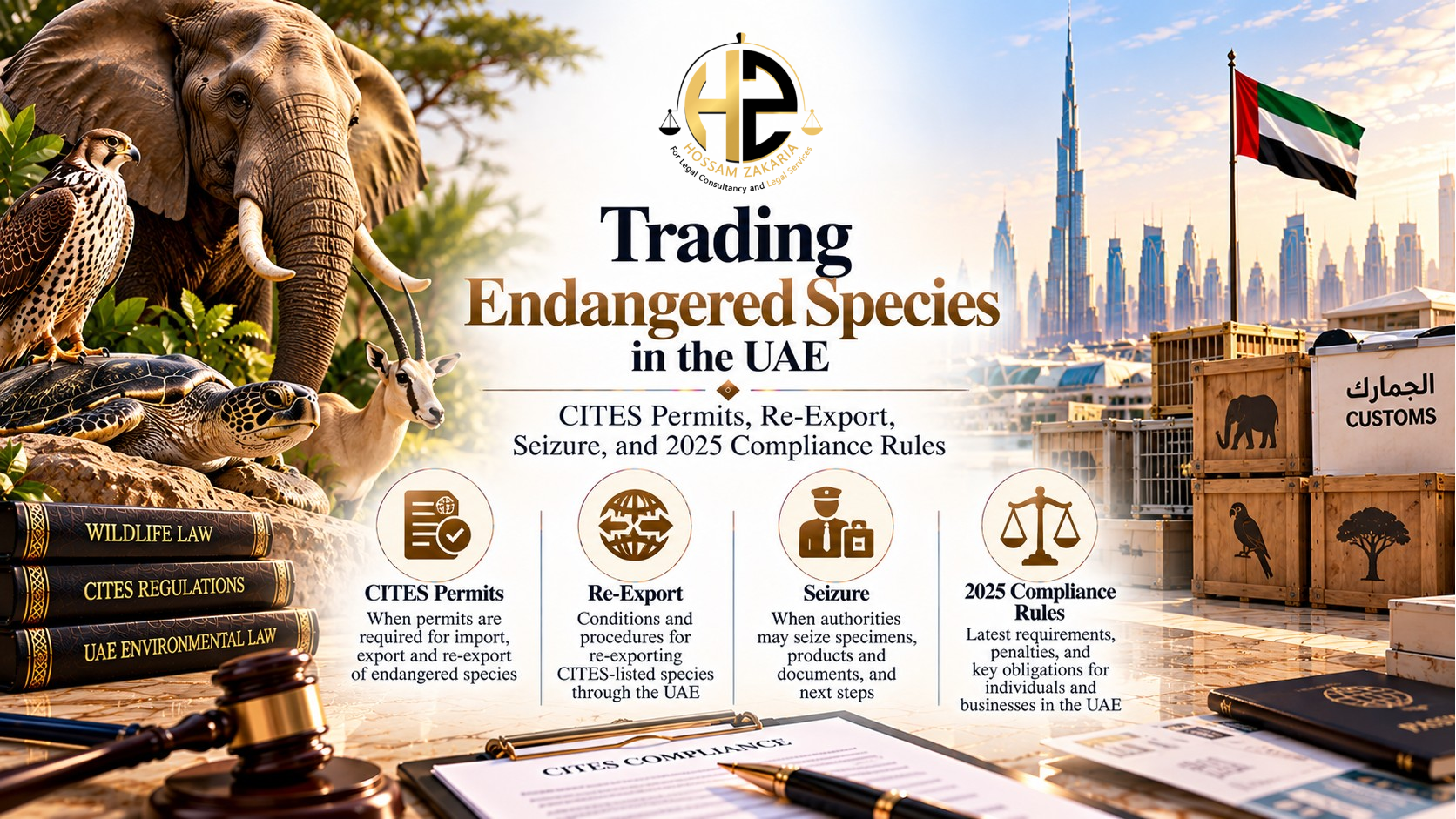
Trading Endangered Species in the UAE: CITES Permits, Re-Export, Seizure, and 2025 Compliance Rules
Practical guide for importers, exporters, re-exporters, breeders, collectors, zoos, veterinary clinics, logistics providers, and businesses handling protected fauna, flora, specimens, or derivatives.
1. The legal framework and the 2025 transition
The UAE’s current federal framework is Federal Law No. (5) of 2025 Regarding the Regulation and Control of International Trade in Endangered Species of Wild Fauna and Flora. It was issued on 26 December 2025 and entered into force on the day after publication; official UAE and sector sources describe the operative date as 1 January 2026. The statute repeals Federal Law No. (11) of 2002, while preserving earlier implementing regulations and decisions until replacement instruments are issued to the extent that they do not conflict with the new law.
The title “2025 compliance rules” therefore needs a timing qualification. The law is a 2025 enactment, but a shipment handled today is generally assessed against the law in force, the current CITES Appendices, the Cabinet’s executive regulations when issued, and the latest Ministry of Climate Change and Environment (MOCCAE) service and port instructions. A business should not assume that an old permit route, form, or administrative practice survives unchanged merely because a specimen was acquired under the 2002 regime.
The law designates MOCCAE as the National Management Authority and separates administrative functions from scientific assessments. It also recognises “Concerned Authorities” with judicial-officer powers to establish violations. The framework reaches imports, exports, re-exports, introduction from the sea, transit, possession and documentation in the situations stated by the law. It also addresses scientific institutions, zoos, circuses, veterinary clinics, personal and household effects, captive-bred or artificially propagated specimens, international trade with non-Parties, and specimens possessed before listing.
Language and verification note: The Arabic legislation published by the UAE authorities is the controlling text. English portal text and explanatory summaries are useful for navigation but should not be treated as a substitute for checking the Arabic article, the relevant CITES Appendix, executive regulations, and the permit conditions attached to the particular shipment.
2. What is regulated under CITES and UAE law?
CITES controls international trade in specimens of listed species, not only live animals. Depending on the species and the listing annotation, the regulated item may be a live plant or animal, a dead specimen, a skin, timber, a root, a trophy, a leather product, a medicine ingredient, a caviar container, a coral or shell product, or another derivative. The legal analysis begins with the scientific name and the form of the specimen, not the commercial description used on an invoice.
The three CITES Appendices are not interchangeable:
| Classification | Compliance significance | Typical risk |
|---|---|---|
| Appendix I | Highest level of protection; commercial transactions are tightly restricted and generally require both the correct UAE certificate and the exporting/importing authorities’ approvals. | Attempted shipment without a valid certificate can create severe criminal exposure, confiscation, and possible deportation for a foreign offender. |
| Appendix II | International trade may be permitted if the specimen is lawfully sourced and the required export or re-export certificate is issued. | Traders often treat an Appendix II item as “unregulated” and ship without a valid document or with a document that does not match the specimen. |
| Appendix III | Controls depend on the listing and the exporting State; certificates or other documentary proof may be required. | Failure to provide the exporting State’s certificate or relying on a generic commercial invoice can stop release and expose the shipment to enforcement. |
The current CITES listing must be checked at the time of the transaction. A specimen can change from an ordinary commercial product to a regulated item because of a listing amendment, a country-specific annotation, a quota, or a restriction published by CITES or a national authority. It is unsafe to rely only on a common name, a seller’s statement, or a previous shipment.
3. The permit and certificate map
MOCCAE’s published service pages show the practical routes for imports and exports/re-exports. The correct document depends on the transaction, Appendix, specimen, origin, destination, and purpose. A certificate is not a general licence to trade every animal or plant in a business’s inventory.
| Movement | Core document route | Operational points to verify |
|---|---|---|
| Import into the UAE | UAE CITES import certificate plus the exporting State’s CITES export or re-export certificate where required. | Import certificate is generally valid for one year; the shipment is inspected at the entry port and released only after documentary and other import conditions are satisfied. |
| Export of a UAE-bred or UAE-grown specimen | UAE CITES export certificate and any destination-country import approval required for the Appendix or purpose. | MOCCAE describes the export/re-export certificate as valid for six months and usable for one shipment; confirm the actual certificate conditions. |
| Re-export of a specimen previously imported into the UAE | UAE CITES re-export certificate supported by the specimen’s lawful import and release records. | The file should show how the specimen entered the UAE, how it was identified, and that the new destination has no applicable CITES trade ban. |
| Transit or trans-shipment | Documents required by the exporting and importing States and the CITES transit rules; MOCCAE instructions may differ for a shipment that merely passes through or is unloaded and reloaded. | Do not treat transit as a universal exemption. Confirm the route, port, custody and inspection position before the shipment moves. |
MOCCAE’s export/re-export service states that a certificate may contain up to four species, is issued for one shipment, and requires the species to appear in the applicant’s electronic account. It also requires exit through approved UAE ports, and a health certificate for agricultural or animal consignments. The published service page lists a standard AED 300 fee for a CITES export or re-export certificate and a separate per-bird fee for falcons; fees and service details should be checked at the time of filing.
For Appendix I exports or re-exports, MOCCAE’s service page refers to an import certificate or preliminary acceptance from the destination State and proof of ownership or a CITES release certificate, depending on when and how the specimen entered the UAE. For Appendix II and III movements, it refers to ownership registration or the CITES release certificate. Those documents are not interchangeable with a purchase invoice.
4. Re-export: why a prior import file matters
Re-export is often where a seemingly complete transaction fails. A UAE re-export certificate does not cure an unlawful or untraceable origin. The applicant should be able to connect the specimen in the proposed shipment to the specimen described in the original foreign export or re-export certificate, the UAE import certificate, the customs declaration, the release record, and the current ownership or registration record.
For live animals, that chain commonly includes a microchip, ring, ear tag, photographic record, breeding record, or other species-appropriate identifier. For plants or derivatives, it may include package markings, batch and container numbers, botanical identification, invoices, treatment records, and the original CITES documents. A mismatch in sex, quantity, species, marking, origin, or description can delay release while authorities investigate whether the specimen is the same one that was lawfully imported.
The commercial contract should allocate the risk of missing documents before the specimen is paid for or shipped. Useful clauses identify the exact scientific name, Appendix, source code where relevant, certificate numbers, responsibility for destination-country permits, the approved port, who bears seizure or storage costs, and what happens if a permit is refused or a shipment is detained. A “seller warrants all permits” clause is helpful but does not prevent authorities from taking action against the UAE importer or possessor.
Re-export checklist
- Confirm the destination country and whether it has a CITES trade restriction or species-specific ban.
- Match the specimen to the original import and release documents using identifiers and quantities.
- Check whether the transaction is a re-export, an export of a UAE-bred specimen, or a different movement requiring a different certificate.
- Obtain any destination import permit or preliminary approval before applying to MOCCAE where required.
- Use an approved port and coordinate veterinary, phytosanitary, customs, airline and carrier requirements.
- Keep the complete chain of custody, including ownership transfers and prior permits.
5. Border ports, transit, and shipment release
Federal Law No. 5 of 2025 includes a border-port framework and authorises inspection of certificates, consignments and specimens, including taking samples or parts for analysis or detailed examination where necessary. The operational question is not simply whether a document exists; it is whether the document is authentic, valid, issued by the correct authority, consistent with the consignment, and being used at an authorised port for the stated movement.
MOCCAE’s import service requires the CITES certificate from the exporting State, the waybill or route statement, customs declaration, and additional veterinary or phytosanitary documents depending on whether the shipment contains live animals, raw products, treated products, live plants, timber, or manufactured plant products. A commercial invoice alone will not substitute for a CITES certificate.
For transit or trans-shipment, the published MOCCAE guidance says that a Ministry permit or certificate may not be required for a shipment that is merely unloaded and reloaded in the UAE, but the shipment may be inspected to verify that the exporting or re-exporting State issued the required document under CITES. That is a factual route exemption, not permission to trade, open, substitute, sell, or redirect the consignment in the UAE. Any change in custody, routing, packaging or destination should be reviewed before it occurs.
Release should be planned as a coordinated process. The CITES file, customs declaration, airway bill, veterinary or phytosanitary certificate, packing list, identification record and carrier instructions should describe the same specimen and quantity. A mismatch can lead to detention, sampling, return, seizure or an investigation even if the underlying specimen is lawfully sourced.
6. Registration, ownership, and lawful-possession records
Federal Law No. 5 of 2025 creates a broader recordkeeping and registration architecture. It includes a registration regime, a certificate of ownership for personal specimens, proof of lawful possession, and special rules for scientific institutions, zoos and circuses. The new law also contemplates records for specimens possessed before they were listed and transitional continuity for older implementing decisions that do not conflict with the new statute.
Ownership is not the same as lawful possession. A person may have bought a specimen in good faith but still be unable to prove that it was imported, bred, transferred or marked in compliance with CITES and UAE law. The practical file should therefore contain:
- scientific name, common name, sex, age or life stage, and quantity;
- photographs and permanent identifiers appropriate to the species;
- original foreign export or re-export certificate and UAE import certificate;
- MOCCAE release document, customs declaration, airway bill and port records;
- breeding, propagation, veterinary, mortality and transfer records;
- ownership registration or ownership certificate where applicable;
- invoices, contracts and payment records showing each transfer; and
- correspondence with authorities, carriers and buyers about the permit route.
Keep records in a way that allows a third party to reconstruct the specimen’s history without relying on one employee’s memory. A cloud folder should be backed by an access log and a read-only copy of issued permits. If a certificate is amended, cancelled, withdrawn or replaced, preserve the earlier version and the authority’s communication explaining the change.
7. Seizure, custody, confiscation, and disposal
Seizure is an enforcement event, not a final finding that the owner committed a crime. The new law provides a framework for judicial enforcement, notification of seizures, custody and handling costs, and court-ordered confiscation. The court may order confiscation of seized specimens in the cases stated by the offence provisions, with disposal assigned to the National Management Authority. A business should therefore preserve evidence immediately and avoid treating a seizure as an ordinary customs delay.
When a specimen is detained or seized, ask for and preserve the seizure report, inventory, photographs, identifier readings, sampling notes, location, date and time, authority, and stated legal basis. Check whether the seized item is described accurately and whether the chain of custody is complete. If the specimen is live, welfare and emergency-care issues require urgent coordination with the competent authority; moving or concealing the specimen without permission can create additional exposure.
Article 34 is particularly important commercially: the offender may be responsible for specified costs of seizure, custody, transport, handling or disposal. A logistics provider, warehouse, airline or veterinary clinic should have a written escalation protocol for a detained wildlife consignment, including who may communicate with the authority, who preserves the evidence, and who funds urgent care pending legal advice.
Confiscation may also destroy the value of an otherwise valuable specimen or product. Insurance policies, sale contracts and financing arrangements should address regulatory seizure, confiscation and permit refusal expressly. Contractual indemnity cannot prevent a criminal prosecution or bind the authority, but it may allocate some private loss between contracting parties if the wording and evidence support the claim.
8. Penalties and the highest-risk compliance failures
Articles 27 to 34 of Federal Law No. 5 of 2025 separate offence categories. The law provides more severe treatment for specified Appendix I conduct, separate penalties for Appendix II and III conduct, offences for unregistered possession or sale, false or forged documents, tampering with official marks, documentation failures by establishments and veterinary clinics, and seizure-related costs. Exact penalty ranges and elements should be checked against the Arabic statutory text for the charge under consideration.
One high-risk example is an attempted import, export, re-export or introduction from the sea of an Appendix I specimen without a valid certificate. The law provides severe custodial and financial sanctions, mandatory confiscation in the circumstances stated, enhanced consequences for repeat offending, and deportation provisions for foreign offenders. Appendix II and III offences carry a separate regime, but “lower” classification does not mean low risk: the law still targets shipments without valid certificates and imports unsupported by the exporting State’s document.
Document integrity is a standalone risk. Altering a certificate, using a document for a different specimen, disguising the scientific name, submitting a misleading invoice, or relying on a forged mark can convert a permit problem into a document or marking offence. Employees should never “fix” a mismatch by editing a PDF or relabelling a package. Stop the shipment, preserve the original records, and seek a controlled correction from the issuing authority.
Establishments and veterinary clinics are not passive bystanders. The law requires them to verify the required documentation when dealing with listed species or specimens. MOCCAE’s service framework also expects participating businesses to use the electronic system and retain the documents supporting release, ownership and movement. A clinic that treats a listed species without checking the required documents can face its own fine under the new law.
| Failure | Immediate consequence | Control |
|---|---|---|
| Wrong Appendix or scientific identification | Wrong permit route, detention, refusal, investigation | Obtain species-level confirmation and check current CITES listings before contracting. |
| Permit obtained after shipment | Shipment may be treated as unauthorised; release is not guaranteed. | Make permit issuance a condition precedent to dispatch. |
| Prior import file incomplete | Re-export application cannot prove lawful origin or identity. | Build and audit a chain-of-custody file before taking ownership. |
| Certificate altered or used for another specimen | Document and marking offences, criminal exposure, confiscation | Use only authority-issued originals and seek formal amendments. |
| Unapproved port or route | Border detention, return, seizure and extra storage costs | Confirm the authorised port, carrier and routing in writing. |
9. A practical compliance workflow
- Classify. Record the scientific name, Appendix, source, form, quantity and identifier. If classification is uncertain, pause the transaction.
- Map the movement. Decide whether it is import, export, re-export, introduction from the sea, transit, personal effects, scientific exchange, or an exceptional captive-bred or artificially propagated movement.
- Check both sides of the border. Confirm the UAE route and the foreign management authority’s requirements. A UAE certificate does not replace the destination State’s import approval when that approval is required.
- Validate the source. Test whether the specimen was lawfully acquired, bred, propagated, imported and released. For re-export, link the specimen to the original documents.
- Apply before dispatch. Use the MOCCAE electronic service, pay the applicable fee, and obtain the issued certificate before the shipment leaves.
- Coordinate the port file. Align the CITES certificate, customs declaration, airway bill, invoice, packing list, health documents, identifiers and carrier instructions.
- Preserve evidence. Store issued certificates, release records, photos, identifiers, correspondence and amendments in a controlled file.
- Escalate a problem. If the specimen is detained, seized, missing a document, or mismatched, stop movement and seek advice before re-labelling, disposing of, selling or transferring it.
For a business with regular trade, the workflow should be supported by a permit register. The register can show each specimen’s Appendix, certificate number, issue and expiry date, one-shipment limitation, approved port, destination approval, identifier, owner, current location and next action. Automated reminders are useful, but they do not replace a human check of the current CITES listing and certificate conditions.
10. Examples
Example 1: A re-exported parrot with a mismatched ring number
A trader buys a listed parrot in the UAE and applies for re-export. The original import certificate identifies a different ring number from the bird’s current ring. Even if the seller provides a receipt, the trader cannot safely assume the mismatch is clerical. The application should be paused, the bird’s identity and ownership history investigated, and any correction obtained through the competent authority. Dispatching first risks detention and a claim that the certificate did not relate to the specimen shipped.
Example 2: Leather goods described only as “exotic leather”
A fashion shipment contains wallets described generically as “exotic leather.” The supplier says the skins are farmed and therefore exempt. The importer should obtain the species, country of origin, source evidence, CITES status, required certificate, and any annotation affecting finished products before shipment. A generic invoice cannot establish that the goods fall outside the Appendices.
Example 3: Transit shipment opened in the UAE
A shipment is intended only for trans-shipment, but a warehouse opens the packaging, replaces cartons, and changes the destination. That conduct may fall outside the narrow transit facts described in MOCCAE guidance. The operator should stop handling, preserve the original documents and packaging, and obtain written instructions before the shipment moves again.
Example 4: Veterinary clinic receives a listed animal without papers
A clinic is asked to treat a listed animal but receives no ownership or import documents. Treatment urgency should be managed with the relevant authority, not by ignoring the document requirement. The clinic should record the animal’s identity, verify the lawful-possession documents, and escalate the matter under its compliance protocol.
11. Frequently asked questions
Is every endangered species shipment prohibited?
No. CITES and UAE law regulate trade through Appendix-specific permits, certificates, source controls, border procedures and exceptions. Some transactions may be permitted, but the burden is to identify the correct route before shipment.
Can I use a foreign CITES export certificate to re-export from the UAE?
Usually not as a substitute for the UAE re-export route. The foreign certificate supports the provenance file, while MOCCAE’s service identifies a UAE CITES re-export certificate for a specimen previously imported into the country. Confirm the exact route for the specimen and destination.
How long is a CITES certificate valid?
MOCCAE’s current service pages describe import certificates as valid for one year and export/re-export certificates as valid for six months. A certificate is also limited by its conditions, shipment, species and destination. Check the issued document itself, not just the general service page.
Does a personal item avoid CITES controls?
Not automatically. The 2025 law contains special rules for personal and household effects and a three-year ownership certificate for personal specimens in the circumstances stated. The exemption or certificate must be confirmed against the actual species, source, quantity and travel facts.
What happens after seizure?
Preserve the seizure report and chain-of-custody evidence, cooperate through a designated contact, and seek advice promptly. The law contains judicial-enforcement, notification, confiscation and cost provisions. Do not move, sell, conceal or destroy a seized specimen.
Are the 2025 executive regulations already available?
Article 41 requires executive regulations within six months of entry into force. Because regulations and service instructions can be issued or updated separately, confirm the current Cabinet instruments and MOCCAE procedures before relying on a transitional interpretation.
Can a contract shift all CITES risk to the seller?
A contract can allocate private costs and warranties, but it cannot bind customs, MOCCAE, prosecutors or courts. The UAE importer, possessor, carrier or establishment may still face enforcement even where the seller caused the documentary problem. Use indemnities as one layer of protection, not as a substitute for pre-shipment verification.
HZ Legal practical view
The most effective CITES defence is built before the shipment exists in the airport system. A business should be able to answer five questions from one controlled file: What exactly is the specimen? Which Appendix and source code apply? Where did it come from? Which authority issued each document? Does the certificate match this specimen, this route, this port and this destination?
When a problem appears, preserve the evidence before trying to solve the commercial deadline. Re-labelling, substituting a specimen, editing a permit, or rushing a shipment through a different port can make a correctable documentation problem look like deliberate evasion. Early legal review is especially valuable for Appendix I specimens, mixed products, re-exports, captive-bred claims, personal effects, non-Party trade, seizures, and any matter involving a false or inconsistent document.
Need advice on a UAE CITES permit, re-export file, seizure, or wildlife-trade investigation? HZ Legal can review the species classification, documents, route, contract allocation, and response strategy with the relevant UAE and foreign-authority requirements in view.
Official sources and verification
- Federal Law No. (5) of 2025 — UAE Legislation portal
- MOCCAE: Export or re-export of a CITES-listed species
- MOCCAE: Import of a CITES-listed species
- Federal Law No. (11) of 2002 — legacy text and transition reference
- CITES Appendices and current species listings
Verification note: This draft was prepared against the official UAE legislation and MOCCAE pages available for review on 17 October 2026. Confirm the latest Arabic law, Executive Regulations, CITES Appendices, service terms, fees, port instructions and any emirate-level or sector-specific approvals before publication or implementation.