
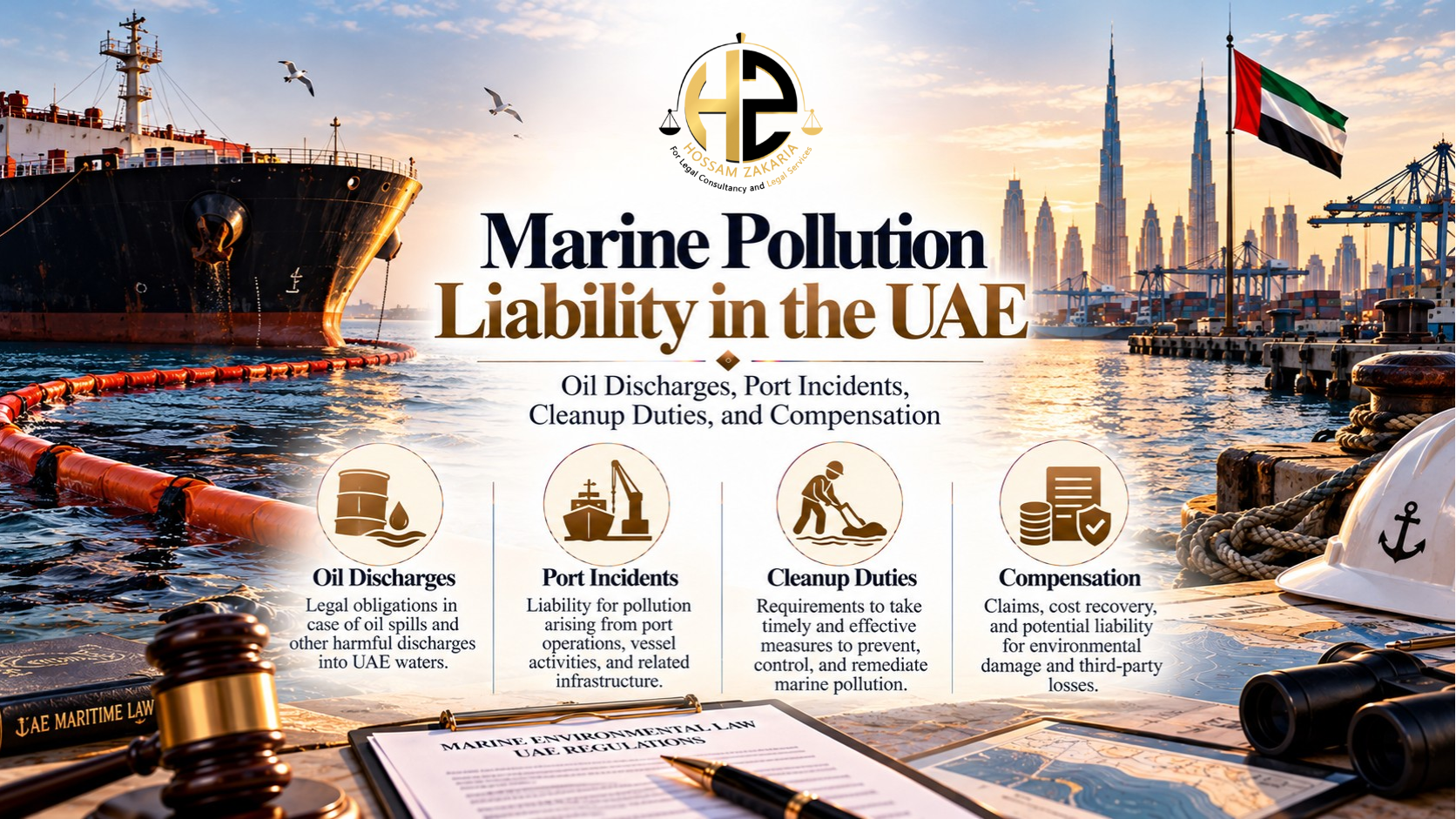
UAE Environmental and Maritime Law
Marine Pollution Liability in the UAE: Oil Discharges, Port Incidents, Cleanup Duties, and Compensation
Practical guidance for shipowners, charterers, captains, terminal operators, port users, cargo interests, oil companies, contractors, insurers and coastal businesses responding to a marine pollution incident.
1. The UAE legal framework
Marine pollution liability in the UAE is not governed by one provision alone. The core environmental statute is Federal Law No. (24) of 1999 Concerning the Protection and Development of the Environment. Its marine-environment chapter prohibits oil and oil-mixture discharges, regulates hazardous substances and waste, requires pollution-response measures after accidents, and creates liability for environmental treatment, removal, rehabilitation and compensation.
The maritime operating framework is now supplemented by Federal Decree by Law No. (43) of 2023 Concerning the Maritime Law. Its security, safety and marine-environment provisions require ships and maritime operators to comply with applicable UAE legislation and ratified international agreements. The Maritime Law also gives the Ministry of Energy and Infrastructure and competent authorities inspection and port-state-control functions, and requires a captain to protect the marine environment, prevent damage and immediately report marine pollution detected in UAE maritime zones.
Local rules remain relevant. Port authorities, municipalities, coast guards and emirate environmental authorities may issue operational requirements, emergency instructions, waste-reception rules, permits, incident forms and cleanup directions. Dubai, Abu Dhabi and other emirates may also apply port, terminal, coastal, environmental, civil-defence and public-health regulations. A federal analysis should therefore be combined with the port’s own procedures and the vessel’s flag, cargo, charter and insurance arrangements.
Language and source note: The Arabic legislation published by UAE authorities is the controlling text. English portal text and summaries are useful for navigation, but a live spill should be assessed against the current Arabic law, implementing decisions, port instructions, applicable international convention and incident-specific orders.
2. Oil discharge and dumping prohibitions
Article 21 of Federal Law No. (24) of 1999 prohibits all marine means of transportation from discharging or disposing of oil or oil mixture into the marine environment, regardless of nationality or registration in the UAE. The statutory definition of oil is broad and includes crude oil, petroleum products, liquid hydrocarbons, lubricating and fuel oils, refined and furnace oils, tar, by-products and oil waste. An oil mixture includes an aqueous mixture containing oil above the statutory threshold.
The prohibition is not limited to a deliberate act. A vessel’s operational discharge, leaking bunker, tank overflow, collision, grounding, hose failure, defective valve, contaminated bilge or transfer incident can trigger regulatory and civil consequences. Whether the release was intentional, negligent, accidental or caused by a third party will matter to the liability analysis, but it should not delay emergency reporting and containment.
Federal Law No. (24) of 1999 also addresses marine means carrying hazardous substances. Article 27 prohibits discharging or disposing of harmful substances or wastes, directly or indirectly, into the marine environment. Article 31 prohibits marine means carrying harmful substances from dumping hazardous wastes and polluting materials. Ships and marine establishments are also prohibited from throwing garbage or wastes into the marine environment and must deliver waste to approved sites under the applicable conditions.
| Release or event | Why it matters | Immediate control |
|---|---|---|
| Bunker or fuel leak | Oil discharge prohibition and cleanup liability may apply even before the cause is resolved. | Stop the source if safe, deploy containment and notify authorities. |
| Collision involving an oil tanker | Captain, owner and transporter duties may be engaged; evidence of fault and response becomes critical. | Protect people, stabilise the vessel, contain the spill and preserve voyage data. |
| Tank or pipeline transfer overflow in port | Terminal, vessel, contractor and port procedures may overlap with federal environmental rules. | Activate the terminal emergency plan and identify the exact transfer point and personnel. |
| Contaminated bilge or oily waste | Operational records, reception facilities and certificates may show whether the waste was lawfully handled. | Quarantine the waste and use an approved reception or disposal route. |
| Hazardous substance release | Additional hazardous-material, cargo declaration, health and environmental controls can apply. | Use the substance-specific emergency plan and safety data. |
3. Captain, owner and transporter duties
Article 22 requires the captain or officer in charge of a marine means to take sufficient protective measures when an accident involving oil may result in pollution and to implement the orders of inspectors or judicial officers. The duty is active: the responsible person must organise containment and response rather than wait for a perfect technical diagnosis.
Article 23 addresses a collision involving oil tankers, marine means, installations or carriers of hazardous substances. Where the event results from a deliberate act, fault or negligence of the officer in charge or assistants, the captain is responsible for stopping the spillage. The owner and transporter are jointly responsible for costs of damage, compensation and control incurred by spillage into the marine environment, coastal areas and beaches. The precise allocation can depend on the facts, contracts, negligence evidence and any applicable convention, but the statutory wording creates a significant early exposure for the owner and transporter.
Article 24 requires the owner, captain or person in charge, persons responsible for transporting oil in ports or the marine environment, and officials of entities involved in oil extraction to immediately report an oil-spillage accident. The report should include the circumstances, nature of the leaking substance and steps taken to stop or control the leakage, following the applicable procedures. Ports authorities and coast guards must then inform the Agency and concerned parties and provide complete information about the accident.
Article 25 requires the owner or captain of a marine means transporting oil and entering the UAE marine environment to maintain a record of oil operations. Article 26 requires the vessel to carry the equipment necessary to undertake pollution-combating operations in accordance with the applicable executive requirements. These obligations make records and equipment readiness part of liability risk, not merely technical housekeeping.
Documents that should be ready
- Oil-transfer, bunker, cargo and tank-operation records.
- Oil Pollution Prevention Certificate and related sludge or discharge statement where applicable.
- Vessel response plan, shipboard emergency plan and port or terminal emergency plan.
- Maintenance, inspection, valve, hose, alarm and equipment-testing records.
- Training, drill, watchkeeping and toolbox-meeting records.
- Waybills, bills of lading, charterparty instructions and terminal operating procedures.
- Photographs, video, CCTV, AIS, VDR, ECDIS, weather, tide and sampling evidence.
4. Port incidents and port-state controls
Port incidents frequently involve several legal actors: the vessel owner, master, charterer, ship manager, terminal operator, bunker supplier, line handler, pilot, tug operator, cargo owner, contractor and port authority. The first question is not simply “who owns the oil?” It is where the release occurred, who controlled the operation, who had the duty to stop it, and which party’s equipment or instruction failed.
Under the Maritime Law, the Ministry and competent authorities may inspect national and foreign ships in UAE maritime zones and ports for compliance with ratified international agreements and applicable legislation. Representatives may board ships, question persons aboard and request information, evidence, documents and certificates. Ships present in territorial waters must maintain their certificates, licences and permits and submit them on request.
Article 68 requires cooperation between the Ministry and competent authorities to enforce coastal-State responsibilities and preserve the marine environment. Article 75 requires the port authority, in coordination with the competent authority, to issue a special regulation on occupational safety, health and environmental protection for entities licensed to provide services or carry out work within the port. Port rules can therefore create operational duties in addition to the federal environmental statute.
A port may restrict operations, require additional containment, order a vessel to remain, deny sailing clearance, require a response contractor, or direct movement to a safe berth. The legal basis and commercial effect should be recorded. A captain or operator should not treat a port instruction as a negotiable commercial request, but it should preserve a written record of the instruction, time, authority and compliance steps.
5. Immediate notification and evidence
The first minutes after a spill can determine both environmental damage and the quality of the later liability record. The responsible company should activate a single incident commander, identify the source, protect people, stop or isolate the operation if safe, deploy containment, notify the required authorities and open a contemporaneous incident log.
Notification checklist
- Notify the port authority, coast guard and other competent authorities through the required channel.
- Provide the location, time, substance, estimated quantity, source, weather, tide, vessel and cargo information.
- Describe immediate actions already taken and the equipment or contractor being mobilised.
- Identify sensitive receptors such as beaches, mangroves, protected areas, desalination intakes, fisheries and aquaculture sites.
- Follow the authority’s instructions and document each call, email, radio message and order.
- Notify insurers, P&I representatives, charterers and legal advisers without delaying public-safety action.
Evidence should be preserved neutrally. Do not edit photographs, replace the original log, delete a message or ask staff to create a single “clean” narrative. Maintain original electronic files, timestamps, samples, seals, tank readings, VDR data and chain-of-custody records. Legal privilege may apply to certain communications with counsel, but ordinary operational records should not be withheld or altered.
6. Cleanup, containment and environmental rehabilitation
Cleanup is both an environmental operation and a legal cost issue. The responsible party may need to stop the release, recover floating oil, protect shorelines, remove contaminated materials, treat or dispose of waste, restore affected habitats, monitor water and sediment, and provide evidence that the response was effective. Authorities may require a specific contractor, method, sampling programme or rehabilitation plan.
Article 71 of the Environmental Law provides that a person who intentionally or negligently causes environmental damage or damage to others by violating the law or its implementing orders and resolutions is responsible for all treatment or removal costs and compensation incurred as a result. Article 72 states that environmental compensation includes damage that prevents or reduces lawful use, damages economic or aesthetic value, and the cost of environmental rehabilitation.
This means that a pollution claim is not limited to the invoice for booms, skimmers or labour. Depending on proof and causation, the claim may include shoreline and habitat restoration, monitoring, waste handling, lost use, fisheries or aquaculture impact, tourism or aesthetic loss, and reasonable emergency-control costs. The claimant still must establish the legal basis, factual connection and quantum, and a court or authority may scrutinise duplication or unreasonable expenditure.
Cleanup contractors should work under a written scope that addresses safety, sampling, waste classification, disposal route, daily reports, authority sign-off, rates, equipment ownership, subcontracting, evidence preservation and responsibility for additional damage. A rushed cleanup that spreads contamination or destroys proof can create a second dispute.
Response priorities
- Source control and vessel stability.
- Protection of people, responders and navigation.
- Containment and interception before the oil reaches sensitive areas.
- Recovery, temporary storage, treatment and lawful disposal.
- Scientific sampling, mapping and baseline comparison.
- Rehabilitation and long-term monitoring where required.
7. Compensation and recoverable costs
Compensation can arise through several routes, and they should not be conflated. The Environmental Law provides statutory environmental liability and rehabilitation costs. The Maritime Law, contracts and general civil principles may support claims between shipowners, charterers, terminal operators, cargo interests and contractors. Insurance and any applicable international convention may provide additional mechanisms, limits, security or procedural requirements.
| Loss category | Evidence usually needed | Practical caution |
|---|---|---|
| Emergency containment and response | Authority orders, contractor invoices, timesheets, equipment logs and photographs | Show that the work was necessary, proportionate and connected to the incident. |
| Cleanup and disposal | Waste classification, manifests, disposal certificates, sampling and daily reports | Do not mix contaminated material with ordinary waste or lose chain-of-custody proof. |
| Environmental rehabilitation | Baseline surveys, expert methodology, restoration plan and monitoring results | Separate restoration cost from ordinary maintenance or unrelated environmental projects. |
| Economic loss | Fisheries, aquaculture, tourism, port or business records and causation analysis | Forecasts should be supported by reliable data and mitigation evidence. |
| Damage to third-party property or vessels | Inspection reports, repair estimates, ownership records and incident evidence | Check contractual risk allocation, limitation clauses, insurance and maritime liens. |
For claimants, early sampling and baseline evidence are essential. For responding parties, it is important to preserve evidence without conceding legal responsibility. A payment made to keep a port operating or to fund emergency response should be documented as an operational step where appropriate, because it may later be mischaracterised as an admission or settlement.
International conventions may apply depending on the substance, vessel, flag, incident location and UAE treaty status. The existence of a convention can affect strict liability, limitation of liability, compulsory insurance, direct action, jurisdiction and fund mechanisms. Always check the current treaty position and the exact convention scope before advising on an oil-cargo or bunker claim.
8. Who may be liable?
Liability should be analysed by role and control rather than by title alone:
- Captain or officer in charge: navigation, safety, pollution prevention, reporting, orders and immediate response.
- Shipowner or ship manager: maintenance, equipment, crewing, procedures, training, certificates and operational systems.
- Charterer or cargo interest: cargo instructions, transfer operations, product information, terminal coordination and contractual duties.
- Terminal or port operator: hose, pipeline, berth, storage, loading or bunkering controls, staff and emergency coordination.
- Bunker supplier or contractor: product, delivery method, equipment, personnel and warnings.
- Pilot, tug or line-handling provider: manoeuvring, communications and safe port operations.
- Oil or extraction operator: offshore or coastal installation controls, monitoring, emergency plans and reporting.
Multiple parties may have contributed to one release. Causation evidence should distinguish the initiating event, the spread of pollution, the response decisions and the resulting damage. A contract may allocate costs between commercial parties, but it cannot prevent a public authority from ordering a response or pursuing a statutory violation.
9. Penalties, detention and operational consequences
Article 73 of Federal Law No. (24) of 1999 provides imprisonment and a fine of AED 150,000 to AED 1,000,000 for violations of specified provisions including Article 21’s oil-discharge prohibition and Articles 27 and 31 concerning harmful substances and dumping. The statute contains further penalty tiers for hazardous-waste and other environmental violations, including additional financial and custodial exposure and, in relevant cases, re-export at the offender’s expense.
The consequence of a spill can also be operational rather than purely criminal. The Ministry may inspect a vessel, request records, prevent sailing, impose corrective conditions, or restrict entry where a ship does not comply with applicable agreements or legislation. Port authorities may suspend a transfer, isolate a berth, require a response contractor, direct a vessel to move or remain, or report the incident to enforcement authorities.
Non-compliance with a reporting order, concealment of the source, interference with an inspection or destruction of evidence can materially worsen the position. A company should appoint trained incident contacts and ensure that crew and contractors know who may speak to authorities and how to preserve evidence.
10. Claims strategy after a spill
- Secure the scene. Protect life, navigation, responders and sensitive areas.
- Notify promptly. Follow federal, port, coast-guard, terminal and local authority procedures.
- Stabilise and contain. Stop the source if safe and implement the approved response plan.
- Preserve evidence. Secure VDR/AIS/ECDIS, logs, samples, photographs, CCTV, maintenance records and communications.
- Separate facts from legal conclusions. Record what happened without guessing fault or quantity.
- Engage experts. Use marine surveyors, pollution scientists, quantum experts and qualified cleanup contractors.
- Coordinate insurance and security. Notify P&I, hull, cargo, terminal, environmental and other relevant insurers.
- Map claimants and authorities. Identify public agencies, port users, fishermen, aquaculture operators, property owners and businesses affected.
- Document mitigation. Keep a record of steps taken to reduce spread, cost and business interruption.
- Review forum and limitation. Check the Maritime Law, contracts, applicable conventions, court jurisdiction, arbitration clauses and limitation periods before issuing or accepting a claim.
Settlement discussions should be carefully framed. Paying a response invoice, providing security or cooperating with an authority does not necessarily resolve environmental rehabilitation or third-party claims. Conversely, refusing a reasonable emergency step can increase both damage and exposure.
11. Practical scenarios
Scenario 1: Bunkering overflow at a commercial berth
During bunkering, a hose connection fails and fuel reaches the water. The vessel and terminal should stop transfer, deploy the approved containment, report to the port and competent authorities, preserve the transfer checklist and identify the exact equipment and personnel involved. The later allocation between supplier, terminal and ship depends on the evidence and contracts, but no party should wait for that allocation before responding.
Scenario 2: Collision outside the port entrance
An oil-carrying vessel collides with another marine means near the port entrance. The captain must take protective measures and report the pollution. The owners, transporter and response contractors should coordinate with the port and coast guard, preserve VDR and AIS data, and record weather, tide, tank soundings and the spread of the oil. The environmental claim may include coastal and beach damage, not only vessel repair.
Scenario 3: Contractor transports contaminated waste without the required route
A cleanup contractor loads oily absorbents into an unapproved vehicle and leaves the port. The original spill response may have been appropriate, but the waste movement can create a separate environmental and hazardous-waste problem. The response plan should identify licensed carriers, temporary storage, manifests and disposal facilities before the first bag is moved.
Scenario 4: Port authority directs immediate sailing restrictions
A vessel’s certificates and pollution equipment are under investigation after a suspected discharge. The operator should comply with the direction, request the legal and factual basis, preserve records and mobilise technical support. Attempting to sail before clearance can create additional enforcement and insurance risk.
12. Frequently asked questions
Is every oil leak a criminal offence?
The law prohibits discharge, but criminal liability depends on the statutory elements, facts, evidence and applicable defences or exceptions. An accidental release can still trigger mandatory reporting, cleanup, compensation and investigation duties.
Who pays for cleanup?
Federal environmental law makes a person who intentionally or negligently causes environmental damage responsible for treatment or removal costs and compensation. In a collision involving oil, the law also addresses owner and transporter responsibility for damage, compensation and control costs. Contracts, insurance and applicable international conventions may affect the final allocation.
Can a port refuse to let a vessel sail?
The Maritime Law gives the Ministry and competent authorities enforcement and inspection powers, including preventing a non-compliant ship from sailing or restricting entry in the circumstances stated. Port instructions may also impose operational restrictions while an incident is controlled.
Must a captain report pollution that is not caused by the vessel?
The Maritime Law requires the captain to take measures to protect the marine environment and immediately report marine pollution detected in UAE maritime zones. Reporting is therefore not limited to pollution caused by the captain’s own vessel.
Can cleanup expenses be recovered from an insurer or contractor?
That depends on policy wording, causation, the contract, the applicable convention and proof that the work was necessary and reasonable. Preserve invoices, authority orders, sampling, daily reports and mitigation evidence.
Does an emergency payment admit liability?
Not necessarily, but the wording and surrounding documents matter. Mark the purpose of the payment clearly where appropriate, reserve rights, and obtain legal advice before signing a settlement, admission or release.
HZ Legal practical view
Marine pollution disputes are won or lost in the first operational record. A vessel or terminal should be able to show when the incident was detected, who was notified, what was stopped, how the source was contained, where samples were taken, what the authority ordered, and why each response cost was incurred.
The legal analysis should then separate four questions: was there a prohibited discharge; who controlled the source; what damage and rehabilitation are proved; and which contract, insurance or convention allocates the final cost? Early reporting and effective cleanup protect the environment, but they also preserve credibility and reduce the risk that a containable incident becomes a criminal, regulatory and commercial crisis.
Need advice on an oil discharge, port detention, cleanup contract, environmental claim or marine pollution investigation? HZ Legal can review the incident record, authority notices, vessel and terminal contracts, insurance position, evidence and compensation strategy.
Official sources and verification
- Federal Decree by Law No. (43) of 2023 Concerning the Maritime Law
- Federal Law No. (24) of 1999 Concerning the Protection and Development of the Environment
- UAE Government: Waste management and marine pollution controls
- MOCCAE: Marine environment and fisheries sustainability
- Dubai Maritime Authority Law No. (3) of 2023
Verification note: This draft was prepared against the official UAE legislation and authority pages available for review on 18 October 2026. Confirm the current Arabic text, executive decisions, port regulations, local emergency procedures, applicable international conventions, insurance conditions and any later amendments before publication or action.