
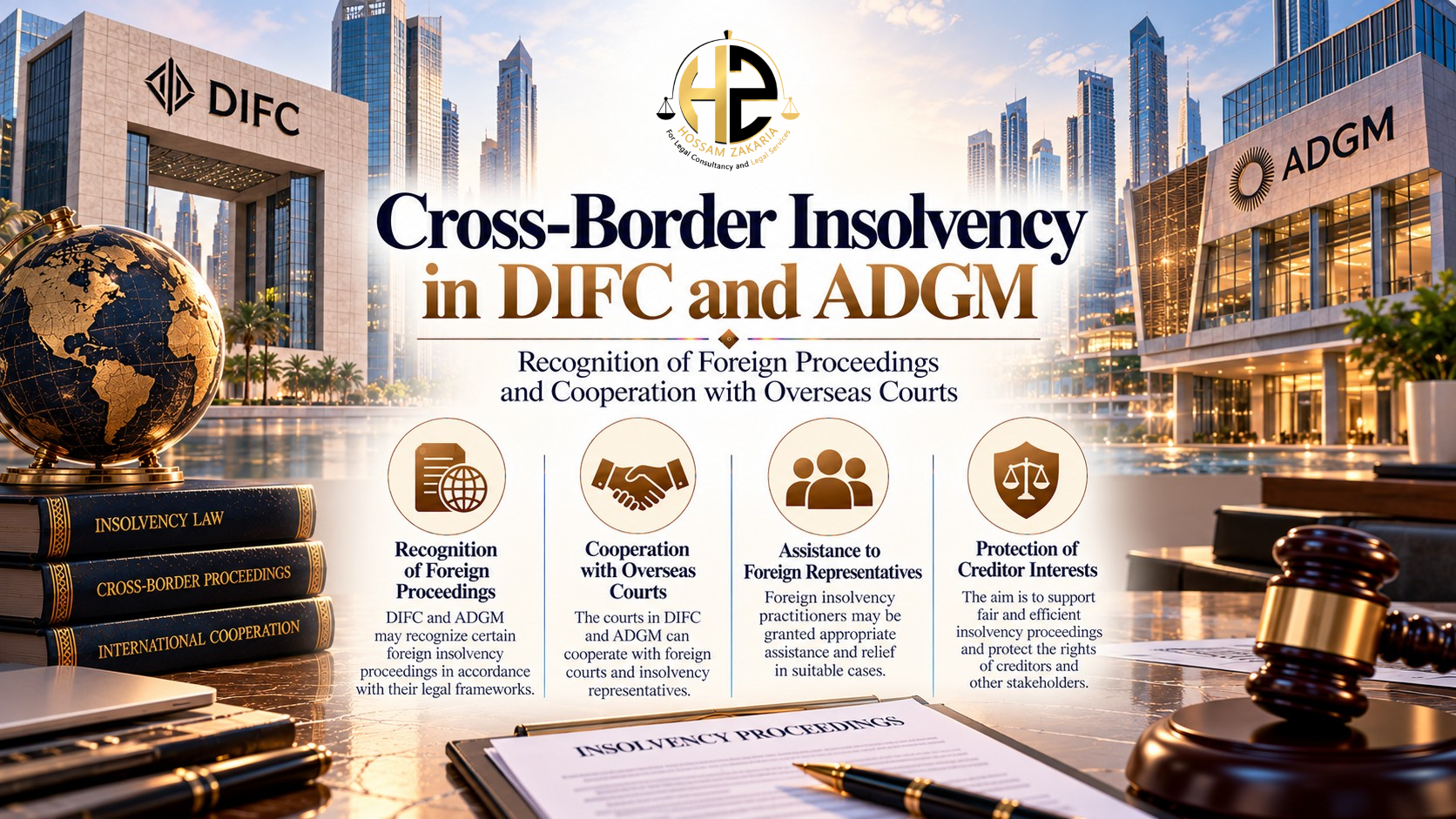
Cross-Border Insolvency in DIFC and ADGM: Recognition of Foreign Proceedings and Cooperation with Overseas Courts
Short answer: DIFC and ADGM provide dedicated cross-border insolvency mechanisms based on the UNCITRAL Model Law, with local modifications. A foreign liquidator, administrator, trustee or other qualifying foreign representative can apply to the relevant Court for recognition of a foreign proceeding as a foreign main or foreign non-main proceeding. Recognition can trigger an automatic stay for a foreign main proceeding, support asset protection and information gathering, permit participation in local proceedings, and enable direct cooperation with overseas courts and office-holders. Recognition is not automatic, however. The applicant must prove that the proceeding and representative qualify, provide the required documents, identify other proceedings, and satisfy the Court that relief is consistent with creditor protection, local law and public policy.
This guide compares the DIFC and ADGM frameworks for companies with assets, creditors, subsidiaries or proceedings in more than one jurisdiction. It focuses on recognition and cooperation rather than ordinary winding-up. A foreign court order, appointment or restructuring plan may still require a separate enforcement or implementation step, especially where it affects local title, regulated assets, third-party rights or persons who were not properly heard.
Contents
- Why DIFC and ADGM matter in cross-border insolvency
- The legal framework and the Model Law structure
- Recognition: foreign main and foreign non-main proceedings
- Preparing the recognition application
- Interim and post-recognition relief
- Cooperation with overseas courts and representatives
- Concurrent proceedings and COMI strategy
- Creditor protection, objections and local priorities
- DIFC and ADGM: practical differences
- Relationship with mainland UAE proceedings
- Practical case study: recognition and assistance
- Checklists, mistakes and recovery strategy
- Frequently asked questions
1. Why DIFC and ADGM matter in cross-border insolvency
Multinational groups often place financing, treasury, intellectual property, shares, investment vehicles or regional headquarters in the DIFC or ADGM while trading through companies in several countries. When a foreign restructuring or liquidation begins, the local questions are immediate:
- Can the foreign office-holder control or preserve assets held in the DIFC or ADGM?
- Will local enforcement, litigation or execution be stayed?
- Can the foreign representative obtain records from a local company, bank or service provider?
- Can the representative intervene in a local case or bring an avoidance claim?
- How will local secured, employee, customer-money or regulatory claims be protected?
DIFC and ADGM are especially important because they operate English-language common-law courts and maintain insolvency legislation that expressly incorporates the UNCITRAL Model Law on Cross-Border Insolvency. This makes them different from the general mainland UAE position, where the federal Financial Restructuring and Bankruptcy Law is the principal domestic statute but does not create the same Model-Law recognition procedure for every foreign proceeding.
The correct route depends on the debtor’s incorporation, the location and nature of the asset, the foreign proceeding, the relationship between the foreign and local entities, and the relief sought. Recognition should be treated as a litigation and evidence project, not as a filing formality.
2. The legal framework and the Model Law structure
DIFC
DIFC Law No. 1 of 2019 (the DIFC Insolvency Law) replaced the earlier DIFC insolvency law and includes a modified UNCITRAL Model Law in Schedule 4. The schedule governs access of foreign representatives and creditors, recognition of a foreign proceeding, relief, cooperation, and concurrent proceedings. The DIFC Court performs the functions assigned to the court under the Model Law.
The DIFC framework is not a general shortcut for every non-DIFC dispute. The Court must be satisfied that the applicant is a foreign representative and that the proceeding concerns a debtor within the relevant statutory definitions. The DIFC Courts have emphasised that recognition depends on the statutory architecture and the facts of the particular debtor and proceeding.
ADGM
ADGM Insolvency Regulations 2022 contain Part 6 on cross-border insolvency and Schedule 10, which applies the UNCITRAL Model Law. The schedule includes chapters on access to the ADGM Courts, recognition and relief, cooperation with foreign courts and representatives, and concurrent proceedings. The ADGM rulebook separately identifies Articles 15–24 for recognition and relief and Articles 25–27 for cooperation.
ADGM’s framework sits alongside its administration, receivership, winding-up and asset-protection provisions. The availability of recognition does not displace the Court’s duty to protect local creditors and interested persons or the need to comply with the requirements for dealing with particular assets, contracts and regulated businesses.
UNCITRAL concepts used in both centres
| Concept | Practical meaning | Why it matters |
|---|---|---|
| Foreign proceeding | A collective judicial or administrative insolvency proceeding in another jurisdiction, subject to court control or supervision, for reorganisation or liquidation. | The applicant must show that the foreign process is genuinely insolvency-related and collective. |
| Foreign representative | A person or body authorised in the foreign proceeding to administer the estate or act as its representative. | Recognition applications are generally made by the qualifying representative, not merely by a creditor or shareholder. |
| Foreign main proceeding | A proceeding in the state where the debtor has its centre of main interests (COMI). | Recognition usually carries stronger or automatic relief, including a stay. |
| Foreign non-main proceeding | A proceeding in a state where the debtor has an establishment but not its COMI. | Relief is generally more discretionary and focused on the local establishment or assets. |
| Public policy | A narrow but important safeguard against relief that would be fundamentally incompatible with the forum’s legal order. | Recognition can be refused, limited or conditioned where fundamental fairness or mandatory rules are engaged. |
3. Recognition: foreign main and foreign non-main proceedings
What must be recognised?
The Court is asked to recognise both the foreign proceeding and the foreign representative. The proceeding may be an administration, liquidation, restructuring, rehabilitation or another collective process, depending on the law of the originating jurisdiction and the Model-Law definitions. A private appointment, informal workout, individual enforcement case or purely personal bankruptcy process may not satisfy the statutory test for corporate recognition.
Recognition is usually sought in the jurisdiction where the debtor has assets, operations, proceedings or persons who must be restrained or assisted. A foreign representative may seek recognition in both DIFC and ADGM if there are relevant assets or proceedings in both centres. Separate applications may be required, and an order in one centre is not automatically an order in the other.
COMI and establishment
COMI is a factual concept. The registered office is an important starting point, but the Court may examine where the debtor’s central management, books, treasury, principal creditors, employees, contracts, decision-making and public-facing business are located. A debtor cannot safely manufacture COMI immediately before filing by moving a registered office without moving the economic reality of the business.
An establishment is generally a place where the debtor carries out non-transitory economic activity with human means and assets or services. A bank account, passive holding company, registered agent or occasional transaction may not be enough. The evidence should identify the actual local activity, personnel, office, contracts, customer relationships and assets.
Why classification matters
Recognition as a foreign main proceeding generally gives stronger protection than recognition as a non-main proceeding. In both DIFC and ADGM, the Court can grant discretionary relief, but the automatic or mandatory consequences associated with a recognised main proceeding may include a stay on the commencement or continuation of individual actions and enforcement against the debtor’s assets. The exact operation of the stay must be checked against the applicable schedule, the recognition order and local exceptions.
A foreign non-main proceeding can still be valuable. It may preserve a local establishment, prevent asset dissipation, enable information gathering and allow the foreign representative to participate in proceedings. But the representative should not assume that a non-main order will freeze every asset or stop every local action.
4. Preparing the recognition application
Core documents
The DIFC and ADGM Model-Law schedules follow the familiar recognition structure. The application should normally include:
- a certified copy of the decision commencing the foreign proceeding;
- a certified copy of the decision appointing the foreign representative, or other evidence of appointment and authority;
- evidence identifying the debtor, its corporate status and its connection with DIFC or ADGM;
- a statement identifying all foreign proceedings and any local proceedings known to the foreign representative;
- evidence of COMI or establishment, depending on the classification sought;
- an explanation of the relief requested and the assets, proceedings or persons affected;
- translations, legalisation or authentication required by the Court or the applicable rules; and
- a witness statement or expert evidence explaining the foreign law, the nature of the proceeding and the representative’s powers.
Do not file a foreign order without explaining its legal effect. The Court needs to know whether the order is final or provisional, whether it is subject to appeal, whether the foreign representative controls the debtor, whether the proceeding is collective, and whether local creditors have notice and a right to be heard.
Identify every known proceeding
Recognition applications require candour. Identify foreign and local proceedings involving the debtor, subsidiaries, guarantors, pledged assets or related entities. Concealing an adverse foreign application, a local enforcement case or an earlier recognition request can undermine credibility and lead to adverse conditions, costs or refusal of relief.
Define the relief precisely
Request orders that match a specific risk. For example:
- stay a named execution file or individual claim;
- restrain the transfer of identified shares, cash or real estate;
- require production of records by a named company or service provider;
- permit the representative to take control of specified local assets;
- authorise participation in a local insolvency or commercial case;
- coordinate a local winding-up with the foreign main proceeding; or
- permit a sale, distribution or other act subject to notice and safeguards.
A broad request to control all assets, stay all litigation and override all local law is more likely to generate objections. Courts can tailor relief to preserve value while protecting local creditors and third parties.
5. Interim and post-recognition relief
Interim relief before recognition
Both Model-Law regimes permit the Court to grant urgent interim relief after the recognition application is filed but before the recognition decision. The purpose is to protect the debtor’s assets and creditors from immediate harm. Depending on the facts, relief may include a stay of execution, restrictions on disposing of assets, entrusting the administration or realisation of local assets to the foreign representative or another person, or other protective measures.
Interim relief requires urgency and evidence. Explain what will happen if the order is delayed, identify the threatened asset or proceeding, and propose undertakings or safeguards. The Court may limit the order in duration, require notice, or direct a return hearing.
Automatic effects of a recognised foreign main proceeding
Recognition of a foreign main proceeding generally triggers the Model-Law effects specified in Article 20 of the DIFC Schedule 4 and the corresponding ADGM Schedule 10 provision. The central effect is a stay on commencement or continuation of individual actions and proceedings concerning the debtor’s assets, rights, obligations or liabilities, subject to statutory exceptions and the Court’s power to modify or terminate the stay.
The stay is not a licence to ignore local law. It may not automatically stop criminal, employment, personal-status or regulatory proceedings, and a local court may need to determine whether a particular claim concerns the debtor’s estate. Parties should obtain the recognition order and check its precise scope before stopping or commencing an action.
Discretionary relief after recognition
After recognition of a foreign main or non-main proceeding, the Court may grant appropriate relief to protect the debtor’s assets or creditors and to support the foreign proceeding. This may include continuing or extending a stay, restricting asset transfers, entrusting local assets to the foreign representative, ordering examination or delivery of information, or coordinating local and foreign proceedings.
Relief is normally subject to Article 22-style protection of creditors and interested persons. The Court may modify or terminate relief if circumstances change. A foreign representative should therefore report material developments, new proceedings, changes in the foreign appointment and any proposed transaction affecting local creditors.
6. Cooperation with overseas courts and representatives
Cooperation is broader than recognition. The DIFC and ADGM provisions allow the local Court, office-holder and foreign representative to communicate and coordinate with overseas courts and insolvency practitioners, directly or through a local insolvency office-holder. The aim is a coordinated administration of the estate, not the automatic surrender of local jurisdiction.
Forms of cooperation
| Cooperation tool | Example use | Safeguard |
|---|---|---|
| Direct court communication | Coordinate hearing dates, protocols, evidence or asset-preservation directions. | Record communications transparently and preserve each court’s independence. |
| Office-holder communication | Exchange books, claims data, valuations, creditor lists and transaction information. | Use confidentiality, data-protection and privilege controls. |
| Protocol or agreed procedure | Coordinate parallel administrations, creditor notices, voting and distributions. | Obtain Court approval where the protocol affects rights or priorities. |
| Recognition and assistance | Enable the foreign representative to intervene, collect assets or seek relief locally. | Comply with local standing, service and evidence requirements. |
| Concurrent-proceeding coordination | Align a local winding-up with a foreign main proceeding and avoid duplicative administration. | Respect local assets, local priorities and the Court’s power to modify relief. |
Practical cooperation often starts before the application: agree a document protocol, identify translation and legalisation requirements, establish a secure data room, and prepare a common asset and creditor schedule. A protocol should not silently change the ranking of creditors or release claims that the local Court has not approved.
7. Concurrent proceedings and COMI strategy
A multinational debtor may have a foreign main proceeding and a local winding-up, administration or other insolvency proceeding. The Model-Law framework does not require every local proceeding to disappear. It seeks to coordinate the proceedings while preserving the local Court’s jurisdiction over local assets and mandatory rules.
DIFC approach
After recognition of a foreign main proceeding, a proceeding under the DIFC Insolvency Law may generally be commenced only if the debtor has assets in the DIFC. The effects of the local proceeding are restricted to DIFC assets and, where necessary for cooperation and coordination, other assets that should be administered under DIFC law. If the local proceeding exists before recognition, relief must be consistent with it; if the local proceeding begins after recognition, the Court can review, modify or terminate inconsistent relief.
ADGM approach
ADGM Schedule 10 contains corresponding rules for commencing and coordinating local and foreign proceedings and for coordinating more than one foreign proceeding. The Court may tailor relief, consider the interests of local creditors and examine whether a local proceeding is necessary to protect assets or administer claims. The foreign representative should present a clear plan rather than ask the Court to choose between competing forums without evidence.
COMI evidence and forum risk
COMI is not a branding exercise. Keep consistent board minutes, management-location records, bank mandates, tax registrations, employee records, group-service agreements and public disclosures. A last-minute migration of the registered office can invite challenge. The foreign and local applications should use the same factual narrative unless there is a genuine reason for a difference.
8. Creditor protection, objections and local priorities
Creditors can participate
Recognition does not eliminate creditor participation. Creditors and interested persons may object to recognition or relief, seek modification of a stay, challenge the foreign representative’s authority, or argue that the requested order prejudices local priorities or procedural rights. The Court’s protection provisions require fair treatment and the ability to be heard in appropriate circumstances.
Local priorities and secured rights
Recognition does not automatically rewrite the ranking of a local mortgage, pledge, statutory lien, employee claim, customer-money regime, netting arrangement or regulatory claim. A foreign representative must identify each local security and any mandatory insolvency priority before seeking a distribution or sale order. Where local law requires Court approval for a transfer of title, recognition alone may not complete the transfer.
Public policy and procedural fairness
Public policy is not a general invitation to re-argue the foreign proceeding. It is a safeguard for fundamental principles. A party objecting should identify a concrete problem: no genuine collective proceeding, denial of notice and hearing, fraud in obtaining the foreign order, conflict with a mandatory local regime, or relief that would produce an intolerable result. Differences in insolvency law or a less favourable distribution do not automatically establish a public-policy bar.
Information and confidentiality
Cross-border cooperation involves sensitive financial, personal and commercial data. Use secure disclosure channels, redaction, confidentiality undertakings and a clear purpose limitation. Coordinate data transfers with local data-protection, banking-secrecy, professional-privilege and regulatory requirements. A foreign representative may need a local order before compelling a third party to produce documents.
9. DIFC and ADGM: practical differences
| Issue | DIFC | ADGM |
|---|---|---|
| Primary instrument | DIFC Law No. 1 of 2019, including Schedule 4. | ADGM Insolvency Regulations 2022, Part 6 and Schedule 10. |
| Model-Law function | Recognition, relief, cooperation and concurrent proceedings for qualifying foreign companies and representatives. | Recognition, relief, cooperation, concurrent proceedings and related winding-up rules. |
| Recognition court | DIFC Courts. | ADGM Courts. |
| Foreign main effect | Article 20-style automatic stay, subject to exceptions and Court control. | Article 20 of Schedule 10-style effects, subject to the schedule and Court protection provisions. |
| Practical focus | Often used for regional assets, DIFC litigation and assistance to foreign administrators or trustees. | Often integrated with ADGM administration, winding-up and financial-centre regulation. |
The comparison is a starting point only. The current consolidated text, Court rules, practice directions, regulator requirements and facts of the debtor control. An application should be filed in the centre with the relevant connection rather than choosing a forum solely because its law appears more convenient.
10. Relationship with mainland UAE proceedings
The Federal Decree-Law No. 51 of 2023 Financial and Bankruptcy Law applies to companies subject to the Commercial Companies Law, but excludes companies and establishments in free zones that have special insolvency provisions, and certain regulated institutions. It does not reproduce the DIFC and ADGM Model-Law procedure in the same form. A foreign representative seeking help with mainland assets may need to consider recognition and enforcement of foreign judgments or orders, civil-procedure mechanisms, court-to-court requests, local insolvency proceedings and any treaty or reciprocal arrangement.
DIFC or ADGM recognition is not a universal conduit for controlling assets in mainland Dubai or Abu Dhabi. A DIFC or ADGM order may assist a foreign representative in local litigation or provide persuasive evidence, but it does not automatically bind a mainland registry, bank, regulator or court. The application should identify the location of each asset and the exact legal step needed to preserve or realise it.
Similarly, a mainland bankruptcy order is not automatically recognised in DIFC or ADGM merely because it is issued by a UAE court. The DIFC Courts have considered and, in a reported matter, refused recognition of certain onshore proceedings where the statutory Model-Law requirements were not met. The lesson is not that onshore proceedings can never be recognised; it is that the applicant must satisfy the relevant definitions and procedural requirements.
11. Practical case study: recognition and assistance
The NMC Healthcare proceedings illustrate the value of a coordinated approach. The DIFC Court recognised English administration proceedings as foreign main proceedings, recognised the English administrators as foreign representatives, and gave effect to the Model-Law relief, including stays. The order also allowed administrators connected with ADGM proceedings to receive active assistance from the DIFC Courts.
The practical lesson is that recognition can be more than a stay. It can create a structured platform for administrators, trustees, banks, companies and Courts to share information and preserve value. The result depended on a qualifying foreign proceeding, recognised representatives, evidence and a carefully framed order. Parties should not cite the case as a guarantee that every foreign or onshore appointment will receive the same treatment.
12. Checklists, mistakes and recovery strategy
Foreign representative checklist
- Confirm whether DIFC, ADGM, the mainland or another jurisdiction has the relevant asset or proceeding.
- Obtain certified appointment and commencement orders and an expert statement on foreign law.
- Prepare a complete schedule of the debtor’s known proceedings, assets, creditors and related entities.
- Prove COMI or establishment with operational evidence, not only a certificate of incorporation.
- Identify each requested form of relief and explain the immediate risk it addresses.
- Plan notice, service, translations, legalisation and confidentiality before filing.
- Coordinate applications in DIFC, ADGM and overseas courts so that factual statements remain consistent.
- Prepare a protocol for information sharing, claims, asset sales and distributions.
Creditor checklist
- Check whether recognition creates a stay affecting your claim or enforcement file.
- File or preserve proof of debt in the foreign proceeding and any local proceeding.
- Review security perfection, customer-money rules, set-off, netting and local priority.
- Object quickly if the foreign proceeding, representative, COMI or requested relief is defective.
- Ask for conditions that protect local creditors, reporting, notice, reserves and distribution transparency.
- Trace assets and related-party transfers while the representative can still obtain records.
Common mistakes
- Assuming recognition is automatic: a foreign appointment is not self-executing in DIFC or ADGM.
- Using the wrong applicant: a shareholder, creditor or local affiliate may not qualify as the foreign representative.
- Proving only registration: incorporation in a country does not by itself prove COMI.
- Requesting relief without asset evidence: the Court needs a factual link between the order and the threatened asset or proceeding.
- Ignoring local priorities: recognition cannot silently remove a secured, employee, customer or regulatory right.
- Overlooking the mainland: an order in DIFC or ADGM may need a separate step for assets outside the centre.
- Failing to update the Court: a changed foreign appointment, settlement or parallel proceeding can affect relief.
Strategic decision matrix
| Objective | Likely first step | Key risk |
|---|---|---|
| Stop a DIFC execution against a debtor in foreign administration | Recognition application for the foreign main proceeding and interim stay if urgent. | Inadequate proof of foreign representative or COMI. |
| Protect ADGM shares or cash before a foreign recognition hearing | ADGM recognition application with specific interim asset-protection relief. | Delay, insufficient urgency evidence or conflict with local security rights. |
| Coordinate a local winding-up with a foreign main proceeding | Recognition plus a court-approved protocol and concurrent-proceeding directions. | Duplicated claims, inconsistent priorities or conflicting distributions. |
| Recover records from a DIFC or ADGM affiliate | Seek recognition, intervention and targeted cooperation or production relief. | Privilege, data-protection and third-party confidentiality objections. |
HZ Legal view
Cross-border insolvency succeeds when the legal story, corporate structure and evidence tell the same story. The foreign representative should identify the centre with the real connection, request only the relief needed to protect value, and give local creditors a fair opportunity to be heard. Creditors should act before assets move, distinguish recognition from enforcement, and challenge the precise gap in the application rather than relying on broad objections. DIFC and ADGM provide sophisticated cooperation tools, but those tools reward disciplined preparation and respect for local priorities.
13. Frequently asked questions
Is a foreign insolvency order automatically effective in DIFC or ADGM?
No. The foreign representative normally must apply for recognition under the applicable Model-Law schedule. The Court then determines whether the proceeding and representative meet the statutory requirements and what relief is appropriate.
What is the difference between foreign main and non-main recognition?
A main proceeding is connected to the debtor’s centre of main interests. A non-main proceeding is connected to an establishment. Main recognition generally produces stronger automatic effects, while non-main relief is more discretionary and locally focused.
Does recognition always stay every lawsuit?
No. The automatic stay and exceptions must be read with the recognition order and the relevant schedule. Criminal, employment, regulatory, personal-status, asset-specific and other proceedings may require separate analysis.
Can a foreign representative take local assets?
Recognition may support entrusting the administration or realisation of local assets to the foreign representative or another person, but the Court can impose conditions. Title transfer, regulated assets, secured rights and third-party interests may require additional orders.
Can a creditor apply for recognition?
The Model-Law recognition application is generally made by the foreign representative. A creditor can participate, object, seek relief or pursue an available local proceeding, but should not assume that it can present itself as the foreign representative without statutory authority.
Can DIFC or ADGM recognise a mainland UAE bankruptcy proceeding?
It depends on the statutory definitions and the facts. A UAE court order is not automatically recognised merely because it is domestic to the wider UAE. The applicant must satisfy the relevant DIFC or ADGM recognition framework.
Can a DIFC or ADGM order control mainland UAE assets?
Not automatically. Mainland assets may require recognition, enforcement or cooperation through the relevant mainland court, registry, bank or regulator. The asset’s location and legal nature control the next step.
What documents are most important?
The commencement order, appointment order, foreign-law evidence, corporate records, COMI or establishment evidence, asset schedule, creditor schedule, known-proceedings statement and a precise relief plan are usually central. Certified copies, translations and proper service records should be prepared early.
Sources and further reading
- DFSA legislation page listing DIFC Insolvency Law 2019.
- DIFC Courts: Punjab National Bank v NMC Healthcare, recognition and assistance order.
- DIFC Courts: Mashreqbank and the effect of recognition.
- ADGM relevant insolvency legislation.
- ADGM Insolvency Regulations 2022, Part 6: Cross-border Insolvency.
- ADGM Schedule 10: Application of UNCITRAL Model Law.
- Federal Decree-Law No. 51 of 2023 on Financial Restructuring and Bankruptcy.
Disclaimer: This article is general information for educational purposes and is not legal, insolvency, tax, accounting or financial advice. DIFC and ADGM legislation, Court rules, practice directions, regulator requirements and foreign laws may change. The Arabic text of UAE federal legislation prevails where applicable. Recognition, relief, enforcement and cooperation depend on the debtor, proceeding, asset, forum and evidence. Obtain advice before filing an application, stopping enforcement, transferring an asset, entering a protocol or relying on a foreign order.