
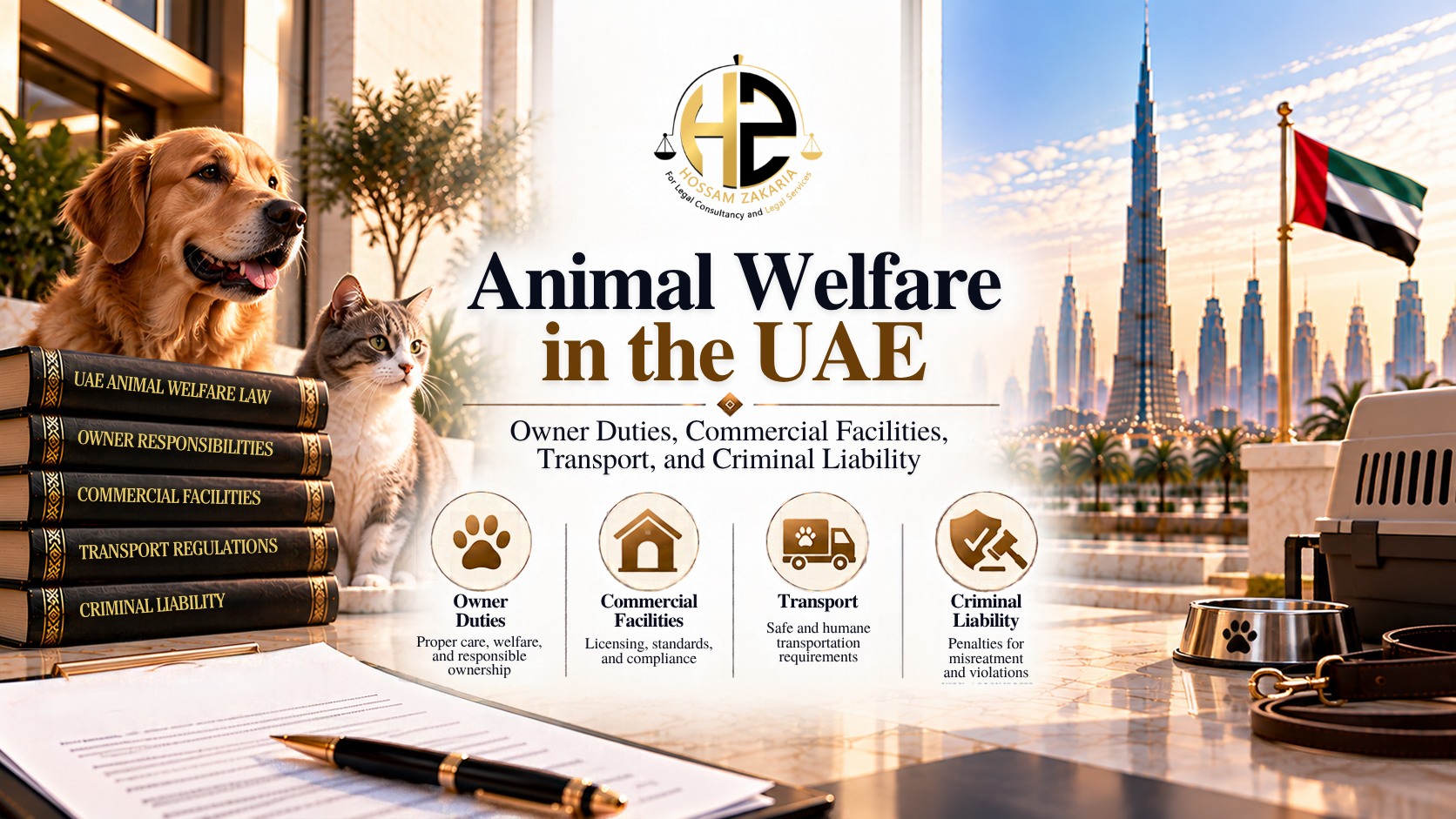
Animal welfare in the UAE is regulated through a combination of general welfare duties, veterinary and facility licensing rules, transport requirements, dangerous-animal controls, quarantine rules and wildlife-trade legislation. The result is a framework that applies not only to pet owners, but also to farms, veterinary clinics, hospitals, shelters, breeders, zoos, transporters, importers, exporters and other businesses that keep or move animals.
The principal federal welfare statute remains Federal Law No. 16 of 2007 Concerning the Protection of Animals, as amended in 2016. Its current framework is supported by the 2018 Executive Regulation issued under Ministerial Resolution No. 476 of 2018. Additional current layers include Federal Law No. 22 of 2016 Regulating the Possession of Dangerous Animals, Cabinet Resolution No. 15 of 2019, Federal Law No. 6 of 2025 Regarding Veterinary Quarantine, Federal Law No. 5 of 2025 on international trade in endangered species, and updated 2026 veterinary-establishment and veterinary-professional requirements.
The governing principle is straightforward: any person who owns, possesses, keeps, transports or commercially manages animals must take positive steps to prevent unnecessary pain, suffering, neglect and avoidable risk.
The duty applies to the person actually responsible for the animal
The Animal Protection Law does not limit responsibility to the registered owner. It also applies to the person who actually controls or looks after the animal.
Article 2 requires owners and persons responsible for animal care to take all precautions necessary to avoid harm, damage, pain or suffering.
That duty includes considering the animal's species, stage of growth, adaptation and needs in light of scientific knowledge and practical experience.
Abandonment is prohibited
One of the clearest owner duties is the prohibition on simply releasing an animal that depends on human care for survival.
If the person no longer wishes to keep the animal, Article 2 requires the animal to be delivered to the competent department or authority rather than abandoned.
The 2018 Executive Regulation reinforces this principle by treating the person responsible for the animal as accountable for its welfare and continued care.
For pet owners, breeders, farms and commercial facilities, abandonment should therefore be treated as a legal compliance issue rather than only an ethical concern.
Daily supervision is a statutory duty
Article 2 requires animals under a person's supervision to be examined and cared for at least once each day.
Commercial operators must also provide a sufficient number of experienced and competent personnel capable of looking after the animals under their control.
This is especially relevant to boarding facilities, farms, shelters, pet shops, breeding facilities and other businesses where animals may remain unattended for extended periods.
Veterinary care must be provided when needed
The person responsible for an animal must provide healthcare and refer the animal to a veterinarian for examination and treatment when necessary.
The legal duty therefore goes beyond providing food and shelter. Ignoring an obvious injury, infection, severe pain or deterioration can become evidence of neglect.
Commercial facilities should maintain written escalation rules identifying when staff must obtain veterinary assistance and who has authority to approve urgent treatment.
Animals must have enough space to move
Article 4 requires adequate space where an animal's movement is permanently or temporarily restricted.
The purpose is to allow the animal to meet its normal needs rather than merely fit physically inside a cage, pen or enclosure.
The 2018 Executive Regulation further addresses freedom of movement and treats harmful confinement as a potential welfare violation.
Housing must be safe and suitable
Article 5 requires barns, cages, stables and other facilities to be constructed from materials that are harmless, capable of cleaning and disinfection and free from sources of contamination.
Animals kept outdoors must also be protected from adverse weather, predators and other risks and must have a proper resting or sleeping area.
The Executive Regulation adds more detailed technical expectations concerning the size, ventilation and suitability of animal accommodation according to species, age, size and weight.
Food and water are minimum legal requirements
Article 6 requires animals to receive complete feed appropriate to their species and age in quantities sufficient to maintain good health and satisfy nutritional needs.
Animals must also have continuing access to an appropriate water source or receive a sufficient daily quantity of water.
For commercial operators, feed schedules, water systems and storage conditions should be documented and auditable.
Cruelty includes neglect as well as deliberate violence
The UAE welfare framework does not limit cruelty to beating an animal.
The 2018 Executive Regulation identifies conduct such as failure to provide adequate nutrition, rest or shelter, physical harm, inappropriate confinement and overworking draft animals without regard to age or physical condition as welfare violations.
It also restricts the use of animals in activities inconsistent with their nature, including staged fighting or abusive entertainment.
This means cruelty can arise from how an animal is kept or used even where no single dramatic act of violence occurs.
Electric shock devices and sharp handling methods are restricted
The 2018 Executive Regulation prohibits specified harmful handling methods, including electroshock devices and sharp tools used to force animals to move, as well as poking animals in sensitive areas.
Facilities handling livestock should therefore train staff in compliant low-stress movement and loading techniques.
Surgical procedures require veterinary control and anaesthesia
Article 8 provides that treatment causing pain, panic or disturbance must be undertaken by a veterinarian or appropriate specialist.
Surgical interventions must be performed under general or local anaesthesia in a location medically equipped for the relevant procedure.
This is relevant not only to veterinary hospitals but also to breeders, farms and owners considering procedures that may be wrongly treated as routine husbandry.
Scientific experiments require authorisation
Using animals in scientific experiments without authorisation from the competent department or authority is a specific criminal offence under Article 14 Bis (1).
Research institutions should therefore distinguish ordinary veterinary treatment from regulated experimental use and should maintain ethics, institutional and regulatory approvals before animal research begins.
Commercial facilities are subject to health and technical requirements
Article 5 Bis of the Animal Protection Law makes establishments subject to the health and technical conditions prescribed by implementing legislation.
Commercial operations can therefore face both welfare obligations and licensing requirements.
Depending on the activity, regulated facilities can include:
- veterinary hospitals and clinics;
- veterinary laboratories;
- commercial animal-production farms;
- animal shelters and care centres;
- zoos and animal parks;
- breeding establishments;
- artificial-insemination centres; and
- other facilities where animals are kept, treated or managed commercially.
Veterinary facilities require licensing and qualified management
Federal Law No. 10 of 2002 on Practising the Veterinary Medicine Profession regulates veterinary professionals and veterinary establishments.
The framework recognises hospitals, clinics, laboratories, advisory offices, commercial production farms and other specified veterinary facilities.
Current 2026 licensing requirements provide that veterinary facilities must satisfy technical, health and biosecurity conditions, obtain the required commercial and regulatory approvals and operate under the management of a veterinarian licensed by the Ministry.
Ministerial Resolution No. 27 of 2026 updated the health and technical conditions for veterinary establishments, while Ministerial Resolution No. 34 of 2026 updated professional and facility-licensing controls.
Facility design must itself support animal welfare
Current MOCCAE requirements address matters such as appropriate space, ventilation, cooling, non-slip flooring, areas for examination and treatment, safe cages or pens, post-operative monitoring and separation of animals where infection control requires it.
The general principle is that the physical environment must be suitable for the species and the veterinary activity being provided.
A facility that holds a licence but operates in materially unsuitable conditions can still face compliance action.
Commercial farms have activity-specific welfare and biosecurity rules
Animal-production farms are subject to technical requirements in addition to the general Animal Protection Law.
For example, Ministerial Resolution No. 316 of 2023 regulates commercial poultry production farms and expressly requires compliance with animal-welfare standards alongside disease prevention and biosecurity.
Other production sectors are subject to their own technical rules and licensing requirements.
Farm operators should therefore maintain an activity-specific compliance register instead of relying only on the general 2007 statute.
Inspection powers are broad
Article 3 authorises designated officers and accompanying specialists to enter facilities for inspection where they believe animals are suffering, abused, sick or being raised contrary to law.
They can examine animals, perform tests, take samples, mark animals for identification and quarantine animals suspected of illness for treatment.
Entry into a private residence requires the appropriate prosecution approval.
Owners and persons responsible for animals in facilities must assist inspectors and provide relevant animal records when requested.
Authorities can quarantine and treat neglected animals
The law allows authorities to quarantine animals and transfer them for treatment where necessary.
Article 9 states that an animal taken for treatment may be returned after recovery and after the authority is satisfied that the neglect will not recur. In repeated-neglect cases, the owner can be charged transport and treatment costs.
This means enforcement can involve both criminal sanctions and practical removal of the animal from the owner's control.
Animal transport must protect the animal from injury and harm
Article 7 establishes the central transport rule: animals must be transported in a way that ensures their safety and protects them from injury or harm.
The Executive Regulation addresses loading, unloading, feeding and the specifications of transport vehicles, and MOCCAE's 2018 guidance confirms that transport permits and welfare requirements form part of the regulatory system.
Transport planning should therefore consider:
- species and number of animals;
- vehicle suitability;
- ventilation and temperature;
- space and separation;
- loading and unloading methods;
- journey duration;
- water and feed requirements;
- rest periods;
- fitness to travel; and
- emergency arrangements.
Heat is a foreseeable transport risk in the UAE
Because of the UAE climate, transporters should treat temperature exposure as a predictable welfare risk.
Journey timing, ventilation, cooling and delays at loading areas or border points should be built into transport procedures.
An otherwise compliant vehicle can still create liability if animals are left exposed to excessive heat or transported in conditions likely to cause avoidable suffering.
The new 2025 Veterinary Quarantine Law affects commercial animal transport
Federal Law No. 6 of 2025 Regarding Veterinary Quarantine now provides the current federal framework for import, export and transit of animal consignments.
Importers, exporters and carriers must comply with permit, veterinary certificate and transport requirements.
Article 9 specifically requires carriers to comply with the specifications and requirements prescribed for transporting animal consignments.
Where a consignment arrives in a contaminated vehicle, in breach of transport requirements or in a condition capable of causing harm at a border point, the Ministry can require disinfection, impose quarantine measures or refuse the consignment and order re-export.
Dogs and dangerous animals are subject to a separate regime
Federal Law No. 22 of 2016 regulates dangerous animals and creates rules that are stricter than ordinary pet ownership.
Natural and legal persons are generally prohibited from owning, possessing, trading in or breeding dangerous animals except through specified licensed establishments such as zoos, animal parks, breeding centres, specialised care and shelter centres and qualifying scientific or research institutions.
Transport of dangerous animals requires prior approval and must use safe and appropriate means that protect the animal's safety and comfort.
Licensed dangerous-animal facilities have express welfare duties
Article 6 of the Dangerous Animals Law requires licensed establishments to provide healthcare and vaccinations, maintain medical-history records, provide safe and appropriate shelter, feed animals appropriately and ensure staff are suitably trained.
The 2019 Executive Regulation adds detailed vehicle, identification, detention and care requirements.
Dangerous-animal offences can carry substantial penalties
Using a dangerous animal to terrorise people can result in imprisonment and/or a fine between AED 100,000 and AED 700,000.
Possessing a dangerous animal for trade can result in imprisonment and/or a fine between AED 50,000 and AED 500,000.
Other breaches of core possession, transport and control provisions can attract imprisonment and fines reaching AED 500,000, depending on the offence.
Endangered species create a separate wildlife-trade risk
Wildlife traders, exotic-animal businesses, zoos, breeders, veterinary clinics and collectors must also consider the current CITES framework.
Federal Law No. 5 of 2025 Regarding the Regulation and Control of International Trade in Endangered Species of Wild Fauna and Flora replaced the older 2002 regime and regulates import, export, re-export, transit and possession documentation for protected specimens.
The Ministry of Climate Change and Environment acts as the National Management Authority.
Veterinary clinics must check protected-species documents
Article 26 of the 2025 endangered-species law requires establishments and veterinary clinics receiving a live listed species or specimen to verify that the required legal documentation exists.
A clinic that treats a listed endangered species without carrying out the required document check can itself face a fine from AED 30,000 to AED 150,000.
This is an important compliance point: veterinary care does not remove the need to verify that a protected animal is lawfully held.
Illegal trade in Appendix I species carries severe penalties
Under Article 28 of the 2025 endangered-species law, importing, exporting, re-exporting or introducing an Appendix I specimen from the sea without a valid certificate, or attempting to do so, can result in at least four years' imprisonment and a fine from AED 200,000 to AED 2 million, or either penalty.
The court must also order confiscation of the seized specimens, and penalties are doubled for repeat offending. Deportation of a foreign offender is also provided for.
The core Animal Protection Law also contains criminal penalties
Article 14 of Federal Law No. 16 of 2007 provides imprisonment of up to one year and/or a fine of up to AED 200,000 for specified conduct including:
- sexual abuse of an animal;
- knowingly releasing an infected animal;
- causing damage, harm, pain or irritation to animals; and
- offering for sale or trading an ill or injured animal.
Unauthorised scientific experimentation can also attract imprisonment of up to one year and a fine between AED 50,000 and AED 200,000.
Other breaches of duties under the law or its implementing rules can attract fines of up to AED 100,000.
Businesses should separate criminal, licensing and civil risk
An animal-welfare incident can create several types of exposure at once.
A facility may face:
- criminal prosecution for cruelty or another statutory offence;
- administrative or licensing action;
- closure or suspension;
- removal or confiscation of animals;
- veterinary professional discipline;
- costs of treatment, quarantine or transport;
- civil claims by owners or third parties; and
- reputational damage.
Insurance and contractual indemnities do not replace statutory compliance.
A practical owner-duty matrix
| Issue | Core duty |
|---|---|
| Abandonment | Do not release an animal dependent on human care; surrender it through the competent route. |
| Daily care | Inspect and care for animals at least daily. |
| Food and water | Provide species-appropriate nutrition and sufficient clean water. |
| Housing | Provide safe, clean, suitable accommodation and enough space for normal needs. |
| Veterinary care | Obtain veterinary examination and treatment when necessary. |
| Transport | Protect animals from injury, harmful handling and unsuitable transport conditions. |
| Surgery | Use qualified veterinary professionals and appropriate anaesthesia. |
| Inspection | Cooperate with authorised inspectors and provide requested records. |
Practical checklist for commercial animal facilities
- Confirm the correct licence. Welfare, veterinary, farm, shelter, zoo or dangerous-animal activities can require different approvals.
- Appoint qualified personnel. Staff numbers and experience should match the animals and activities.
- Design for welfare. Space, ventilation, temperature, flooring, pens, cages and isolation facilities should be species-appropriate.
- Maintain daily records. Health, feed, treatment, mortality, breeding and incident records should be auditable.
- Escalate illness promptly. Do not leave sick or injured animals without veterinary review.
- Separate infected animals. Apply biosecurity and quarantine procedures.
- Control transport. Use suitable vehicles, trained handlers and documented journey plans.
- Review protected-species status. CITES documentation may be required even where the animal is receiving treatment.
- Train for inspections. Staff should know who holds records and who is authorised to respond to regulators.
- Report serious incidents. Disease, escape, death, cruelty allegations and dangerous-animal incidents should follow an escalation protocol.
Key takeaway
Animal welfare in the UAE is based on positive duties of care, not simply a prohibition on extreme cruelty. Owners and keepers must provide suitable accommodation, movement, feed, water, daily supervision and veterinary care and must not abandon animals that depend on them.
Commercial facilities face an additional layer of licensing, health, technical and biosecurity requirements. The 2026 veterinary-establishment and professional rules reinforce the need for qualified veterinary management and suitable premises, while the 2025 Veterinary Quarantine Law modernises the rules governing commercial animal consignments and cross-border movement.
Transport is itself a welfare obligation. Animals must be loaded, moved and unloaded in conditions that minimise injury and suffering, while dangerous animals require additional approvals and specialised transport controls.
Criminal exposure can be significant. Core welfare offences can lead to imprisonment and fines, dangerous-animal violations can attract substantial penalties, and illegal international trade in endangered species can result in multi-year imprisonment, multimillion-dirham fines, confiscation and deportation.
HZ Legal can assist pet businesses, veterinary facilities, farms, shelters, breeders, zoos, transport companies, importers, exporters and animal owners with UAE animal-welfare compliance, facility licensing, transport procedures, dangerous-animal regulation, CITES and wildlife-trade controls, inspections, incident response and criminal or regulatory investigations.
Official and authoritative sources
- UAE Legislation — Federal Law No. 16 of 2007 Concerning the Protection of Animals, as amended.
- Ministry of Climate Change and Environment — 2018 Executive Regulation guidance for the Federal Animal Welfare Law.
- UAE Legislation — Federal Law No. 22 of 2016 Regulating the Possession of Dangerous Animals.
- UAE Legislation — Cabinet Resolution No. 15 of 2019, Executive Regulation of the Dangerous Animals Law.
- UAE Legislation — Federal Law No. 10 of 2002 on Practising the Veterinary Medicine Profession.
- MOCCAE — Ministerial Resolution No. 27 of 2026 on health and technical requirements for veterinary establishments.
- MOCCAE — Ministerial Resolution No. 34 of 2026 on veterinary professional and establishment licensing controls.
- UAE Legislation — Federal Law No. 6 of 2025 Regarding Veterinary Quarantine.
- UAE Legislation — Federal Law No. 5 of 2025 Regarding the Regulation and Control of International Trade in Endangered Species of Wild Fauna and Flora.
- UAE Legislation — Cabinet Resolution No. 104 of 2022 on technical requirements for animal slaughter in accordance with Islamic rules.
This article provides general legal and regulatory information only and does not constitute veterinary, criminal or case-specific legal advice. Animal-welfare requirements vary according to species, activity, emirate, facility type, transport route, disease status and whether the animal is dangerous or protected under CITES. Current Ministry and local-authority procedures should be checked before opening a facility, transporting animals, importing or exporting animals, conducting research or dealing with protected species.