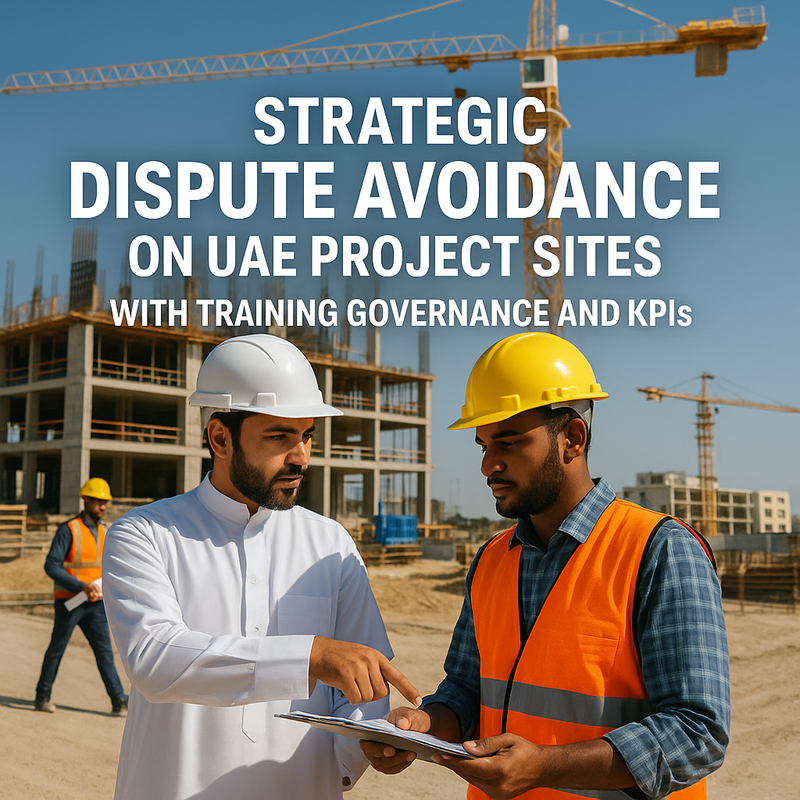
Introduction: The Evolving Imperative for Dispute Avoidance at UAE Sites
The rapid development of infrastructure, construction, and service projects in the UAE has positioned the country as a global destination for business and innovation. However, with this growth comes rising complexity in contractual relationships, multicultural workforce dynamics, and stringent legal and regulatory frameworks. Accordingly, prevention of disputes—rather than simply managing them post-emergence—has become a core strategic objective for forward-thinking UAE organizations. This proactive approach is enshrined in the most recent legal landscape, notably Federal Decree Law No. 20 of 2023 on the Regulation of Labor Relations (the ‘New Labour Law’), Ministerial Resolution No. 46 of 2022, and Cabinet Decision No. 22 of 2022, which collectively present fresh mandates around workplace governance, dispute avoidance mechanisms, and compliance benchmarks.
For site operators, contractors, developers, HR managers, and legal teams, dispute-avoidance programs—anchored in robust training, governance structures, and Key Performance Indicators (KPIs)—are no longer ‘nice to have’ but statutory expectations. Failure to align with current regulatory requirements risks penalties, business disruptions, and damage to the reputation painstakingly built in a highly competitive regional market.
This article provides an authoritative analysis of dispute-avoidance obligations as detailed in UAE’s legal framework, practical consultancy insights, compliance strategies, and actionable recommendations. Informed by recent government sources and decrees, we empower organizations to transition from reactive to proactive, embedding dispute-avoidance as a business-critical success factor for 2025 and beyond.
Table of Contents
- Regulatory Framework: UAE Law on Dispute Avoidance
- Drivers of Change: Why Dispute Avoidance Matters in 2025
- Training for Dispute Prevention: Legal Mandates and Best Practice
- Governance Structures for Effective Dispute Management
- Key Performance Indicators and Their Legal Significance
- Comparison Table: Old vs New Legal Obligations
- Risk Analysis and Strategic Compliance Roadmap
- Case Studies: Implementing Dispute Avoidance in Practice
- Conclusion and Strategic Recommendations for UAE Entities
Regulatory Framework: UAE Law on Dispute Avoidance
Core Statutes and Decrees
Dispute avoidance in the UAE is underpinned by several interrelated statutes and regulations. Chief among these are:
- Federal Decree Law No. 20 of 2023 on the Regulation of Labour Relations (the “New Labour Law”).
- Ministerial Resolution No. 46 of 2022 concerning Settling Labour Disputes.
- Cabinet Decision No. 22 of 2022 regulating the Internal Work Regulation.
These legal instruments reflect the pledged commitment of the Ministry of Human Resources and Emiratisation (MOHRE), the Ministry of Justice, and other UAE authorities to create a transparent, harmonious, and competitive work environment. The concept of dispute avoidance is not incidental but central—emphasizing preventative training, transparent communication frameworks, prompt escalation procedures, and structured monitoring via KPIs.
Key Provisions Relevant to Dispute Avoidance
The above statutes set forth the following requirements and recommendations:
- Mandatory Internal Policies: Entities must maintain a written, accessible internal grievances and complaints procedure (Cabinet Decision No. 22/2022, Article 5).
- Obligatory Staff Training: All staff, managers, and contractors must undergo periodic training on conflict prevention, cultural sensitivity, and lawful dispute escalation routes.
- Prompt Internal Resolution: Organizations must provide initial review and resolution of complaints within specified timelines (typically within five to ten working days).
- KPI Monitoring and Reporting: Businesses are required to monitor, document, and report on disputes and their resolution under certain thresholds, and to periodically analyze trends for remediation.
- Governance Structures: Sites must designate responsible individuals or committees to oversee adherence to dispute prevention standards.
Failure to comply attracts significant administrative penalties, possible blacklisting, and in egregious cases, loss of government contract eligibility.
Scope and Applicability
These obligations apply to all businesses operating under UAE jurisdiction, regardless of size, sector, or workforce nationality mix. Certain sectors—such as construction, hospitality, and services—face heightened scrutiny due to workforce scale and multicultural factors.
Drivers of Change: Why Dispute Avoidance Matters in 2025
Heightened Regulatory Oversight
From 2022 onwards, UAE regulators have prioritized workplace efficiency and reduction of legal disputes as part of the ‘Future of Work’ initiative championed by MOHRE. This drive is motivated by:
- Large-scale workforce diversification and increased labor mobility.
- The need to minimize project delays and cost overruns due to unresolved grievances.
- Brand and reputational concerns in attracting international investors.
- Frequent legal reforms aligning UAE standards with global best practices.
Business Implications for UAE Entities
Organizations face significant cost and operational risks if disputes escalate to external complaint channels or litigation. Proactive dispute avoidance delivers:
- Reduced legal and HR costs.
- Improved productivity and morale at worksites.
- Enhanced compliance posture (essential for public sector tenders and licensing renewal).
- Lower reputational risk and better investor relations.
Training for Dispute Prevention: Legal Mandates and Best Practice
Mandatory Training Requirements
As detailed in Article 80(2) of Federal Decree Law No. 20 of 2023 and Cabinet Decision No. 22/2022, UAE employers must implement systematic, regular training to empower employees and line managers to:
- Recognize early signs of workplace conflicts.
- Understand their rights and obligations under UAE Law.
- Deploy approved internal escalation and resolution channels.
Best Practice: Designing Compliant Training Programmes
A compliant dispute avoidance training initiative should include:
- Induction modules for new staff spotlighting company grievance procedures and legal rights.
- Annual refresher workshops for supervisors and site managers covering updates in UAE law.
- Scenario-based workshops simulating real-life dispute triggers at UAE sites (e.g., contractual ambiguity, cultural misunderstandings, wage disputes).
- Assessment and certification mechanisms ensuring staff understanding (with completion KPIs).
Consultancy Insight: Many disputes arise from miscommunication or lack of awareness. Clients are advised to integrate culturally sensitive and multilingual elements, and to use anonymized feedback tools to continually improve training relevance.
Comparison: Historical vs. 2025 Training Obligations
| Aspect | Pre-2022 Obligations | Post-2023 Updates (Law 20/2023) |
|---|---|---|
| Mandatory training | Ad hoc, not expressly required | Now statutory for all staff, documented, with KPIs |
| Content | General workplace rights | Focused on dispute prevention, escalation, and legal procedure |
| Recordkeeping | Variable, rarely audited | Mandatory training logs, audit-ready |
| Language accessibility | Not specified | Clear use of primary workplace languages |
Table: Comparing dispute-avoidance training requirements under old and new UAE laws.
Governance Structures for Effective Dispute Management
Legal Obligations for Internal Governance
Cabinet Decision No. 22/2022 mandates that every entity establishes either a designated grievance and dispute committee or an appointed senior individual responsible for:
- Monitoring grievance submissions and timelines.
- Upholding impartiality and confidentiality in investigations.
- Documenting dispute resolution outcomes for reporting purposes.
Implementation Models
The law does not prescribe a single format; organizations may choose structures best suited to their scale and sector. Typical options include:
- Dispute Prevention Committees (for medium and large enterprises).
- Designated Dispute Resolution Officers (for small sites, or branch-based organizations).
The effectiveness of governance is judged against internal KPIs and through periodic inspection or audit by MOHRE and sector regulators.
Process Flow Diagram Recommendation
We recommend visualizing the governance structure workflow as a process diagram:
- Step 1: Dispute trigger identified (by employee, contractor, or manager).
- Step 2: Incident reported internally (digital or written form).
- Step 3: Initial review by officer/committee within two working days.
- Step 4: Decision/mediation within statutory deadline (max 10 working days).
- Step 5: Outcome documented; trends analyzed for recurrence or escalation.
Visual suggestion: A process flow diagram showing the above five steps, reinforcing the need for timely, transparent action.
Key Performance Indicators and Their Legal Significance
Legal Rationale for KPIs
Article 8 of Cabinet Decision No. 22/2022 requires businesses to implement measurable KPIs to track the effectiveness of their dispute-avoidance systems. This supports accountability—both internally (to management) and externally (to regulators).
Recommended KPIs
Organizations should monitor and report on:
- Number of internal grievances raised per quarter
- Average response time to complaints
- Resolution rate (% disputes resolved internally versus escalated externally)
- Repeat complaints rate
- Staff and manager training completion rate (%)
- Employee satisfaction scores relating to dispute handling
For large projects or multinational entities, these KPIs can be benchmarked against group or industry averages to drive continual improvement.
| KPI | Target Threshold | Legal Mandate |
|---|---|---|
| Resolution within 10 working days | >95% | Statutory (Cabinet Dec. 22/2022) |
| Training completion | 100% (annual) | Required (Decree Law 20/2023) |
| Repeat disputes per site | <5% per annum | Regulatory best practice |
Table: Examples of key KPIs aligned to legal requirements for UAE sites.
Consultancy Guidance
Clients are advised to integrate these KPIs into regular management reporting and assign ownership for corrective actions. Non-compliance with KPI targets can attract regulatory audit and, in serious cases, administrative sanctions.
Comparison Table: Old vs New Legal Obligations
| Requirement | Previous Regime (Pre-2022) | Current Regime (2023/2025 Updates) |
|---|---|---|
| Dispute avoidance policy | Optional, rarely enforced | Mandatory under Cabinet Decision No. 22/2022 |
| Internal committee/appointed officer | Common only in large companies | Compulsory for all entities |
| KPI monitoring | Optional, informal | Statutory, subject to audit |
| Reportable documentation | Ad hoc, for major incidents | Comprehensive, continuous reporting required |
| Regulatory penalties | Rarely applied for minor breaches | Significant, with administrative blacklisting possible |
Comparison chart showing legal obligations under old and new dispute avoidance frameworks.
Risk Analysis and Strategic Compliance Roadmap
Risks of Non-Compliance
Legal Risks: Non-adherence to dispute-avoidance laws can result in:
- Significant fines (ranging between AED 5,000 and AED 50,000 per infraction; see Article 40 of New Labor Law).
- Administrative penalties, including company blacklisting and suspension from government project bidding.
- Possible criminal liability for egregious or willful violations.
Operational & Reputational Risks:
- Escalation of disputes to external litigation channels, with attendant costs and delays.
- Loss of business partners and diminished brand trust in the UAE marketplace.
- Disrupted project timelines and increased insurance premiums.
Compliance Roadmap: Practical Steps for UAE Organizations
- Conduct a legal audit of current complaints and grievances procedures for adherence to new statutory mandates.
- Design, roll out, and document compliant staff training programs with measurable outcome metrics.
- Establish and communicate clear governance structures (officer or committee) with defined roles and escalation frameworks.
- Integrate mandatory KPIs into HR and management reporting cycles, with corrective action processes for underperformance.
- Annually review and update dispute-avoidance policies to reflect regulatory updates (in consultation with UAE legal counsel).
Visual suggestion: A compliance checklist or flowchart summarizing the above roadmap for readers’ reference.
Case Studies: Implementing Dispute Avoidance in Practice
Case Study 1: Multinational Construction Site
Scenario: A multinational construction contractor in Abu Dhabi introduces a multilingual dispute-avoidance training series for all workers and supervisors. An internal Dispute Prevention Committee meets fortnightly to review new incidents. After six months, the resolution rate for grievances internally climbs from 65% to 97%, and repeat complaints fall below 3%.
Consultancy Insight: The visible impact on productivity and reduction in costly delays demonstrates the ROI of aligning programs with legal KPIs and cultural realities.
Case Study 2: Hospitality Operator in Dubai
Scenario: A luxury hotel operator establishes a dedicated Dispute Resolution Officer and records all grievance outcomes in a centralized system. Annual policy reviews identify a spike in wage-related complaints, resulting in a targeted awareness campaign and a further drop in escalations to MOHRE.
Consultancy Insight: Data-driven governance and regular review cycles enable early identification of systemic issues and position the company as a sector compliance leader.
Case Study 3: SME Compliance Audit
Scenario: An SME in Sharjah faces a regulatory audit when an atypically high number of staff complaints are escalated externally. The audit finds lack of a formal dispute policy and inadequate training. Following an urgent implementation of a grievance committee and annual training, the regulator lifts the risk rating and the SME resumes government tenders.
Conclusion and Strategic Recommendations for UAE Entities
The UAE’s regulatory environment is fast-evolving, with dispute avoidance at the heart of its strategy to foster sustainable, harmonious, and internationally competitive workplaces. Through Federal Decree Law No. 20 of 2023, Cabinet Decision No. 22 of 2022, and parallel regulations, businesses are called upon to embed proactive dispute-avoidance protocols into all levels of site operations.
Organizations that excel in acting—rather than reacting—by investing in regular staff training, transparent governance, and rigorous KPI monitoring are best-placed to outperform on compliance, efficiency, and reputation. The legal mandates of today will soon become the operational minimum expected by business partners, regulators, and employees alike.
Key Recommendations:
- Regularly audit and update internal dispute procedures in line with legislative developments.
- Future-proof operational resilience by integrating dispute avoidance into wider ESG and governance strategies.
- Engage proactively with UAE legal experts to interpret complex or sector-specific standards.
By embracing these best practices, organizations can ensure their continued success and legal security in the competitive UAE project landscape for 2025 and beyond.
