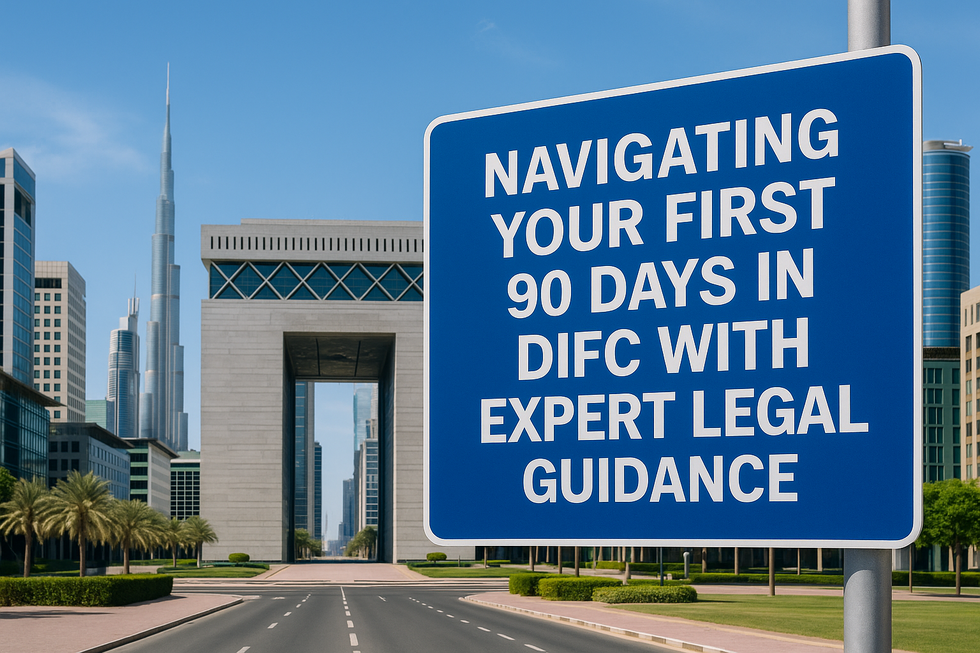
Introduction: The Strategic Importance of Your Initial 90 Days in DIFC
The Dubai International Financial Centre (DIFC) stands as a premier financial hub within the UAE, renowned for its robust legal framework, business-friendly environment, and independent common law judiciary. As the region’s global business standards rise, navigating legal, regulatory, and compliance obligations in the DIFC during the critical first 90 days is essential for every new entrant—whether you are launching a new business, relocating an international entity, or onboarding teams. Proactive legal compliance and a strategic entry approach are more crucial than ever, particularly in light of recent updates in UAE federal laws, Ministerial Resolutions, and DIFC-specific amendments effective in 2024 and beyond. Hossam Zakaria Legal Consultations presents this immersive legal playbook as a consultancy-grade resource to empower you to achieve seamless integration and ongoing compliance, minimize risks, and maximize competitive advantage in the heart of the Middle East’s financial innovation landscape.
This article synthesizes authoritative sources—including the UAE Ministry of Justice, Ministry of Human Resources and Emiratisation (MOHRE), the Dubai Financial Services Authority (DFSA), and the Federal Legal Gazette—to deliver a comprehensive, actionable analysis. Whether you are an executive, compliance officer, legal counsel, or HR lead, this resource will arm you with practical guidance to ensure your first 90 days position you for enduring success.
Table of Contents
- Understanding DIFC’s Legal Ecosystem: The Foundation of Success
- Corporate Setup: Essential Legal Milestones in the First 30 Days
- Employment and Labour Law Compliance: The First New Hires
- Corporate Governance, Data Protection, and Regulatory Reporting
- Risks, Liability, and Enforcement: Safeguarding Your Operation
- Best Practices and Strategic Recommendations: Navigating Forward
- Conclusion: Building a Future-Ready DIFC Presence
Understanding DIFC’s Legal Ecosystem: The Foundation of Success
The Unique Legal Architecture of DIFC
DIFC operates as an independent jurisdiction within the UAE, applying its own set of civil and commercial laws—largely modeled after English common law—while remaining subject to overarching UAE federal regulations. The DIFC Courts, an autonomous English-language judiciary, oversee civil and commercial disputes; criminal matters are governed by UAE federal law. Regulatory oversight is conducted by the Dubai Financial Services Authority (DFSA), ensuring rigorous standards for authorized firms, financial services providers, and ancillary businesses.
Key Legal Sources and Regulatory Bodies
- DIFC Laws: Including the Companies Law (DIFC Law No. 5 of 2018), DIFC Employment Law (No. 2 of 2019, as amended in 2024), and DIFC Data Protection Law (No. 5 of 2020).
- Federal Laws: For instance, Federal Decree-Law No. 20 of 2018 on Anti-Money Laundering (AML), UAE Labour Law (Federal Decree-Law No. 33 of 2021), and cabinet decisions regulating business activities.
- Guidance and Enforcement: The UAE Ministry of Justice, MOHRE, and related authorities provide binding and interpretive guidance.
Why the First 90 Days Matter
The opening quarter in DIFC is high-impact: it sets the tone for future regulatory relationships and determines the compliance posture for your entity. Immediate legal obligations arise on incorporation, licensing, employment contracts, operational risk, AML, corporate governance, and data reporting. Delayed or incomplete compliance can result in fines, reputational harm, and operational constraints.
Corporate Setup: Essential Legal Milestones in the First 30 Days
Forming Your Entity in DIFC: Procedures, Timelines, and Legal Touchpoints
Incorporation initiates your legal existence and triggers obligations under both DIFC and federal laws. The process typically entails:
- Choosing the Legal Structure: Options include Private Companies, Limited Liability Partnerships (LLP), Branches, or Representative Offices, each with unique regulatory, governance, and reporting requirements (per DIFC Companies Law No. 5 of 2018).
- Submission of Required Documentation: Memorandum and articles of association, founder details, proof of share capital, office lease, and business plans.
- DIFC Registrar of Companies (ROC) Approval: The ROC assesses completeness, legal capacity, and alignment with permitted activities. (See DIFC Practice Notes and Circulars for documentation specifics.)
- DFSA Authorisation: Required for regulated financial activities, triggering enhanced licensing and compliance requirements.
Recent Legislative Updates Affecting Corporate Setup
| Aspect | Prior to 2024 Updates | 2024 & 2025 Updated Provisions |
|---|---|---|
| Minimum Capital Requirements | Fixed minimums for most company types | Risk-based, activity-dependent requirements; flexibility for innovation clusters |
| Beneficial Ownership Declarations | Annual filing on shareholder register | Quarterly filing, digital beneficiary register, enhanced verification |
| Onboarding Timing | 60-day grace to launch operations | 30-day mandatory operational commencement post-licensing |
| Anti-Money Laundering Controls | Basic identity verification | Enhanced Know-Your-Customer (KYC) and Source of Funds due diligence |
Practical Insights and Recommendations
- Accelerated Timelines: The revised 30-day operational rule necessitates advance coordination—secure office space, arrange capital, and complete KYC before license issuance.
- Beneficial Ownership Transparency: Maintain an always-updated digital register in line with Federal Cabinet Decision No. 58 of 2020 regarding real beneficiary data for companies.
- DFSA Expectations: For regulated entities, robust policies for integrity, financial soundness, and AML must be formalized before authorisation.
Case Example: Initial Setup Scenario
A global investment firm’s Dubai branch completed regulatory clearances rapidly due to pre-submission checks on founders’ backgrounds and upfront evidence of sufficient risk-based capital. A similar local startup faced delays as missing documentation and late office lease evidence triggered ROC rejections. Lesson: Legal counsel and due diligence before license application are critical to meeting DIFC’s compressed rollout schedules.
Employment and Labour Law Compliance: The First New Hires
DIFC’s Employment Law in 2024–2025: Key Compliance Requirements
The DIFC Employment Law (No. 2 of 2019, with the Regulation of Employment Amendment 2024) establishes clear obligations distinct from the UAE Federal Labour Law (Federal Decree-Law No. 33 of 2021). Recent amendments particularly affect probation, terminations, anti-discrimination, end-of-service benefits, and mandatory insurance schemes.
Highlights of Employment Law Provisions
- Employment Contracts: Written contracts specifying probation (maximum 6 months), remuneration, leave, working hours, and notice periods are mandatory before commencing employment (Art. 9, DIFC Employment Law).
- Probation & Onboarding: Probation may not exceed 6 months; all rights accrue from day 1 of employment. Notice of termination must be given in writing, with clear grievance procedures outlined.
- Work Permits & Visas: DIFC entities must obtain employment permits through the DIFC Authority and coordinate UAE residence visas through MOHRE and the General Directorate of Residency and Foreigners Affairs (GDRFA).
- Anti-Discrimination & Harassment: Expanded grounds prohibit discrimination based on nationality, gender, age, marital status, pregnancy, disability, and religion. The new DIFC Anti-Discrimination Regulation 2024 requires proactive workplace policies and training.
- End-of-Service Benefits: The DIFC Employee Workplace Savings (DEWS) Plan replaced gratuity payments. Contributions (typically 5.83% to 8.33% of salary) must be remitted monthly to an approved scheme, aligning with Federal changes under Cabinet Resolution No. 46 of 2022 on Pension and Social Security Systems.
Comparison Table: Old vs. New DIFC Employment Law Provisions
| Provision | Before 2024 Update | 2024 & 2025 Standards |
|---|---|---|
| Probation Periods | Varied practices, up to 12 months | Maximum 6 months strictly enforced |
| DEWS Contributions | Employer-paid gratuity at termination | Monthly mandatory contributions to DEWS |
| Discrimination Law | General clause; weaker enforcement | New, robust grounds; enforcement policies and training required |
| Remote Work Provisions | Rarely addressed in contracts | Detailed remote work clauses and allowances now recommended |
Practical Consultation and Example
HR Integration Scenario: A technology firm hiring expatriate software engineers was flagged for late DEWS enrolment and imprecise contract clauses on remote work, resulting in a warning and potential financial penalty. Remediation included drafting standard documentation templates and onboarding checklists for all hires, reviewed quarterly by legal counsel for ongoing compliance. Key takeaways: Standardisation, legal vetting, and timely DEWS payment are vital.
Corporate Governance, Data Protection, and Regulatory Reporting
Corporate Governance Under DIFC Regulations
Robust governance from the outset mitigates compliance breaches and inspires investor confidence. The DIFC Companies Law and regulatory guidance require:
- Director and Shareholder Appointments: Proper board and meeting records, as per DIFC Companies Law Articles 49–62.
- Written Policies: Documenting conflicts of interest, anti-bribery, whistleblower mechanisms, and cybersecurity.
- Annual Filings: Timely submission of financial statements, AML forms, and beneficial ownership registers to the Registrar and (for regulated firms) the DFSA.
Data Protection Law: Meeting Global Standards
The DIFC Data Protection Law (No. 5 of 2020), aligned with the EU’s GDPR, regulates personal data collection, processing, transfer, and breach notification. New requirements in 2024 clarified cross-border data transfer protocols and the roles of data protection officers (DPOs). Scope includes:
- Privacy Notices: Must be transparent, concise, and accessible before data is collected.
- Data Subject Rights: Individuals may request access, rectification, or erasure of their data within mandated timeframes.
- Breach Notification: DPOs must notify the Commissioner of Data Protection within 72 hours of a notifiable breach.
Visual Aid Suggestion
A process flow diagram illustrating the mandatory steps for data breach response and reporting, from identification through notification and remediation, will enhance compliance understanding for readers. [Insert Data Breach Compliance Flowchart]
Regulatory Reporting Routine for New Entrants
- Quarterly and annual filings monitored by the DIFC Registrar and DFSA.
- Real-time reporting for AML, suspicious transactions, and cybersecurity events.
Risks, Liability, and Enforcement: Safeguarding Your Operation
Risks of Non-Compliance: Penalties and Regulatory Action
Failure to meet initial DIFC and UAE federal requirements can trigger swift enforcement actions. The table below compares common risks by infraction type, penalty, and remedy (extracted from the DFSA Rulebook, MOHRE penalties guidance, and DIFC Practice Directions):
| Infraction | 2023- Penalty | 2024+ Penalty/Consequence | Remedial Action |
|---|---|---|---|
| Late Company Filings | AED 2,000–10,000 fine; warning | AED 5,000–25,000 fine; possible license suspension | Rectification and extenuating evidence submission |
| Incomplete KYC/AML Procedures | Caution; improvement notice | DFSA investigation; restriction of business activities | Retrospective KYC and periodic AML audits |
| Employment Contract Issues | Warning from DIFC Authority | Fines per employee; loss of DEWS eligibility | Template overhaul and retroactive staff sign-off |
| Data Breach Non-Reporting | Commissioner reprimand | Fines up to AED 100,000; enforced data audits | Mandatory staff training and appointment of external DPO |
Reducing Risks and Maximising Compliance
Legal consultations, internal compliance training, automated reporting systems, and regular audits—especially for AML and data protection—are essential. Document every regulatory action and maintain real-time access to updated legislation for reference.
Best Practices and Strategic Recommendations: Navigating Forward
- Engage Outside Counsel Early: Professional legal input before and after establishment prevents costly missteps and accelerates approvals.
- Establish Standard Operating Procedures: Document and automate key processes for onboarding, regulatory filings, DEWS administration, and data breach management.
- Continuous Legal Education: Regular training for HR, compliance, and management on UAE law 2025 updates and evolving DIFC requirements (via DIFC Academy and MOHRE webinars).
- Leverage Technology: Invest in compliance management software for reporting and document repository, minimising manual errors and deadline breaches.
- Review and Update Policies: Quarterly review of contracts, handbooks, and governance structures to ensure dynamic compliance with ministerial and DFSA circulars.
Compliance Checklist Suggestion
A downloadable, hyperlinked PDF compliance checklist—covering incorporation, AML, employment, reporting, and data protection—serves as a practical reference for DIFC entrants. [Insert Compliance Checklist Visual]
Conclusion: Building a Future-Ready DIFC Presence
The legal environment in the UAE, and DIFC specifically, is evolving rapidly to match heightened global benchmarks for transparency, accountability, and agility in business operations. Your first 90 days in DIFC will define your regulatory footing for years ahead. By staying abreast of the latest legislative developments, engaging with expert legal advisers, and deploying a robust, proactive compliance framework, your business is not just protected from risk—it is positioned to innovate and lead in the region’s dynamic financial ecosystem.
Stay Forward-Looking: The next wave of legal changes—anticipated in the 2025 UAE Federal Law updates and further DIFC reforms—will deepen expectations for digital governance, ESG integration, and board accountability. Establishing your compliance infrastructure now is less about “ticking the box” and more about building a sustainable, resilient business in the world’s most vibrant commercial centre.
Hossam Zakaria Legal Consultations stands ready to guide you with bespoke risk assessments, tailored documentation, and ongoing regulatory monitoring, ensuring that your DIFC venture is not only compliant—but future-ready.
