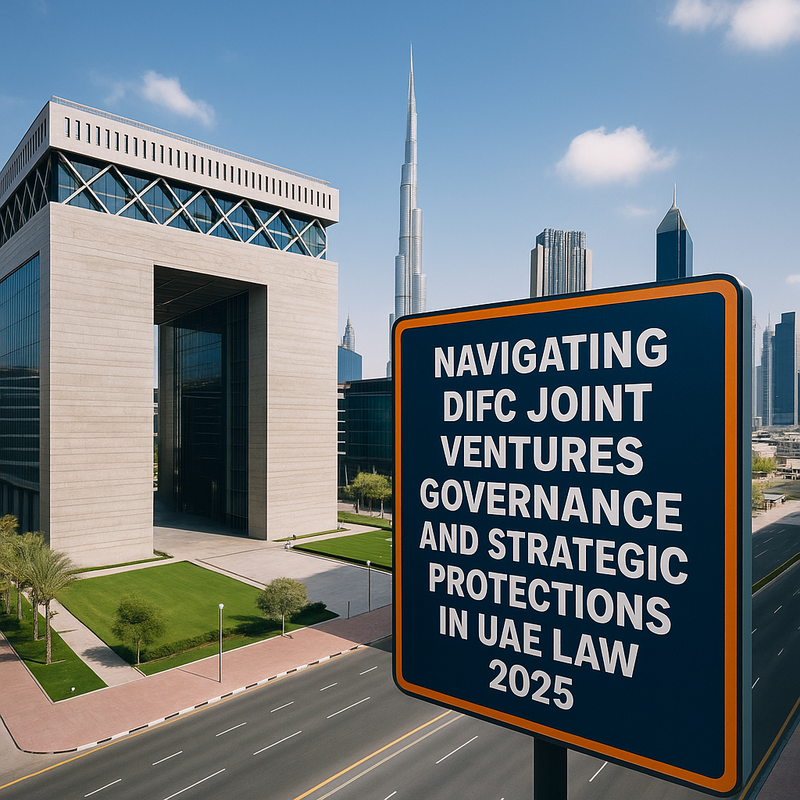
Introduction
The United Arab Emirates has positioned itself as a global business hub, consistently enacting forward-thinking regulations to foster commercial innovation, investment, and partnerships. A critical element in this evolution is the establishment of joint ventures (JVs), particularly within the Dubai International Financial Centre (DIFC), one of the region’s most commercially-active and internationally-regarded free zones. With regulatory developments set for 2025 and sustained economic diversification aligning with UAE Vision 2031, understanding joint venture governance, deadlock resolution, and funding protections in the DIFC has never been more essential for businesses, executives, and legal professionals. This article provides an authoritative analysis on the legal frameworks, recent updates, risk factors, and pragmatic solutions relevant to DIFC-based joint ventures, empowering organizations to harness the full potential of strategic collaborations while remaining fully compliant under UAE law.
Recent directives, including Federal Decree Law No. 32 of 2021 on Commercial Companies and the updated DIFC Operating Law (DIFC Law No. 7 of 2018, as amended), establish robust mechanisms for transparency, investor protection, and dispute resolution. For stakeholders exploring partnerships in one of the GCC’s most sophisticated legal systems, mastery of JV governance—particularly in relation to board controls, minority rights, deadlock management, and funding safeguards—can be the difference between commercial success and costly litigation. This definitive guide distills expert legal insights and actionable recommendations for structuring, managing, and safeguarding joint ventures in the DIFC in line with the latest regulatory standards.
Table of Contents
- Legal and Regulatory Framework for DIFC Joint Ventures
- Common JV Structures in the DIFC
- Governance Mechanisms and Board Control
- Deadlock Scenarios and Resolution Provisions
- Funding Protections and Finance Arrangements
- Compliance Strategies and Risk Mitigation
- Case Studies and Applied Insights
- Conclusion and Future Outlook
Legal and Regulatory Framework for DIFC Joint Ventures
Understanding the DIFC Legal Regime
The DIFC operates as a common law jurisdiction, distinct from the UAE’s civil law system, underpinned by its own statutes, regulations, and court system. The DIFC Companies Law, now governed by DIFC Law No. 5 of 2018, and the Operating Law (DIFC Law No. 7 of 2018), set out the principal requirements for forming and managing joint venture entities. Federal Decree Law No. 32 of 2021 on Commercial Companies also impacts JV structuring, particularly regarding foreign ownership, anti-money laundering obligations, and corporate governance expectations.
Key Legislative References
- Federal Decree Law No. 32 of 2021 on Commercial Companies
- DIFC Operating Law No. 7 of 2018 (as amended in 2023)
- DIFC Companies Law No. 5 of 2018
- DIFC Contract Law No. 6 of 2004 and DIFC Law of Obligations
Complementing these are sectoral guidelines, Ministerial Resolutions, and the DIFC Authority’s circulars, reflecting the Centre’s ongoing commitment to regulatory clarity and international best practice.
Comparison: Old vs. New Company Law in JV Context
| Aspect | Pre-2021 Regime | Post-2021 (Federal Decree Law 32/2021 & DIFC 2018–2023) |
|---|---|---|
| Foreign Ownership | Limited to minority shareholding with sector exceptions | Full foreign ownership allowed in most sectors, subject to Cabinet Resolution No. 16 of 2020 |
| Board Composition | Strict local representation, minimum requirements | Greater flexibility on board appointments permitted under DIFC regime |
| Dispute Resolution | Federal courts and arbitration, varied certainty | DIFC Courts or international arbitration, more predictable and enforceable |
| Capital Requirements | Minimum share capital determined by type | Minimum capital for private companies often abolished or reduced |
Common JV Structures in the DIFC
Equity Joint Ventures
Equity joint ventures involve the formation of a new legal entity—typically a private company limited by shares (Ltd)—with stakeholders holding shares proportional to their investments and agreed governance rights. The DIFC Companies Law allows for bespoke share classes, tailored voting frameworks, and minority protection mechanisms, essential for addressing control and funding concerns.
Contractual Joint Ventures
Alternatively, parties may adopt non-incorporated contractual JVs, governed by DIFC Contract Law and the Law of Obligations. These are often used for specific projects, with shared profits, losses, and risk allocation expressly detailed in tailored JV agreements.
Representative Visual: JV Structure Flow Chart
Suggested Visual: Flow diagram showing the formation process of an equity JV in the DIFC, capturing entity set-up, initial shareholding, and board appointment steps.
Governance Mechanisms and Board Control
Board Composition and Rights
Effective governance is the bedrock of a resilient joint venture in the DIFC. Parties must consider board structure, director appointment rights, reserved matters, and information access rights. Under DIFC Companies Law, shareholders are largely free to agree bespoke articles and shareholder agreements, but clarity is essential to avoid future conflicts.
Reserved Matters and Veto Rights
JV agreements typically set out reserved matters—significant issues requiring either supermajority or unanimous consent (e.g., changes to share capital, major contracts, changes in business direction). Reserved matters protect minority participants from unilateral decisions.
Minority Protection
| Protection Mechanism | Application in DIFC JV |
|---|---|
| Veto Rights | Minority can block major decisions—common for strategic investments |
| Information Rights | Guaranteed access to financials, management reports |
| Tag Along Rights | Enables minority to sell on same terms if majority exits |
| Anti-Dilution | Entitles existing shareholders to participate in new share issues to maintain their holding |
Careful balancing of control is critical: over-broad vetoes may impede operations, while insufficient protections expose minority investors to material risk. Stakeholders must bespoke their governance model, considering both the Commercial Companies Law and DIFC best practices.
Director Duties and Standards
DIFC directors owe statutory duties of care, loyalty, and good faith under the Companies Law and Contract Law. Breaches (such as undisclosed conflicts, diversion of corporate opportunities, or gross neglect) may trigger not only civil liability but also DIFC Court enforcement—reinforcing the premium placed on good governance. Firms are advised to reinforce these duties through clear contracts and board policies.
Deadlock Scenarios and Resolution Provisions
Nature of Deadlock in DIFC JVs
Deadlocks are fundamental disagreements between shareholders or directors that threaten the JV’s viability. They are particularly common in 50:50 or paritarian JVs where neither side has controlling interest. If unaddressed, deadlock can immobilize governance, hinder operations, and cause steep commercial losses.
Deadlock Triggers
- Failure to agree on reserved matters or annual budgets
- Disagreement over appointment/replacement of key executives
- Conflicting shareholder priorities in exit or expansion scenarios
Best Practice Deadlock Mechanisms
| Deadlock Solution | How it Works | Risks/Considerations |
|---|---|---|
| Escalation to Parent Company Executives | Dispute referred to higher management within stakeholders | May prolong resolution—ineffective if policy impasse is absolute |
| Chairman/Third Party Mediator | Appointment of neutral chair or professional mediator to break tie | Only works if parties agree on a mediator and their mandate |
| Russian Roulette Mechanism | One party offers to buy/sell at a set price; counterparty must buy or sell on same terms | Can be high risk, favours better-financed party |
| Texas Shoot Out/Sealed Bid | Both submit bids to buy the other out; highest bid proceeds | Requires both parties to have access to finance |
| Put/Call Options | Pre-agreed right to require the other to sell/buy in deadlock events | Tricky to price and enforce if circumstances shift |
| Orderly Winding-Up | Last-resort dissolution if business purpose is frustrated | Destroys JV value; only suitable when no other outcome is viable |
Recent trends in DIFC joint ventures, especially post-2021 reforms, favour multi-stage escalation combined with clear, time-bound triggers to ensure disputes are not allowed to stagnate, protecting value and enabling continuity.
Case Example: Deadlock in a DIFC Technology JV
Imagine a 50:50 JV in the fintech sector where shareholders deadlock over expansion into a new GCC market. The JV Agreement stipulates initial escalation to parent boards, followed by mediation. When mediation fails, the parties trigger a ‘Russian roulette’ clause, resulting in one buying out the other. Thanks to DIFC Operating Law provisions, this process is enforceable and expedient—demonstrating the importance of foresight in JV documentation.
Funding Protections and Finance Arrangements
Initial and Ongoing Funding Commitments
JV parties must establish clear terms for capital contributions—whether by equity, shareholder loans, or external debt—detailing timing, quantum, and remedies for default. The DIFC’s flexible PLC and Ltd regimes enable tailored solutions, but the onus is on parties to contract for protections up front.
Protections Against Dilution and Default
- Pre-emption Rights: Most JV agreements in the DIFC give existing shareholders the right to subscribe for new shares pro rata, limiting dilution risk.
- Anti-Dilution Clauses: Especially where new equity is issued at a lower value, anti-dilution mechanisms (‘full ratchet’ or ‘weighted average’) safeguard minority interests.
- Compulsory Loan Conversion: Allows defaulting parties’ loans to covert into equity, diluting their interest as penalty or enabling third-party rescue investment.
Remedies for Funding Breaches
DIFC statutes and reputable JV agreements typically specify consequences if a party fails to provide its committed funding, e.g.:
- Loss or suspension of voting rights
- Right for non-defaulting party to provide funding and dilute defaulter’s share
- Buy-out or forced sale provisions
Comparison: Funding Protection Mechanisms
| Mechanism | Application | Enforceability under DIFC Law |
|---|---|---|
| Pre-Emptive Rights | First refusal on new share issues | Strong if expressed in articles/JV agreement |
| Shareholder Loan Conversion | Loans convert into equity if not repaid or if capital call default | Generally enforceable, subject to statutory solvency rules |
| Default Penalty Provisions | Temporary suspension, forced sale, or dilution | Requires clear contractual drafting |
Practical Insights: Debt Financing in the DIFC
External debt is commonly used in DIFC JVs, subject to regulated financial covenants and the DIFC Security Law. Parties should ensure security arrangements are properly documented and registered, and that inter-creditor arrangements clarify priority among funders.
Regulatory Compliance Strategies and Risk Mitigation
Key Compliance Pillars
- Regulatory Registration: Timely registration with the DIFC Registrar of Companies, including UBO (Ultimate Beneficial Ownership) declarations and AML/KYC compliance (per the UAE Ministry of Justice and Cabinet Resolution No. 58/2020).
- Ongoing Corporate Governance: Maintenance of statutory registers, filing of annual accounts, adherence to DIFC data protection and anti-money laundering obligations.
- Tax and Economic Substance: Conformance with UAE’s Economic Substance Regulations (ESR) and Value Added Tax Law for JVs meeting prescribed thresholds.
Risks of Non-Compliance
- Regulatory fines and forced dissolution (administrative penalties up to AED 100,000 under DIFC Operating Law, increased per Federal Cabinet Res. No. 58/2020)
- Criminal liability for directors or designated officers
- Loss of limited liability protections
- Impaired ability to raise capital or exit the JV
Suggested Visual: Compliance Checklist Table
| Compliance Task | Responsible Party | Deadline/Frequency | Regulatory Authority |
|---|---|---|---|
| Registration of JV entity | JV Management | Before operations commence | DIFC Registrar of Companies |
| Beneficial Owner upload (UBO) | Company Secretary/Compliance Officer | Within 60 days of incorporation | DIFC Registrar/Ministry of Justice |
| Annual Returns and Accounts | Board of Directors | Annual | DIFC Authority |
| AML/KYC reports | Compliance Officer | Ongoing | Ministry of Justice/DIFC |
Case Studies and Applied Insights
Case Study 1: International Retail JV in DIFC
A European retail chain partners with a local Emirati investor to establish a DIFC-based holding company. Shareholding is split 60:40, with detailed reserved matters, anti-dilution, and a Texas shoot-out deadlock clause. When market conditions necessitate new capital, minority protections allow the local partner to maintain influence while the majority shareholder secures additional investment. The agreed dispute mechanism enables swift resolution, preserving the JV’s commercial objectives.
Case Study 2: Financial Technology JV and Regulatory Breach
A 50:50 fintech JV neglects timely UBO filing, triggering a compliance review by the DIFC Registrar. Penalties are imposed, and banking facilities are suspended until full remediation and an independent audit are completed. This underscores the strategic need for ongoing compliance monitoring and robust board governance.
Hypothetical Example: Default on Funding Commitment
In a joint venture with staggered funding obligations, one party defaults. The JV agreement contains a ‘compulsory share transfer’ provision whereby the non-defaulting party may acquire defaulting shares at a pre-agreed formula. This swift remedy, underpinned by clear DIFC law contractual enforceability, ensures business continuity without prolonged disputes.
Conclusion and Future Outlook
Establishing and managing joint ventures in the DIFC requires more than a cursory understanding of UAE law. The interplay of Federal Decree Law No. 32 of 2021, the DIFC’s contemporary legal framework, and enhanced compliance protocols means due diligence, meticulous contract drafting, and ongoing regulatory engagement are no longer optional—they are essential. The regulatory trajectory for 2025 and beyond emphasises transparency, robust governance, and ready dispute resolution, marking a new era of investment protection and commercial agility in the UAE.
Businesses, executives, and legal practitioners must approach DIFC joint ventures with a proactive, preventative mindset—anticipating conflict, funding challenges, and regulatory shifts. Embedding comprehensive governance, deadlock, and funding protection mechanisms is a vital component of resilience and commercial success. For tailored legal guidance, risk audits, and ongoing compliance support, organizations should consult with UAE-qualified legal advisors experienced in DIFC JV frameworks.
Key Takeaways:
- Strategic JV governance and deadlock management are fundamental to stability and investor protection in the DIFC.
- 2025 legal updates reinforce the need for precise contractual arrangements and proactive compliance monitoring.
- Penalties for non-compliance are material; robust board controls and funding safeguards are vital risk mitigants.
Best Practice Recommendations
- Engage in specialist legal review of JV agreements and corporate documents prior to execution
- Implement multi-tiered deadlock mechanisms with clear, timebound triggers
- Ensure funding commitments and protections are detailed and enforceable under DIFC law
- Maintain ongoing compliance monitoring using digital checklists and periodic legal audits
With diligent preparation, strategic foresight, and expert legal support, joint ventures in the DIFC can deliver substantial competitive advantages while complying with the new regulatory paradigm.
