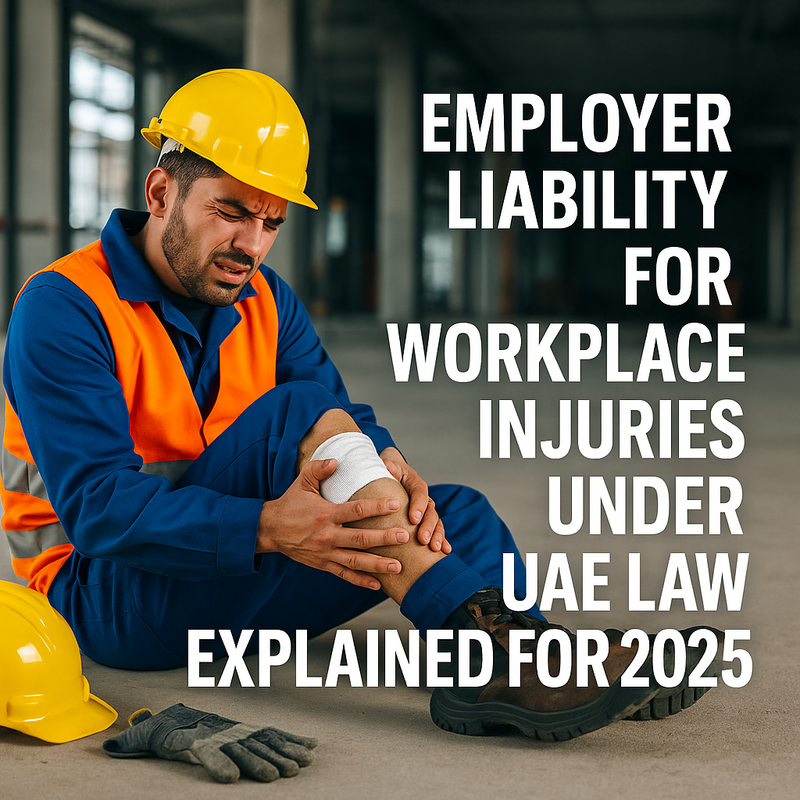
Introduction: Navigating Employer Liability in the Evolving UAE Legal Landscape
Workplace injuries present complex legal and financial risks for businesses across the United Arab Emirates (UAE). The question of employer liability in such cases is not only crucial for HR professionals, executives, and legal counsels, but also for enterprises seeking to foster compliance and proactively safeguard their workforce. With the recent enactment of Federal Decree-Law No. 33 of 2021 (Regulating Labour Relations), its subsequent Executive Regulations (Cabinet Resolution No. 1 of 2022), and anticipated updates for 2025, a comprehensive and up-to-date understanding of employer obligations has never been more critical.
This article offers a detailed consultancy-grade analysis of employer liability for workplace injuries under UAE law, addressing the new regulatory environment, its practical implications, case study insights, and forward-looking strategies for organizations. The discussion is grounded in official sources, including the UAE Ministry of Human Resources & Emiratisation (MOHRE), UAE Ministry of Justice, and guidance from the UAE Government Portal. Whether you are a business leader, HR director, or legal consultant, this article will equip you with actionable knowledge to maintain compliance and mitigate operational risks in the UAE’s dynamic business ecosystem.
Table of Contents
- Legal Framework: UAE Employer Liability for Workplace Injuries
- Key 2025 Legal Updates and Comparisons: Then and Now
- Scope and Coverage of Employer Liability
- Employer Duties: Prevention, Response, and Reporting
- Employee Rights and Compensation Entitlements
- Risks of Non-Compliance and Legal Consequences
- Strategies for Managing Liability and Ensuring Compliance
- Case Studies: Real-World Applications and Advisory Insights
- Conclusion: Future Developments & Best Practices
Legal Framework: UAE Employer Liability for Workplace Injuries
Overview of Relevant Legislation
The principal source of employer liability for workplace injuries in the UAE is Federal Decree-Law No. 33 of 2021 on the Regulation of Labour Relations, complemented by Cabinet Resolution No. 1 of 2022 (Executive Regulations). Articles 36, 37, and 38 set out employer duties, liability, and compensation provisions. These are underpinned by guidance from the Ministry of Human Resources & Emiratisation (MOHRE), as well as obligations under Federal Law No. 8 of 1980 (now largely replaced by the 2021 Decree-Law).
The regulatory framework reflects international best practices, emphasizing employer obligations regarding workplace safety, prompt incident reporting, and fair compensation. Anticipated updates (“UAE law 2025 updates”) are expected to reinforce these mechanisms, sharpening employer accountability and compliance requirements.
Official Sources
- UAE Ministry of Justice
- UAE Ministry of Human Resources & Emiratisation (MOHRE)
- UAE Government Portal: Workplace Injuries
- Federal Legal Gazette, Official Publications
Employers in all seven Emirates are subject to these federal rules, supplemented by local regulations for free zones or specific industry sectors.
Key 2025 Legal Updates and Comparisons: Then and Now
Evolution of Employer Liability under UAE Law
The UAE’s approach to employer liability has matured significantly with each legislative update. The transition from Federal Law No. 8/1980 to Federal Decree-Law No. 33/2021, and the expected legislative enhancements for 2025, collectively signal a commitment to global occupational health and safety standards and stringent enforcement mechanisms.
| Feature | Federal Law No. 8/1980 (Old) | Federal Decree-Law No. 33/2021 & 2025 Updates (New) |
|---|---|---|
| Scope of Employer Duty | General duty to ensure safety | Detailed, specific preventive measures mandated, including risk assessments and OHS training |
| Compensation for Injury | Based on fixed schedule and medical board assessment | Explicit calculation formulas, recognition of temporary and permanent disability, streamlined claim procedures |
| Reporting Obligations | Within 24 hours of incident | Immediate electronic notification to MOHRE, ongoing updates required |
| Penalties for Non-Compliance | Fines and potential compensation orders | Severe administrative fines, temporary business suspension, enhanced compensation liability, public blacklisting |
| Employee Rights | Right to compensation | Expanded entitlements (medical, psychological), improved access to dispute resolution mechanisms |
Key 2025 Anticipated Changes
- Digital workplace safety documentation and reporting
- Significantly higher penalties for repeat violators
- Strengthened protection for temporary, remote, and gig workers
- Enhanced role of occupational health committees in large organizations
These legislative milestones, guided by the Ministry of Justice and MOHRE, make proactive legal compliance a critical business priority in 2025 and beyond.
Scope and Coverage of Employer Liability
What Constitutes a Workplace Injury?
“Workplace injury” under UAE law encompasses any physical or psychological harm suffered by an employee during the course of employment or arising from workplace conditions or employment-related activities. This includes construction site accidents, factory incidents, office injuries, and injuries during work-related travel (excluding commutes, unless specifically covered by contract).
Inclusive Scope of Liable Parties
- Mainstream employers: All private sector firms operating in the UAE outside free zones
- Free zone entities: Must comply with free zone rules that often mirror or exceed federal standards
- Public sector employers: Governed by specific civil service rules, but often adopt similar OHS practices
- Outsourcing/Contracting companies: Liability may extend based on contractual arrangements and actual employer control
Exclusions and Limitations
Employers may limit liability in cases where:
- The injury arose outside the course of employment
- The injury was intentionally self-inflicted or resulted from gross employee misconduct (such as inebriation or criminal activity)
- Third-party negligence was the primary cause (employers may still bear compensation obligations, then seek recovery from the third party)
Employer Duties: Prevention, Response, and Reporting
Core Employer Obligations
- Prevention: Maintain a safe work environment (risk assessments, OHS training, safety equipment, routine inspections).
- Immediate Response: Provide prompt first aid and arrange urgent medical care; secure the scene and preserve evidence.
- Incident Reporting: Notify MOHRE and the local police immediately via electronic channels (per Cabinet Resolution No. 1/2022, Articles 24-26).
- Cooperation: Facilitate investigations by authorities and provide all requested documentation.
- Documentation and Record-Keeping: Maintain accurate logs of workplace injuries, safety audits, remedial actions, and communications.
Suggested Visual: Compliance Process Flow Diagram
Recommendation: Place a workflow diagram here summarizing the reporting, medical response, and follow-up procedures (from incident occurrence, first response, reporting, government inquiry, to final compensation).
Employee Rights and Compensation Entitlements
Compensation Under UAE Law
- Medical Expenses: Employer is liable for all direct medical, hospital, and rehabilitation expenses until an employee is declared fit for work or certified as disabled.
- Full Salary During Treatment: Employee is entitled to full salary for up to 6 months while undergoing treatment for a work-related injury or occupational disease (Article 37).
- Partial Salary Thereafter: Following the initial 6-month period, a reduced salary (half-pay) may be paid until the employee recovers or is declared permanently disabled.
- Disability or Death Benefits: Compensation for permanent disability or death is calculated based on the employee’s wage and the degree of impairment, with rates set by Cabinet Resolutions and MOHRE schedules.
Calculation Example Table
| Type of Injury | Compensation Basis |
|---|---|
| Permanent Total Disability | Equivalent to 24 months of basic salary |
| Partial Disability | Proportionate percentage according to government schedule (e.g., 60% disability = 60% of total benefit) |
| Death | 24 months of basic salary to designated beneficiaries, up to AED 200,000 (per Executive Regulations) |
Access to Dispute Resolution
Employees may initiate claims before MOHRE or competent local courts. Dispute resolution mechanisms include mediation, expedited hearings, and appeals, providing enhanced access for injured workers in light of 2021 Decree-Law reforms.
Risks of Non-Compliance and Legal Consequences
Legal and Financial Repercussions
Non-compliance with workplace injury laws can result in severe penalties:
- Administrative fines: Up to AED 1,000,000 for serious or repeat breaches (expected in “UAE law 2025 updates”).
- Compensation claims: Court-ordered payment of medical and salary compensation plus legal costs.
- Temporary suspension of business activities: Pending investigation or rectification.
- Public blacklisting: Companies listed on MOHRE website for recurring OHS violations.
- Imprisonment for gross negligence or willful endangerment.
Compliance Checklist Table
| Requirement | Recommended Action Points |
|---|---|
| Risk Assessments | Annual audits, regular update after any major incident/change |
| OHS Policy | Documented, signed by senior management, communicated to staff |
| Safety Training | Mandatory at induction, at least annually for all staff |
| Accident Reporting Procedures | Posted in visible workplace locations, regular drills |
| Medical Coverage | Insurance policies updated to reflect current law |
| Record Keeping | Maintain logs for at least 5 years, secure digital backups |
Strategies for Managing Liability and Ensuring Compliance
Best Practice Recommendations
- Appoint a Health & Safety Officer: Assign responsibility to a qualified staff member or consultant, as mandated for larger organizations under expected 2025 rules.
- Invest in Robust Safety Infrastructure: Ensure PPE (personal protective equipment), signage, and emergency facilities meet government standards.
- Embed a Culture of Safety: Conduct regular training, anonymous incident reporting, and visible management participation.
- Review Contractor and Third-Party Contracts: Explicitly assign OHS responsibilities and indemnities in writing.
- Audit and Update Policies: Keep written health and safety policies current with MOHRE guidance and legislative changes.
- Utilize Digital Compliance Tools: Adopt recognized OHS management platforms for record-keeping and automated reporting to MOHRE (expected 2025 requirement).
Insurance Considerations
Employers should ensure comprehensive workplace injury and group health insurance policies are in force, covering both statutory compensation and supplemental benefits. Insurance arrangements must align with the nature of workplace risk, with special attention to construction, manufacturing, and logistics sectors.
Case Studies: Real-World Applications and Advisory Insights
Case Study 1: Construction Sector Injury
Scenario: A scaffolding collapse at a Dubai construction site injures multiple workers. The employer follows required protocol: immediate medical intervention, prompt MOHRE notification, full documentation, and cooperation with government investigators. Compensation and salary benefits are paid as per official tariff schedules. No regulatory action ensues, demonstrating the protective effect of compliance.
Case Study 2: Non-Compliance in Manufacturing
Scenario: A factory neglects regular OHS training and maintains outdated incident logs. An employee is injured due to faulty machinery. Upon investigation, authorities discover the lack of proper records and expired safety certifications. The company faces an administrative fine of AED 500,000, and is temporarily suspended from bidding for government contracts. The reputational and operational costs dwarf any short-term savings from non-compliance. Consultancy Insight: Proper documentation is as vital as physical safety measures.
Case Study 3: Remote Work and Psychological Injury
Scenario: A technology employee develops anxiety due to excessive remote work demands, diagnosed as work-related. The employer, uncertain of their obligations, consults legal advisors. The company adapts its health policies, ensures access to counseling, and recognizes psychological injury compensation in accordance with emerging 2025 regulations, thus avoiding regulatory scrutiny and a workplace dispute.
Suggestion: Insert a case summary infographic to visually contrast the ‘compliant’ and ‘non-compliant’ employer outcomes.
Conclusion: Future Developments & Best Practices
The landscape of employer liability for workplace injuries in the UAE is marked by increasing rigor, digital innovation, and a shift toward global standards. As federal authorities prioritize occupational health and align with international benchmarks, businesses face not only legal obligations but also reputational imperatives to act decisively on workplace safety.
- Strict and proactive compliance with Federal Decree-Law No. 33/2021, its Executive Regulations, and 2025 updates is non-negotiable.
- Leadership commitment, digital record-keeping, and an open safety culture will define successful enterprises.
- Regular legal audits and engagement with experienced UAE legal consultants will be essential to adapting to ongoing reforms.
- Organizations must anticipate that the scope of covered injuries—including remote and psychological injuries—will expand, and that enforcement will become even more stringent.
To remain competitive and resilient, UAE businesses should make health and safety a strategic priority, building robust systems that evolve alongside this dynamic regulatory environment. By doing so, they not only comply with the law, but also secure their workforce, reputation, and long-term growth prospects in the UAE’s ambitious economic landscape.
