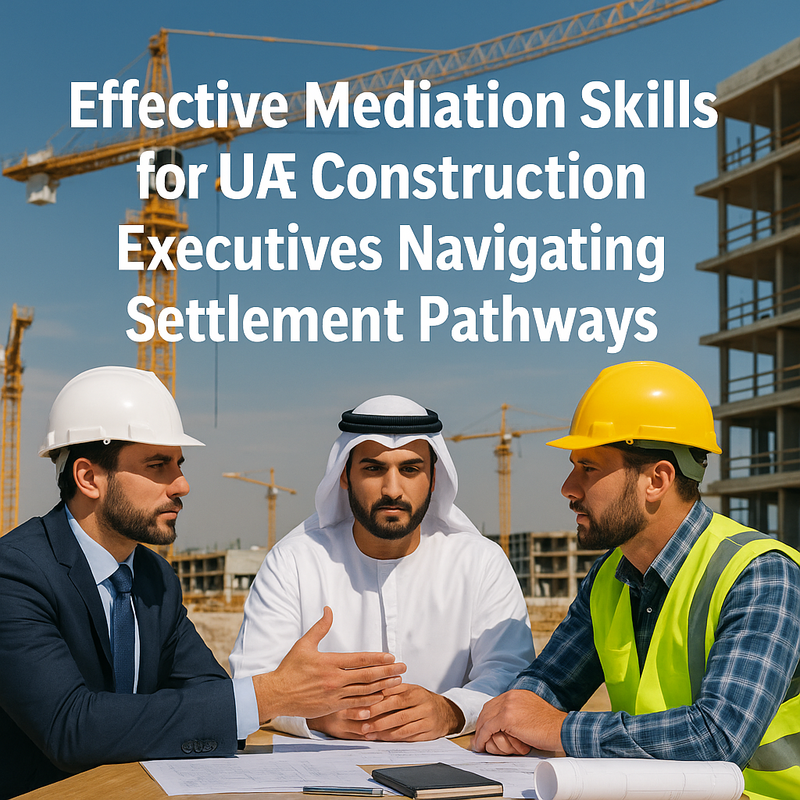
Introduction: Mediation and the UAE Construction Sector
The UAE construction industry stands as one of the main pillars of the nation’s economic vision, supporting infrastructure, real estate, hospitality, and global events such as Expo 2020 and COP28. However, the industry’s complexity inevitably generates disputes concerning contracts, delays, payments, and performance. In response, the UAE has implemented significant legal reforms to encourage mediation as an effective alternative to litigation and arbitration, especially under Federal Decree Law No. 6 of 2021 on Mediation in Civil and Commercial Disputes. For construction executives, mastering mediation skills is no longer optional—it is a strategic imperative for safeguarding organizational interests, achieving commercial outcomes, and ensuring regulatory compliance.
This expert analysis explores the evolving legal framework, practical mediation techniques, compliance strategies, risk analysis, and real-world applications—all tailored to executive-level stakeholders in UAE construction. Drawing on the latest legal updates from verified sources such as the Ministry of Justice, Ministry of Human Resources and Emiratisation, and the Federal Legal Gazette, this in-depth article offers a practical roadmap for leveraging mediation to achieve successful settlements and maintain corporate resilience.
Table of Contents
- Mediation in the UAE: Legal Framework and Recent Reforms
- The Role of Mediation in UAE Construction Disputes
- Essential Mediation Skills for Construction Executives
- Navigating Compliance and Legal Requirements
- Practical Insights: Case Studies and Hypotheticals
- Avoiding Risks: Challenges, Pitfalls, and Mitigation Strategies
- Best Practices and Executive Recommendations
- Conclusion: The Future of Dispute Settlement in UAE Construction
Mediation in the UAE: Legal Framework and Recent Reforms
Overview of UAE Mediation Laws
Recognizing the inefficiency and cost of protracted litigation, the UAE has enhanced its legal infrastructure to promote amicable resolution through mediation. The cornerstone of these efforts is Federal Decree Law No. 6 of 2021 on Mediation in Civil and Commercial Disputes. This statute formalizes mediation procedures, provides for the enforceability of mediation agreements and settlement terms, and establishes necessary safeguards for neutrality and confidentiality.
Key Features of Federal Decree Law No. 6 of 2021:
- Voluntary and Judicial Mediation: Parties may opt for mediation voluntarily or it may be ordered by the court, especially for construction disputes where preservation of commercial relations is critical.
- Accreditation of Mediators: Mediators must be accredited by the Ministry of Justice, ensuring competence, impartiality, and integrity.
- Enforceability of Settlement Agreements: Settlement agreements reached through mediation are now directly enforceable—streamlining outcomes and reducing further litigation risk.
- Confidentiality: Mediation proceedings and disclosures are protected from judicial or arbitral use, barring few exceptions.
Official Sources and Supporting Regulations
Further guidance is found in Cabinet Decision No. 57 of 2018 On the Regulation of Mediation, as well as the updated UAE Civil Procedures Law (Federal Law No. 11 of 1992, as amended), which integrates mediation mechanisms in civil court procedures. Specialized mediation centers such as Dubai’s Center for Amicable Settlement of Disputes (CSD) and Abu Dhabi’s Judicial Department Mediation Section offer sector-specific mediation support.
Comparative Table: Pre-2021 vs Post-2021 Mediation Law in UAE
| Aspect | Pre-2021 Regime | Post-2021 (Federal Decree Law No. 6 of 2021) |
|---|---|---|
| Mediator Appointment | Ad hoc; often mutual selection, limited regulation | Accredited mediators by Ministry of Justice; formal appointment standards |
| Enforceability of Settlements | Not always directly enforceable; required court ratification | Automatically enforceable as executive instruments |
| Confidentiality | Often contractual, sometimes unclear | Statutory confidentiality protection |
| Judicial Referral | Rarely court-mandated | Court may order parties into mediation |
| Specialized Construction Panels | Limited formalization | Increasing establishment of sector-specific mediation centers |
The Role of Mediation in UAE Construction Disputes
Prevalence and Nature of Construction Disputes
Construction projects—by their scale, complexity, and interdependent stakeholder relationships—are prone to disputes including:
- Contractual ambiguities
- Payment delays and non-compliance with milestone deliverables
- Variations and scope-of-work changes
- Delays and extension-of-time claims
- Defective work and warranty issues
- Performance security and guarantees disputes
Traditional litigation and arbitration, while robust, can be prohibitively slow, expensive, and adversarial—often irreparably damaging business relationships. Mediation bridges this gap, prioritizing commercial sensibility and continuity.
Why Construction Executives Must Prioritize Mediation
- Project Continuity and Stakeholder Relations: Mediation helps preserve contractor-owner relationships.
- Time and Cost Efficiency: Typical construction mediations resolve disputes in weeks or months instead of years.
- Confidentiality: Settlements protect commercially sensitive information from public courts.
- Customization: Settlement terms in mediation can reflect practical business needs that litigation remedies may not provide.
- Regulatory Compliance: Recent amendments increasingly require parties to demonstrate genuine efforts at amicable settlement before litigation proceeds.
Essential Mediation Skills for Construction Executives
Skillset Overview: What Every UAE Construction Executive Needs
- Understanding of Legal Processes: Executives must be conversant with mediation law, enforceability of agreements, and sector-specific statutory obligations.
- Negotiation & Bargaining Techniques: Constructive negotiation, the ability to identify commercial priorities, and creative problem-solving are crucial in mediation. Executives should also be adept at reframing positions as interests to unlock value in settlement talks.
- Stakeholder Communication: Clarity, honesty, and professionalism in communicating with internal teams, counterparties, and mediators avoid escalation and misunderstanding.
- Risk Assessment & Management: Evaluating the risks, strengths, and weaknesses of a case under mediation (versus litigation/arbitration) enables informed decision-making.
- Compliance Mindset: Awareness of regulatory reporting, corporate governance responsibilities, and mediation clause requirements in contracts.
Practical Techniques and Executive Approaches
- Pre-Mediation Preparation: Collate contract documents, project records, correspondence, and expert reports. Appoint empowered representatives with full settlement authority.
- Process Mapping: Use flowcharts (see suggested visual below) to outline the step-by-step mediation path, ensuring transparent internal delegation and accountability.
- BATNA/WATNA Analysis: Evaluate the Best Alternative to a Negotiated Agreement and the Worst Alternative to inform bargaining thresholds and escalation policies.
- Cultural Sensitivity: Recognize nuances in cross-border contracts and multi-national stakeholder engagement, mindful of local norms and UAE legal requirements.
Suggested Visual: Mediation Process Flowchart
(Insert a clear, step-by-step flowchart illustration: “From Dispute Identification & Mediator Appointment to Settlement Enforcement”)
Navigating Compliance and Legal Requirements
Formal Legal Requirements and Compliance Pitfalls
Recent legislation imposes concrete duties on construction firms with respect to mediation and alternative dispute resolution (ADR). Key compliance points include:
- Mediation Clauses: Contracts should mandate mediation as a condition precedent to court proceedings, in line with industry best practice and court policy.
- Accredited Mediators: Only mediators recognized by the Ministry of Justice or local mediation centers are to be appointed; failure may invalidate the process or settlement.
- Documentation: Parties must ensure all mediation communications and agreements are executed in writing and comply with prescribed formats under Cabinet Decision No. 57 of 2018.
- Registration and Enforcement: Settlement agreements must be registered with appropriate judicial authorities for immediate enforceability.
Compliance Checklist Table for Construction Executives
| Compliance Item | Mandatory? | Notes |
|---|---|---|
| Mediation Clause in Contracts | Highly advised | Increasingly a prerequisite for court/arbitration |
| Mediator Accreditation | Mandatory post-2021 | Must use Ministry/center accredited mediators |
| Confidentiality Agreement | Mandatory | Enshrined in law; check enforceability |
| Written Settlement Agreement | Mandatory for enforcement | Execute according to UAE law standards |
| Registration of Settlement | Recommended for enforceability | Register with competent court |
Practical Insights: Case Studies and Hypotheticals
Case Study 1: Contractor-Employer Payment Dispute
Scenario: A contractor faces non-payment for substantial completion due to alleged non-conformity with project specifications. The parties are on the brink of terminating their contract and escalating the dispute to the courts.
Mediation Steps:
- Parties agree to mediation under the terms of their FIDIC-based contract, as updated by a bespoke mediation clause.
- A Ministry-accredited mediator is appointed under the auspices of the Dubai CSD.
- Both parties prepare by gathering technical reports and expert opinions.
- During mediation, executives—supported by in-house counsel—are empowered to negotiate alternative remedies including partial payments and corrective actions.
- A written, enforceable settlement is registered with the Dubai Courts, avoiding a lengthy and damaging trial.
Case Study 2: Delay and Penalty Dispute
Scenario: COVID-19 supply chain disruptions delay a high-value Abu Dhabi infrastructure project. The employer claims delay penalties. The contractor asserts that force majeure applies and seeks extension-of-time relief.
Mediation Approach:
- Executives agree to mediation per contractual dispute resolution escalation procedure.
- BATNA/WATNA analysis informs both parties’ risk thresholds (risk of losing versus cost of settlement).
- Mediation identifies shared commercial interests: project continuation, reputation, and regulatory approval.
- Outcome: A settlement under which both penalty claims are reduced and revised project milestones acknowledged, registered for enforcement.
Hypothetical Example: International Joint Venture
- Joint venture partners (local Emirati company and an international EPC contractor) face a dispute about allocation of overhead and variations in a mega-project.
- Cross-cultural mediation facilitated in English and Arabic, utilizing sector-expert mediators well versed in UAE Civil Code obligations and international contracting standards.
- Confidential settlement achieved—protecting sensitive project and financial information and maintaining key strategic alliances.
Suggested Visual: Penalty Comparison Chart (Litigation vs. Mediation)
(Insert a side-by-side chart: “Average Time Cost and Penalty Exposure in Litigation versus Mediation” for UAE construction disputes)
Avoiding Risks: Challenges, Pitfalls, and Mitigation Strategies
Main Risks of Non-Compliance and Poor Mediation Practice
- Unenforceable Settlements: Use of non-accredited mediators or inadequate settlement documents can result in unenforceable agreements, exposing parties to renewed litigation.
- Breach of Confidentiality: Administrative or procedural lapses in maintaining confidentiality can invalidate settlements and trigger liability.
- Regulatory Non-Compliance: Failure to adhere to mediation requirements may result in regulatory sanctions, contractual repudiation, or exclusion from future tenders.
- Reputational Damage: Public or poorly managed disputes can harm corporate reputation, impairing future business opportunities.
Mitigation Strategies
- Mandate legal review of all mediation-related contract provisions and processes.
- Engage only accredited mediators and register all resulting settlements.
- Update internal policies to reflect changing regulatory framework (referencing Federal Decree Law No. 6 of 2021 and the most recent MOJ guidelines).
- Train executives on communication skills, negotiation tactics, and cultural intelligence for cross-border disputes.
Best Practices and Executive Recommendations
Integrating Mediation in Corporate Governance
- Regularly review and amend standard contracts to ensure robust mediation clauses fully in line with UAE legal requirements.
- Develop internal protocols for dispute escalation and mediation readiness—ensuring all project leaders are briefed on legal obligations and commercial objectives.
- Utilize reputable legal advisors to facilitate mediation, particularly in complex or high-value disputes involving international elements.
- Establish feedback mechanisms post-mediation to capture lessons learned and drive continuous improvement.
Executive Action Plan: Compliance and Settlement Success
- Conduct a legal audit of ongoing and upcoming construction projects for mediation compliance gaps.
- Invest in executive and in-house legal training on the nuances of UAE mediation law and best practices.
- Create a centralized repository of accredited mediation centers and expert panels for quick access in case of disputes.
- Monitor legal developments: assign responsibility for ongoing monitoring of legislative changes, circulars, and Ministry of Justice updates relevant to construction mediation.
Conclusion: The Future of Dispute Settlement in UAE Construction
The UAE’s proactive mediation framework sets a global benchmark for efficient, business-friendly dispute resolution, especially in the construction sector. Federal Decree Law No. 6 of 2021 reflects a transformative shift from adversarial litigation towards collaboration, enforceability, and commercial pragmatism. For construction executives, acquiring advanced mediation skills—combined with careful legal compliance and proactive risk management—will be central to sustainable business success.
It is imperative that organizations embed mediation into their corporate culture, contractual frameworks, and governance structures, taking advantage of the UAE’s modern approach. Forward-thinking leaders who master mediation not only avoid costly legal battles but also enhance business reputation, continuity, and market access in an increasingly competitive environment.
To remain ahead, construction executives must: (i) rigorously comply with the new legal mandates; (ii) upskill in mediation and negotiation; and (iii) embrace dynamic, settlement-focused dispute management strategies tailored for 2025 and beyond.
Legal compliance is not just risk avoidance—it is also a commercial advantage in the new UAE construction landscape.
