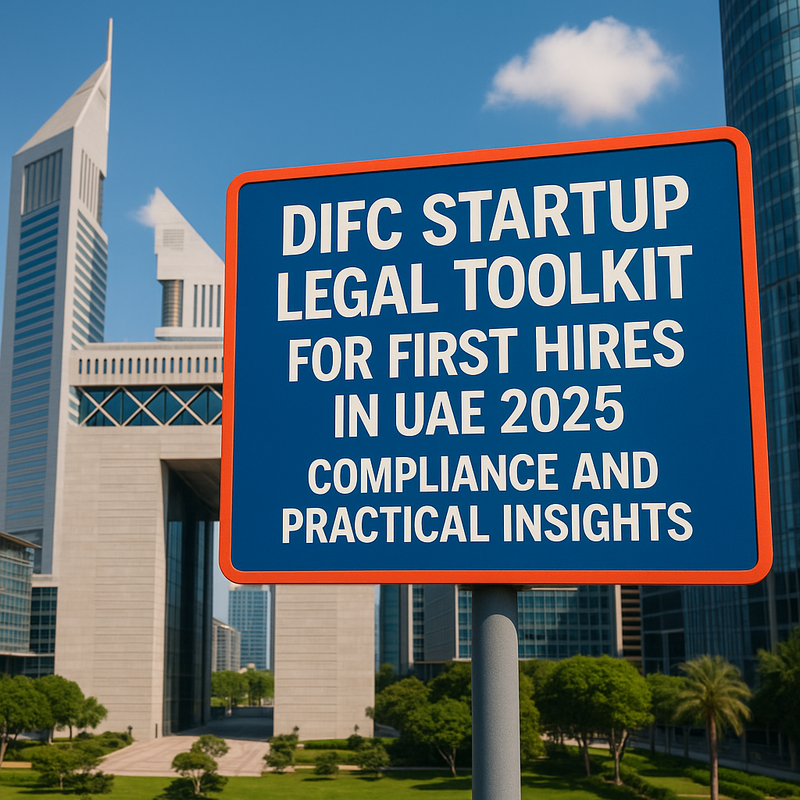
Introduction: Navigating DIFC Startup Growth and First-Hire UAE Legal Compliance
The Dubai International Financial Centre (DIFC) has established itself as the region’s premier business and innovation hub, attracting startups eager to leverage its world-class infrastructure, robust regulatory environment, and international connectivity. With the UAE government’s ongoing efforts to bolster economic diversification—exemplified by recent legal reforms and Federal Decree-Law No. 33 of 2021 on Labor Relations (as amended)—the compliance landscape for startups operating in DIFC has rapidly evolved, especially regarding onboarding their first employees.
This article is prepared as a comprehensive, consultancy-grade legal toolkit for DIFC startups hiring their first team member. It analyses the latest relevant UAE laws, official DIFC regulations, best-practice contract frameworks, workplace policy mandates, and intellectual property (IP) considerations. Leveraging guidance from the UAE Ministry of Human Resources and Emiratisation (MOHRE), the UAE Federal Legal Gazette, and authoritative DIFC practice guidance, this resource is essential for founders, executives, legal advisors, and HR professionals seeking to mitigate risk, ensure compliance, and protect business interests.
Whether you are finalizing your inaugural employment contract or designing an employee handbook tailored to UAE and DIFC statutory requirements, this article equips you with actionable guidance and professional recommendations. As the UAE continues to update its legislative landscape through 2025 and beyond, staying informed and proactive is vital to safeguarding your business and workforce in this dynamic environment.
Table of Contents
- UAE Labor Laws and DIFC Employment Regulations: Foundations for Startup Onboarding
- Essential Employment Contracts: Drafting and Compliance for First Hires in DIFC
- Workplace Policies: Mandatory UAE Requirements and DIFC Best Practices
- Intellectual Property: First-Hire Protection Strategies under UAE and DIFC Law
- Comparative Table: Key Changes in UAE Labor and Employment Laws Pre- and Post-2022
- Risks of Non-Compliance and Strategic Compliance Actions for DIFC Startups
- Case Study: Onboarding and Protecting Your First Employee in Practice
- Conclusion and Next Steps: Achieving Robust DIFC Startup Compliance in 2025
UAE Labor Laws and DIFC Employment Regulations: Foundations for Startup Onboarding
Legal Context and DIFC’s Unique Regulatory Environment
The UAE’s labor and employment regime distinguishes between onshore federal legislation—recently overhauled via Federal Decree-Law No. 33 of 2021 and its amendments—and special economic zones such as DIFC, which operate under their own employment frameworks. DIFC’s Employment Law (DIFC Law No. 2 of 2019, as amended in 2021) governs the employment relationship for DIFC-registered startups and generally provides autonomy in HR practices, contractual terms, and dispute resolution, subject to overarching UAE public policy.
For startups, understanding the intersection of federal and DIFC-specific regulations is vital. DIFC startups must be acutely aware of:
- The mandatory features of employment contracts under both regimes
- Specific employee rights and entitlements regarding leave, end-of-service benefits, and non-discrimination
- The applicability of new labor standards, including those introduced from 2022 onwards
Key DIFC and UAE Legislation: Authoritative Sources
- DIFC Employment Law (No. 2 of 2019, as amended by Law No. 4 of 2021)
- Federal Decree-Law No. 33 of 2021 on Regulation of Labor Relations (as amended by Ministerial Resolutions)
- UAE Ministry of Human Resources and Emiratisation (MOHRE) Circulars
UAE 2025 Labor Law Updates and Impact on DIFC Companies
The UAE’s continuing labor reforms emphasize transparency, employee rights, and digital compliance, affecting both mainland and DIFC-regulated entities. Significant changes implemented in 2022 and rolling into 2025 include:
- Fixed-term contracts as mandatory form (abolishing unlimited contracts for all new hires)
- Enhanced anti-discrimination protections
- New protocols for remote/hybrid work and digital onboarding
- Revised end-of-service benefit structures (including an optional DIFC Employee Workplace Savings (DEWS) scheme)
Visual Suggestion: Compliance checklist for first-hire onboarding under UAE and DIFC rules.
Essential Employment Contracts: Drafting and Compliance for First Hires in DIFC
Mandatory Elements under DIFC Law
Under DIFC Law No. 2 of 2019 (as amended), every employment contract for your first and subsequent hires must clearly address:
- Name, address, and DIFC registration number of the employer
- Details of the employee and job description
- Effective employment commencement date
- Remuneration, benefits, and payment terms (including pay cycle, allowances, bonuses, and any DEWS arrangements)
- Working hours, overtime calculations, and leave entitlement (annual, sick, maternity/paternity, etc.)
- Termination clauses (notice period, grounds for early termination, end-of-service benefit calculation)
These requirements must be carefully harmonized with UAE labor law provisions on minimum conditions and statutory leaves, even though DIFC is a separate jurisdiction. Startups should avoid ‘off-template’ contracts which risk omitting regulatory requirements, especially in areas such as anti-discrimination, data privacy, and conflict of interest provisions.
Best Practices: Crafting a Robust First-Hire Employment Contract
- Localisation: Reference all relevant DIFC and federal law obligations in the contract preamble.
- Clarity: State all job expectations, probation terms, remuneration, and review dates.
- Flexibility: Incorporate provisions for remote/hybrid working, digital signatures, and dispute processes in accordance with latest labor guidelines (see MOHRE Circulars 2023-2024).
- IP and Confidentiality: Annex tailored confidentiality and IP assignment clauses (see section below for examples).
Tip: Regularly review your templates in line with federal and DIFC regulatory updates. Outdated contracts are a major risk in regulatory audits.
Workplace Policies: Mandatory UAE Requirements and DIFC Best practices
Why Internal Policies Matter for Startups
Startups often overlook formal written policies for their first employees, but UAE and DIFC compliance expectations are increasingly stringent. Absence of formal policies can expose the business to legal disputes, regulatory penalties, and reputational risk—especially regarding anti-discrimination, harassment, whistleblowing, and workplace health and safety.
Core Policy Areas for DIFC Startups (as at 2025)
- Anti-Discrimination and Harassment: Federal Decree-Law No. 33/2021 and DIFC Law No. 2/2019 require clear anti-discrimination, workplace bullying, and harassment policies.
- Leave Management: Policies covering annual, sick, maternity/paternity, compassionate, and study leave must be transparent and reflect both DIFC and UAE minimums.
- Salaries and Benefits: Clear documentation of pay structures, bonus criteria, benefits, and end-of-service rules aligned to DIFC DEWS or federal EOSB rules.
- Remote/Hybrid Work: In line with latest MOHRE and DIFC circulars, policies should spell out eligibility, equipment provision, data privacy, and working time monitoring in remote or hybrid settings.
- Workplace Health & Safety: Obligatory as per UAE Ministry of Human Resources and Emiratisation regulations; risk assessment and workplace safety controls must be in writing and effectively communicated to employees.
- Data Privacy: UAE’s Personal Data Protection Law (PDPL) and DIFC Data Protection Law require startups to set out clear protocols for collecting, storing, accessing, and processing employee personal data.
Visual Suggestion: Flow diagram illustrating policy development process for first hires.
Developing Policies: Practical Steps
- Identify statutory and DIFC regulatory requirements specific to your business activities.
- Draft clear, accessible policies; engage employees in rollout for buy-in.
- Regularly review and update policies to reflect legal and regulatory changes (at least annually or as new rules come into force).
- Translate key documents into English and Arabic as a best practice for workforce inclusivity, although English is the default in DIFC.
Intellectual Property: First-Hire Protection Strategies under UAE and DIFC Law
IP Considerations in Employment Relationships
Intellectual property is often a startup’s most valuable asset. The UAE’s IP regime, underpinned by Federal Law No. 11 of 2021 on Industrial Property Rights and DIFC IP Regulations, provides comprehensive protection for copyrights, trademarks, patents, and trade secrets. However, IP rights by default may vest in individuals unless expressly assigned to the startup via well-drafted employment contracts and policies.
Key points to consider:
- Automatic Ownership: UAE law presumes employer ownership of IP produced in the course of employment only if explicitly stated in the contract (see Article 8(1), Federal Law No. 11/2021).
- Assignment Clauses: Clearly state that all inventions, designs, works, and trade secrets created during the term of employment belong to the startup, to the extent permitted by law.
- Post-Employment Enforcement: Use robust confidentiality and non-disclosure clauses to restrict former employees from disclosing or using proprietary information after they leave.
- Non-Compete and Restrictive Covenants: Enforceable under both DIFC and UAE law if reasonable in time, geography, and business scope—recent court decisions require careful drafting to avoid invalidation.
Visual Suggestion: Sample IP assignment clause and infographic on legal protection steps for startups.
Best Practice Checklist for Protecting IP with First Hires
- Include comprehensive IP assignment clauses in all first-hire contracts.
- Register key patents, trademarks, copyrights, and designs promptly with UAE Ministry of Economy or DIFC IP Registry.
- Develop confidential information management policies and train employees accordingly.
- Review and reinforce IP clauses at each stage of hiring, promotion, and exit interviews.
Comparative Table: Key Changes in UAE Labor and Employment Laws Pre- and Post-2022
To help startups and their legal advisors stay compliant, the following table summarizes pivotal changes in labor law and employment contract obligations, especially relevant to first hires in DIFC companies.
| Theme | Pre-2022 UAE Labor Law | Post-2022/2025 Labor Law (inc. DIFC updates) |
|---|---|---|
| Contract Type | Unlimited and limited terms allowed; less oversight on renewals | Only fixed-term contracts (max 3 years, renewable); strict renewal/termination provisions |
| Notice & Termination | 30-day minimum notice; limited employee-friendly grounds | 30-90 days notice; expanded employee rights for termination/resignation; more dispute channels |
| Leaves | Basic entitlements (30 days annual, etc.) | Extended maternity, paternity, bereavement, study, and sick leave entitlements |
| End-of-Service Benefits | Lump-sum gratuity payment as per years of service | Optional DEWS scheme (DIFC), revised EOSB computations, early access mechanisms |
| Employee Protection | Generic harassment and discrimination clauses | Mandatory anti-discrimination, anti-bullying, whistleblowing policies; reporting channels required |
| Remote Work | Not explicitly regulated | Defined remote/hybrid work regulations; digital wage payment and timekeeping rules |
Alt Text: Table comparing pre- and post-2022 UAE labor law changes for startups
Caption: A comparative breakdown of key legal reforms affecting DIFC employment contracts and policies in the UAE.
Risks of Non-Compliance and Strategic Compliance Actions for DIFC Startups
Legal and Financial Risks
Non-compliance with UAE and DIFC labor, contract, and IP laws exposes startups to severe risks, including:
- Regulatory penalties and fines imposed by the DIFC Authority or MOHRE
- Invalidation of employment or IP agreements—leaving startups open to claims for unpaid wages, unlawful termination, or lost IP
- Reputational harm and difficulty securing funding or partnership with other DIFC-regulated institutions
- Potential criminal liability in extreme cases, such as fraud, data breach, or harassment coverup
Suggestion: Chart summarizing tiered penalty ranges for non-compliance under UAE/DIFC law
Practical Strategies to Achieve Compliance
- Adopt and update legal templates tailored to latest UAE, MOHRE, and DIFC guidance
- Conduct regular internal compliance audits—especially after each legal update (2022, 2025, and ongoing)
- Engage DIFC-licensed legal counsel to review all contractual documents, policies, and procedures
- Document staff training and policy rollout (important defense against negligence claims)
Case Study: Onboarding and Protecting Your First Employee in Practice
To illustrate the real-world application of these legal requirements, consider the following hypothetical example:
StartX DIFC: First Hire Onboarding Lifecycle (2025)
- Initial Employment Contract Drafting: StartX engages a DIFC-licensed legal consultant to draft a contract encompassing all DIFC Law No. 2/2019 requirements, DEWS arrangements, robust IP assignment, and clear anti-discrimination clauses.
- Policy Implementation: Before onboarding, StartX adopts concise anti-harassment, remote work, and data privacy policies, providing documents in English and Arabic. Staff training sessions are documented and stored digitally.
- IP and Trade Secret Protection: The first employee, a software engineer, signs a bespoke IP assignment, non-compete, and non-disclosure agreement covering all work products and trade secrets, developed in line with Federal Law No. 11/2021.
- Ongoing Compliance Checks: StartX appoints an HR compliance officer to review all contracts and policies annually, ensuring alignment with new DIFC and federal regulations, including emerging digital onboarding standards.
- Audit Readiness: When approached for a regulatory audit in 2025, StartX presents all employment and policy documentation, IP registrations, and evidence of compliance training—passing audit with no adverse findings.
Conclusion and Next Steps: Achieving Robust DIFC Startup Compliance in 2025
The UAE’s recent legal reforms and the DIFC’s ongoing regulatory refinement present both opportunities and challenges for emerging startups. As labor, contract, and IP regulations become more detailed and stringent, proactive compliance—starting from a business’s very first hire—becomes not just a best practice, but a legal and commercial necessity.
By understanding and implementing the requirements of Federal Decree-Law No. 33/2021, DIFC Law No. 2/2019, and contemporary MOHRE and PDPL guidance, startups will:
- Shelter themselves from regulatory and reputational risks
- Foster an inclusive, high-performance workplace attractive to global talent
- Preserve and maximize the value of their intellectual property
- Future-proof their operations as further legal reforms are rolled out in the UAE through 2025 and beyond
For startup founders, executives, and HR leads: the best investment you can make is in continually reviewing contracts, policies, and IP records to align with the latest legislative and regulatory developments. Engage professional, DIFC-experienced legal counsel for templates, updates, and strategic advice tailored to your company’s growth trajectory. With this DIFC startup first-hire legal toolkit, you are equipped to build a compliant, resilient, and future-ready business in Dubai’s most dynamic commercial environment.
