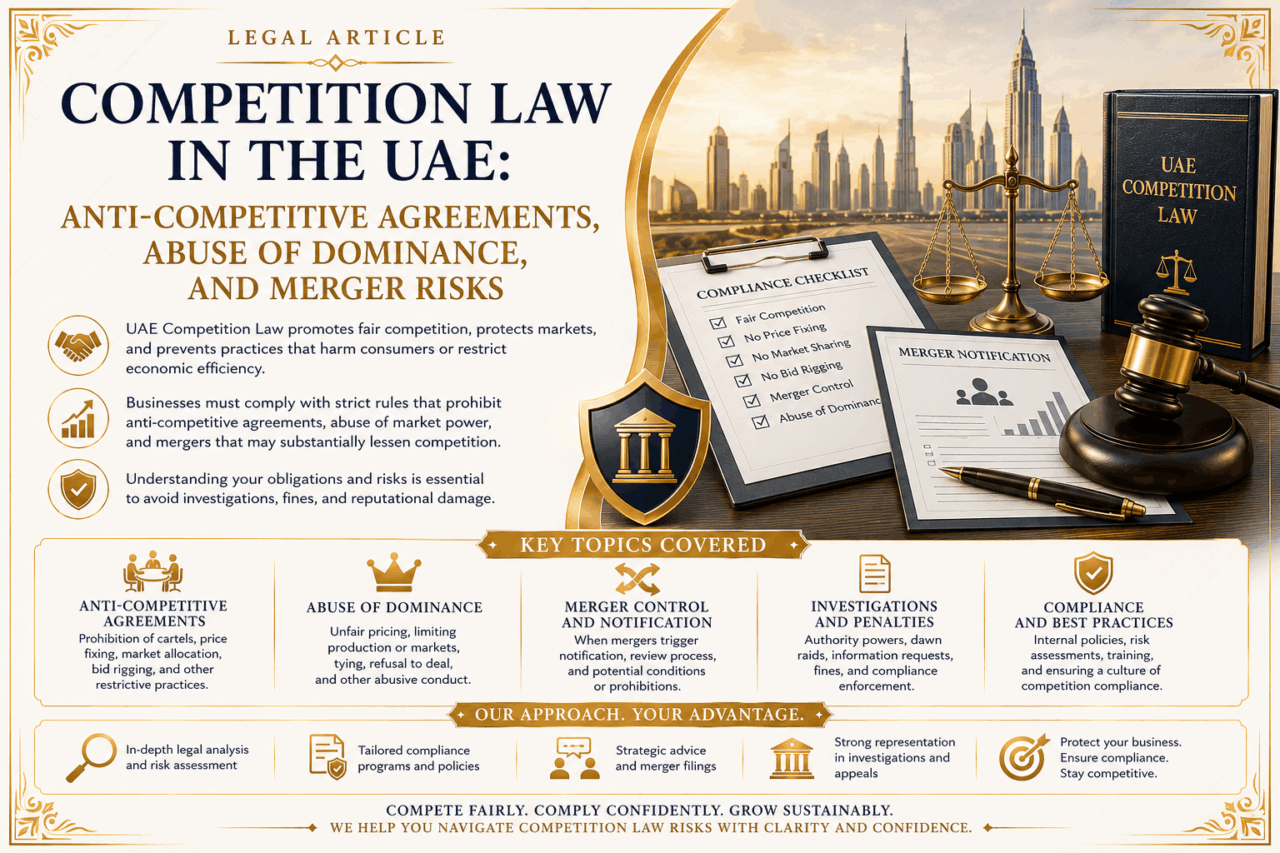
Competition Law in the UAE: Anti-Competitive Agreements, Abuse of Dominance, and Merger Risks
A practical legal guide to restrictive agreements, price coordination,
exclusivity, market power, economic-concentration filings, evidence,
penalties and competition-compliance safeguards in the United Arab Emirates.

market conduct and corporate transactions.
UAE competition law is no longer a subject that only concerns
multinational companies completing billion-dirham acquisitions. It can affect
ordinary commercial decisions made by sales teams, distributors, procurement
departments, shareholders, trade associations and business owners.
A discussion between competitors about future prices, an agreement to divide
customers, an exclusivity clause imposed on a distributor, a coordinated tender
strategy or the acquisition of control over another business may create serious
legal exposure. The risk does not depend only on what the parties call the
arrangement. UAE competition rules examine its substance, purpose and effect on
the relevant market.
The consequences may include regulatory investigations, compulsory disclosure
of documents, delayed transactions, rejection of an economic concentration,
substantial fines, private claims for compensation, interruption of business
operations and damage to commercial reputation.
As at 16 July 2026, Federal Decree-Law No. 36 of 2023 and Cabinet
Resolution No. 3 of 2025 are active. Cabinet Resolution No. 59 of 2026,
containing detailed new Executive Regulations, is scheduled to enter into
force on 30 July 2026.
UAE Competition Law: The Legal Framework
Federal Decree-Law No. 36 of 2023
The central federal legislation is Federal Decree-Law No. 36 of 2023
Regarding Regulating Competition. It became effective on 29 December 2023
and repealed Federal Law No. 4 of 2012, while preserving earlier implementing
regulations and decisions until replaced.
The Decree-Law regulates restrictive agreements, abuse of a dominant
position, abuse of economic dependence, predatory pricing and economic
concentrations that transfer direct or indirect control.
Its scope extends to economic activities conducted in the UAE, exploitation
of intellectual-property rights inside or outside the UAE and activities
conducted outside the country where they affect competition within the UAE.
Cabinet Resolution No. 3 of 2025
Cabinet Resolution No. 3 of 2025 established the numerical thresholds used
for dominance and economic-concentration notification.
| Test | Current threshold |
|---|---|
| Dominant position |
The undertaking’s share exceeds 40% of total transactions in the relevant market. |
| Economic-concentration sales test |
Combined annual sales in the relevant UAE market exceed AED 300 million during the previous fiscal year. |
| Economic-concentration market-share test |
The parties’ combined share exceeds 40% of transactions in the relevant UAE market. |
The sales and market-share notification tests are alternatives. A transaction
may therefore require notification because of market share even where the
parties’ sales are below AED 300 million.
Cabinet Resolution No. 59 of 2026
Cabinet Resolution No. 59 of 2026 introduces detailed Executive Regulations
governing dominance analysis, predatory pricing, exemption applications,
economic-concentration filings, complaint procedures, confidentiality and
investigations.
It is scheduled to take effect on 30 July 2026 and to repeal Cabinet
Resolution No. 37 of 2014. Filings that cross this transition date should be
checked against the procedure and forms applicable on the submission date.
Federal, local and sectoral jurisdiction
A relevant local authority may consider a matter where all undertakings
concerned are located only in the same emirate and the competitive effect
does not extend beyond that emirate. Wider or cross-emirate effects require
assessment of the federal route.
Certain sectors may have specialised rules administered by sectoral
regulatory bodies. Government ownership, sector regulation or free-zone
incorporation should not be treated as an automatic exemption.
Mainland, free zones, DIFC and ADGM
The legislation focuses on economic activity and market effect rather than
legal form. Free-zone status alone is therefore not a complete safe harbour.
A DIFC or ADGM jurisdiction clause may govern contractual disputes, but it
does not automatically remove federal, local or sectoral competition issues.
Regulatory jurisdiction and contractual dispute jurisdiction should be
analysed separately.
Key Legal Concepts and Definitions
Undertaking
An undertaking is any person engaged in economic activity, regardless of
legal form. The definition may include companies, partnerships, branches,
commercial groups, professional businesses, platforms and associations.
Agreement
A competition-law agreement is broader than a signed contract. It can include
a written or verbal understanding, an implicit arrangement, confidential
coordination, informal cooperation or a decision made by a trade association.
Relevant market
The relevant product market includes goods or services that customers regard
as interchangeable or substitutable because of their price, characteristics
and intended use.
The relevant geographic market is the physical or digital area where supply
and demand meet under sufficiently similar competitive conditions.
Restrictive agreement
A restrictive agreement is one whose subject, purpose or effect is to distort,
lessen, prevent or restrict competition. Important examples include price
coordination, bid rigging, output restrictions, collective boycotts, market
sharing and customer allocation.
Horizontal and vertical arrangements
Horizontal arrangements are concluded between competitors. Vertical
arrangements involve businesses at different levels of the supply chain.
Vertical agreements may be legitimate, but resale prices, exclusivity,
non-compete obligations, tying and customer restrictions require careful
assessment.
Dominant position and abuse
Dominance means the ability to control or influence a relevant market.
Exceeding 40% establishes dominance under the numerical threshold, but market
influence may also be assessed through qualitative factors.
Dominance itself is not unlawful. Abuse may include discriminatory treatment,
exclusionary below-cost pricing, unjustified refusal to deal, coercive
exclusivity, tying, limiting production or denying access to essential
physical or digital infrastructure.
Abuse of economic dependence
The law also addresses circumstances in which a customer or supplier has no
realistic alternative for marketing or supply. This can be important where
a smaller business depends heavily on a major retailer, platform, supplier
or customer.
Predatory pricing
Predatory pricing involves excessively below-cost prices where the objective
or effect is to exclude a competitor, remove a product or prevent market entry.
Genuine discounts and efficient pricing are not automatically predatory.
Economic concentration
An economic concentration may include a merger, share acquisition, asset
acquisition, joint venture or another transaction transferring direct or
indirect control.
Who UAE Competition Law Applies To
UAE competition rules may affect mainland companies, free-zone entities,
foreign groups selling into the UAE, directors, shareholders, investors,
distributors, suppliers, retailers, platforms, trade associations and
professional businesses.
Sales and pricing teams
Sales teams should not discuss future prices, discounts, customers, output
or tender plans with competitors. Information should come from legitimate
public, customer or independent research sources.
Procurement and tender teams
Suppliers may be exposed through coordinated bidding, cover quotations,
bid rotation or agreements not to compete. Procurement organisations may
also be victims of these practices.
Distributors and retailers
Distribution networks require review of exclusivity, resale-price influence,
online-sales restrictions, minimum purchases, territorial rules and rebates.
Trade associations
Associations should use controlled agendas, legal guidance and properly
aggregated information so legitimate industry work does not become a forum
for competitor coordination.
Investors and transaction parties
Buyers, sellers, funds, shareholders and joint-venture partners should screen
UAE merger-control issues before signing and before sensitive due-diligence
information is exchanged.
Rights and Obligations of Businesses
Competitor contacts
Competitors must avoid coordinating prices, discounts, territories,
customers, supply, production, market entry or tender participation.
Dominant-company obligations
A dominant business may compete strongly and innovate, but its pricing,
rebates, access conditions, refusal-to-deal decisions and exclusivity
arrangements should be objectively justified and consistently applied.
Right to defend legitimate conduct
A company may demonstrate that no coordination existed, market definition is
incorrect, customers had alternatives, differential treatment reflected
different costs, refusal was objectively justified or the arrangement
produced proportionate efficiencies.
Exemption applications
An arrangement may qualify for exemption where it is necessary to improve
production, distribution, competitiveness or consumer benefit, provided it
does not impose unnecessary restrictions or eliminate competition.
Rights in merger review
Transaction parties may present market evidence, commercial rationale,
efficiencies, consumer benefits and proposed commitments. The authority may
approve, conditionally approve, reject or determine that notification is not
required.
Complaints and damages
Interested parties may submit complaints and injured parties may seek
compensation. A damages claim must establish unlawful conduct, loss,
causation and reliable quantification.
Competition Procedures in the UAE
Initial assessment
The first step is to identify the parties, economic group, relevant products,
geographic market, competitive relationship, market shares, jurisdiction and
possible restrictions.
Document review
Agreements, drafts, side letters, emails, messages, pricing data, tender
documents, market studies and internal presentations should be reviewed
together.
Complaint procedure
Under the new Executive Regulations scheduled for 30 July 2026, a complaint
should identify the parties, practices, facts, legal provisions, evidence,
actual or potential harm, requested relief and any parallel proceedings.
The scheduled procedure provides for formal examination, an opportunity to
provide missing documents, notice to the respondent and an investigation
period subject to the prescribed extensions.
Investigation
The authority may request contracts, electronic communications, sales data,
cost information, market calculations, corporate records and employee
explanations.
A document hold should be issued immediately after an investigation,
complaint or credible internal concern becomes known.
Economic-concentration filing
A notifiable transaction must be submitted at least 90 days before completion.
The statutory decision period is 90 days from receipt of a complete
application, with a possible 45-day extension and possible interruption of
the review clock.
The parties must not complete the concentration during review. Transaction
documents should include appropriate clearance conditions and sufficient
long-stop periods.
Documents under the new Executive Regulations
From 30 July 2026, the scheduled filing package includes corporate documents,
licences, the transaction agreement, three years of audited financial
statements, ownership information, market studies, sales data, competitor
and customer information, consumer-impact analysis and proposed commitments.
Administrative complaint and court challenge
A stakeholder may submit a written complaint against a decision within
15 working days of notification. The complaint should be decided within
30 days. A dismissal may then be challenged before the competent court
within the statutory period after the mandatory administrative stage.
Required Documents and Evidence
Agreements and transaction documents
- Distribution, supply, agency and franchise agreements
- Exclusivity, non-compete and rebate terms
- Tender submissions and joint-bidding documents
- Merger, acquisition and joint-venture agreements
- Shareholder and governance documents
- Draft agreements and negotiation correspondence
Communications
- Emails and internal chat records
- WhatsApp and text messages used for business
- Trade-association meeting minutes
- Call notes and internal memoranda
- Communications with competitors, distributors and customers
Pricing and cost data
- Transaction-level sales records
- Discount and rebate approvals
- Production, marketing and distribution costs
- Margin analyses and promotional budgets
- Records showing the source of competitor information
Market evidence
- Customer switching information
- Competitor and customer lists
- Industry and market reports
- Capacity, import and tender data
- Entry barriers, network effects and switching costs
- Evidence of customer or supplier alternatives
Confidentiality
Confidential material should be clearly identified and, where required,
accompanied by a meaningful non-confidential summary. Confidentiality claims
should be targeted and legally justified.
Common Misunderstandings
“There is no signed contract”
A verbal or implicit understanding may still constitute an agreement for
competition purposes.
“We only discussed the market”
Discussions of future prices, customers, production or tender strategy may
reduce competitive uncertainty and support an inference of coordination.
“Recommended resale prices are always safe”
Risk increases where the supplier monitors adherence, threatens penalties,
restricts supply or links rebates to compliance.
“Exclusivity is always illegal”
Exclusivity is assessed according to duration, market coverage, alternatives,
necessity and competitive effect.
“Dominance is prohibited”
Dominance itself is lawful. Abuse of dominance is prohibited.
“Below 40% means no risk”
The ability to influence the market may still be relevant even below the
numerical threshold.
“AED 300 million is the only merger test”
The alternative 40% market-share test may capture smaller transactions.
“Foreign and free-zone companies are exempt”
Conduct may be caught where it affects competition in the UAE. Incorporation
location alone is not decisive.
“A private settlement ends the case”
Regulatory interest may continue where conduct affects the market or
consumers.
Common Mistakes to Avoid
- Discussing future prices during association meetings
- Using competitor messaging groups for sensitive topics
- Imposing resale prices through indirect commercial pressure
- Drafting exclusivity provisions more broadly than necessary
- Assuming a general business justification is a complete defence
- Leaving merger-control review until after signing
- Exchanging current customer-level information during due diligence
- Beginning integration before approval
- Submitting incomplete or misleading data
- Deleting communications after a complaint or investigation
- Ignoring an authority request or legal deadline
Practical UAE Competition-Law Examples
Competitors agree on a minimum price
Sales managers agree in a messaging group that none will sell below a
specified price. The messages may establish unlawful price coordination
even without a signed agreement.
Tender rotation
Contractors agree that each will win a different tender while the others
submit intentionally high bids. This may constitute collusive tendering.
Exclusive distribution and resale-price pressure
A manufacturer appoints one distributor and threatens retailers that
discount below its price list. The exclusivity and resale-price conduct
require separate legal analysis.
Dominant platform refuses access
A platform grants an essential interface to affiliated providers while
rejecting competitors without objective technical or security grounds.
The conduct may raise discrimination and refusal-to-deal concerns.
Transaction exceeds the UAE sales threshold
The parties’ combined annual sales in the relevant UAE market exceed
AED 300 million, but the transaction agreement provides for closing in
45 days. The closing timetable may be incompatible with the mandatory
notification and review period.
Smaller acquisition meets the market-share test
Sales are below AED 300 million, but the parties account for more than
40% of a specialised market. The transaction may still require notification.
Legal Risks and Consequences
Statutory fines may range from AED 100,000 to 10% of annual total UAE
sales. Where sales cannot be calculated, the fixed range is AED 500,000
to AED 5 million.
Merger-control penalties
Notification violations may attract fines calculated at 2% to 10% of the
relevant annual UAE sales or service revenue. Where the amount cannot be
calculated, a fixed statutory range applies.
Separate fines may apply to breach of the standstill obligation while the
concentration is under review.
Obstruction and misleading information
Withholding information, providing misleading data, destroying relevant
evidence or obstructing authorised employees may create separate liability.
Closure, publication and damages
The court may order temporary closure and publication of a conviction.
Injured parties may also pursue compensation for provable loss.
Transaction and reputational consequences
Competition issues may delay closing, disrupt financing, trigger transaction
termination rights, require remedies and damage relationships with customers,
investors and regulators.
How a Lawyer Evaluates the Matter
Jurisdiction and applicable law
The lawyer identifies the federal, local, sectoral and contractual forum and
verifies the legislation and procedure applicable on the relevant date.
Market definition
Products, substitutes, customer groups, geographic scope and digital channels
are analysed before market shares or dominance conclusions are accepted.
Competitive relationship
The lawyer determines whether the parties are competitors, potential
competitors, supplier and customer, platform and merchant or members of the
same economic group.
Evidence strength
Communications, drafts, conduct, financial data, witness accounts and economic
evidence are tested for consistency and credibility.
Market power and dependence
Market share, entry barriers, network effects, customer alternatives,
switching costs and access to infrastructure are assessed together.
Objective justification
The lawyer determines whether the restriction is necessary and proportionate
to an identifiable commercial or regulatory purpose.
Procedure and commercial impact
Exemption, complaint, defence, settlement, merger commitments, urgent relief
and litigation are considered against cost, timing, customer relationships
and the client’s commercial objectives.
How a Lawyer Builds a Stronger Legal Position
- Reviewing agreements before they are signed
- Redrafting resale, exclusivity and access provisions
- Implementing practical competition policies
- Training sales, procurement and transaction teams
- Screening mergers and joint ventures early
- Creating clean-team and data-room protocols
- Issuing document-preservation notices
- Organising evidence into a clear chronology
- Preparing legally and economically supported submissions
- Coordinating accountants, economists and industry experts
- Designing proportionate merger remedies and commitments
Settlement vs Litigation
Settlement may preserve commercial relationships, control cost and resolve
restrictive contractual provisions more quickly than litigation.
Possible solutions include revising exclusivity, adopting objective supply
criteria, removing resale-price controls, restoring access, changing rebate
structures or paying compensation.
Private settlement does not necessarily end regulatory interest. An authority
may continue where conduct affects the wider market.
Litigation or a formal complaint may be necessary where harmful conduct
continues, damages are substantial, evidence may be lost, urgent suspension
is required or an administrative decision must be challenged.
When Urgent Legal Action May Be Needed
- A competitor proposes discussing prices, customers or tenders
- An employee has exchanged competitively sensitive information
- An authority notice or information request is received
- Records may be deleted or key employees may leave
- A notifiable transaction is approaching closing
- Integration has started before competition clearance
- A dominant supplier or platform threatens immediate exclusion
- Potential predatory pricing is causing market exit
- A significant exclusivity agreement is being renewed
- An administrative or court deadline is approaching
Frequently Asked Questions
1. What is an anti-competitive agreement under UAE law?
It is an agreement, arrangement or practice whose subject, purpose
or effect is to distort, lessen, prevent or restrict competition. It
can be written, verbal, express, implicit, public or confidential.
2. Can WhatsApp discussions between competitors create liability?
Yes. Messages concerning future prices, customers, output, discounts
or tender strategy may be evidence of coordination.
3. Are exclusive distribution agreements prohibited?
Not automatically. The analysis considers duration, market coverage,
alternatives, commercial necessity and competitive effects.
4. Is a company in breach simply because it exceeds 40%?
No. Exceeding the threshold establishes dominance, but dominance
itself is not unlawful. Abuse of that position is prohibited.
5. Can a company below 40% still be dominant?
Potentially. Market influence may be established through qualitative
factors, including barriers, buyer dependence, network effects and
the ability to act independently.
6. When must a merger or acquisition be notified?
Notification should be assessed where control is transferred and
annual sales in the relevant UAE market exceed AED 300 million or
combined market share exceeds 40%.
7. Is the purchase price used for the AED 300 million threshold?
No. The threshold concerns annual sales in the relevant UAE market,
not the transaction value.
8. Can parties close while the review is pending?
The parties must not complete a notifiable economic concentration
during the review period.
9. Does the law apply to foreign and free-zone companies?
It can apply where activities occur in the UAE or foreign conduct
affects competition in the country. Incorporation location is not
an automatic exemption.
10. What evidence is important?
Agreements, messages, tender records, price data, costs, market
studies, invoices and evidence of actual or potential harm may all
be important.
11. What penalties may apply?
Fines may be calculated as a percentage of annual UAE sales or
revenue. Fixed ranges, temporary closure, judgment publication and
private damages claims may also arise.
12. What changes on 30 July 2026?
Cabinet Resolution No. 59 of 2026 is scheduled to introduce detailed
new procedures for dominance, exemptions, merger filings, complaints,
investigations and confidentiality.
Conclusion
UAE competition law reaches pricing discussions, tender conduct, distribution
structures, exclusivity, rebates, platform access, below-cost pricing, market
power and transactions transferring control.
The most serious risks often begin as routine commercial decisions. Early
legal analysis can separate legitimate competition from unlawful coordination,
identify filing requirements and ensure that evidence and transaction
timetables are managed correctly.
Businesses should also prepare for the procedural transition on 30 July 2026.
A strong UAE competition-law strategy is preventive, evidence-based and
commercially informed.
Obtain Tailored UAE Competition-Law Advice
If your business is reviewing a distribution agreement, responding to
competitor contact, facing exclusionary conduct or preparing a merger,
acquisition or joint venture, early legal advice can help you assess your
obligations, evidence and regulatory strategy.
A UAE legal consultant can review the relevant market, contractual
restrictions, control structure, filing thresholds and procedural risks
before the matter becomes more complicated.
Official Sources and Authorities
-
Official UAE legislation portal — Federal Decree-Law No. 36 of 2023
-
Official UAE legislation portal — Cabinet Resolution No. 3 of 2025
-
Official UAE legislation portal — Cabinet Resolution No. 59 of 2026
-
UAE Ministry of Economy and Tourism — Regulation of Competition
- UAE Ministry of Justice
- Relevant UAE authority website
- Dubai Courts
- Abu Dhabi Judicial Department
- DIFC Courts
- ADGM Courts
