Tax Disputes in the UAE: VAT Assessments, Corporate Tax Positions, Penalties, and Reconsideration
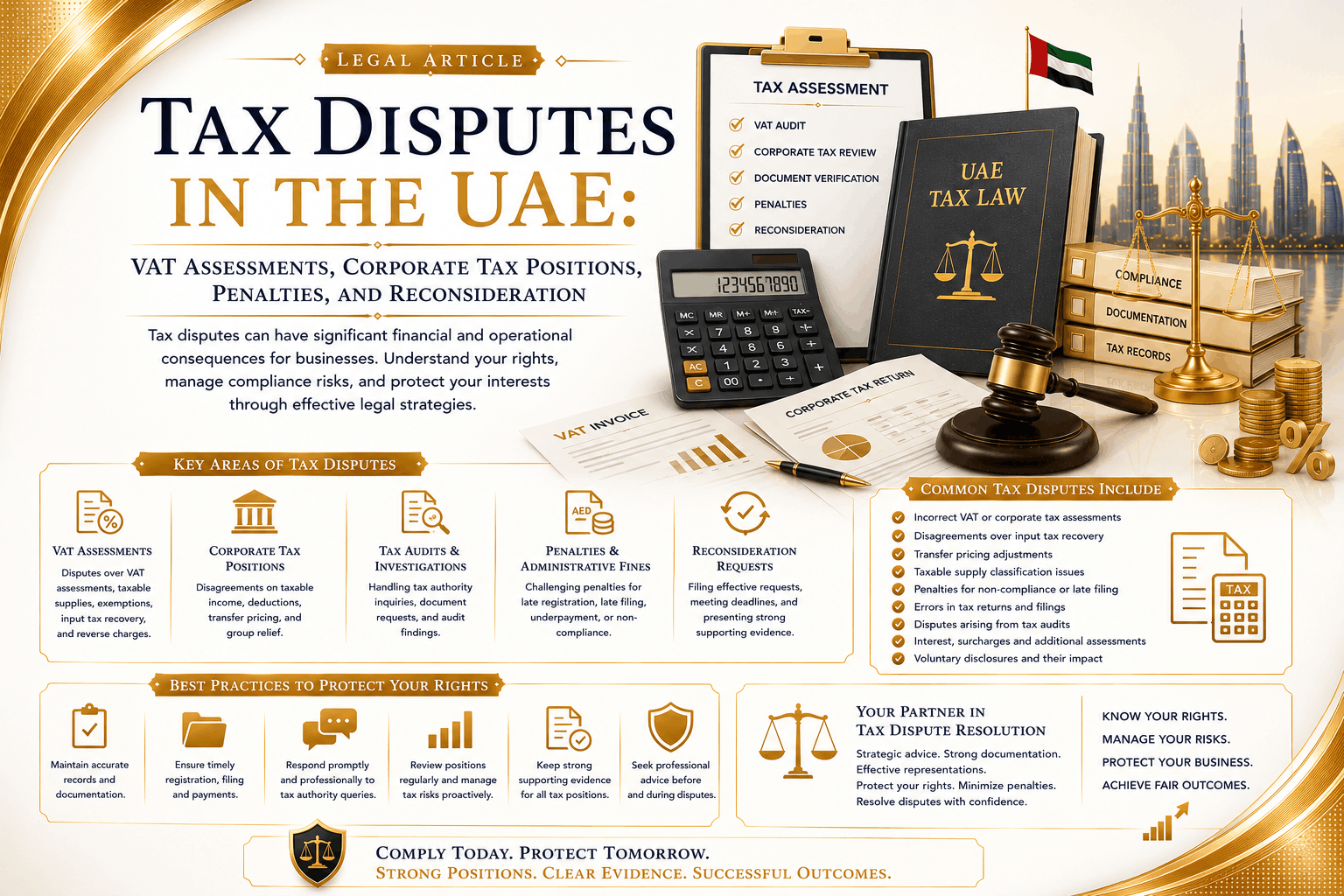
Tax disputes in the UAE can arise from VAT assessments, corporate tax positions, administrative penalties, refund rejections, FTA audits, reconsideration requests, weak records, and escalation to tax dispute resolution channels.
UAE Legal Framework for Tax Disputes
UAE tax disputes may involve Federal Decree-Law No. 28 of 2022 concerning Tax Procedures, VAT legislation, corporate tax legislation, Cabinet and Ministerial Decisions, Federal Tax Authority procedures, reconsideration requests, Tax Dispute Resolution Committee objections, court proceedings, free zone documentation, and accounting evidence.
Official UAE legislation portal | Federal Tax Authority | UAE Ministry of Finance | UAE Ministry of Justice | Relevant UAE authority website | Dubai Courts | Abu Dhabi Judicial Department | DIFC Courts | ADGM Courts
Key Legal Concepts and Definitions
Important concepts include tax assessment, VAT assessment, corporate tax position, administrative penalty, reconsideration request, Tax Dispute Resolution Committee, tax audit, voluntary disclosure, recordkeeping, refund rejection, and FTA decision.
Who UAE Tax Dispute Rules Apply To
These rules may affect VAT-registered businesses, corporate tax registrants, free zone persons, mainland companies, branches, foreign companies with UAE activity, e-commerce businesses, real estate companies, importers, exporters, financial institutions, SMEs, multinational groups, directors, finance managers, accountants, tax agents, shareholders, and investors.
Rights and Obligations of Taxpayers, Businesses, Directors, Tax Agents, and the FTA
Taxpayers may challenge official FTA decisions through the proper route, submit evidence, respond to audits, and escalate where legally available. They must also register, file, pay, keep records, respond to FTA requests, and comply with applicable tax obligations.
VAT Assessments and Common VAT Dispute Areas
VAT disputes may involve late registration, output tax, input tax recovery, missing tax invoices, export evidence, zero-rating, exempt supplies, reverse charge, import VAT, tax grouping, real estate, refund claims, voluntary disclosures, and timing of supply.
Corporate Tax Positions and Risk Areas
Corporate tax disputes may involve registration, taxable person status, free zone qualifying income, permanent establishment risk, related-party transactions, transfer pricing, expense deductibility, loss utilisation, tax grouping, exempt income, and penalty exposure.
Administrative Penalties and Penalty Disputes
Penalty disputes require clear analysis of the FTA decision, penalty basis, notification date, alleged non-compliance, calculation, payment status, and evidence supporting cancellation, amendment, or reconsideration.
Tax Audits, Recordkeeping, and Evidence
Tax audits are evidence-driven. Businesses should preserve invoices, contracts, ledgers, bank records, customs files, transfer pricing records, free zone evidence, accounting reconciliations, and FTA correspondence in an organised format.
Reconsideration Requests before the FTA
A reconsideration request should identify the FTA decision, tax period, disputed amount, legal grounds, chronology, supporting documents, technical analysis, and requested outcome. It should be treated as a formal legal submission rather than a general complaint.
Tax Dispute Resolution Committee and Court Escalation
Where reconsideration does not resolve the issue, the taxpayer may consider escalation to the Tax Dispute Resolution Committee, subject to applicable procedures, payment requirements, Arabic documentation, evidence, and deadlines. Further court escalation may be available according to applicable procedures.
Free Zones, Mainland Companies, DIFC, ADGM, and Cross-Border Issues
Federal tax rules may apply across the UAE, but business structure affects evidence and analysis. Free zone persons, DIFC companies, ADGM companies, branches, foreign entities, and multinational groups should review actual activities, substance, contracts, invoices, related-party arrangements, and accounting records.
Procedures in the UAE
- Identify the FTA decision, tax type, tax period, notification date, and disputed issue.
- Preserve portal records, FTA notices, returns, invoices, ledgers, bank records, and correspondence.
- Review the legal basis of the assessment, penalty, refund rejection, or audit inquiry.
- Prepare a structured reconsideration request where applicable.
- Assess payment requirements and eligibility for escalation to the Tax Dispute Resolution Committee.
- Prepare Arabic-supported objections, evidence bundles, and expert analysis where needed.
- Consider court appeal or further action according to applicable procedures.
- Close the matter through payment, refund, correction, settlement, judgment, or compliance improvement.
Required Documents and Evidence
- FTA decision, assessment, penalty notice, audit notice, and portal screenshots
- VAT returns, corporate tax returns, voluntary disclosures, and tax registration records
- Tax invoices, credit notes, contracts, purchase orders, delivery notes, and customs records
- Bank statements, payment confirmations, receipts, ledgers, trial balances, and financial statements
- Transfer pricing files, related-party agreements, board resolutions, and substance evidence
- Free zone licences, mainland licences, lease agreements, employee records, and activity evidence
- Emails, WhatsApp messages, FTA correspondence, tax agent communications, and submission receipts
- Expert reports, Arabic translations, reconsideration submissions, TDRC objections, and court filings
Common Misunderstandings
- The FTA will accept explanations without documents.
- The accountant handled it, so the company is automatically safe.
- A reconsideration request is only a complaint.
- Corporate tax is only an annual filing issue.
- Input VAT can be recovered simply because the expense is real.
- Free zone companies have no corporate tax risk.
- Penalties cannot be challenged.
- Ignoring a tax notice gives more time.
Common Mistakes to Avoid
- Missing reconsideration or escalation deadlines
- Failing to identify the correct FTA decision
- Submitting incomplete or disorganised evidence
- Relying on unsupported accounting explanations
- Ignoring Arabic submission requirements where applicable
- Failing to reconcile VAT returns to ledgers and bank records
- Treating free zone status as automatic tax protection
- Changing explanations between audit, reconsideration, and TDRC stages
- Waiting until enforcement or cash-flow pressure becomes urgent
Practical Examples
Late VAT Registration Penalty
A company receives a penalty after late VAT registration. A lawyer would review turnover thresholds, dates, correspondence, registration attempts, FTA portal records, notification dates, and legal grounds before preparing reconsideration.
Input VAT Rejected After Audit
A business may lose input VAT recovery if tax invoices, supplier records, payment evidence, and ledger reconciliations are weak. The better approach is to organise evidence before responding to the audit.
Corporate Tax Free Zone Position Challenged
A free zone company should support its corporate tax position with licences, activity evidence, contracts, invoices, financial statements, substance records, and transfer pricing documentation.
Weak Penalty Reconsideration
A reconsideration request that simply says the penalty is unfair is usually weak. The submission should include law, chronology, evidence, portal records, filing history, payment records, and a clear requested outcome.
Legal Risks and Consequences
Tax disputes may lead to additional tax assessments, administrative penalties, refund rejection, enforcement action, cash-flow pressure, rejected reconsideration, TDRC proceedings, court costs, expert costs, transaction delays, business disruption, reputational harm, and loss of investor confidence.
How a Lawyer Evaluates a UAE Tax Dispute
A lawyer reviews the FTA decision, tax type, applicable law, notification date, procedural deadline, taxpayer identity, evidence strength, audit record, accounting records, penalty basis, payment status, reconsideration route, TDRC route, court route, settlement options, litigation risk, enforcement exposure, commercial impact, and client objectives.
How a Lawyer Builds a Stronger Legal Position
Legal support may include reviewing FTA decisions, identifying challengeable issues, preparing reconsideration requests, organising evidence, drafting submissions, coordinating with tax advisers, reviewing penalty calculations, preparing TDRC objections, translating key documents, instructing experts, and preparing court claims or defences.
Settlement vs Litigation or Administrative Escalation
Some tax disputes may be resolved through audit response, reconsideration, correction, payment, or administrative engagement. Litigation or formal escalation may be necessary where the amount is significant, penalties are substantial, evidence is strong, or the FTA decision remains disputed.
When Urgent Legal Action May Be Needed
- A reconsideration deadline may expire
- An FTA audit request requires immediate response
- A tax assessment or penalty has been issued
- A VAT refund has been rejected
- A company sale or acquisition is affected by tax risk
- Records may be lost or deleted
- TDRC or court escalation is being considered
- The company cannot manage payment requirements or enforcement risk
Frequently Asked Questions
1. What is the main tax procedure law in the UAE?
The main tax procedure framework is Federal Decree-Law No. 28 of 2022 concerning Tax Procedures.
2. Can a taxpayer challenge an FTA decision?
Yes. A taxpayer may submit a reconsideration request for an official FTA decision, subject to the applicable requirements and evidence.
3. What decisions can be subject to reconsideration?
Only official FTA decisions concerning the taxpayer are subject to reconsideration requests.
4. What happens after the FTA rejects reconsideration?
The taxpayer may consider objection before the Tax Dispute Resolution Committee, subject to applicable procedures, Arabic documentation, payment requirements, and deadlines.
5. Must tax and penalties be paid before escalation?
Payment requirements may apply before approaching the tax dispute committee stage. The current law and procedure should be reviewed before escalation.
6. What evidence is important in a VAT assessment dispute?
Evidence includes VAT returns, invoices, credit notes, contracts, customs documents, bank statements, ledgers, reconciliations, supplier records, and FTA correspondence.
7. What are common corporate tax dispute risks?
Common risks include free zone qualifying income, transfer pricing, related-party transactions, expense deductibility, tax grouping, permanent establishment issues, losses, exempt income, and penalties.
8. Can administrative penalties be challenged?
Yes, where there is a legal or factual basis. The taxpayer should support the challenge with decision details, dates, evidence, legal reasoning, and a clear requested outcome.
9. Are free zone companies exempt from tax disputes?
No. Free zone companies may still face corporate tax, VAT, recordkeeping, transfer pricing, and documentation risks.
10. Why is legal advice important in tax disputes?
Legal advice helps identify the correct route, preserve evidence, avoid missed deadlines, prepare reconsideration or committee submissions, and build a consistent strategy.
Conclusion
Tax disputes in the UAE require careful legal, procedural, and evidential strategy. VAT assessments, corporate tax positions, penalties, reconsideration requests, audits, and dispute escalation all depend on documents, timing, legal reasoning, and consistency.
Early legal advice can help taxpayers organise evidence, identify the correct procedural route, challenge FTA decisions where appropriate, manage penalties, protect cash flow, and avoid mistakes that may weaken the case before the matter becomes more complicated.
Need Advice About UAE Tax Disputes?
Obtain tailored advice on VAT assessments, corporate tax positions, administrative penalties, FTA reconsideration, tax audit evidence, refund rejection, TDRC objections, court escalation, settlement, and legal strategy.
Book a Legal Consultation