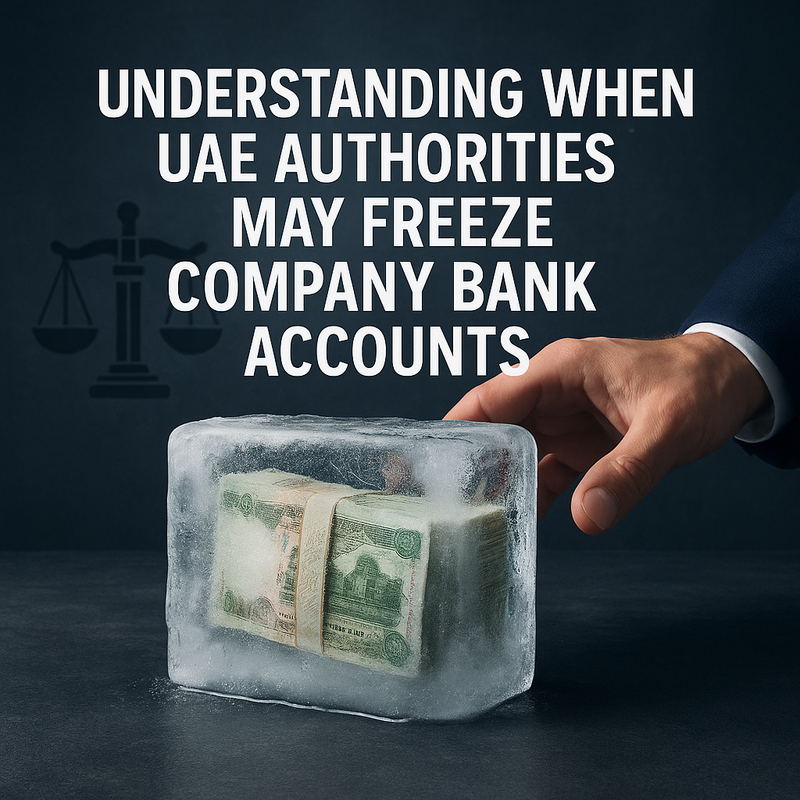
Introduction: Navigating Corporate Bank Account Freezes in the UAE
Operating a business in the UAE requires a nuanced understanding of local financial regulations—not least of which are the authorities’ powers to freeze company bank accounts. With the UAE’s economic landscape undergoing significant evolution through recent legislative updates, it is paramount for company directors, executives, HR leaders, and legal practitioners to remain vigilant and well-informed. This briefing delivers a consultancy-grade analysis of the frameworks governing bank account freezes, offering practical risk management strategies, regulatory insights, and compliance recommendations for entities registered across freezones and mainland UAE. In the wake of Federal Decree-Law No. 20 of 2018 (Anti-Money Laundering Law), Ministerial Decision No. 38 of 2022, and the stream of compliance directives in 2023–2025, the repercussions for both domestic and multinational firms are material—and a misstep could put core operations at risk. This article is designed as your essential legal roadmap to ensure robust compliance and business continuity.
Table of Contents
- Overview of UAE Legal Framework
- Circumstances Triggering Account Freezes
- Key Laws and Regulatory Bodies
- Freezing Process: Steps and Flow
- Risk Analysis and Impact of Account Freezes
- Comparison of Old and New UAE Laws
- Case Studies and Hypothetical Examples
- Compliance Strategies and Recommendations
- Conclusion and Future Outlook
Overview of UAE Legal Framework
The UAE is highly regarded for its commitment to international best practices relating to Anti-Money Laundering (AML), Combating the Financing of Terrorism (CFT), and upholding transparency in business and financial dealings. Central to these efforts are:
- Federal Decree-Law No. 20 of 2018 (Anti-Money Laundering and Counter-Terrorism Financing Law), later amended by Federal Decree-Law No. 26 of 2021.
- Cabinet Decision No. 10 of 2019 regarding the executive regulations of AML/CFT activities.
- Ministerial Decision No. 38 of 2022 offering further granularity on regulatory compliance.
- Guidelines and notices regularly published by the UAE Central Bank and the UAE Ministry of Justice.
These instruments empower regulatory authorities—such as the Central Bank of the UAE (CBUAE), Financial Intelligence Unit (FIU), and judicial authorities—to freeze corporate bank accounts under specifically defined circumstances. Such measures are not taken lightly, as the consequences can be severe for business operations, its stakeholders, and broader market confidence.
Circumstances Triggering Account Freezes
Common Triggers for Freezing Company Bank Accounts
The freezing of a company’s bank account is generally prompted by one or more of the following circumstances:
- Suspicion or Evidence of Money Laundering (pursuant to Federal Decree-Law No. 20/2018): If an account is suspected of facilitating illegal financial flows, authorities may act swiftly to prevent the movement of illicit funds.
- Suspicious Transaction Reports (STRs): If a bank files an STR with the UAE FIU, this can trigger an immediate regulatory investigation and account hold.
- Terrorist Financing or Security Violations: Activities linked to terrorism or non-compliance with international sanctions can result in asset freezes as per Cabinet Decision Nos. 20 and 74 of 2019.
- Court Orders or Legal Proceedings: Courts may issue freeze orders as part of ongoing litigation or criminal investigations (e.g., fraud, embezzlement, regulatory breaches).
- Tax Evasion Allegations: Following developments in the UAE’s corporate tax environment (see Federal Decree-Law No. 47 of 2022 on Taxation of Corporations and Businesses), findings of tax evasion may prompt the Federal Tax Authority (FTA) to request asset restraint actions.
- Non-Compliance Notices: Repeated non-response to Central Bank or FTA directives, or failure to update mandatory KYC (Know Your Customer) information, may also result in account freezing.
Visual: Suggested Process Flow Chart
Visual Suggestion: Insert a process flow diagram depicting the step-by-step authority actions: from detection and reporting (by banks), referral to FIU, preliminary investigation, decision by regulatory body, to formal freezing order and subsequent company notification.
Key Laws and Regulatory Bodies
Federal Decree-Law No. 20 of 2018 (and its Amendments): Anti-Money Laundering Law
This legislation, and subsequent updates, form the backbone of the UAE’s AML and CFT framework. Under specific provisions, authorities can:
- Freeze assets that are suspected to be involved in money laundering or terrorist financing.
- Direct financial institutions to block transactions related to listed individuals or entities.
- Impose time-bound or indefinite account freezes based on investigation outcomes.
Other Relevant Legislation
- Cabinet Decision No. 10 of 2019—serves as the executive regulations to operationalize the AML Law.
- Federal Decree-Law No. 47 of 2022—addresses corporate taxation, with provisions enabling the FTA to seek asset restraint where tax offenses are suspected.
- Ministerial Decision No. 38 of 2022—strengthens compliance expectations for banks and financial institutions in regard to account freezes, transaction monitoring, and client communication.
Regulatory Authorities
- Central Bank of the UAE (CBUAE)—regulatory oversight and enforcement for banks.
- Financial Intelligence Unit (FIU)—intelligence gathering and investigation coordination.
- Ministry of Justice and Judicial Authorities—issuance and execution of court-ordered asset freezes.
- Federal Tax Authority (FTA)—initiates account holds in tax-related offenses.
Freezing Process: Steps and Flow
How Is a Bank Account Freeze Initiated?
The process broadly follows these steps:
- Red Flags Raised: Triggered by bank monitoring systems or whistleblowing mechanisms.
- Filing of Suspicious Activity/Transaction Report (SAR/STR): Bank informs the FIU and Central Bank.
- Preliminary Regulatory Review: Authorities review the basis of suspicion and may request further documentation.
- Decision and Order: If sufficient grounds exist, regulators issue a written order to freeze specified accounts.
- Notification: The affected business is typically notified, but in urgent or covert cases, prior notice is not guaranteed.
- Compliance by Bank: The bank must immediately comply, blocking all transactions (debits, credits, withdrawals).
- Investigation Phase: Authorities undertake detailed examination of financial records, source of funds, and business activity legitimacy.
- Lifting or Extension: If the suspicion is cleared, the freeze is lifted. If wrongdoing is found, the freeze may persist and progress to asset confiscation or court prosecution.
Compliance Note
Under Ministerial Decision No. 38/2022, financial institutions face severe penalties for failing to implement freeze orders promptly, reinforcing the need for robust internal controls and response protocols.
Visual: Compliance Checklist
Visual Suggestion: Include a compliance checklist for businesses to ensure readiness to respond to regulatory inquiries and avoidance of triggers for account freezes. Items should include periodic KYC reviews, transaction monitoring, and proactive communication with banking partners.
Risk Analysis and Impact of Account Freezes
Direct Consequences for Companies
- Immediate Disruption to Cash Flow: Inability to pay suppliers, employees, or creditors can rapidly affect day-to-day operations and business reputation.
- Legal Proceedings: Asset freezes may be accompanied by formal investigations, requiring urgent legal representation and documentation.
- Credit and Banking Impact: Freezing events are reported in compliance records, which may dissuade banks from onboarding or renewing business relationships in the future.
- Reputational Harm: Investigations or enforcement actions may lead to adverse publicity or loss of commercial trust—especially relevant for regulated sectors like financial services or real estate.
Risks for Directors and Executives
- Potential criminal liability for complicit or negligent conduct.
- Possible inclusion of personal accounts in freeze actions, particularly if corporate wrongdoing is intertwined with personal gain.
Comparison of Old and New UAE Laws
| Aspect | Pre-2018 Regime | Post-2018 (with 2021–2025 Updates) |
|---|---|---|
| Trigger for Account Freeze | Mostly reliant on explicit court orders or high suspicion levels | Wider scope—includes regulator discretion per AML/CFT risk signals, STRs, or non-compliance with KYC |
| Regulatory Authority | Central Bank, courts | FIU, Central Bank, FTA, law enforcement, and newly empowered compliance bodies |
| Scope of Freeze | Typically targeted accounts | Can encompass all related accounts, assets, and affiliate entities |
| Enforcement Speed | Slower, more bureaucratic | Accelerated—often immediate, with stricter timelines |
| Compliance Obligations | Less detailed requirements for ongoing reviews | Enhanced self-reporting, continuous KYC, periodic compliance confirmations, and legal liability for lapses |
| Penalties for Non-Compliance | Fines, business warnings | Higher fines (up to AED 50 million), potential criminal charges, and long bans from operating in regulated sectors |
Case Studies and Hypothetical Examples
Case Study 1: Inadvertent Non-Compliance and Prompt Rectification
Background: A Dubai-based trading company receives an urgent freeze on its main corporate bank account. The trigger: its failure to update Ultimate Beneficial Owner (UBO) information, despite reminders from its banking partner.
Action Taken: Upon notification, the company’s compliance officer urgently contacts the Central Bank and provides all outstanding documentation, including certified UBO records and KYC updates.
Outcome: After regulatory review, the freeze is lifted within seven business days, but the company is warned and subject to ongoing monitoring for the next 12 months.
Case Study 2: Strategic Use of Suspicious Transaction Analysis
Background: A multinational entity based in Abu Dhabi sees a freeze order following multiple international fund transfers that triggered red flags in the bank’s monitoring system.
Action Taken: The company engages external legal counsel to review historical transactions, submits detailed business justifications, and initiates dialogue with both the local bank and the FIU.
Outcome: Findings validate legitimate business activity; while the freeze persists for 21 days pending final clearance, no penalty is imposed, and the case is closed with procedural recommendations for onboarding additional compliance staff.
Hypothetical: Prolonged Freeze Due to Criminal Investigation
Scenario: An SME in a high-risk sector is targeted following a court-ordered investigation into alleged VAT fraud. The account remains frozen for several months, impacting staff salaries and supply contracts. Due to the gravity of suspicions, legal action proceeds, and company assets are eventually seized by judicial order following indictment.
Compliance Strategies and Recommendations
Best Practice Suggestions for UAE Businesses
- Regular KYC/UBO Updates: Schedule quarterly reviews and updates of all beneficial ownership and key contact details with your banking partners.
- Transaction Monitoring: Install or upgrade internal systems to flag anomalous transactions, and implement secondary review protocols for high-risk deals.
- Staff Training: Educate directors and compliance officers about AML/CFT triggers, reporting obligations, and the legal consequences of non-compliance.
- Engage Legal Counsel: When notified of an account freeze—or upon discovery of a regulatory inquiry—retain experienced UAE legal counsel immediately to ensure a robust response.
- Documentation: Maintain meticulous transaction records and make sure all business activity is supported by valid underlying contracts or invoices.
- Proactive Regulator Engagement: If anticipating a regulatory review or noticing delays in banking transactions, proactively reach out to regulatory bodies or compliance contacts within banking institutions.
Visual: Penalty Comparison Chart
Visual Suggestion: Place a chart comparing penalties for first-time vs. repeat violations—showing escalation from fines to operational bans and criminal prosecution.
Conclusion and Future Outlook
The regulatory environment surrounding corporate bank account freezes in the UAE is dynamic, reflecting global standards of financial integrity and transparency. With evolving legislation—such as the recent Federal Decree-Law No. 47 of 2022 on Taxation and ongoing refinements in AML/CFT enforcement—businesses must maintain agility and a commitment to best compliance practices. While account freezes present severe operational risks, proactive governance, legal foresight, and investment in compliance infrastructure serve as the best bulwarks. As the UAE continues to rise as a leading business hub, companies equipped with the right knowledge and controls will be well-placed to thrive without disruption. Our consultancy stands ready to advise clients at every step, from regulatory audits to account recovery strategies.
