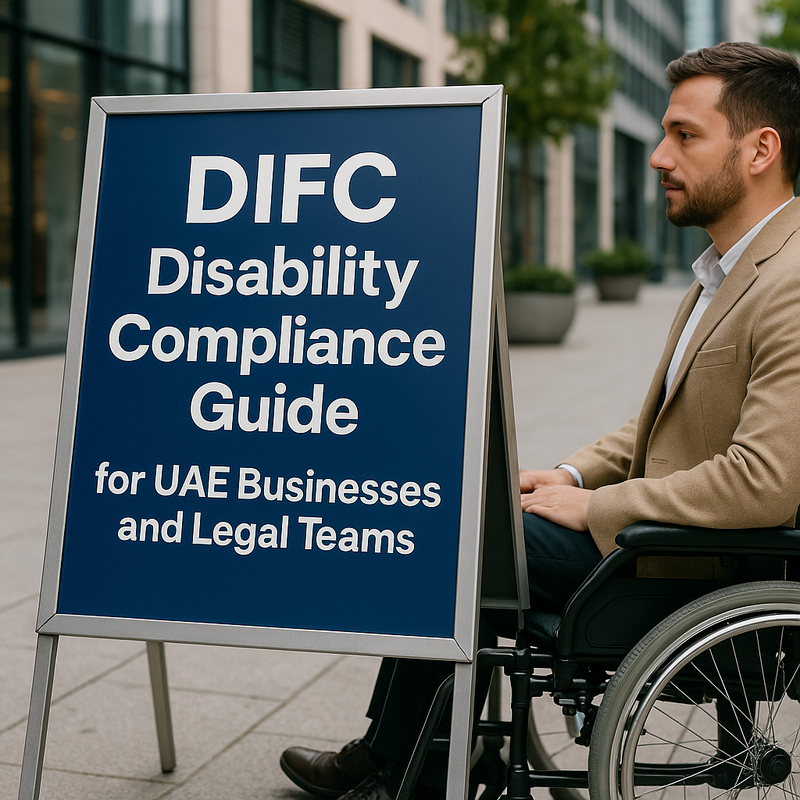
Introduction
As the United Arab Emirates (UAE) continues its progressive advancement towards creating an inclusive society, the legal landscape for disability rights and workplace accommodations has undergone significant transformation. The Dubai International Financial Centre (DIFC) has taken a leading stance in aligning its regulations with international benchmarks to ensure the workplace is accessible and equitable for all individuals, including persons with disabilities. Recent legal updates, including the implementation of Federal Decree-Law No. 29 of 2006 and its subsequent amendments, as well as the updated DIFC Employment Law (DIFC Law No. 2 of 2019, as amended), have set new standards for compliance. These developments are particularly relevant as we enter 2025, with increasing regulatory scrutiny and a clear shift towards enhanced protection for employees with disabilities in DIFC entities.
This comprehensive guide explores the core elements of DIFC disability law and reasonable adjustments, assesses practical compliance strategies, and elaborates on risk management for UAE-based organizations. Whether you are a business owner, HR professional, legal counsel, or executive, understanding the regulatory environment is paramount to ensuring legal compliance, safeguarding your organization’s reputation, and fostering an inclusive workplace. The analysis herein is grounded in authoritative legal sources, including the UAE Ministry of Justice, Ministry of Human Resources and Emiratisation, and the Federal Legal Gazette.
Table of Contents
- Overview of DIFC Disability and Employment Law
- Legal Framework: Federal and DIFC Regulations
- Key Definitions and Scope
- Employer Obligations Regarding Disability in DIFC
- Reasonable Adjustments: Practical Application
- Comparative Analysis: DIFC Law vs Federal Law
- Case Studies and Hypotheticals
- Risks of Non-Compliance and Penalties
- Implementation and Best Practices
- Conclusion and Forward-Looking Insights
Overview of DIFC Disability and Employment Law
The DIFC, as a leading global financial centre, operates a distinct set of rules and regulations separate from the wider UAE jurisdiction. However, its employment laws draw heavily on both international standards and federal initiatives such as UAE Federal Decree-Law No. 29 of 2006 Concerning the Rights of People of Determination (the primary federal law on disability rights) and Federal Decree-Law No. 33 of 2021 Regarding the Regulation of Labor Relations. These provide a robust legal framework mandating non-discrimination, reasonable adjustments, and equal opportunity for individuals with disabilities.
The 2019 DIFC Employment Law (as amended by Law No. 4 of 2021 and subsequent regulations) places significant obligations on DIFC employers to accommodate employees with disabilities, including making reasonable adjustments and preventing workplace discrimination. These reflect the UAE’s commitment to the principles outlined in the United Nations Convention on the Rights of Persons with Disabilities (CRPD), to which the UAE is a signatory.
Legal Framework: Federal and DIFC Regulations
Key Statutes and Regulations
- UAE Federal Decree-Law No. 29 of 2006 (as amended): Guarantees rights for persons of determination (the UAE’s official term for persons with disabilities), including employment equality and access to reasonable adjustments.
- DIFC Employment Law No. 2 of 2019 (as amended): Mandates non-discriminatory recruitment, retention, and workplace policies for persons with disabilities in DIFC entities.
- Ministerial Resolution No. 43 of 2018: Clarifies recruitment priorities for people of determination in the private sector.
The DIFC’s legal regime is both proactive and remedial in nature, requiring employers to pre-emptively identify and address barriers in recruitment, retention, and workplace environment. Compliance thus extends not merely to reactive modifications upon request, but obliges an anticipatory approach to disability inclusion.
Reference Table: Key UAE and DIFC Disability Laws
| Law/Regulation | Jurisdiction | Main Provision |
|---|---|---|
| Federal Decree-Law No. 29 of 2006 | UAE (Federal) | Equal rights, non-discrimination, mandatory reasonable adjustments |
| DIFC Law No. 2 of 2019 (amended 2021) | DIFC (Free Zone) | Prohibits disability discrimination, mandates reasonable accommodations |
| Ministerial Resolution No. 43 of 2018 | UAE (Federal) | Recruitment priorities and quotas in private sector |
Key Definitions and Scope
Compliance requires a clear understanding of critical legal terms as defined by both federal and DIFC employment laws. Notable definitions include:
- People of Determination: The official UAE term for persons with disabilities, used in statutes and government publications.
- Disability: Any permanent or temporary, full or partial, impairment of a person’s physical, sensory, mental, or intellectual capability, as recognized by the Ministry of Community Development and referenced in Article 1 of Federal Law No. 29 of 2006.
- Reasonable Adjustment: As per DIFC Law, this means any change or modification to the workplace or work arrangements necessary to accommodate persons with disabilities, provided that such change does not impose a disproportionate burden on the employer.
Employers should ensure that internal policies mirror these statutory definitions to prevent potential disputes regarding applicability or scope.
Employer Obligations Regarding Disability in DIFC
The crux of compliance lies in recognizing and proactively fulfilling employer obligations prescribed by both DIFC law and, where applicable, federal statutes. These are not limited to hiring and recruitment filters but pervade the entire employment relationship lifecycle—from probation and performance review to promotion, compensation, and termination.
Detailed Employer Duties
- Non-Discrimination: Employers must not treat employees or candidates less favourably due to disability. This is explicitly stated in Article 57 of DIFC Law No. 2 of 2019, reflecting Federal Law No. 29 of 2006, Article 16.
- Reasonable Adjustments: An obligation to implement reasonable adjustments where necessary to ensure an employee with a disability can perform essential job functions.
- Proactive Accommodation: Employers should proactively identify workplace barriers and address them.
- Confidentiality: Medical and disability information must be kept confidential and only disclosed on a need-to-know basis.
- Consultation: Engage with the affected individual to jointly explore viable adjustments.
The DIFC Authority encourages a consultative approach, underlining that accommodations should be tailored and based on the needs of both the employee and the practical realities of the business.
Reasonable Adjustments: Practical Application
One of the most critical aspects of compliance is understanding what constitutes a ‘reasonable adjustment.’ This can vary widely depending on the size of the business, the resources available, the nature of the disability, and the core demands of the job role. However, some practical examples can serve as key guidance:
- Provision of accessible workstations or adaptive equipment (e.g., ergonomic keyboards, speech-to-text software)
- Flexible working hours or hybrid work models where necessary
- Accessible parking and restroom facilities
- Modification of work duties if non-essential tasks create barriers
- Sign language interpreters or alternative communication aids during training, meetings, or onboarding
Reasonability and Undue Hardship
A crucial compliance point is the threshold of ‘reasonableness’ and what constitutes an undue burden. DIFC Law (Article 46) and Federal Law No. 29 state that accommodations become unreasonable if they impose excessive cost or disruption relative to the size and resources of the organization. Employers must carefully document their assessment of undue hardship, including financial impact and operational feasibility.
Process Flow Diagram Suggestion
(Place a process diagram here showing: Disability Disclosure – Employer Assessment – Consultation – Implementation of Reasonable Adjustment – Follow-up Review)
Comparative Analysis: DIFC Law vs Federal Law
Although both legal regimes share core principles, important procedural and substantive differences exist. Practitioners should be vigilant to these, especially when operating across multiple UAE jurisdictions.
| Issue | DIFC Law No. 2 of 2019 | Federal Decree-Law No. 29 of 2006 (amended) |
|---|---|---|
| Statutory Scope | Applies to DIFC-registered firms and employees | UAE-wide (public/private sectors) |
| Definition of Disability | Adopts international conventions and detailed categories | Focus on impairment as certified by authorities |
| Reasonable Adjustment Threshold | Explicit proportionality clause; detailed undue hardship defense | Broader, less detailed in statute but interpreted via ministerial guidance |
| Complaint Mechanism | DIFC Courts and Arbitration | Federal Courts and Ministry of Human Resources channels |
Insights
While the federal regime sets a national baseline, the DIFC law’s specificity and procedural clarity can benefit both employers and employees—especially regarding the defense against claims that adjustments are not ‘reasonable.’
Case Studies and Hypotheticals
Case Study 1: Office Accessibility
A DIFC-based investment firm receives an application from a candidate who uses a wheelchair. The office currently lacks accessible restrooms and ramps. The firm proactively engages with the candidate, consults with an occupational health specialist, and implements necessary renovations. The adjustment is reasonable relative to the company’s scale and budget. This action fulfills DIFC and Federal legal requirements and positions the firm as an inclusive employer.
Case Study 2: Communication Barriers
An employee in a DIFC law firm develops a temporary hearing impairment. Upon disclosure, the employer provides real-time captioning and ensures meeting notes are shared in writing. The cost is minimal, the impact on business operations is negligible, and the employee remains fully engaged and productive.
Case Study 3: Denial of Accommodation and Legal Risk
A small fintech company in DIFC declines a candidate’s request for flexible working hours due to mental health-related disability, arguing it is ‘inconvenient.’ The candidate files a claim with DIFC Courts. The business is found to have failed its duty of consultation and reasonable accommodation, resulting in reputational harm, compensation orders, and compliance directives. This example underscores the importance of properly assessing requests and documenting processes.
Visual Suggestion
(Insert table summarizing case outcomes, accommodation provided, and compliance status)
Risks of Non-Compliance and Penalties
Non-compliance with reasonable adjustment obligations and disability discrimination prohibitions exposes businesses to substantial legal and commercial risks:
- Litigation in DIFC Courts or UAE Federal Courts, resulting in compensation awards
- Regulatory investigation and potential suspension of business licenses
- Reputational damage—critical in high-profile sectors such as finance and legal services
- Employee attrition and reduced talent acquisition appeal
Penalty Comparison: Old vs New Laws
| Regime | Prior to 2019 (Old Law) | Current (Post-2021 Updates) |
|---|---|---|
| DIFC | Milder penalties; limited private remedies | Stronger compensatory remedies, explicit court powers to order adjustments or compensation |
| Federal | N/A – little explicit detail on workplace sanctions | Broader enforcement; possible criminal penalties for intentional obstruction |
Compliance Checklist Suggestion
(Insert checklist outlining key steps: Policy update – Training – Adjustment process – Documentation – Review)
Implementation and Best Practices
Recommended Steps for Employers
- Audit and Update Policies: Review all HR and workplace policies to ensure explicit reference to disability and accommodations in line with latest DIFC and UAE federal laws.
- Training: Conduct regular training for HR, management, and line supervisors on recognising requests for reasonable adjustments and the process for assessing and implementing them.
- Accessibility Review: Periodically assess premises, IT systems, and communications to identify and address barriers for persons with disabilities.
- Consultative Process: Create clear procedures for engaging with employees or candidates regarding accommodation requests, ensuring documentation and confidentiality.
- Documentation and Evidencing: Maintain records of all requests, steps taken, consultations, and rationale for any refusals or modifications.
- Monitor and Update: Appoint a compliance champion or committee to monitor ongoing compliance, review legal updates, and track outcomes.
Professional Recommendations
- Engage legal counsel for bespoke policy drafting and review.
- Ensure employee handbooks and recruitment materials clearly state the company’s commitment to disability inclusion.
- Proactively participate in government and DIFC inclusion signposting initiatives to enhance reputation and stakeholder trust.
Conclusion and Forward-Looking Insights
The evolution of DIFC and UAE disability employment law presents both challenges and opportunities for organizations operating in the country’s premium business hub. Compliance is no longer a checklist exercise but a strategic imperative, given the regulatory emphasis on proactive, anticipatory adjustments and transparent consultation processes. The recent legal updates signal that DIFC and UAE authorities will continue to elevate standards, with a growing focus on enforcement as 2025 approaches.
Forward-thinking employers that embed disability inclusion into their organizational culture—through ongoing policy review, investments in accessibility, and transparent engagement—will not only mitigate legal risk but also position themselves as leaders in the region’s rapidly globalizing talent market.
Legal compliance in this arena requires diligence, process, and a collaborative mindset. Engage with professional counsel, prioritize staff training, and document all adjustment-related decisions to ensure your business remains resilient, competitive, and fully compliant in the years ahead.
