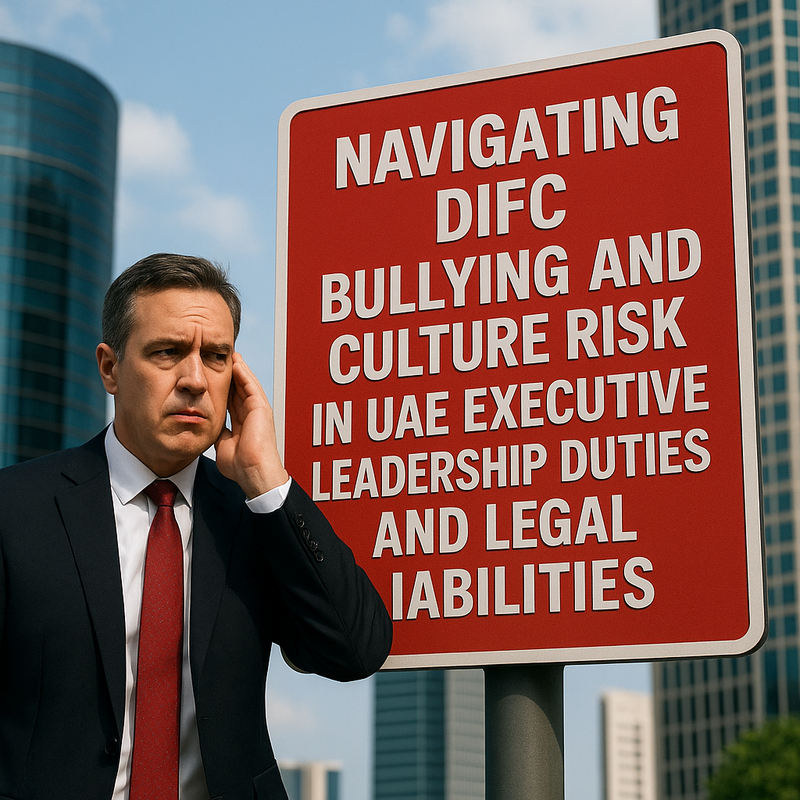
Introduction: The New Era of Workplace Culture and Legal Responsibility in the UAE’s DIFC
The legal and business landscape in the United Arab Emirates, particularly within the Dubai International Financial Centre (DIFC), is evolving rapidly. Among the most pressing concerns for modern organisations and their leaders is the issue of workplace bullying and the associated culture risks. Recent legal updates, influenced by global trends and leading to stronger regulatory frameworks, have elevated expectations for directors, executives, and HR professionals within DIFC-based companies. Understanding, managing, and mitigating bullying and toxic culture risks are now not only ethical imperatives but legal obligations, with significant exposure for those who fall short.
This in-depth analysis explores the latest legal developments, executive duties, and practical risk management strategies relating to bullying and culture risk in DIFC. Against the backdrop of landmark amendments—such as the DIFC Data Protection Law, the UAE Labour Law (Federal Decree-Law No. 33 of 2021 and subsequent Cabinet Decisions), and DIFC Employment Law (DIFC Law No. 2 of 2019, as amended)—this article delivers actionable insights and authoritative guidance. Our commentary is relevant for board members, C-suite executives, HR leads, and in-house counsel navigating compliance and safeguarding business reputation in the UAE’s premier financial centre.
In light of international scrutiny and the UAE’s Vision 2030 commitments, the stakes for corporate governance, risk culture, and executive accountability are higher than ever. This article provides the strategic tools to keep your DIFC business compliant, competitive, and future-ready.
Table of Contents
- Understanding DIFC Culture Risk and Bullying: Legal Foundations
- Evolution of UAE and DIFC Workplace Law: Key Statutes and Recent Updates
- Executive and Board Liabilities Under UAE Law 2025 Updates
- Bullying Case Examples and Hypotheticals in the DIFC Context
- Legal Exposure and Risks: Consequences of Non-Compliance
- Best Practices: Building a Legally Compliant Culture and Bullying Prevention Program
- Future Trends: The Changing Landscape of Culture Risk Management in the UAE
- Conclusion: Moving Forward With Confidence and Compliance
Understanding DIFC Culture Risk and Bullying: Legal Foundations
Defining Workplace Bullying and Culture Risk
Workplace bullying is characterised by repeated, unreasonable behaviour directed at an employee or group that creates a risk to their health and safety. Culture risk refers to the dangers an organisation faces when its workplace environment fosters harassment, bullying, or systemic disrespect, leading to reputational harm and legal liability. In the UAE’s DIFC, such conduct is not only a clear violation of internal codes of conduct, but is increasingly subject to regulatory action suitable for the workplace of the future.
Why It Matters in the DIFC
The DIFC acts under its own distinct legal system, guided by English common law principles, and is a magnet for leading financial and professional services firms. However, DIFC Employment Law (DIFC Law No. 2 of 2019, as amended) now imposes stringent requirements on managing employee wellbeing and preventing workplace misconduct. When coupled with Federal UAE Labour Law (Federal Decree-Law No. 33 of 2021) and Ministerial Resolutions (such as MOHRE Resolution No. 47 of 2022 on Labour Disputes), DIFC-based companies must integrate both local and federal best practices for compliance. Failure to do so can result in fines, litigation, and brand damage.
Evolution of UAE and DIFC Workplace Law: Key Statutes and Recent Updates
Relevant Laws and Recent Amendments
Organisations in the DIFC must navigate a complex array of interlocking regulations. The most impactful legal frameworks concerning bullying and workplace culture in 2024–2025 include:
- DIFC Employment Law (DIFC Law No. 2 of 2019, as amended by Law No. 4 of 2020 and subsequent amendments in 2023)—Sets out express obligations for employers to prevent ‘harassment, bullying, and victimisation,’ mandates internal complaints procedures, and provides for compensation.
- Federal Decree-Law No. 33 of 2021 on Regulation of Labour Relations—Applies to most mainland employers, but often sets standards for best-in-class approaches even within free zones. Prominently addresses ‘psychological and physical harm’ and prohibits workplace discrimination, harassment, and bullying as per Cabinet Resolution No. 1 of 2022.
- MOHRE Resolution No. 47 of 2022—Outlines mediation and dispute resolution processes, including the treatment of bullying complaints and employer investigatory duties.
- DIFC Data Protection Law (DIFC Law No. 5 of 2020)—Mandates safeguarding employees’ personal data during internal investigations and complaints procedures.
The following table compares key provisions as they relate to bullying and workplace culture risks as per the latest legal framework:
| Provision | DIFC Employment Law (2023) | Federal Labour Law (2021–2022) |
|---|---|---|
| Scope | Applicable to DIFC entities/employees | Applies to all UAE mainland companies |
| Definition of Bullying/Harassment | Specifically defined, includes bullying, harassment, victimisation | Broader references to ‘abuse’, ‘maltreatment,’ ‘psychological harm’ |
| Mandate to Prevent | Explicit employer duty to prevent and address bullying/harassment | Implied duty via duty of care and general anti-discrimination provisions |
| Internal Policies Required | Yes, including clear reporting, investigation, and redress mechanisms | Best practice, not always mandatory but increasingly expected |
| Penalties for Non-Compliance | Compensation, fines, possible criminal referral | MOHRE penalties, criminal and civil action possible |
Key Takeaway for 2025
Regulatory trends—even for free zone entities—are towards stricter mandates, deeper scrutiny of leadership behaviour, and heavier penalties for non-compliance. Real-time reporting and cultural risk audits are fast becoming the norm in the UAE’s leading business districts.
Executive and Board Liabilities Under UAE Law 2025 Updates
Legal Duties of Senior Management and Directors
Modern UAE law, as applied through both federal and DIFC-specific legislation, demands that those occupying positions of authority maintain a workplace free of bullying and harassment. This extends to the proactive implementation of internal policies, mandatory training, and the reporting and escalation of complaints. Where these standards are not met, directors, CEOs, and CHROs face individual as well as corporate liability.
Highlighting the severity, Article 64 of the DIFC Employment Law states that beyond company penalties, individual officers “knowingly complicit” in failing to act face potential personal liability—including compensatory damages and loss of office. These duties are underpinned by the Federal Law on Commercial Companies No. 32 of 2021, which establishes director fiduciary and statutory duties to foster a safe and ethical culture.
Board Oversight: Key Legal Responsibilities
- Ensure comprehensive anti-bullying and anti-harassment policies are in place and updated as per the latest UAE and DIFC requirements.
- Monitor executive conduct and culture periodically (e.g., via third-party audits) to detect non-compliant patterns early.
- Guarantee that whistleblowing and complaints procedures are accessible and protect confidentiality and employees’ personal data in line with DIFC Data Protection Law.
Personal Exposure for Leadership
Executives may be personally named in lawsuits or DIFC-LCIA arbitral proceedings related to bullying claims. Case law from the DIFC Courts increasingly supports holding individuals accountable for systemic culture failures where directors “turned a blind eye” to known misconduct.
Comparison Table: Old vs. New Executive Liabilities
| Aspect | Pre-Amendments (pre-2019) | Current Law (2024–2025) |
|---|---|---|
| Liability Standard | Primarily falls on corporate entity; rare to target individuals | Directors/executives individually liable for wilful neglect/concealment |
| Executive Training Mandate | Not specifically mandated | Clear duty to ensure senior management is trained on compliance |
| Investigative Duty | Minimal; often reactive | Proactive obligation to investigate complaints and act decisively |
| Risk of Regulatory Referral | Low risk unless criminal acts alleged | Automatic referral in severe/breach cases; increased scrutiny from DFSA |
Bullying Case Examples and Hypotheticals in the DIFC Context
Case Study 1: Unaddressed Bullying Leading to Damages
Consider a scenario where a senior team member persistently targets a subordinate with derogatory remarks and professional sabotage. Despite repeated complaints to HR, no formal action is taken. The employee suffers psychological harm, documented by medical professionals. Under the DIFC Employment Law and Federal Labour Law, the company and its HR head could be liable for damages, regulatory fines, and reputational fallout, especially if company policies and complaint mechanisms are found wanting.
Case Study 2: Transparent Culture Saving Costs and Mitigating Risk
An alternative example involves a DIFC investment firm with clear anti-bullying policies, annual mandatory training, and a third-party hotline. A reported incident is investigated swiftly with full confidentiality, and remedial action is taken as soon as the facts are established. The process not only resolves the issue but demonstrates the company’s robust compliance culture, defusing regulator scrutiny and bolstering employee trust.
Diagram Opportunity
Suggested Visual: Process Flow Diagram: “From Complaint to Resolution—Best Practice Investigation Pathway Under DIFC Law.” This can help clients visualise recommended steps to mitigate legal exposure.
Legal Exposure and Risks: Consequences of Non-Compliance
Types of Legal and Regulatory Risks
The consequences for failing to address bullying and culture risk are increasingly severe in the DIFC. Risks may include:
- Civil damages: Employees may recover compensation for harm suffered, including psychological injury and constructive dismissal.
- Regulatory penalties: DFSA-imposed fines for breach of compliance duties, especially for regulated firms.
- Criminal repercussions: Severe cases, particularly where threats, blackmail, or discrimination intersect, may be referred to public prosecutions as per the Penal Code (Federal Decree-Law No. 31 of 2021).
- Reputational harm: Negative media, social media escalation, and loss of client confidence.
Penalties Comparison Chart
| Type of Breach | DIFC Penalty (typical) | Federal/Mainland Penalty |
|---|---|---|
| Ignoring Bullying Complaints | Compensation, up to US$ 250,000 in aggravated cases | Administrative fine (AED 50,000+), MOHRE censure |
| Personal Data Mishandling | Data authority fine, up to US$ 50,000 per breach | Criminal/civil data privacy penalties |
| Retaliation Against Complainants | Double damages, potential criminal referral | Possible criminal referral, increased damages |
Checklist: Legal Compliance for DIFC Employers
- Review and update anti-bullying and D&I policies annually
- Regularly train all management and staff on workplace conduct
- Maintain clear, confidential complaint and investigation procedures
- Audit complaint handling records securely (align with Data Protection Law)
- Engage in annual independent culture audits
- Report severe incidents promptly to regulatory authorities as required
Best Practices: Building a Legally Compliant Culture and Bullying Prevention Program
Designing a Proactive Compliance Framework
Legal compliance in the DIFC requires both substantive policy measures and a practical, transparent culture supported from the highest levels. We recommend the following core components for a robust program:
- Board-level Commitment: Explicit endorsement of anti-bullying and culture risk policies at board meetings, documented in minutes.
- Tailored Training: Mandatory induction and annual refresher training on workplace bullying, cultural sensitivity, and reporting mechanisms—as mandated by both DIFC and Federal frameworks.
- Clear Policies and Reporting Lines: Written, accessible materials outlining what constitutes bullying, redress mechanisms, and protection for whistleblowers.
- Confidentiality Protections: Compliance with DIFC Data Protection Law during investigations to avoid secondary liability.
- Regular Monitoring and Audits: At least annual external or internal audits of HR processes, culture surveys, and anonymous staff feedback.
- Early Intervention and Remediation: Ensure that informal resolution options are available, with escalation routes to legal or board level where appropriate.
Resources and External Support
- UAE Ministry of Human Resources and Emiratisation (MOHRE): Official HR Guidance Portal
- DIFC Authority: Latest employment guides and compliance toolkits
- DFSA: Regulatory updates and enforcement bulletins
Future Trends: The Changing Landscape of Culture Risk Management in the UAE
International Pressures and Local Reform
Leading up to 2025, the DIFC and UAE more broadly will continue harmonising internal policies with international standards. The UAE’s commitment to human capital development, economic diversification, and post-pandemic resilience drives this trend. Enforcement activity has already increased, with regulatory authorities such as the DFSA and MOHRE demonstrating reduced tolerance for superficial or outdated approaches to culture management. Organisational culture and leadership will remain a key criterion in government scoring and licensing schemes.
What to Expect: Regulation and Litigation
- Expanded whistleblower protections for employees reporting bullying or cultural malaise
- Further guidance and possible mandatory certification for culture risk officers
- Movement towards more punitive damages for aggravated or systemic failures
- Regular publishing of enforcement or compliance “league tables” for financial services and professional firms
Conclusion: Moving Forward With Confidence and Compliance
As the DIFC fortifies its reputation as a best-in-class business hub, those in leadership roles must rise to meet new legal and ethical standards around bullying and culture risk. The legal regime—via the latest amendments to DIFC Employment Law, Federal Labour Law, and supporting regulations—compels a holistic and proactive approach. Leaders are now required not only to put strong policies in place but to drive cultural transformation, backed by demonstrable compliance and periodic oversight.
For businesses in the DIFC, these developments are both a challenge and an opportunity: a challenge to ensure rigorous compliance, and an opportunity to build workplaces that attract and retain top talent by promoting transparency, psychological safety, and accountability. For most organisations, the cost of compliance is vastly outweighed by the protection it offers against regulatory, financial, and reputational harm.
Staying ahead means embedding these cultural and legal imperatives into every level of the business—from boardroom to front line. Proactive engagement with external legal counsel and regular self-audits are key best practices for future readiness in the UAE’s dynamic legal environment.
