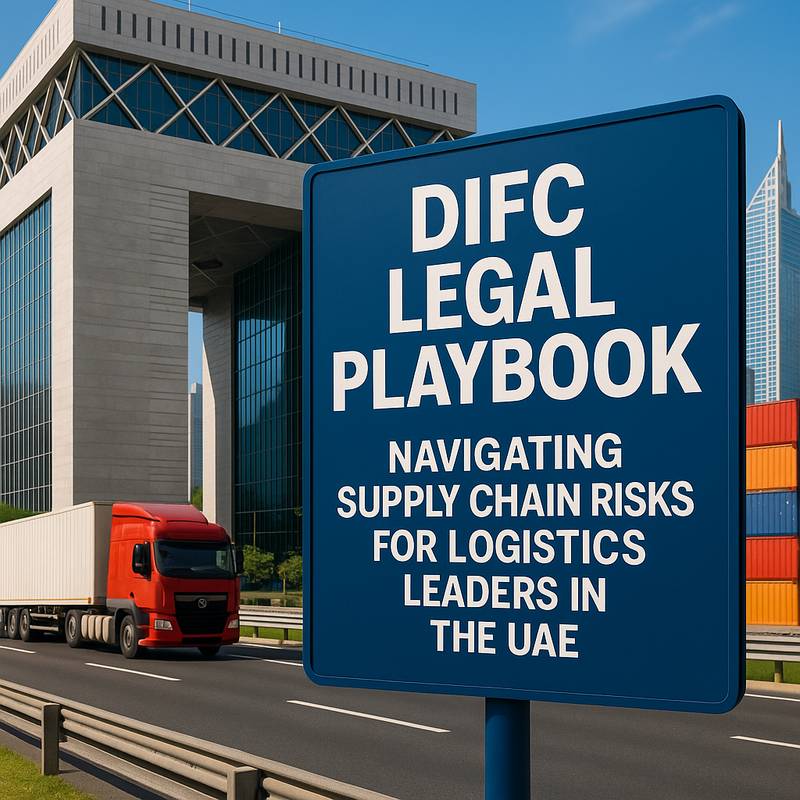
Introduction: Elevating Supply Chain Risk Management Under UAE Law
In a rapidly transforming global trading environment, logistics CEOs operating in the Dubai International Financial Centre (DIFC) must advance beyond operational efficiency to robust legal risk management. Supply chains today traverse borders, cultures, and ever-evolving regulatory frameworks. In the UAE—especially under the distinct legal ecosystem of the DIFC—recent regulatory updates demand a sophisticated, proactive approach to mapping and mitigating supply chain risks.
With the implementation of new federal decrees, expanded compliance obligations, and an increased focus on transparency, the regulatory landscape imposes heightened scrutiny on logistics and supply chain operations. Non-compliance can result in serious legal and financial consequences, jeopardizing corporate reputation, partnerships, and regional trade opportunities.
This playbook offers a consultancy-grade deep dive for logistics executives and in-house legal teams, analyzing the latest UAE law updates, comparative insights, practical compliance strategies, and actionable recommendations. Whether navigating customs compliance, sanctions, ESG regulations, data protection, or contract enforcement, you will find authoritative guidance tailored to the realities of modern logistics in the DIFC.
Table of Contents
- DIFC Legal Framework: Supply Chains in the UAE Ecosystem
- Regulatory Landscape 2025: Key Updates Impacting Supply Chains
- Risk Mapping in Critical Legal Domains
- Contractual Risk Management: DIFC and Mainland Considerations
- Trade Compliance and Sanctions Controls
- Supply Chain Data Governance Under UAE Law
- ESG, Labour, and Human Rights Compliance
- Enforcement, Penalties, and Remediation
- Strategic Compliance and Proactive Risk Mitigation
- Case Studies and Hypothetical Applications
- Conclusion: The Future of UAE Supply Chain Legal Compliance
DIFC Legal Framework: Supply Chains in the UAE Ecosystem
Understanding the DIFC Legal Model
The DIFC is a common law jurisdiction within the UAE, operating under its own legislative system. While most of the UAE applies federal civil law, the DIFC’s unique regulations allow international best practices and legal certainty for commercial entities. This duality—DIFC rules alongside federal legislation—requires logistics companies to navigate both frameworks for seamless compliance.
Key Legislative Foundations
- DIFC Contract Law (DIFC Law No. 6 of 2004, as amended): Governs contractual relations within the DIFC, providing freedom of contract, robust enforcement, and remedies for breach.
- Federal Decree-Law No. 31 of 2021 (UAE Penal Code): Applies nationally, imposing criminal liability for offenses including fraud, bribery, and data breaches affecting logistics transactions.
- UAE Cabinet Decision No. 57 of 2020: Addresses Economic Substance Regulations, impacting cross-border logistics structures.
Practical Consultancy Insights
Why does this matter for logistics CEOs? Many logistics contracts, finance agreements, and dispute resolution clauses involve DIFC law or courts, even when shipments cross outside the Centre. A misstep, such as relying solely on mainland templates or omitting mandatory DIFC provisions, can invalidate contracts, delay shipment clearance, or trigger regulatory investigations.
Regulatory Landscape 2025: Key Updates Impacting Supply Chains
Major Legal Updates
In the past two years, the UAE has enacted significant legal reforms that reshape supply chain governance:
- Federal Decree-Law No. 45 of 2021 (Data Protection Law): Sets comprehensive requirements for data processing, sharing, and security—including in logistics systems.
- UAE Cabinet Resolution No. 83 of 2022: Tightens customs procedures; mandates real-time tracking and enhanced documentation across the supply chain.
- DIFC Operating Law (DIFC Law No. 7 of 2018): Details economic substance, anti-money laundering (AML), and beneficial ownership obligations for all registered entities.
- New Labour Law (Federal Decree-Law No. 33 of 2021): Introduces stricter worker protection, anti-discrimination, and whistleblower provisions impacting workforce sourcing and management.
Comparative Table: Pre-2021 vs. Post-2021 Supply Chain Legal Requirements
| Domain | Pre-2021 Law | Post-2021 Law |
|---|---|---|
| Data Protection | Sectoral, limited requirements | Federal Decree-Law No. 45 of 2021 – comprehensive, cross-sector mandates |
| Customs Controls | Emirate-level, fragmented | Cabinet Resolution No. 83 of 2022 – unified federal standards, digital tracking |
| Labour Compliance | Federal Law No. 8 of 1980 | Decree-Law No. 33 of 2021 – enhanced protections, clarity on penalties |
| Sanctions Regimes | Limited, ad hoc sanctions | Broader, explicit lists (as per Ministry of Foreign Affairs and International Cooperation) |
Risk Mapping in Critical Legal Domains
Legal Risks in the DIFC Supply Chain Context
Risks in supply chain law are multi-dimensional, spanning legal, regulatory, contractual, reputational, and operational spheres. The following domains are especially critical for DIFC supply chain leaders:
- Contractual Risk: Multi-jurisdictional contracts, inconsistent terms, poorly drafted indemnities, unenforceable penalty clauses.
- Regulatory Risk: Failure to monitor or implement updates in customs rules, ESG mandates, or data protection obligations.
- Sanctions and Trade Controls Risk: Exposure to fines or asset freezing from inadvertently dealing with sanctioned goods, individuals, or counterparties.
- Labour and ESG Risk: Violations of worker welfare provisions, forced labour prohibitions, or environmental compliance benchmarks—especially when suppliers operate across multiple legal jurisdictions.
- Data and Cybersecurity Risk: Inadequate controls over shipment tracking data, supplier records, or customer information—leading to data breaches, regulatory actions, or business interruption.
Visual Aid Suggestion:
Visual: Supply Chain Risk Map or Infographic
Suggested placement here: A process flow diagram illustrating key risk points across supplier onboarding, goods movement, customs clearance, and last-mile delivery, mapped against relevant law and penalties.
Consultancy Insight:
Practical Approach: Create a living supply chain risk register, mapped to UAE laws (citing and updating from the Federal Legal Gazette and the UAE Government Portal). Regularly schedule legal audits to review new decrees and consult with DIFC-specialist counsel to preemptively identify gaps.
Contractual Risk Management: DIFC and Mainland Considerations
Core Provisions Under DIFC Law
Key contractual issues for supply chain managers include:
- Clear definition of goods, services, specifications, and standards
- Jurisdictional and governing law clauses (DIFC vs. UAE Federal Law)
- Risk allocation (warranties, indemnities, limitation of liability)
- Enforcement and dispute resolution flows (DIFC Courts, Arbitration, Courts of Cassation)
- “Back-to-back” supplier and customer obligations, ensuring seamless flow of risk and responsibility
Comparative Table: DIFC Law vs. UAE Federal Law on Contracts
| Issue | DIFC Law (No. 6 of 2004, as amended) | UAE Federal Law (No. 5 of 1985) |
|---|---|---|
| Freedom of Contract | High—parties may tailor obligations extensively | Freedom, but with mandatory civil law restrictions (e.g. penalty caps) |
| Penalty Clauses | Generally enforced if reasonable and expressly stated | Subject to judicial adjustment if deemed excessive |
| Dispute Resolution | DIFC Courts or Arbitration; global enforceability | UAE Civil Courts; enforcement limited to UAE |
| Contract Formation | Flexibility with presumption of validity | Certain formalities required (witnessing, signatures, notarization) |
Case Analysis: Hypothetical Example
Scenario: A DIFC-headquartered logistics provider signs a multi-million-dirham contract with a German manufacturer. The contract selects DIFC law and courts for disputes. If a delayed shipment leads to lost profits, the DIFC court will apply its clear-cut rules on loss calculation and penalties, offering certainty and speed to both parties.
Trade Compliance and Sanctions Controls
Key UAE Regulatory Sources
- UAE Federal Law No. 13 of 2007 (Commodity Control): Governs import, export, and transit of controlled or prohibited goods.
- Ministry of Foreign Affairs and International Cooperation Sanctions Lists: Updated lists of sanctioned entities, individuals, countries—compliance is mandatory for all UAE businesses.
- UAE Cabinet Decision No. 10 of 2019: Outlines anti-money laundering (AML) protocols in customs and trade activities.
Common Pitfalls
Logistics actors sometimes neglect to update due diligence processes, failing to screen new supply chain partners against updated sanctions lists, or misclassifying goods subject to export controls.
Remedial Actions
- Implement a real-time sanctions screening tool fully integrated with UAE government updates.
- Assign regulatory compliance officers to monitor and train staff.
- Retain records of all screening and customs filings for at least five years (as per the Federal Legal Gazette).
Visual Aid Suggestion:
Visual: Compliance Checklist Table
Suggested here: A table listing required checks (e.g., sanctions screening, dual-use goods checks, AML reporting), responsible personnel, and documentation standards.
Supply Chain Data Governance Under UAE Law
Federal Decree-Law No. 45 of 2021: Data Protection Obligations
This landmark legislation (mirroring the EU’s GDPR in several respects) establishes sweeping rules for all UAE entities processing personal data—including logistics companies tracking shipments, drivers, and customer records.
- Obligations include obtaining consent for data use, appointing Data Protection Officers (DPOs), preparing impact assessments, and notifying authorities of breaches within stringent timeframes.
- DIFC Data Protection Law (DIFC Law No. 5 of 2020) provides even stricter requirements for entities registered in the DIFC, with penalties up to USD 100,000 for egregious violations.
Practical Guidance
- Review all third-party supplier and logistics IT contracts for compliance with UAE and DIFC data transfer rules.
- Conduct annual data protection audits, benchmarked against Federal Decree No. 45 of 2021 and DIFC Law No. 5 of 2020, reporting findings to the Board.
ESG, Labour, and Human Rights Compliance
The Expanding Legal Mandate
Sustainability, labour protection, and responsible sourcing are now essential legal requirements—not merely reputational concerns. Recent changes include:
- Federal Decree-Law No. 33 of 2021 (UAE Labour Law): Enables inspections, stiffens anti-forced labour mandates, and strengthens whistle-blower protections.
- DIFC Employment Law (DIFC Law No. 2 of 2019): Enshrines strict anti-discrimination and equal treatment principles.
- UAE Cabinet Decision No. 94 of 2022 (ESG Reporting): Requires disclosure of environmental and social risks in annual corporate reports.
Practical Implications
- Supply chain audits must move beyond cost to evaluate labour sourcing, wage practices, workplace safety, and environmental impact in real time.
- Logistics CEOs must ensure supplier codes of conduct match the latest legal requirements, or risk joint liability for violations.
Hypothetical Application
Scenario: A DIFC logistics client discovers a subcontractor utilizing excessive working hours in a third country. If ignored, this exposure may trigger enforcement under both UAE and DIFC laws, leading to contract termination, fines, and reputational damage.
Enforcement, Penalties, and Remediation
Updated Penalty Framework
Recent amendments empower authorities with new tools for detecting and penalizing non-compliance:
- On-the-spot regulatory audits across supply chain operations
- Substantial administrative and criminal penalties (e.g., up to AED 10 million for certain customs infringements under Cabinet Resolution No. 83 of 2022)
- Immediate publication of enforcement actions—damaging corporate reputation
- Personal liability for CEOs and Board directors for certain willful violations
Comparative Table: Example Penalty Matrix
| Offense | Relevant Law | Penalty |
|---|---|---|
| Failure to screen for sanctions | Federal Law No. 13 of 2007 | Up to AED 5 million, import license suspension |
| Data breach (unreported) | Decree-Law No. 45 of 2021 | Fines up to AED 1 million, stop processing orders |
| Forced labour or discrimination | Decree-Law No. 33 of 2021 | Fines, public naming, possible imprisonment |
Remediation and Mitigation
- Engage with authorities proactively upon discovering noncompliance.
- Document remedial actions and staff retraining.
- Voluntarily update customers and partners on corrective steps and compliance improvements.
Strategic Compliance and Proactive Risk Mitigation
Core Recommendations for Logistics Leaders
- Implement a Centralized Legal Risk Register: Regularly updated against Federal Gazette and DIFC sources; assign ownership and monitor status at Board level.
- Digitalize Supply Chain Compliance Processes: Embed real-time sanctions, customs, and ESG checks into digital platforms.
- Adopt a “Contract Playbook” Approach: Maintain standard templates reflecting best practices under both DIFC and UAE law, with customizable provisions for cross-border transactions.
- Regular Training and “Bootcamps”: For supply chain, compliance, and legal staff on latest UAE and DIFC regulatory updates.
- Independent Legal Audits: Conducted by accredited outside counsel, focused on high-risk segments and critical deviations.
Sample Visual Aid:
Visual: Compliance Program Flowchart
Suggested placement here: A step-by-step diagram showing legal risk identification, mapping, policy creation, monitoring, mitigation, and reporting cycles.
Case Studies and Hypothetical Applications
Case Study 1: Customs Documentation Failure
Background: A regional logistics operator inadvertently relied on outdated customs documentation templates, failing to adopt new e-documentation mandates under Cabinet Resolution No. 83 of 2022. This resulted in shipment seizures and financial loss.
Insight: Timely legal compliance audits, automated document management systems, and continuous staff training would have averted penalties.
Case Study 2: Sanctions Screening Oversight
Background: A DIFC entity shipped goods to an international distributor later added to the UAE’s sanctions list. The lack of a daily updated screening tool led to fines and reputational damage.
Insight: Daily integration with UAE ministry sanctions lists and mandatory transaction “pause” protocols until screening clears all parties are essential compliance strategies.
Case Study 3: ESG Compliance in a Multi-Jurisdiction Supply Chain
Background: A supply chain audit revealed labour rights violations involving a Tier-2 supplier overseas.
Insight: Establishing contractual “right to audit” clauses and ongoing risk-based supplier vetting programs ensures alignment with UAE Labour and ESG legal requirements—reducing risk of joint liability.
Conclusion: The Future of UAE Supply Chain Legal Compliance
For DIFC-based logistics leaders, the regulatory landscape is evolving at pace with technology, global trade disruptions, and the UAE’s broader ambition to remain a preeminent logistics hub. 2025 brings tougher federal decrees, stricter DIFC standards, and intensified enforcement. Survival and growth will depend on a dual focus: agile commercial strategy and uncompromising legal foresight.
Key takeaways:
- Legal risk mapping is now a foundational boardroom priority, not an annual compliance formality.
- Embedding legal compliance into every layer of the supply chain—from procurement and documentation to labour and ESG—reduces not only fines but creates competitive advantage.
- Proactivity is non-negotiable: Regular audits, integrated digital compliance tools, and continuous staff training underpin sustainable growth.
As the UAE legal regime continues to align with global standards, logistics CEOs who champion best-in-class legal governance will be the ones positioned to capture new opportunities and weather complex risks. In partnership with your specialist UAE legal advisors, now is the time to strengthen your DIFC legal playbook and transform risk into resilience.
