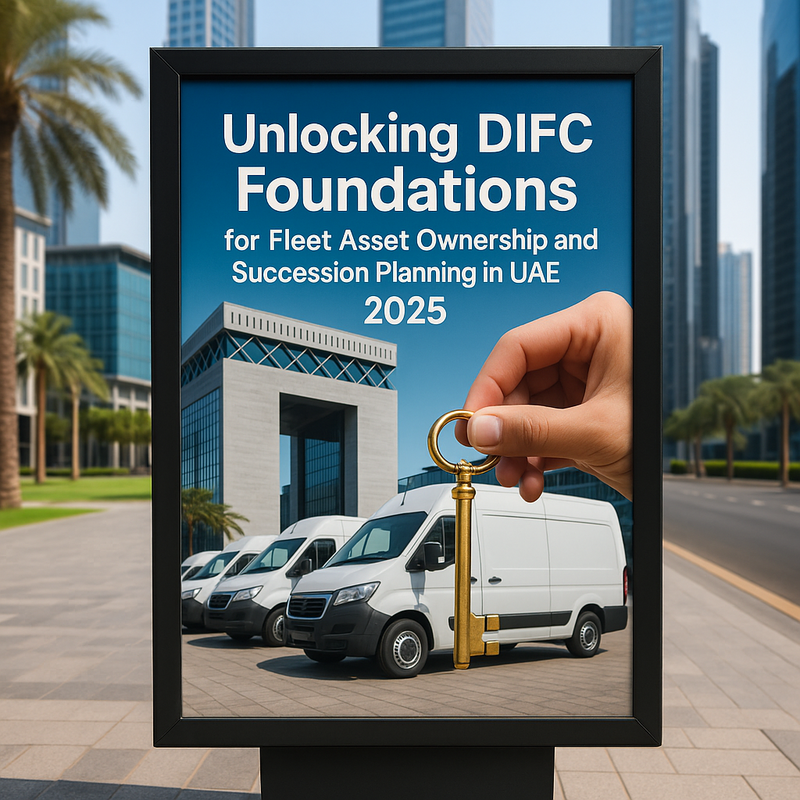
Introduction: Exploring DIFC Foundations for Fleet Ownership and Succession in the UAE
In the rapidly evolving landscape of UAE law, legal structures for wealth management, asset protection, and succession planning have moved to the forefront of interest for high-net-worth individuals, family offices, and corporate entities. The Dubai International Financial Centre (DIFC) Foundations regime stands out as a robust, flexible, and internationally recognized legal vehicle, particularly well-suited for the ownership and succession planning of fleet assets, including corporate fleets, luxury vehicles, and maritime or aviation assets.
This article offers a consultancy-grade analysis of how DIFC Foundations can transform fleet ownership and succession strategies, especially in light of recent UAE law updates such as Federal Decree-Law No. 26 of 2020 (Commercial Companies Law amendments) and pertinent Cabinet Resolutions on beneficial ownership and economic substance. We demonstrate how DIFC Foundations can ensure asset protection, seamless generational transfer, enhanced governance, and full legal compliance in a changing regulatory environment.
As leading UAE legal consultants, our goal is to demystify the interplay between DIFC Foundation structures, UAE federal laws, and practical compliance demands facing businesses, executives, and legal practitioners in 2025.
Table of Contents
- DIFC Foundations: Legal Framework and Key Features
- Fleet Ownership Structures and Legacy Risks in the UAE
- Succession Planning Advantages with DIFC Foundations
- Navigating Legal Compliance and Regulatory Risks
- Case Studies: DIFC Foundations in Fleet Asset Management
- Comparative Analysis: DIFC Foundations vs. Traditional UAE Structures
- Best Practice Strategies for Legal Compliance in 2025
- Conclusion and Professional Recommendations
DIFC Foundations: Legal Framework and Key Features
Origins and Legislative Basis
The DIFC Foundations regime was introduced under the DIFC Foundations Law No. 3 of 2018 and its accompanying regulations, offering a vehicle calibrated for asset protection, governance, and succession. It is modelled after global best practices while tailored for the unique legal landscape of the UAE, benefiting from the DIFC’s independent common law legal system and creditor protection mechanisms.
DIFC Foundations have been officially endorsed and recognized as stand-alone legal entities distinct from trusts or corporate vehicles. They hold assets for defined purposes or beneficiaries, governed according to their Charter, By-Laws, and the oversight of a Council and Guardian where applicable.
Key Legal Attributes
- Separate Legal Personality: Can hold fleet assets, enter contracts, and open bank accounts.
- Perpetual Succession: Ideal for asset continuity and generational transfer.
- No Shareholders: Controlled by a Council, not susceptible to shareholder disputes.
- Flexibility of Purpose: Can own, manage, or hold a wide spectrum of assets – tangible or intangible.
- Enhanced Confidentiality: Details of the Foundation charter, council, and beneficiaries can be kept private as per DIFC Register confidentiality policies, subject to legal exceptions.
Reference: Full legislative text – DIFC Foundations Law, DIFC Law No. 3 of 2018.
Fleet Ownership Structures and Legacy Risks in the UAE
Prevailing Legal Structures for Fleet Ownership
Historically, UAE-resident individuals and companies held fleet assets in their personal name, LLCs (under Federal Decree-Law No. 32 of 2021 on Commercial Companies), or offshore structures, each carrying distinct risks and limitations:
- Personal Ownership: Exposes assets to personal liabilities and forced heirship under Federal Law No. 28 of 2005 (UAE Personal Status Law) for UAE nationals and certain residents.
- LLCs or JSCs: Subject to share transfer restrictions, local sponsor/shareholding requirements (prior to the 2020 amendments), and potential inclusion in bankruptcy estates as per the Federal Decree-Law No. 9 of 2016 on Bankruptcy.
- Offshore Vehicles: Risk tax and substance scrutiny under Cabinet Resolution No. 57 of 2020 (Economic Substance Rules) and ultimate beneficial ownership (UBO) under Cabinet Decision No. 58 of 2020.
This exposes fleets to succession disputes, probate delays, creditor risks, jurisdictional uncertainties, and compliance challenges.
Legacy Challenges in Succession of Fleet Assets
Traditional succession exposes fleet assets to several legacy risks:
- Forced Heirship: Application of Shariah to personal assets upon death.
- Probate Delays: Commercial fleets often immobilized during inheritance processes.
- Disputes: Multiple heirs with divergent interests can lead to mismanagement or asset dissipation.
Succession Planning Advantages with DIFC Foundations
How DIFC Foundations Solve Legacy Issues for Fleets
The DIFC Foundations regime addresses legacy fleet risks by allowing the separation of ownership and control from the personal estate of principals. Key benefits include:
- Perpetual Ownership and Purpose: Foundation owns and controls fleet assets regardless of founder/death status.
- Customized Succession: Council/Guardian may distribute income or assets based on By-Laws, independent of UAE forced heirship rules.
- Asset Protection: Shields fleets from creditors in line with Article 42(3) of the Foundations Law (subject to bona fide creditor claims and anti-fraud provisions).
- Cross-Border Structuring: Enables compliance with international estate and succession planning.
- Minimized Probate Risk: As foundation holds legal title, no asset freeze or court process upon founder’s death.
Consultancy Insight: Foundations can be used solely as holding vehicles, or as operational entities (through subsidiaries), adding governance capability for large or commercially managed fleet portfolios.
Legal Formulation Example
The Foundation Charter can detail distribution mechanics, stipulate protections for specific beneficiaries (e.g., disabled family members), and direct reinvestment/maintenance plans for fleets beyond the founder’s lifetime.
Illustrative Clause: “Upon the demise of the Founder, the Council shall allocate 30% of net fleet income to educational and healthcare expenses for Beneficiary X, with the balance reinvested for fleet maintenance and expansion.”
Visual Aid Suggestion
Recommended visual: Process flowchart illustrating succession flow under DIFC Foundation versus direct personal ownership.
Navigating Legal Compliance and Regulatory Risks
Relevant Laws Regulating Foundations and Fleet Assets
DIFC Foundations, while created under DIFC law, frequently hold assets located in the UAE mainland or other jurisdictions. Consequently, a layered compliance strategy is necessary to reconcile federal, emirate-level, and DIFC regulations.
| Law/Regulation | Implication | Reference |
|---|---|---|
| DIFC Foundations Law No. 3 of 2018 | Sets structure, formation, and duties for Foundations | DIFC |
| Federal Decree-Law No. 26 of 2020 (Companies Law Amendments) | Permits 100% foreign ownership for most sectors; removes some shareholder restrictions | UAE Federal Government |
| Cabinet Decision No. 58 of 2020 (UBO) | Mandates disclosure of ultimate beneficial owners of UAE-registered entities | Ministry of Economy |
| Cabinet Resolution No. 57 of 2020 (Economic Substance) | Requires certain business activities to demonstrate UAE substance | Ministry of Finance |
Risks of Non-Compliance
- UBO Penalties: Failure to disclose can trigger administrative fines up to AED 100,000 and suspension of entity operations.
- Economic Substance Fines: Non-compliance may incur fines of AED 50,000 to AED 400,000 and reporting obligations.
- Mainland Asset Holding: Registration complexities may arise when a DIFC Foundation holds fleets in mainland UAE; DED or sectoral regulator approval may be required.
- Cross-Border Recognition: Foundations may require recognition to enforce asset ownership internationally, subject to treaties and international private law.
Practical Guidance: Early engagement with Ministry of Economy and DIFC Registrar is advised before transferring major UAE assets into a DIFC Foundation structure.
Suggested Visual Aid
Penalty comparison chart: UBO/Economic Substance fines for non-compliance (see above table).
Case Studies: DIFC Foundations in Fleet Asset Management
Hypothetical Scenario: Family Fleet Succession
Situation: A UAE-resident business owner operates a diversified transport and limousine business, with a premium fleet worth AED 80 million. Assets are currently held in a mainland LLC, with the family as equal shareholders.
Concerns:
- Succession disputes among heirs who have differing business acumen and interests.
- Risk of asset freeze upon the founder’s death.
- Potential sale of key assets to settle personal debts of heirs.
Consultancy Solution: The fleet assets and shareholding in the LLC are contributed to a DIFC Foundation, with By-Laws stipulating management succession, income distribution, and re-investment policies. The Council includes both family and independent members, and a Guardian oversees the Council for compliance with the Founder’s wishes.
Upon the principal’s passing, operational control is maintained, fleets are not immobilized, and distributions adhere to a predetermined, legally enforceable plan—insulating the business from probate or personal creditor claims.
Commercial Fleet Management Example
Corporate clients, such as logistics providers or aviation charter operators, often wish to ringfence their UAE assets. By establishing a DIFC Foundation, a foreign parent can ensure local operations remain uninterrupted by changes in corporate control or ownership. Compliance with UBO and economic substance filings means transparency is maintained, while asset protection is optimized.
Comparative Analysis: DIFC Foundations vs. Traditional UAE Structures
| Feature | DIFC Foundation | Mainland LLC | Offshore SPV/Trust |
|---|---|---|---|
| Asset Protection | High (separate legal entity) | Medium (shareholder-related) | Variable (jurisdiction dependent) |
| Succession Planning | Customizable, bypasses UAE forced heirship | Subject to Personal Status Law | Limited (enforcement issues) |
| Mainland Fleet Asset Holding | Possible (with approvals) | Standard | May face substance/UBO scrutiny |
| Regulatory Disclosure | Confidential in DIFC, but UBO disclosure required for UAE assets | Transparent to authorities | Increasing international transparency |
| Operational Flexibility | High (charter/by-law driven) | Medium | Low for day-to-day management |
Consultant’s Commentary
Where asset protection, succession flexibility, and confidentiality are paramount, DIFC Foundations clearly outperform conventional options, subject to careful legal structuring for onshore asset registration.
Best Practice Strategies for Legal Compliance in 2025
Recommended Compliance Steps for DIFC Foundation Users
- Due Diligence: Map out all fleet assets, assess their regulatory status, and confirm registration protocols for DIFC foundation ownership.
- Regulatory Engagement: Consult with Ministry of Economy and sectoral regulators (RTA, DMCA, GCAA) for pre-clearance of asset transfers involving fleets.
- Foundation Charter and By-Laws: Clearly articulate asset holding, succession, and management rules; appoint qualified Council and, if complex, a Guardian as per Article 25 of DIFC Foundations Law.
- Compliance Program: Establish protocols for periodic UBO and Economic Substance compliance filings, leveraging DIFC Registrar’s guidance notes and UAE Ministry portals.
- Legal Audit: Conduct annual legal audits to verify continued regulatory compliance and adapt to law updates, particularly as UAE rolls out further harmonization of federal and free zone asset holding rules.
- Tax Review: Monitor evolving tax frameworks (including corporate tax) to ensure absence of unintended exposures for foundation-held fleets.
Sample Compliance Checklist Table
| Compliance Area | Action | Responsible Party | Frequency |
|---|---|---|---|
| UBO Registration | Annual filing with MOE/UAE Portal | Foundation Secretariat | Annually/Upon Change |
| Economic Substance | Submit ESR report to relevant authority | External Legal Counsel | Annually |
| DIFC Regulatory Filings | Maintain updated Foundation records, filings | Foundation Council | Ad hoc/As required |
Conclusion and Professional Recommendations
The strategic deployment of DIFC Foundations is fast becoming the gold standard for fleet asset ownership and succession planning in the UAE and the wider Gulf region. By leveraging perpetual succession, enhanced asset protection, and bespoke governance mechanisms, businesses and families are not only future-proofing their holdings but also guaranteeing compliance with an increasingly sophisticated regulatory environment.
Recent UAE legal updates—especially around foreign ownership, UBO transparency, and economic substance—underscore the necessity of partnering with experienced legal consultants to structure and maintain DIFC Foundations prudently. Looking forward, we anticipate further convergence of federal and free zone asset holding rules. Organizations should proactively adopt DIFC Foundations, regularly review their compliance programs, and update legal documentation in line with new Cabinet Decisions, Ministry guidelines, and DIFC Registrar circulars.
For tailored advice on establishing, governing, or restructuring DIFC Foundations for fleet assets, contact our specialist team. Staying ahead of regulatory change is now essential for both business continuity and intergenerational wealth preservation in the UAE’s vibrant market.
