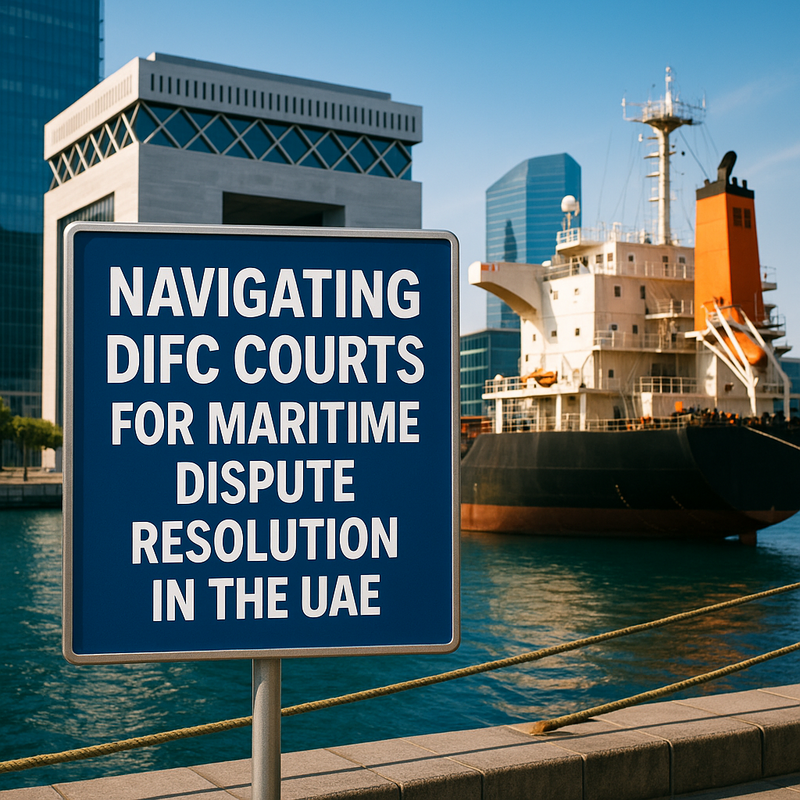
Introduction
The United Arab Emirates (UAE) has experienced a dynamic transformation in its legal landscape, particularly regarding the adjudication of maritime disputes. This evolution is anchored in the UAE’s strategic ambition to serve as a global maritime hub, facilitated by robust legal frameworks and innovative judicial institutions. Within this context, the Dubai International Financial Centre (DIFC) Courts have emerged as a pivotal forum for resolving complex maritime matters, offering an alternative—and, in some cases, a complement—to the UAE’s traditional civil courts.
Recent developments, including the implementation of Federal Decree-Law No. 20 of 2016 on the Maritime Law and critical amendments in DIFC Court jurisdiction, have made it imperative for businesses, shipping operators, insurers, and legal practitioners to re-evaluate their dispute resolution clauses. Navigating when and why to opt into the DIFC Courts for maritime disputes is not merely a procedural consideration—it is a substantive strategic decision influencing enforceability, speed, confidentiality, and commercial certainty. This article delivers a comprehensive analysis and practical consultancy guidance to help UAE-based and international stakeholders make well-informed choices, in light of the latest legal updates and regulatory shifts for 2025 and beyond.
Table of Contents
- UAE’s Maritime Legal Framework: An Overview
- DIFC Courts Jurisdiction and Evolution in Maritime Disputes
- The Statutory Basis for Opting into DIFC Courts
- Comparing UAE Civil Courts and DIFC Courts for Maritime Disputes
- Case Studies: Real-World Impacts and Examples
- Risks of Non-Compliance and Recommended Compliance Strategies
- Professional Analysis: When to Opt In (and When Not To)
- Conclusion and Best Practices for Future-Ready Maritime Contracts
UAE’s Maritime Legal Framework: An Overview
Key Laws and Regulations
The foundation of maritime law in the UAE is Federal Decree-Law No. 26 of 1981 (UAE Maritime Code), as amended by Federal Decree-Law No. 20 of 2016 and further supplemented by Cabinet Resolution No. 57 of 2018 regarding the Executive Regulation of the Civil Procedure Law. These statutes collectively stipulate rights and obligations for shipping, chartering, marine insurance, ship arrest, and dispute resolution.
Key regulatory bodies include:
- United Arab Emirates Ministry of Energy and Infrastructure (Maritime Sector)
- UAE Ministry of Justice
- Federal Transport Authority – Land & Maritime (FTA-LM)
- Emirate-level port authorities (e.g., Dubai Maritime City Authority)
Jurisdiction of UAE Courts
By default, the UAE’s onshore civil courts retain jurisdiction over maritime disputes occurring within UAE waters or relating to agreements governed by UAE law, unless parties have expressly agreed to an alternative forum such as arbitration or the DIFC Courts.
Recent Legal Updates
Key updates affecting maritime disputes in recent years include:
- Modernization of the arrest and release of ships regime, affording expedited procedures and broader creditor protections.
- Recognition and enforcement of foreign judgments and arbitral awards (see UAE Civil Procedure Code as amended by Cabinet Resolution No. 57 of 2018).
- Enactment of DIFC Court guidance for extending their jurisdiction to non-DIFC, non-financial matters, including complicated maritime cases (see DIFC Courts Law No. 10 of 2004, as amended).
These legislative developments reflect the UAE’s alignment with international conventions, such as the International Maritime Organization (IMO) instruments and the New York Convention on the Recognition and Enforcement of Foreign Arbitral Awards.
DIFC Courts Jurisdiction and Evolution in Maritime Disputes
Historical Origins and Expansion
The DIFC Courts were established by Dubai Law No. 12 of 2004, with amendments by Dubai Law No. 16 of 2011, to adjudicate civil and commercial disputes arising within the DIFC geographic footprint. Over time, legislative and judicial reforms have widened the jurisdictional net, allowing “opt-in” by consent—even if neither party is physically present in the DIFC, nor the subject matter directly connected to the Centre.
DIFC Courts and Maritime Disputes: A Growing Nexus
Although maritime law is not an explicit head of jurisdiction under the original DIFC Law 10 of 2004, recent case law and business practices increasingly leverage the DIFC Courts for ship finance, insurance, charterparty, and carriage of goods by sea disputes. This is due in part to the courts’ established common law procedures, English-speaking bench, international enforceability, and confidentiality provisions.
Key Legislative Instruments
- DIFC Courts Law No. 10 of 2004 (as amended)
- Article 5(A) of Dubai Law No. 12 of 2004 (Opt-In Clause)
- Dubai Law No. 16 of 2011 (Extending DIFC Jurisdiction by Consent)
Collectively, these laws enable parties to maritime contracts to stipulate, in their dispute resolution clauses, that the DIFC Courts will have “exclusive or non-exclusive jurisdiction.”
The Statutory Basis for Opting into DIFC Courts
The Legal Mechanism
The right to choose the DIFC Courts as the forum for dispute resolution is not automatic but is expressly provided for by law. Article 5(A) of Dubai Law No. 12 of 2004, as amended, allows parties to refer their disputes to the DIFC Courts by express agreement—even if the dispute has no direct nexus to the DIFC.
This flexibility is particularly attractive for cross-border maritime contracts, where parties often seek a neutral, credible, and internationally recognized forum.
Recommended Jurisdiction Clauses
For the opt-in to be effective, the jurisdiction clause must be clearly worded. For maritime agreements, we recommend formulations such as:
“The Parties hereby agree that any dispute, controversy, or claim arising out of or in connection with this Contract, including any question relating to its existence, validity, or termination, shall be submitted to the exclusive jurisdiction of the DIFC Courts.”
Practical Validation by Registered DIFC Practitioners
It is prudent that such contract wording be reviewed and validated by locally registered DIFC legal practitioners. This ensures compliance with the statutory requirements and best protects the parties’ intentions.
Comparing UAE Civil Courts and DIFC Courts for Maritime Disputes
Core Differences: Procedure, Language, Enforceability
The choice between the UAE’s civil courts and the DIFC Courts produces substantially different outcomes in terms of process, cost, confidentiality, and international enforceability. Below, we present a comparative analysis in table form for clear reference.
| Criteria | UAE Civil Courts | DIFC Courts |
|---|---|---|
| Governing Law | Primarily UAE Maritime Code (Federal Law No. 26 of 1981), Arabic language, civil law principles | DIFC Laws (Common Law), English language, parties may agree non-DIFC law |
| Language of Proceedings | Arabic (official translation required for evidence in other languages) | English |
| Confidentiality | Generally public hearings | Generally more confidential / privacy respected |
| Judicial Expertise | Local judges, not always commercial/maritime specialists | International bench, often including ex-judges from leading common law countries |
| Procedural Rules | Civil procedure rules, less flexible, limited disclosure | Common law procedures, extensive disclosure/discovery, interim remedies available |
| Speed of Proceedings | Moderate to slow due to translation, multi-level appeals | Faster processes, summary judgment possible |
| Enforceability | State-wide within UAE; recent improvements in foreign enforcement | Within DIFC and via ‘conversion’ in Dubai onshore courts; New York Convention for international |
| Appeal Structure | Multi-leveled, risk of re-litigation | More streamlined |
| Costs | Lower initial fees, but can be protracted | Higher initial fees, but potential overall savings due to expedited process |
Visual Recommendation
Suggest Visual: A process flow diagram illustrating step-by-step DIFC Courts litigation compared to onshore civil court timelines in maritime disputes.
Case Studies: Real-World Impacts and Examples
Case Study 1: Ship Arrest under a DIFC Jurisdiction Clause
Scenario: Party A, a UAE-based shipowner, charters a vessel to Party B, a European logistics company. The charterparty agreement includes an “exclusive DIFC Courts jurisdiction” clause. Due to a payment default, Party A seeks to arrest Party B’s vessel in Jebel Ali Port.
Practical Outcome: Although the arrest is technically executed under UAE onshore law (per Federal Decree-Law No. 26 of 1981), Party A’s substantive contractual dispute is heard by the DIFC Courts—offering speed and confidentiality, and enhanced international enforceability.
Case Study 2: Insurance Coverage Dispute
Scenario: A marine insurance policy between an Emirati shipping company and an international insurer incorporates a DIFC Courts jurisdiction clause. Following an onboard incident, coverage is disputed.
Practical Outcome: The DIFC Courts, with their common law approach and familiarity with English marine insurance precedents, provide an efficient, business-savvy forum. Appeals and enforcement are less time-consuming, particularly where parties hold assets in multiple jurisdictions.
Case Study 3: Charterparty Default
Scenario: An offshore support vessel operator enters a time charter with an Abu Dhabi oil services firm, with a traditional UAE courts dispute resolution clause (pre-2018 contract). A severe delay and dispute arises in 2023.
Legal Insight: Without an express “opt-in” clause, the operator is compelled to litigate in the Arabic-language civil courts, facing delays, translation issues, and reduced procedural flexibility. Comparison underscores the risk of touting the default forum in high-value, time-sensitive contracts.
Risks of Non-Compliance and Recommended Compliance Strategies
Risks of Inadequate Jurisdiction Clauses
- Invalid or ambiguous jurisdiction clauses may result in jurisdictional objections, delays, or fragmentation of claims—damaging commercial relationships and increasing costs.
- Failure to “opt in” to the DIFC Courts can expose parties to local court procedural constraints and lengthy timelines.
- Attempting onshore enforcement of DIFC judgments requires compliance with Dubai Court protocols (see Dubai Law No. 12 of 2004 and subsequent MOUs between DIFC and Dubai Courts).
Compliance Strategies
- Draft clear, precise jurisdiction clauses in all maritime contracts. Engage a DIFC-qualified practitioner for review and validation.
- Educate commercial, legal and operations teams about procedural differences and strategic implications of each forum.
- Monitor ongoing UAE legal updates (source: UAE Ministry of Justice; Federal Legal Gazette; UAE Government Portal).
- Implement periodic internal audits to ensure legacy contracts are appropriately updated and compliant.
Suggest Visual: Compliance checklist or risk heat map for in-house legal teams managing multi-jurisdictional maritime portfolios.
Professional Analysis: When to Opt In (and When Not To)
Situations Favouring DIFC Courts Jurisdiction
- Where parties seek English language proceedings and common law predictability.
- Transactions involving international parties or assets outside the UAE requiring enforceable judgments.
- High-value or complex insurance, ship finance, charterparty, or multi-modal logistics disputes.
- Where commercial confidentiality and expedited dispute resolution are priorities.
Situations Favouring Onshore UAE Courts/Other Arbitration Forums
- Solely domestic parties without cross-border elements.
- Disputes heavily reliant on mandatory UAE public policy, statutory, or regulatory considerations (e.g., vessel registration, certain marine casualties).
- Where local enforcement and cost sensitivity are paramount, and parties are comfortable with Arabic-language, civil law proceedings.
Balancing Considerations: Decision-Making Framework
Deciding whether to opt into the DIFC Courts must be assessed on a case-by-case basis. Key elements include:
| Decision Factor | Best Forum |
|---|---|
| International Parties/Assets | DIFC Courts |
| Purely UAE-Based Dispute | UAE Civil Courts |
| Urgency and Speed | DIFC Courts |
| Complex Financial Instruments | DIFC Courts |
| Local Maritime Regulation | UAE Civil Courts |
Conclusion and Best Practices for Future-Ready Maritime Contracts
The increasing accessibility and credibility of the DIFC Courts for maritime disputes marks a notable shift in the legal and operational landscape of the UAE and the wider region. By thoughtfully considering the choice of jurisdiction at the contract negotiation stage, parties can enjoy enhanced certainty, efficiency, and cross-border enforceability—attributes vital for today’s maritime industry. However, non-compliance or ill-advised forum selection poses substantial legal risks and may lead to unenforceable judgments or protracted disputes.
To remain proactive and compliant in the evolving UAE regulatory ecosystem, businesses are encouraged to:
- Conduct periodic reviews of active maritime contracts with attention to dispute resolution clauses;
- Incorporate DIFC Courts jurisdiction where cross-border enforceability and English common law processes add value;
- Seek expert consultancy to audit, draft, and validate jurisdiction provisions in light of regular UAE legal updates and DIFC procedural reforms;
- Monitor forthcoming changes for 2025 and beyond, leveraging resources from the UAE Ministry of Justice and Federal Legal Gazette.
In summary, the DIFC Courts offer unparalleled benefits for many—but not all—maritime disputes. A tailored, well-informed approach ensures commercial interests are advanced and legal risks minimized as the UAE cements its global leadership in maritime trade and dispute resolution.
