

UAE criminal law | Financial fraud | Forged documents | Digital evidence | Fund tracing | Civil recovery
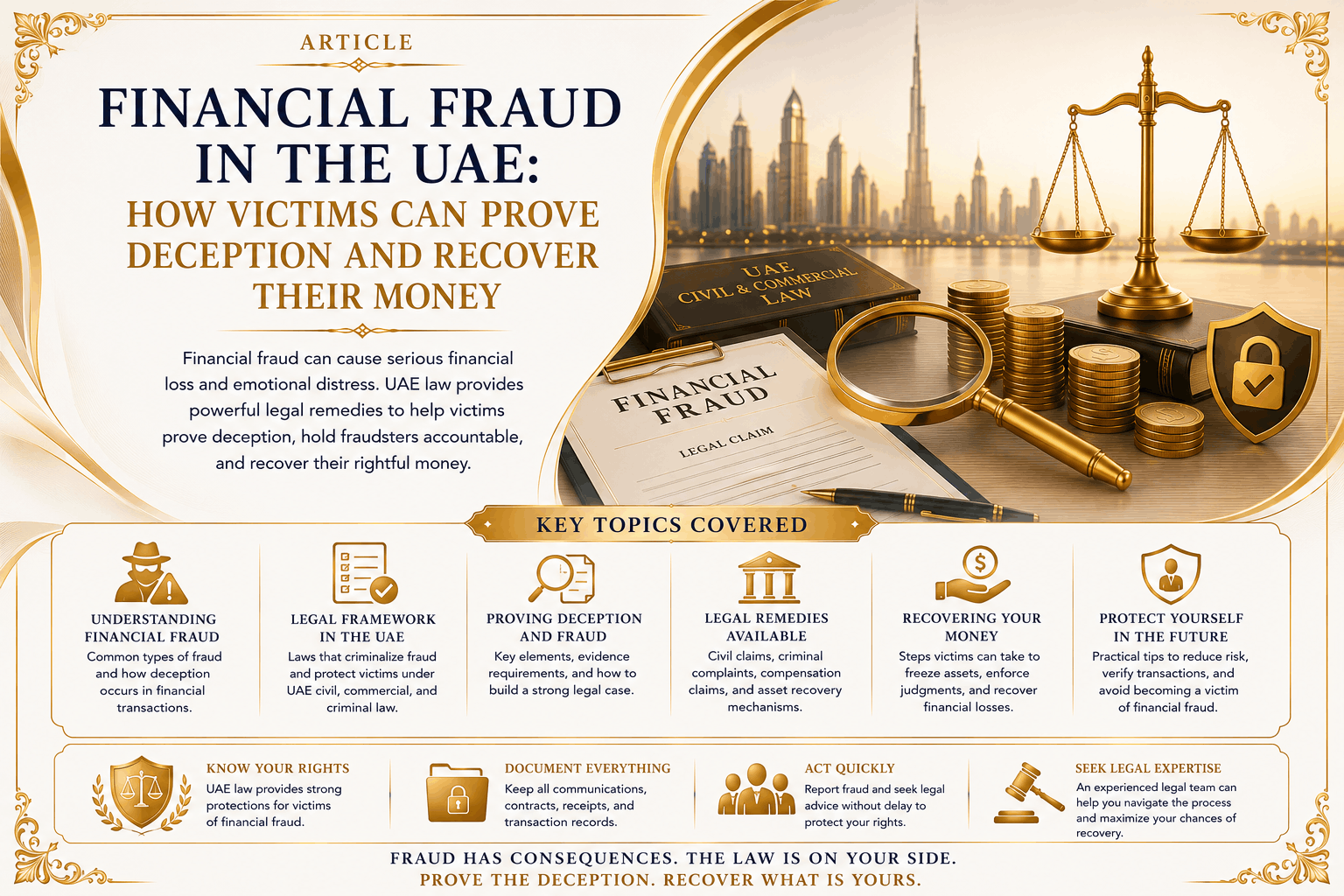 A practical guide to proving deception, preserving financial evidence,
tracing transferred funds, filing criminal complaints, and pursuing civil
recovery in the UAE.
A practical guide to proving deception, preserving financial evidence,
tracing transferred funds, filing criminal complaints, and pursuing civil
recovery in the UAE.
Financial fraud in the UAE may involve false investments, forged documents, impersonation, altered payment instructions, sham partnerships, or deliberate deception used to obtain money.
Key principle: Financial loss alone does not establish criminal fraud. The victim must connect deception, payment, dishonest conduct, and loss through reliable evidence.UAE Legal Framework for Financial Fraud
Criminal Law
UAE criminal legislation addresses fraud, breach of trust, forgery, use of forged documents, impersonation, and related offences.
Cybercrime and Electronic Documents
Electronic fraud, fake websites, payment diversion, unauthorised access, and forged electronic documents may engage federal cybercrime and electronic-transactions legislation.
Civil Recovery
Victims may also pursue contractual, civil-liability, restitutionary, compensation, attachment, and enforcement remedies.
Official-source placeholders:Official UAE legislation portal | UAE Ministry of Justice | Dubai Police | Abu Dhabi Police | Dubai Courts | Abu Dhabi Judicial Department
Key Legal Concepts and Definitions
Fraud involves deliberate deception. Reliance connects the deception to the victim’s decision. Causation connects the conduct to the loss. Forgery concerns false documents, while fund tracing follows money and assets.
Who UAE Fraud Law Applies To
Fraud laws may affect individuals, investors, companies, directors, employees, consumers, banks, property buyers, contractors, shareholders, mainland businesses, and free-zone entities.
The Difference Between Fraud and a Contractual Dispute
Delay, non-payment, or business loss does not automatically prove fraud. Evidence should show deliberate deception or another dishonest method used to obtain the payment.
Core Elements of a Financial-Fraud Case
- A specific deceptive representation
- Evidence showing that it was false
- Dishonest intention
- Payment or transfer induced by the deception
- Quantifiable loss
Common Types of Financial Fraud
Schemes may involve investments, property, fake suppliers, payment diversion, forged guarantees, online trading platforms, partnerships, invoices, loans, cards, cryptocurrency, or advance fees.
Investment and Partnership Fraud
The legal analysis should examine licences, ownership, business activity, use of funds, promises of returns, risk disclosure, company records, and whether the alleged shares or assets actually existed.
Bank-Transfer and Payment-Diversion Fraud
Preserve full email headers, bank instructions, transfer confirmations, internal approvals, cybersecurity records, and previous legitimate payment details.
Forged Documents and False Corporate Records
Forged contracts, guarantees, licences, signatures, invoices, approvals, and share certificates may require official verification or technical expert analysis.
Electronic and Online Financial Fraud
Preserve websites, advertisements, usernames, telephone numbers, payment links, wallet addresses, messages, and displayed account balances before the platform disappears.
Rights of Fraud Victims
Victims may report criminal conduct, submit evidence, seek compensation, pursue civil recovery, challenge forged documents, request lawful asset preservation, and enforce judgments.
Rights and Defences of Accused Persons
The accused may challenge intent, account ownership, authenticity, reliance, causation, loss calculations, and whether the case is properly criminal or civil.
Immediate Steps After Discovering Fraud
- Stop further payments.
- Contact the relevant bank immediately.
- Preserve original evidence.
- Secure accounts and devices.
- Prepare a chronology.
- Identify recipient accounts and possible assets.
- Obtain legal review.
Criminal Complaint Procedures in the UAE
A complaint should identify the deceptive conduct, payment, evidence of falsity, accused persons, recipient accounts, loss, and requested investigation.
Dubai Fraud-Complaint Procedures
Dubai Police accepts criminal complaints and electronic supporting evidence through its designated channels.
Abu Dhabi Reporting and Police Assistance
Abu Dhabi Police provides police and Aman reporting channels for security and criminal concerns.
Police Investigation and Public Prosecution
Investigation may involve statements, bank records, company files, device examination, telecommunications information, document verification, and technical experts.
Civil Recovery of Fraud Losses
Civil proceedings may seek repayment, rescission, restitution, compensation, asset attachment, and enforcement against identified property.
Contractual, Civil-Liability, and Restitutionary Claims
The correct claim depends on whether the transaction arose from a valid contract, wrongful conduct, invalid agreement, unjustified receipt of money, or several overlapping legal grounds.
Fund Tracing and Asset Identification
| Date | Sender | Recipient | Amount | Reference |
|---|---|---|---|---|
| Transfer 1 | Victim | Company A | AED X | Investment |
| Transfer 2 | Company A | Individual B | AED Y | Related transfer |
Provisional Attachment and Asset Preservation
Asset-preservation applications require a proper legal basis, supporting documents, identifiable assets, urgency, and compliance with procedural conditions.
Required Documents and Evidence
- Identity and corporate records
- Contracts and investment documents
- Invoices and receipts
- Bank transfers and statements
- Messages and emails
- Advertisements and presentations
- Forged or disputed documents
- Website and account information
- Witness details
- Accounting and technical reports
Bank Transfers and Financial Records
Bank evidence should connect the payment to the representation, recipient, promised purpose, actual use of money, and resulting loss.
Digital Evidence and Electronic Communications
Preserve original devices, complete chats, email headers, attachments, audio, website links, usernames, dates, and backups.
Proving Forgery and Altered Documents
Identify the false feature, person who used the document, genuine comparison record, resulting payment, and evidence from the issuing authority or expert.
Accounting and Technical Experts
Experts may analyse payments, company records, losses, email origin, metadata, document manipulation, account attribution, and cryptocurrency transactions.
Anonymous Accounts, Nominees, and Intermediaries
Investigators may examine nominee companies, money mules, employee accounts, related parties, foreign accounts, and cryptocurrency wallets.
Cross-Border Fraud and Foreign Assets
Recovery may require foreign asset searches, parallel proceedings, translation, international banking evidence, and recognition or enforcement abroad.
Common Defences and Objections
Defences may concern lack of deception, disclosed risks, genuine business failure, account compromise, authentic documents, lack of personal participation, repayment, or incorrect loss calculations.
Common Misunderstandings
- Every unpaid debt is fraud.
- A contract prevents criminal liability.
- A bank transfer proves the entire case.
- A criminal complaint guarantees recovery.
- WhatsApp messages are automatically decisive.
- A company director is automatically personally guilty.
- Settlement proves the case was weak.
Common Mistakes to Avoid
- Continuing to pay after warning signs
- Confronting the suspect before preserving evidence
- Deleting messages or original documents
- Publishing accusations online
- Exaggerating losses
- Filing against the wrong party
- Failing to trace funds
- Signing a broad waiver
- Waiting until assets disappear
Practical Examples
Fake Property Investment
Verify title ownership, preserve the false document, identify the account, report the forgery, and assess asset-preservation options.
Business-Email Compromise
Contact the banks immediately and preserve email headers, transfer confirmations, approval records, and security logs.
Sham Partnership
Compare investor representations with company records, trace the money, and determine whether the conduct amounts to fraud, misappropriation, or a civil dispute.
Fake Trading Platform
Stop paying additional release fees, preserve the platform and wallet details, and report the scheme promptly.
Legal Risks and Consequences
Poor handling may cause permanent loss, rejected complaints, weak civil claims, asset dissipation, evidence loss, counterclaims, foreign-enforcement difficulties, and increased court costs.
How a Lawyer Evaluates a Fraud Case
A lawyer examines deception, intention, payments, forged documents, company structure, recipient accounts, jurisdiction, civil and criminal routes, assets, settlement potential, and enforceability.
How a Lawyer Builds a Stronger Recovery Position
Legal support may include evidence preservation, complaint drafting, document verification, fund tracing, expert coordination, civil proceedings, asset preservation, settlement security, and judgment enforcement.
Settlement vs Criminal and Civil Proceedings
A settlement may provide immediate or secured repayment, but litigation may be necessary where liability is denied, assets are moving, documents were forged, or settlement is being used to delay recovery.
When Urgent Legal Action May Be Needed
- A transfer was made recently
- The recipient may withdraw or move funds
- The accused may leave the UAE
- A company is closing
- Property may be sold
- Cryptocurrency is moving
- Evidence is being deleted
- The victim is being pressured to sign a waiver
Frequently Asked Questions
1. What must a victim prove?
The victim should prove deception, falsity, dishonest intention, payment, causation, responsible parties, and financial loss.
2. Is non-payment automatically fraud?
No. It may be a debt or contractual breach unless dishonest inducement or another criminal element can be proved.
3. Can criminal and civil cases both be filed?
Potentially. They serve different purposes and may need to be coordinated.
4. Are WhatsApp messages evidence?
They can be, subject to authenticity, context, completeness, ownership, translation, and lawful preservation.
5. Can transferred funds be frozen?
Preservation measures may be available where the legal requirements and evidence are satisfied.
6. What if documents were forged?
Preserve the originals and obtain official, expert, registry, or banking verification.
7. Can money transferred abroad be recovered?
Potentially, through foreign tracing, proceedings, and enforcement where assets are located.
8. Does conviction guarantee repayment?
No. Recovery also depends on civil or compensation orders, available assets, and enforcement.
9. Can directors be personally liable?
Potentially, where personal involvement or another legal basis is proved.
10. What should I do after a fraudulent transfer?
Contact the bank, preserve evidence, secure accounts, identify recipients, and report the matter promptly.
11. Can I name the accused publicly?
Public allegations may create defamation or privacy exposure. Use official reporting and legal channels.
12. How long does a fraud case take?
Timing depends on evidence, banks, experts, defendants, cross-border issues, and the court schedule.
Conclusion
Financial fraud in the UAE requires proof of deception, dishonest intention, payment, causation, and recoverable loss.
Early legal advice can help preserve evidence, notify banks, trace funds, identify responsible parties, structure criminal and civil proceedings, and protect assets before recovery becomes more difficult.
Need Advice About Financial Fraud in the UAE?
Obtain tailored advice on fraud complaints, forged documents, bank transfers, digital evidence, fund tracing, civil recovery, asset preservation, and enforcement.
Book a Legal ConsultationLegal Disclaimer: This article is for general information only and does not constitute legal advice. The correct strategy depends on the facts, evidence, transaction date, jurisdiction, parties, assets, and procedural stage.
Services | Legal Consultation | Contact Us | UAE Law Articles | About Us