Technology Licensing in the UAE: Protecting Patents, Know-How, and Commercial Innovation
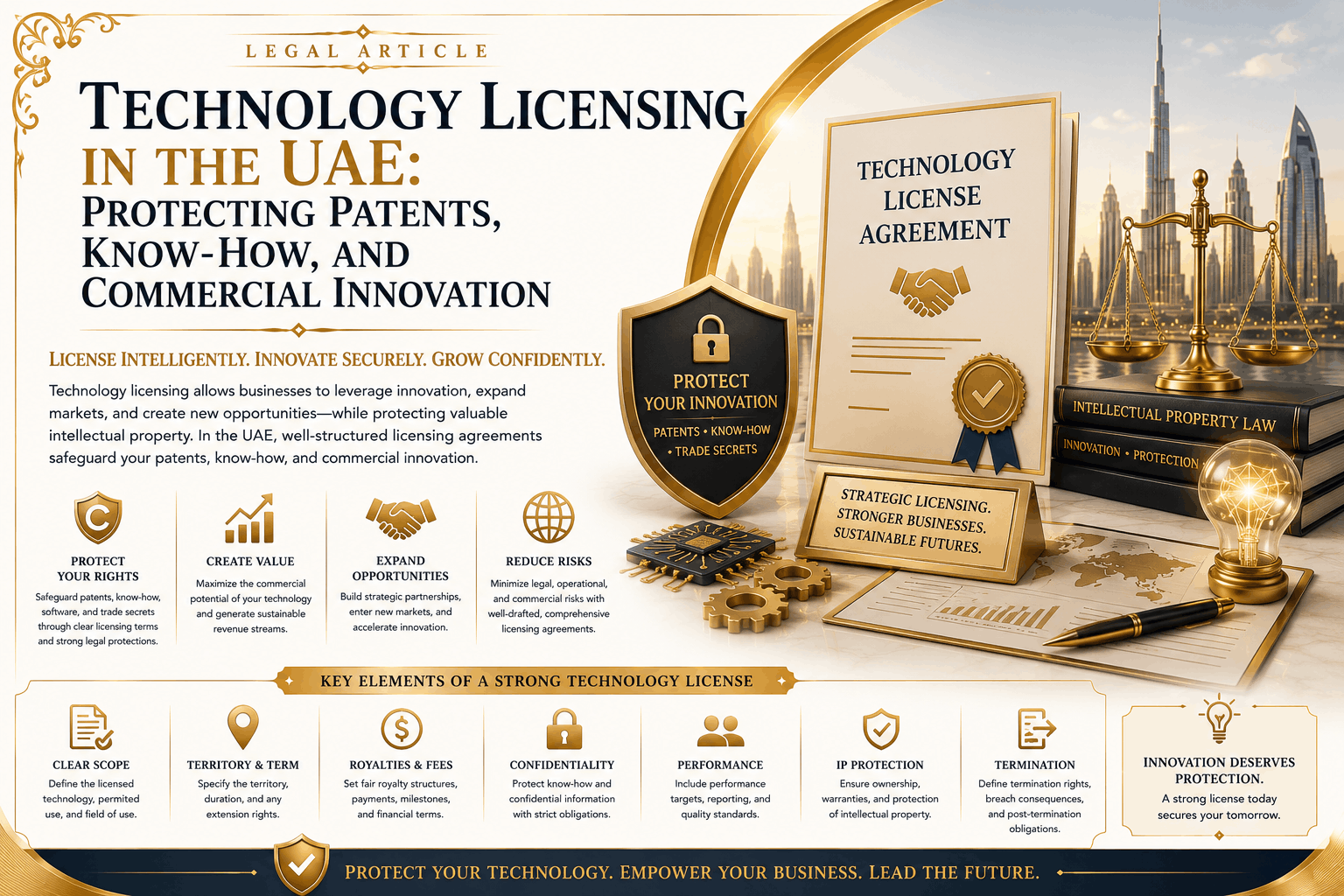
Technology licensing in the UAE is essential for commercializing patents, know-how, technical innovation, software-enabled systems, industrial processes, and research-driven assets.
UAE Legal Framework for Technology Licensing
UAE technology licensing may involve Federal Law No. 11 of 2021 on the Regulation and Protection of Industrial Property Rights, Ministry of Economy and Tourism industrial property procedures, contract law, confidentiality obligations, civil claims, arbitration, court proceedings, and sector-specific rules where the licensed technology is regulated.
Official UAE legislation portal | UAE Ministry of Economy | UAE Ministry of Justice | Relevant UAE authority website | Dubai Courts | Abu Dhabi Judicial Department | DIFC Courts | ADGM Courts
Key Legal Concepts and Definitions
Important concepts include technology licence, licensor, licensee, patent, utility model, know-how, undisclosed information, royalty, improvement, sublicence, field of use, exclusivity, assignment, confidentiality, and termination.
Who UAE Technology Licensing Rules Apply To
Technology licensing may affect patent owners, inventors, startups, investors, manufacturers, software companies, research centres, universities, laboratories, engineering firms, distributors, franchise operators, mainland companies, free zone companies, and foreign companies licensing technology into or from the UAE.
Rights and Obligations of Licensors, Licensees, Investors, and Commercial Partners
Licensors may seek royalties, confidentiality protection, audit rights, quality control, and termination remedies. Licensees may seek clear usage rights, technical support, exclusivity where agreed, sublicensing where needed, and certainty over improvements.
Patent Licensing and Patent Exploitation in the UAE
Patent licences should identify the patent or application, owner, legal status, territory, field of use, permitted acts, royalty structure, enforcement duties, maintenance responsibility, improvements, and termination consequences.
Confidential Know-How, Trade Secrets, and Undisclosed Information
Know-how may include formulas, engineering tolerances, production settings, source code, drawings, training manuals, data, technical files, and manufacturing methods. Protection depends on confidentiality controls and evidence of disclosure.
Royalty Structures, Payment Terms, and Audit Rights
Royalties may be lump-sum, per-unit, percentage-based, milestone-based, minimum annual, subscription-based, revenue-share, or hybrid. The agreement should define calculation, deductions, records, reporting, currency, taxes, late payment, and audit rights.
Ownership of Improvements, Upgrades, and Derivative Technology
Improvement clauses should define who owns modifications, derivative inventions, upgrades, process optimizations, patentable developments, and jointly created technology, and whether either party receives ongoing licence rights.
Exclusivity, Territory, Field of Use, and Sublicensing
Scope should be clear. The agreement should state whether the licence is exclusive or non-exclusive, what territory applies, what industry or field is permitted, whether export is allowed, and whether sublicensing requires approval.
Termination Risks and Post-Termination Restrictions
Termination clauses should address breaches, cure periods, unpaid royalties, existing stock, confidential information, improvements, sublicences, customer support, audits, and post-termination non-use obligations.
Competition, Commercial Agency, and Distribution Issues
Technology licensing may overlap with distribution, exclusivity, competition law, and commercial agency issues. Hybrid arrangements should be reviewed carefully to avoid unintended regulatory, contractual, or enforcement consequences.
Procedures in the UAE
- Identify the technology, ownership, patent status, know-how, and commercial objective.
- Conduct due diligence on rights, capacity, technical feasibility, and existing restrictions.
- Negotiate the licence scope, royalties, confidentiality, improvements, and termination terms.
- Consider registration, modification, or termination recordal where relevant.
- Monitor royalty reports, quality standards, confidentiality, and performance milestones.
- Use legal notice, audit, expert review, settlement, arbitration, or court action if disputes arise.
Required Documents and Evidence
- Patent certificates, applications, and utility model documents
- Industrial design and integrated circuit layout records
- Licence agreements, amendments, and side letters
- NDAs and confidentiality undertakings
- Technical manuals, source code, drawings, prototypes, and specifications
- Royalty reports, sales records, invoices, bank transfers, and audit reports
- Improvement disclosures, R&D files, and expert reports
- Emails, WhatsApp messages, meeting minutes, and termination notices
- Evidence of unauthorized use, sublicensing, or post-termination exploitation
Due Diligence Before Signing a Technology Licence
Parties should verify ownership, patent status, competing rights, third-party components, open-source software, regulatory approvals, technical feasibility, sublicensing needs, royalty economics, continuation rights, and confidentiality safeguards before signing.
Common Misunderstandings
- A licence means ownership.
- Know-how is protected without documentation.
- Royalty clauses are simple.
- Improvements automatically belong to the party that created them.
- Exclusivity is always better.
- Termination ends every obligation.
- A patent licence automatically covers know-how.
- Free zone companies do not need UAE IP review.
Common Mistakes to Avoid
- Signing a short licence without defining the technology
- Failing to verify patent ownership
- Disclosing know-how before signing an NDA
- Failing to define royalties and audit rights
- Granting exclusivity without performance obligations
- Ignoring ownership of improvements
- Allowing sublicensing without controls
- Using unclear termination clauses
- Failing to preserve evidence
Practical Examples
UAE Manufacturer Licenses Foreign Patent
If the agreement does not clarify whether export is allowed, later GCC sales may create a territory dispute. The contract should define permitted territories and export rights.
Startup Licenses Confidential Algorithm
A startup should sign an NDA, disclose in stages, watermark technical files, restrict access, and document disclosure before sharing a confidential algorithm with a potential partner.
Exclusive Licence With No Performance Targets
Exclusivity without minimum sales, milestones, or conversion rights may trap the licensor if the licensee underperforms.
Improvement Ownership Dispute
If a licensee improves the technology and the contract is silent, technical expert review and evidence of contribution may become necessary.
Legal Risks and Consequences
Technology licensing failures may cause loss of patent value, loss of know-how secrecy, unpaid royalties, unauthorized sublicensing, improvement disputes, manufacturing disruption, contract termination, investor concerns, civil claims, arbitration, court proceedings, and business interruption.
How a Lawyer Evaluates a Technology Licensing Case
A lawyer reviews applicable law, IP status, patent ownership, know-how documentation, confidentiality measures, contract wording, licence scope, royalties, audit rights, improvements, warranties, termination rights, dispute resolution, jurisdiction, evidence, and commercial objectives.
How a Lawyer Builds a Stronger Legal Position
Legal support may include due diligence, patent review, licence drafting, NDA drafting, royalty structuring, audit mechanisms, improvement clauses, sublicensing controls, termination clauses, legal notices, expert coordination, settlement negotiation, and arbitration or court strategy.
Settlement vs Litigation or Arbitration
Settlement may clarify royalties, audit rights, exclusivity, improvements, or termination. Litigation or arbitration may be necessary where misuse of know-how, unpaid royalties, unauthorized sublicensing, or post-termination exploitation causes serious harm.
When Urgent Legal Action May Be Needed
- Confidential know-how has been disclosed without authority
- Source code or technical files were copied
- A licensee continues use after termination
- A sublicence was granted without approval
- A product launch is imminent using disputed technology
- A patent is being exploited outside scope
- A licensee refuses audit access
- Royalty records may be altered
- Evidence may be deleted or transferred
Frequently Asked Questions
1. What is technology licensing in the UAE?
It is a legal arrangement allowing one party to use, manufacture, sell, distribute, develop, or commercialize defined technology owned or controlled by another party.
2. What law applies to patent licensing?
Patent and industrial property licensing is mainly connected to Federal Law No. 11 of 2021 on the Regulation and Protection of Industrial Property Rights.
3. Is know-how protected like a patent?
Know-how is different. It often depends on confidentiality, access controls, contractual restrictions, and evidence of protected disclosure.
4. Does a patent licence automatically include know-how?
No. Confidential know-how should be expressly included if the licensee needs technical manuals, training, data, manufacturing instructions, or source code.
5. Can a technology licence be exclusive?
Yes, but exclusivity should usually be linked to performance obligations, minimum royalties, milestones, territory, field of use, and termination rights.
6. How should royalties be calculated?
Royalties may be based on sales, units, milestones, lump sums, revenue share, minimums, or hybrid formulas. Clear definitions and audit rights are essential.
7. Who owns improvements?
The contract should define this. Improvements may belong to the licensor, licensee, both parties, or the party that created them, with licence rights granted to the other party.
8. Can a licence continue after patent expiry?
It depends on the agreement and whether the licence also covers know-how, software, technical services, or other rights beyond the patent.
9. What happens after unauthorized post-termination use?
The licensor may consider claims for breach of contract, misuse of confidential information, unpaid royalties, damages, injunctions, or other remedies.
10. Is arbitration useful for technology licensing disputes?
Arbitration may be useful for confidential and technical disputes, especially cross-border matters, but court action may still be needed for urgent relief.
Conclusion
Technology licensing in the UAE is a powerful tool for commercializing patents, know-how, industrial innovation, software-enabled systems, and research-driven assets.
Early legal advice can help parties define rights, protect confidential know-how, structure royalties, regulate improvements, control termination risks, preserve evidence, and choose the correct dispute strategy before the relationship becomes difficult to control.
Need Advice About UAE Technology Licensing?
Obtain tailored advice on patents, know-how, royalty structures, sublicensing, exclusivity, improvements, confidentiality, termination, dispute prevention, arbitration, and enforcement.
Book a Legal Consultation