

UAE mediation | Amicable settlement | Civil and commercial disputes | Settlement agreements | Alternative dispute resolution
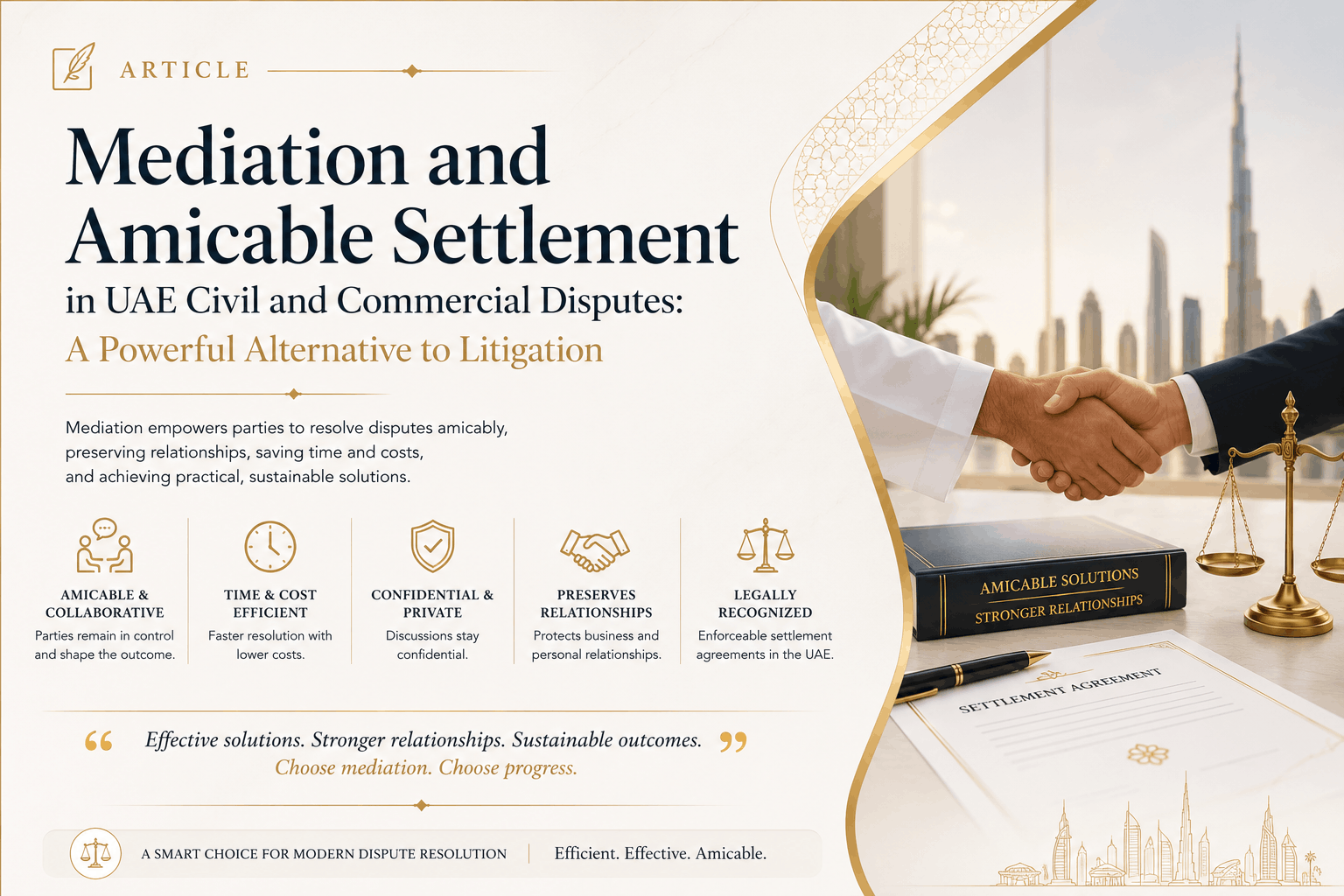 Resolving UAE civil and commercial disputes efficiently through
structured mediation, strategic negotiation, and enforceable settlement
agreements.
Resolving UAE civil and commercial disputes efficiently through
structured mediation, strategic negotiation, and enforceable settlement
agreements.
Mediation and amicable settlement in UAE disputes can provide individuals and businesses with a practical alternative to prolonged court litigation.
Instead of asking a court or arbitral tribunal to impose a decision, the parties attempt to resolve their dispute through structured negotiation, often with the assistance of an independent mediator or conciliator.
Key principle: A successful settlement is not simply a compromise. It is a legally structured solution that reflects evidence, risk, commercial objectives, security, and enforceability.UAE Legal Framework for Mediation and Conciliation
Federal Framework
The principal federal framework is Federal Decree-Law No. 40 of 2023 on Mediation and Conciliation in Civil and Commercial Disputes.
It provides a structure for judicial and non-judicial mediation, conciliation centres, digital platforms, settlement documentation, and related procedures.
Private Mediation Centres
Private mediation centres and branches of foreign mediation centres are subject to the current UAE regulatory framework. Parties should confirm authorisation, rules, mediator appointment, fees, confidentiality, and the route for documenting settlements.
Court and Contractual Procedures
Some disputes may be referred to a conciliation centre before ordinary court litigation. Commercial contracts may also require negotiation or mediation before litigation or arbitration.
Official-source placeholders:Official UAE legislation portal | UAE Ministry of Justice | Relevant UAE authority website | Dubai Courts | Abu Dhabi Judicial Department | DIFC Courts | ADGM Courts
Key Legal Concepts and Definitions
Mediation
A structured process in which an independent mediator helps the parties negotiate a voluntary solution.
Conciliation
An amicable process in which a conciliator may assist the parties in narrowing issues and exploring settlement proposals.
Settlement Agreement
A written contract recording the agreed resolution, payment or performance obligations, releases, security, default consequences, and enforcement.
Settlement Authority
The legal power of a representative to bind an individual or company to the settlement.
Who Mediation and Amicable Settlement Apply To
Mediation may assist creditors, debtors, contractors, developers, consultants, suppliers, purchasers, shareholders, investors, landlords, commercial tenants, professional advisers, mainland companies, free-zone entities, UAE nationals, expatriates, and foreign companies.
Rights and Obligations of the Parties
Parties generally control whether to settle and on what terms. They should participate through representatives with authority, preserve confidentiality, obtain independent advice, and protect court or contractual deadlines.
When Mediation May Be Better Than Litigation
- The commercial relationship has continuing value
- Privacy is important
- Flexible remedies are needed
- Both sides face litigation risk
- Speed and cost control matter
- A secured payment plan may produce better recovery
- Several connected disputes should be resolved together
Mediation and Settlement Procedures in the UAE
- Conduct an initial legal assessment.
- Collect and organise evidence.
- Issue a legal notice or invitation to mediate.
- Select the appropriate mediation process.
- Appoint a suitable mediator.
- Prepare confidential position statements.
- Attend joint and private sessions.
- Negotiate financial and non-financial terms.
- Draft and review the settlement agreement.
- Obtain approval or documentation where appropriate.
- Monitor implementation and preserve payment evidence.
Required Documents and Evidence
- Contracts and amendments
- Purchase orders and invoices
- Bank transfers and receipts
- Delivery and completion records
- Emails and WhatsApp messages
- Company documents and licences
- Shareholder and board resolutions
- Technical and expert reports
- Financial statements and valuations
- Legal notices and existing pleadings
- Court, arbitration, and enforcement documents
- Guarantee and security documents
Evidence affects settlement leverage because each party evaluates what is likely to happen if mediation fails.
Legal Value of Settlement Agreements
A settlement agreement should identify the correct parties, resolved claims, amounts, deadlines, security, releases, confidentiality, default consequences, governing law, jurisdiction, and authority of signatories.
Release warning: A creditor should consider making the final release conditional on full payment rather than releasing all claims when an instalment agreement is signed.Confidentiality and Without-Prejudice Negotiation
The mediation agreement should address confidential documents, offers, expert material, mediator notes, disclosure to regulators, and disclosure required to enforce the final settlement.
Parties should not assume that placing “without prejudice” in an email automatically protects every statement.
Negotiation Strategy and Settlement Preparation
The client should identify its objectives, best alternative if settlement fails, acceptable settlement range, non-negotiable terms, required security, and individuals authorised to approve the agreement.
Objective criteria such as contract terms, valuations, accounting records, expert findings, and realistic enforcement prospects improve negotiation.
Protecting Business Relationships
A settlement may introduce new communication procedures, revised pricing, quality-control systems, future milestones, escalation channels, confidentiality, and non-disparagement obligations.
Payment Plans, Security, and Default Clauses
Payment terms should state exact amounts and dates, security, acceleration, default consequences, treatment of interest and costs, and when releases become effective.
Security may include guarantees, assignments, pledges, mortgages, escrow, or other legally enforceable protection suitable to the transaction.
Court-Referred and Private Mediation
Court-referred mediation integrates the process with litigation. Private mediation offers flexibility in mediator choice, language, timing, procedure, and technical expertise.
Online mediation may be appropriate for international parties, provided identity, confidentiality, document security, and valid execution are addressed.
Mainland, Dubai, Abu Dhabi, DIFC, ADGM, and Free-Zone Considerations
UAE procedures differ by jurisdiction and type of claim. Parties should confirm the competent centre, electronic filing process, language, fees, approval method, and enforcement route.
Abu Dhabi maintains Mediation and Conciliation Centres, while the DIFC Courts offer a separate mediation service with a route for documenting enforceable settlements under the applicable DIFC framework.
Common Misunderstandings
“Mediation means splitting the difference.”
Settlements may include security, revised performance, asset transfers, management changes, confidentiality, or future cooperation.
“Settlement means the claim was weak.”
Strong claims settle to reduce delay, expense, uncertainty, and enforcement risk.
“The mediator decides who wins.”
The mediator facilitates discussion but does not ordinarily impose a decision.
“A signed settlement guarantees payment.”
The value of the agreement depends on authority, drafting, security, and enforceability.
Common Mistakes to Avoid
- Negotiating without legal assessment
- Sending emotional or threatening communications
- Disclosing the minimum position too early
- Signing an unclear term sheet
- Using the wrong legal entity name
- Failing to verify settlement authority
- Releasing claims before payment
- Accepting unsecured instalments
- Ignoring existing proceedings
- Failing to address default
Practical Examples
Unpaid Commercial Invoices
A settlement may combine immediate payment, credit for disputed goods, replacement stock, revised quality controls, and security for the balance.
Construction Variation Dispute
Mediation may resolve variation payments, completion milestones, defect rectification, retention, and delay claims together.
Shareholder Deadlock
A negotiated solution may establish valuation, share transfer, management resignation, record handover, guarantee release, and confidentiality.
Debtor Requests Instalments
The creditor should seek immediate partial payment, financial disclosure, security, acceleration after default, and a conditional release.
Legal Risks and Consequences
Poorly managed settlement may lead to admissions, waiver of rights, missed deadlines, asset dissipation, unclear obligations, unenforceable terms, repeat litigation, loss of security, inadequate recovery, or release of the wrong claims.
How a Lawyer Evaluates the Dispute
A lawyer assesses parties, authority, jurisdiction, applicable law, contract wording, evidence, claim value, counterclaims, deadlines, assets, security, litigation risk, enforcement prospects, commercial relationships, reputation, and client objectives.
How a Lawyer Builds a Stronger Settlement Position
Legal support may include document review, evidence organisation, claim calculations, legal notices, deadline protection, mediator selection, position papers, offer structuring, settlement drafting, security, judicial approval, implementation, and enforcement after default.
Settlement Versus Litigation or Arbitration
Settlement may be preferable where flexibility, speed, privacy, and business continuity matter. Litigation or arbitration may be necessary where urgent protection is required, bad faith persists, disclosure is refused, or a binding legal determination is needed.
When Urgent Legal Action May Be Needed
- Assets may be transferred
- Evidence may be destroyed
- A court deadline is approaching
- Contract termination is imminent
- A bank guarantee may be called
- The company may close or enter insolvency
- A shareholder is removing records
- A settlement demands immediate signature
- Security may expire
Frequently Asked Questions
1. Is mediation legally recognised in the UAE?
Yes. UAE legislation provides a formal framework for mediation and conciliation in qualifying civil and commercial disputes.
2. Is mediation mandatory before filing a civil case?
It depends on the jurisdiction and claim. Certain matters may need review through a mediation or conciliation centre before litigation.
3. Is a mediated settlement enforceable?
A properly executed settlement is generally contractually binding. Judicially approved or recorded settlements may have a more direct enforcement route.
4. Are mediation discussions confidential?
They are generally designed to be confidential, but the precise protection depends on the applicable law, rules, and agreement.
5. Can a mediator force settlement?
No. The mediator assists negotiation, while the parties decide whether to accept the proposed resolution.
6. Should a lawyer attend mediation?
Legal advice is particularly useful in complex or high-value disputes to assess risk, preserve rights, evaluate offers, and draft enforceable terms.
7. Can parties settle after court proceedings begin?
Yes. Settlement can occur before judgment, during appeal, or during enforcement. The agreement should address the status of the existing case.
8. What should a payment settlement contain?
It should identify amounts, dates, security, default consequences, releases, costs, enforcement rights, and treatment of existing proceedings.
9. Does settlement mean accepting less?
Not necessarily. Settlement value includes speed, security, savings, relationship protection, risk reduction, and realistic collectability.
10. When is mediation unsuitable?
It may be unsuitable where urgent protection is needed, evidence may be destroyed, one party acts in bad faith, or there is no genuine intention to negotiate.
Conclusion
Mediation and amicable settlement in UAE disputes can provide a powerful alternative to litigation where the process is legally structured, supported by evidence, and concluded through a clear and enforceable agreement.
Its advantages include privacy, flexibility, cost control, faster resolution, relationship protection, and commercially creative remedies.
Need Advice on Mediation or Amicable Settlement in the UAE?
Early UAE legal advice can help you assess the strength of your case, prepare a negotiation strategy, protect deadlines, secure payment terms, and draft an enforceable settlement.
Book a Legal ConsultationLegal Disclaimer: This article is for general information only and does not constitute legal advice. The correct approach depends on the dispute, forum, documents, parties, assets, applicable law, and current UAE procedures.
Services | Legal Consultation | Contact Us | UAE Law Articles | About Us