

UAE real estate law | Jointly owned property | Owners’ committees | Service charges | Property management | Common-area disputes
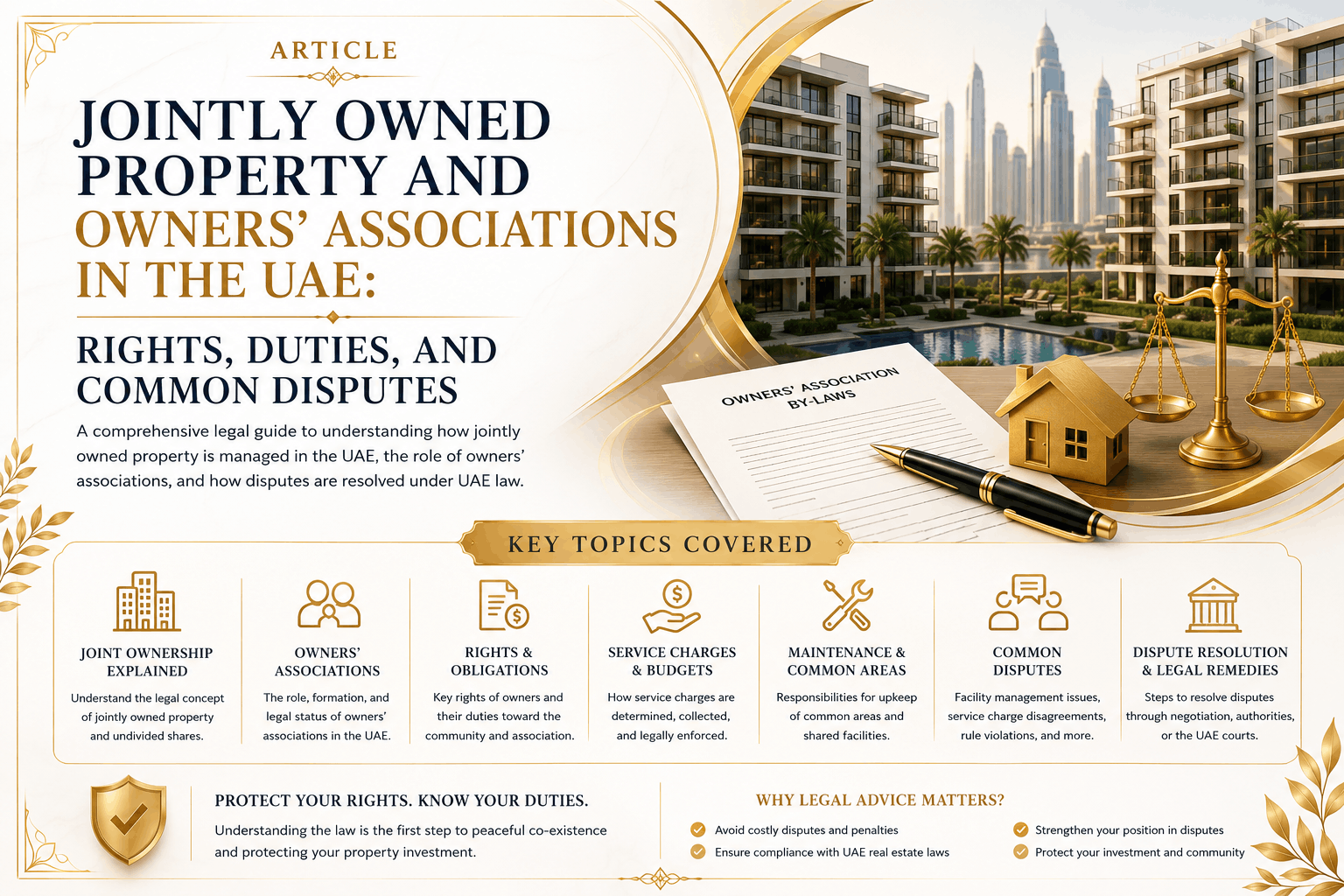 A practical legal guide to service charges, common-area maintenance,
owners’ committees, management companies, and disputes in UAE jointly
owned developments.
A practical legal guide to service charges, common-area maintenance,
owners’ committees, management companies, and disputes in UAE jointly
owned developments.
Jointly owned property in the UAE combines individually owned units with common areas and facilities that must be managed, maintained, and funded collectively.
Key principle: Ownership of a unit includes rights in the shared development, but it also creates obligations to pay approved common costs and comply with the registered governance documents.UAE Legal Framework for Jointly Owned Property
Dubai
Dubai’s framework regulates jointly owned developments, common parts, owners’ committees, management companies, service charges, usage charges, regulatory accounts, and property-management obligations.
Abu Dhabi
Abu Dhabi applies its own local real estate legislation, owners’ committee rules, service-charge approval procedures, and ADREC regulatory framework.
Federal Principles
Federal civil-law principles may also apply to contracts, compensation, negligence, maintenance agreements, co-ownership, evidence, and enforcement.
Official-source placeholders:Official UAE legislation portal | Dubai Legislation Portal | Dubai Land Department | Abu Dhabi Real Estate Centre | UAE Ministry of Justice | Dubai Courts | Abu Dhabi Judicial Department
Key Legal Concepts and Definitions
Unit
The privately owned apartment, office, shop, villa, or other registered part of the development.
Common Parts
Shared structural, operational, or recreational areas used for the benefit of multiple units.
Owners’ Committee
A representative body formed from qualifying owners to perform the functions assigned under the applicable legal framework.
Management Company
The licensed entity responsible for operational management, maintenance, service providers, approved budgets, and owner complaints.
Who the Law Applies To
The framework may affect owners, landlords, tenants, investors, developers, master developers, management companies, committee members, facility managers, contractors, auditors, insurers, and mortgage lenders.
Ownership of Units and Common Parts
Unit ownership normally includes an allocated interest in common parts. Responsibility for a wall, pipe, balcony, roof, parking area, or mechanical system depends on the title, registered plans, property declaration, and management regulation.
Owners’ Rights
- Lawful use of the unit and common areas
- Proper management and maintenance
- Access to approved charge information
- Participation in qualifying committee processes
- Complaint and dispute-resolution rights
- Compensation for proven loss where legally justified
Owners’ Duties
- Pay approved service and usage charges
- Comply with community rules
- Avoid damaging common property
- Obtain required renovation approvals
- Permit reasonable access for common repairs
- Ensure tenants and guests comply with the rules
Owners’ Committees and Owners’ Associations
Owners’ committees represent owners, review management performance, raise concerns, and perform assigned governance functions. They should not be confused with the licensed management company or treated as having unrestricted contracting or financial authority.
Role of the Management Company
The management company may maintain common property, procure services, prepare budgets, arrange insurance, manage utilities, collect approved charges, supervise contractors, respond to complaints, and implement community rules.
Service Charges and Usage Charges
Charges may fund security, cleaning, landscaping, utilities, maintenance, insurance, management, waste collection, master-community services, and reserve contributions.
Payment warning: Owners should pay only through the approved regulatory account and official channels stated on the authorised invoice.Challenging Service Charges
Owners should verify regulatory approval, unit area, annual rate, usage charges, reserve contribution, opening balance, credits, and payment history. Poor service does not automatically cancel an approved invoice.
Reserve Funds and Major Repairs
Reserve funds may finance lift replacement, roof repair, façade works, mechanical replacement, fire-system upgrades, structural work, and other long-term expenditure.
Common-Area Maintenance Duties
Management is generally responsible for common property, while owners remain responsible for private-unit maintenance and damage caused by their conduct. Technical evidence may be required to classify the disputed component.
Defects, Water Leaks, and Damage Between Units
Liability depends on the source of the damage, responsibility for maintenance, notice, negligence, and causation. Owners should document the damage and allow reasonable technical inspection.
Facility Management Disputes
Complaints may involve security, cleaning, elevators, cooling, pools, parking, landscaping, waste, fire safety, utilities, and emergency response. Repeated documented failures are stronger than unsupported general complaints.
Community Rules and Restrictions
Rules may regulate noise, pets, renovations, parking, short-term rentals, balconies, signage, waste, facilities, and commercial activities. They should be applied consistently and within lawful authority.
Meetings, Voting, and Access to Information
Disputes may concern meeting notices, member eligibility, minutes, budgets, voting, conflicts of interest, procurement, and access to records.
Developer Control and Transition of Management
Transition disputes may involve unfinished common areas, missing warranties, incomplete records, defective infrastructure, reserve funds, supplier contracts, and unpaid charges on developer-owned units.
Procedures in the UAE
- Identify the property and responsible entities.
- Review title and registered governance documents.
- Verify approved charges and payment records.
- Preserve technical and financial evidence.
- Submit a formal written complaint.
- Use the applicable regulatory complaint channel.
- Obtain engineering or accounting evidence.
- Negotiate settlement where appropriate.
- File before the competent forum if necessary.
- Enforce the judgment or settlement.
Required Documents and Evidence
- Title deed and unit plan
- Jointly owned property declaration
- Building management regulation
- Community rules
- Approved budgets and invoices
- Mollak or authority records
- Bank transfers and receipts
- Maintenance and insurance contracts
- Owners’ committee minutes
- Technical and audit reports
- Photos, videos, and complaint tickets
- Emails and WhatsApp messages
- Repair quotations and invoices
- Authority correspondence
Common Misunderstandings
- Owners control every management decision.
- The owners’ committee can impose charges.
- Poor service automatically cancels service charges.
- Everything inside a unit is private responsibility.
- Management owns the common areas.
- All UAE emirates follow the same procedure.
Common Mistakes to Avoid
- Refusing all charges without verification
- Paying unofficial accounts
- Failing to preserve receipts
- Making unauthorised structural changes
- Repairing damage before inspection
- Relying only on verbal complaints
- Filing against the wrong party
- Waiting until the damage becomes severe
Practical Examples
Disputed Service-Charge Increase
The owner should verify approval, budget categories, unit area, reserve contribution, usage charges, and previous balances before refusing payment.
Water Leak from a Common Riser
Technical evidence should establish whether the pipe is common property, whether management responded reasonably, and what losses resulted.
Unauthorised Balcony Enclosure
The owner should review façade ownership, approved plans, community rules, and structural implications before altering the balcony.
Committee Member Directs a Contractor
Informal instructions may create authority, procurement, payment, and liability disputes if the committee lacks contracting power.
Legal Risks and Consequences
Incorrect handling may lead to arrears, recovery proceedings, rejected complaints, increased damage, insurance disputes, reduced value, safety risks, regulatory action, expert costs, and enforcement proceedings.
How a Lawyer Evaluates the Dispute
A lawyer reviews the property location, title, common-area classification, governance documents, management authority, committee powers, approved charges, payment records, technical evidence, insurance, jurisdiction, settlement options, and enforcement prospects.
How a Lawyer Builds a Stronger Legal Position
Legal support may include document review, invoice verification, payment audit, formal notices, technical inspections, regulatory complaints, compensation claims, defense against recovery proceedings, negotiation, and representation before the competent forum.
Settlement vs Litigation
Settlement may address invoice corrections, payment plans, repairs, access, independent inspection, contractor replacement, compensation, and record disclosure. Formal proceedings may be necessary where liability, payment, safety, or authority remains disputed.
When Urgent Legal Action May Be Needed
- Fire or structural safety is affected
- Water leakage is causing rapid damage
- Essential access or services are blocked
- Common funds may be misused
- Evidence may disappear
- Recovery proceedings have begun
- A property sale is blocked by disputed arrears
Frequently Asked Questions
1. What is jointly owned property?
It combines individually owned units with common parts or facilities shared by multiple owners.
2. Is the owners’ committee the management company?
No. The committee represents owners, while the licensed management company generally handles operational management.
3. Must owners pay service charges?
Owners generally must pay approved charges allocated to their units.
4. Can payment be withheld because services are poor?
Unilateral non-payment is risky. The owner should verify the charge and pursue the service-quality complaint separately.
5. How can Dubai charges be checked?
Review the approved invoice, Mollak information, DLD Service Charge Index, title-deed area, budget, and account statement.
6. Who pays for a water leak?
Responsibility depends on whether the source is private or common and on the cause, maintenance duty, and evidence.
7. Can management impose arbitrary penalties?
No. Any penalty or administrative charge requires a proper legal and documentary basis.
8. Can an owner change the façade?
Such changes usually require approval because the façade may form part of the common property or regulated design.
9. Where can poor management be reported?
The owner should complain formally to management and then use the applicable emirate-level regulatory channel.
10. Are Dubai and Abu Dhabi rules identical?
No. Each emirate has its own legislation, regulator, terminology, and procedures.
Conclusion
Jointly owned property in the UAE requires a balance between individual ownership, collective costs, regulated management, and community obligations.
Early legal advice can clarify responsibility, verify charges, preserve evidence, and identify whether regulatory complaint, expert review, settlement, or litigation is appropriate.
Need Advice About a Jointly Owned Property Dispute?
Obtain tailored advice on service charges, management conflicts, owners’ committee authority, maintenance failures, common-area defects, and the appropriate UAE dispute-resolution route.
Book a Legal ConsultationLegal Disclaimer: This article is for general information only and does not constitute legal advice. The correct position depends on the emirate, property, registered documents, approved charges, evidence, parties, and current procedures.
Services | Legal Consultation | Contact Us | UAE Law Articles | About Us