Family Businesses in the UAE: Succession Planning, Shareholder Control, and Dispute Prevention
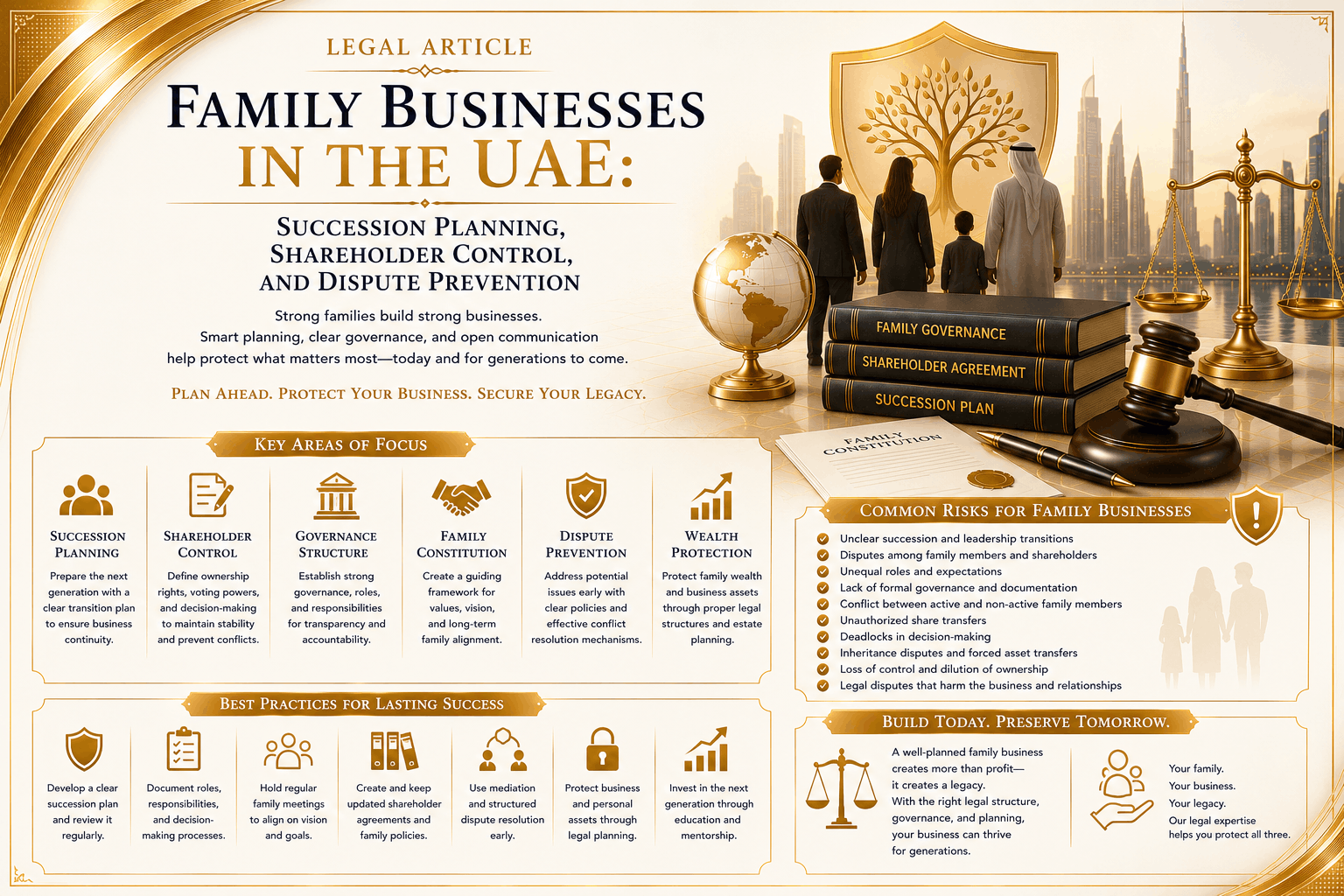
Family businesses in the UAE require careful legal planning because ownership, control, succession, inheritance, management roles, voting rights, and family expectations can directly affect business continuity.
UAE Legal Framework for Family Businesses
UAE family business matters may involve Federal Decree-Law No. 37 of 2022 concerning Family Businesses, commercial companies law, personal status and inheritance rules, free zone regulations, DIFC and ADGM structures, company registries, court procedures, arbitration clauses, shareholder agreements, and family charters.
Official UAE legislation portal | UAE Ministry of Economy | UAE Ministry of Justice | Relevant UAE authority website | Dubai Courts | Abu Dhabi Judicial Department | DIFC Courts | ADGM Courts
Key Legal Concepts and Definitions
Important concepts include family business, succession planning, shareholder agreement, family charter, family council, reserved matters, deadlock, buy-sell mechanism, voting control, inheritance disruption, and corporate governance.
Who UAE Family Business Rules Apply To
These rules may affect founders, spouses, children, heirs, siblings, shareholders, directors, managers, authorised signatories, family offices, holding companies, mainland companies, free zone companies, DIFC and ADGM entities, banks, employees, creditors, investors, and buyers.
Rights and Obligations of Founders, Shareholders, Heirs, Directors, and Managers
Founders should document succession and control. Shareholders should follow company documents and shareholder agreements. Directors and managers should act within authority, preserve records, avoid conflicts, and protect company assets. Heirs should understand that ownership rights and management authority are not always the same.
Succession Planning and Generational Transfer
Succession planning should address ownership transfer, leadership transition, voting control, emergency authority, buyout rights, dividends, heirs, minor shareholders, family employment, and dispute resolution. Planning should happen before death, incapacity, or conflict.
Family Charter, Family Council, and Governance Structures
A family charter can document values, succession rules, family employment policies, family council procedures, ownership principles, and dispute-resolution methods. Governance structures can separate family communication from board and management decisions.
Exit Mechanisms, Buy-Sell Rights, and Share Transfer Restrictions
Exit mechanisms can reduce conflict by setting rules for share sales, valuation, payment schedules, right of first refusal, tag-along rights, drag-along rights, death or incapacity buyouts, default buyouts, and restrictions on transfers to outsiders.
Inheritance-Related Disruption and Business Continuity
Inheritance issues may affect shares, voting control, bank mandates, management powers, guarantees, licences, and business continuity. The correct approach depends on company documents, wills, heirs, personal status rules, court procedures, and registry requirements.
Governance of Family Members Working in the Business
Family employment policies should address eligibility, qualifications, salary, promotion, reporting lines, performance evaluation, benefits, termination, conflicts of interest, and whether spouses or in-laws may work in the company.
Mainland, Free Zone, DIFC, ADGM, and Cross-Border Structures
Family businesses may be structured through mainland companies, free zone companies, holding companies, DIFC or ADGM vehicles, foundations, or cross-border groups. Each structure affects succession, governance, tax, jurisdiction, enforcement, and dispute resolution.
Procedures in the UAE
- Identify the family, company, ownership, management, and urgent risk profile.
- Review licences, articles, shareholder agreements, family charters, resolutions, bank mandates, and succession documents.
- Map control, succession, voting, deadlock, exit, inheritance, and management risks.
- Draft or update shareholder agreements, family charters, buy-sell clauses, reserved matters, and governance policies.
- Update registries, managers, authorised signatories, bank mandates, share records, and beneficial ownership filings where needed.
- Use mediation, settlement, court proceedings, arbitration, or authority filings where disputes arise.
- Implement agreed transfers, payments, governance changes, and business-continuity measures.
Required Documents and Evidence
- Trade licences, articles of association, memorandum of association, and company registers
- Shareholder agreements, family charters, family council rules, and succession plans
- Board resolutions, shareholder resolutions, powers of attorney, bank mandates, and authorised signatory records
- Financial statements, audit reports, accounting records, dividend records, loan agreements, and personal guarantees
- Employment contracts, salary records, role descriptions, meeting minutes, and family employment policies
- Emails, WhatsApp messages, bank transfers, receipts, valuation reports, and expert reports
- Wills, inheritance planning documents, death certificates, heirship documents, and court filings where relevant
- Legal notices, settlement correspondence, arbitration documents, and court records
Common Misunderstandings
- Family trust is enough without legal documents.
- Equal shares always prevent conflict.
- The eldest child automatically controls the company.
- Inheritance planning is only a personal matter.
- A shareholder agreement is only needed after a dispute starts.
- WhatsApp messages are enough to prove ownership.
- Settlement means one side lost.
- Ignoring the dispute will preserve family peace.
Common Mistakes to Avoid
- Relying on verbal promises about ownership or management
- Failing to sign shareholder agreements
- Leaving the founder as sole decision-maker without a succession plan
- Giving relatives roles without job descriptions or performance rules
- Allowing personal use of company funds
- Failing to document loans, dividends, and related-party transactions
- Ignoring minority shareholders and passive family members
- Failing to create exit and buy-sell mechanisms
- Sending emotional messages during disputes
Practical Examples
Founder Dies Without a Succession Plan
The family may face bank authority issues, management uncertainty, share transfer delays, and operational disruption. A lawyer would review company documents, heirship procedures, bank mandates, and interim authority options.
Siblings Own Equal Shares but Cannot Agree
Equal ownership can create deadlock. A shareholder agreement with buy-sell rights, valuation rules, reserved matters, and mediation can reduce the risk.
Family Member Uses Company Funds
The issue may involve authority, accounting evidence, related-party approvals, and possible recovery claims. Proper governance can prevent personal and company funds from being mixed.
Informal Promise of Shares
A family member claiming promised ownership needs evidence beyond emotion. Share registers, contracts, payments, emails, resolutions, and conduct may all become important.
Legal Risks and Consequences
Poor family business planning may cause shareholder disputes, inheritance disruption, deadlock, bank restrictions, misuse-of-funds claims, unpaid dividends, urgent court applications, arbitration, valuation disputes, employee uncertainty, creditor pressure, reputational harm, and loss of business value.
How a Lawyer Evaluates a Family Business Matter
A lawyer reviews the company structure, applicable law, jurisdiction, legal capacity, ownership records, shareholder agreements, articles, family charter, voting rights, authority documents, inheritance exposure, wills, management control, bank mandates, financial records, evidence strength, settlement options, litigation risk, enforcement possibilities, commercial impact, and client objectives.
How a Lawyer Builds a Stronger Legal Position
Legal support may include drafting shareholder agreements, family charters, succession plans, board resolutions, reserved matters, buy-sell clauses, valuation procedures, employment policies, exit agreements, legal notices, mediation submissions, settlement agreements, court pleadings, arbitration claims, and evidence bundles.
Settlement vs Litigation or Family Business Mediation
Settlement may protect the company, employees, and family reputation. Litigation or arbitration may be needed where there is fraud, misuse of funds, refusal to recognise ownership, unauthorised asset transfer, breach of shareholder agreement, or urgent need to stop harmful conduct.
When Urgent Legal Action May Be Needed
- A founder dies or becomes incapacitated
- A bank account is at risk of being frozen or misused
- A shareholder is transferring assets without approval
- A manager is signing contracts without authority
- Company funds are being used for personal expenses
- Important evidence may be deleted
- A company sale is being negotiated without consent
- Court, arbitration, or authority deadlines apply
Frequently Asked Questions
1. What law regulates family businesses in the UAE?
Federal Decree-Law No. 37 of 2022 concerning Family Businesses is the key UAE law for registered family businesses. Other company, inheritance, free zone, DIFC, ADGM, and contract rules may also apply.
2. Is every family-owned company automatically a registered family business?
No. A company may be family-owned without being registered as a family business. Registration should be reviewed according to the company structure and family objectives.
3. Why is succession planning important?
Succession planning protects continuity by clarifying ownership, management, voting, dividends, buyout rights, and treatment of heirs before death, incapacity, or retirement.
4. What is a family charter?
A family charter documents family principles, succession rules, employment policies, family council procedures, ownership expectations, and dispute-resolution methods.
5. Do family businesses need shareholder agreements?
Yes, in most cases. Shareholder agreements help regulate voting, reserved matters, exit rights, transfers, valuation, deadlock, dividends, confidentiality, and dispute resolution.
6. What happens to company shares when a shareholder dies?
The answer depends on company documents, succession planning, wills, inheritance rules, heirs, and court or registry procedures. Control does not always pass automatically in the way family members expect.
7. How can deadlock be prevented?
Deadlock can be reduced through voting rules, reserved matters, mediation clauses, family council escalation, buy-sell rights, valuation mechanisms, and clear management authority.
8. When is mediation useful?
Mediation is useful where the family wants to preserve relationships and business value while resolving dividends, exits, management roles, information rights, or governance disputes.
9. Can family members working in the company receive different salaries?
Yes, but there should be a clear employment policy based on role, qualifications, performance, and market practice rather than informal family expectations.
10. Why is early legal advice important?
Early legal advice helps document ownership, prevent deadlock, organise succession, protect bank access, draft enforceable agreements, and resolve disputes before they damage company value.
Conclusion
Family businesses in the UAE require legal structure, succession planning, shareholder control, governance discipline, inheritance readiness, and dispute-prevention mechanisms.
Early legal advice can help founders, shareholders, heirs, and managers protect family wealth and business continuity through properly drafted agreements, governance documents, exit mechanisms, and dispute-resolution strategies.
Need Advice About UAE Family Businesses?
Obtain tailored advice on succession planning, shareholder agreements, family charters, voting controls, exit mechanisms, inheritance exposure, governance records, settlement, mediation, litigation, and arbitration strategy.
Book a Legal Consultation