

UAE Family and Personal Status Law
Establishing Parentage in the UAE: Legal Procedures, Evidence, and Consequences of Court JudgmentsA detailed guide to UAE parentage and lineage claims, court-supervised DNA evidence, birth registration, legal acknowledgments and the effects of a judgment on identity, maintenance, custody and inheritance.
Legal Article Jurisdiction: United Arab Emirates Last reviewed: July 2026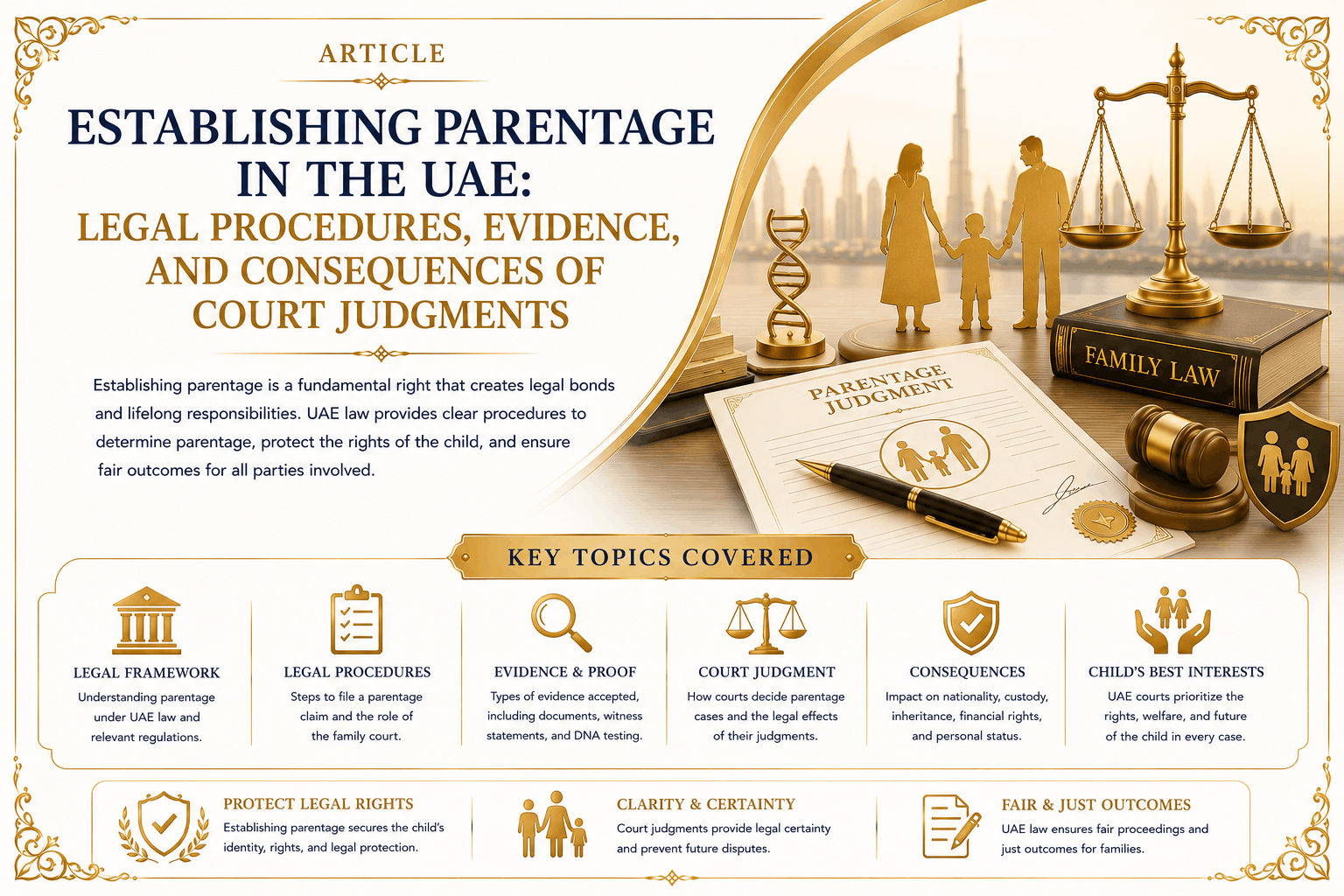 UAE parentage proceedings may involve marriage records, formal
acknowledgments, court-supervised DNA evidence and amendments to
official identity records.
UAE parentage proceedings may involve marriage records, formal
acknowledgments, court-supervised DNA evidence and amendments to
official identity records.
Establishing parentage in the UAE is not merely a question of biological connection. It is a legal process that may determine a child’s official identity, birth registration, maintenance rights, family name, guardianship arrangements, inheritance position and relationship with government authorities.
A biological relationship may exist as a matter of fact, but that relationship does not always become legally effective simply because one party says that it exists or because a private DNA report appears to confirm it. UAE courts examine the applicable personal status framework, the circumstances of the child’s birth, any marriage or acknowledgment, the reliability of the evidence and the procedural route through which the application or dispute has been brought.
The legal position can become particularly sensitive where the parents are not married, where one parent refuses to acknowledge the child, where the mother was married to another person at the relevant time, where the alleged father has died, or where expatriates may seek to rely on foreign law.
Why early legal advice matters
An incorrectly filed application may be rejected. A private DNA test may not carry the legal effect expected by the parties. An informal acknowledgment may create evidence that later prevents a denial of parentage. Delay may also complicate birth registration, maintenance or inheritance proceedings.
The UAE Legal Framework Governing Parentage
Federal Decree-Law No. 41 of 2024 on Personal Status
The principal general framework is Federal Decree-Law No. 41 of 2024 on the Issuance of the Personal Status Law. It became effective on 15 April 2025 and replaced the former Federal Personal Status Law.
The law uses the concept of lineage in its official English translation. In practical legal discussions, the terms lineage, parentage, maternity and paternity may be used depending on the issue being addressed.
The law recognises several possible methods of establishing parentage, including birth during marriage, legally effective acknowledgment, other admissible proof and scientific methods. Parentage to the mother is established through proof of birth.
Parentage arising from marriage
Where a child is born during a standing marriage, the timing of the marriage, pregnancy, birth, separation and possible contact between the spouses can be legally decisive. The law contains statutory pregnancy periods and rules governing attribution to the husband.
A person should not assume that the biological question alone resolves the case. The court must examine whether a legal presumption already applies and whether the law permits that presumption to be challenged.
Parentage established by acknowledgment
An acknowledgment may establish parentage where the statutory conditions are satisfied. Relevant issues include the legal capacity and free will of the person making the acknowledgment, whether the child’s lineage is otherwise unknown and whether the age difference reasonably supports the claimed relationship.
A message saying “this is my child,” a signed declaration, participation in birth registration, payment of expenses or consistent conduct may become important evidence. Whether that conduct amounts to a legally effective acknowledgment depends on the circumstances and applicable law.
Scientific methods and court-ordered DNA testing
The court may order DNA testing in disputed lineage proceedings and other legally recognised circumstances. A private DNA report does not automatically amend a birth certificate or create an enforceable legal relationship. The evidence must be received and assessed through the appropriate judicial process.
Restrictions on denying established parentage
Where parentage has been legally established through recognised methods, a later denial may be inadmissible. The general Personal Status Law also contains a specialised and highly time-sensitive route for a husband seeking to deny lineage in qualifying circumstances.
Important deadline warning
Under the relevant denial provisions, a 15-day period from knowledge of the birth may apply, and an earlier express or implied acknowledgment can prevent the denial. Immediate advice is essential before signing documents, sending messages or delaying action.
Civil personal status framework for non-Muslims
Federal Decree-Law No. 41 of 2022 on Civil Personal Status is also relevant to non-Muslim UAE citizens and non-Muslim foreign residents falling within its scope. It recognises parentage through marriage or acknowledgment and permits court-ordered DNA testing under its statutory conditions.
Determining whether the general Personal Status Law, Civil Personal Status Law, permitted foreign law or a local Abu Dhabi civil family framework applies may require analysis of nationality, religion, residence, marital status and the relief requested.
Birth registration legislation
UAE birth-registration legislation distinguishes between the hospital notification of birth, the official civil registration of the child and the legal documents needed to identify the parents.
A successful parentage judgment may therefore be only one stage. The judgment may then need to be presented to the competent health or registration authority so that the birth certificate and related records can be issued or amended.
Dubai and Abu Dhabi procedures
Dubai matters are generally handled through the onshore personal status and family court system using the applicable Dubai Courts registration and electronic filing procedures.
Abu Dhabi has additional civil family procedures for certain foreign and non-Muslim family matters. In qualifying uncontested cases, parents who both acknowledge biological parenthood may submit a designated application supported by the birth notification, identity documents and other requested evidence.
DIFC and ADGM courts
Ordinary parentage proceedings are family and personal status matters. They are not normally filed as commercial disputes before the DIFC or ADGM courts. The competent forum will generally be the relevant onshore personal status or civil family court.
Key Legal Concepts and Definitions
Biological parentage
Biological parentage concerns the genetic relationship between a child and a biological parent. DNA testing may provide scientific evidence of this relationship, but biology is not always identical to legal status.
Legal parentage or lineage
Legal parentage is the status recognised by law and reflected in a court judgment or official civil record. It may create rights and duties relating to identity, maintenance, guardianship and inheritance.
Birth notification and birth certificate
A birth notification records the medical event of birth. A birth certificate is the official civil status document issued by the competent authority. The notification does not always resolve a disputed claim concerning the identity of the legal father.
Acknowledgment
An acknowledgment is a statement or conduct accepting a parent-child relationship. It is subject to legal conditions and should never be treated as a casual or easily reversible declaration.
Establishment and denial claims
An establishment claim seeks judicial recognition of a legal parent-child relationship. A denial claim seeks to challenge an existing legal attribution and is subject to stricter restrictions.
Who UAE Parentage Law Applies To
- A mother seeking recognition of the child’s father.
- A father seeking to be legally recognised.
- A husband challenging attribution of a child born during marriage.
- A child seeking identity, maintenance or inheritance rights.
- An adult child seeking recognition after many years.
- Parents who agree but cannot obtain a birth certificate administratively.
- Expatriate parents whose documents were issued abroad.
- Heirs disputing whether a claimant is related to a deceased person.
- Guardians acting on behalf of minors.
- Non-Muslim families using civil personal status procedures.
The applicable law cannot be identified by looking only at the child’s place of birth. Nationality, religion, marital circumstances, residence, earlier judgments and the specific court orders requested may all be relevant.
Rights and Obligations Arising from Parentage
Identity and civil records
Once parentage is established, the judgment may support the issuance or amendment of the child’s birth certificate and other records. Parentage does not automatically determine nationality, which is governed by separate legislation.
Maintenance
Legal parentage may provide the basis for a child-maintenance claim. Maintenance may include food, clothing, accommodation, medical treatment and education, depending on the applicable law and the child’s circumstances.
Custody and guardianship
Parentage can affect who may request custody, visitation or guardianship orders. Establishing parentage does not automatically grant unrestricted physical custody. These matters are determined under separate legal standards.
Inheritance
Parentage may determine whether a child is legally recognised as an heir. Where the alleged parent has died, the claimant may need to coordinate the parentage proceedings with an estate file.
Accuracy and truthfulness
Parties must provide accurate information to hospitals, courts, notaries and registration authorities. False declarations, forged acknowledgments or manipulated testing may create serious legal consequences.
Procedures for Establishing Parentage in the UAE
Step 1Initial legal assessment
Review the child’s birth status, nationality, religion, marriage history, existing acknowledgments and current civil records.
Step 2Identify jurisdiction
Determine the competent court based on residence, domicile, workplace, the child’s location and the local judicial system.
Step 3Determine applicable law
Assess whether the general Personal Status Law, Civil Personal Status Law, permitted foreign law or a local civil family framework applies.
Step 4Organise documents
Attest and translate foreign marriage, birth, divorce and identity records where required.
Step 5Draft the application
Set out the legal capacity of the parties, chronology, evidence and precise orders requested from the court.
Step 6Register and serve
File through the relevant court portal, typing centre or licensed lawyer and complete service on the respondent.
Step 7Evidence and DNA
Submit documents, respond to court questions and attend any court-ordered testing or expert procedure.
Step 8Judgment and implementation
Obtain the final judgment, address any appeal and submit it to the competent registration and other authorities.
Initial consultation and chronology
The lawyer should identify dates of conception, marriage, separation, birth and acknowledgment, together with the child’s current official status. A precise chronology is often the foundation of the case.
Family guidance and settlement review
Suitable family disputes may be referred to Family Guidance. Urgent matters and cases where reconciliation is not feasible may proceed differently. Local practice and the classification of the request affect this stage.
Judgment and appeal
The court may establish or reject parentage and address connected relief where it has been properly requested. The applicable challenge period depends on whether the decision is a final judgment, interim order or petition order.
Administrative implementation
A final judgment may need to be submitted to health, civil registration, immigration, embassy, education or estate authorities. The legal process is not complete until the required records have been updated.
Required Documents and Evidence
Identity documents
- Emirates IDs and passports.
- Residence visas.
- Family books or nationality records where applicable.
- The child’s existing identity documents.
Birth and medical evidence
- Hospital birth notification.
- Existing birth certificate.
- Antenatal and delivery records.
- Medical reports concerning pregnancy dates.
- Records establishing the identity of the mother who gave birth.
Marriage and separation records
- UAE or foreign marriage certificates.
- Civil marriage certificates.
- Divorce judgments.
- Separation agreements.
- Documents proving when the marriage began or ended.
Acknowledgment evidence
- Notarised or embassy declarations.
- Signed parentage forms.
- Birth registration declarations.
- Messages accepting the child as a son or daughter.
- Insurance, school or medical forms naming the parent.
- Consistent financial support records.
Electronic evidence
WhatsApp messages, emails, photographs, voice notes and electronic transfers may support the chronology or acknowledgment. Original devices, full conversations, metadata and account details should be preserved where possible.
DNA evidence
Court-supervised testing may involve appointment notices, verified identification, controlled sample collection, chain-of-custody records and an approved laboratory report.
Foreign-law evidence
Where a party requests application of foreign law, an authoritative and properly translated explanation may be required. Informal internet summaries are not a safe substitute for proper legal evidence.
The Role of DNA Testing
Three questions must remain separate:
- Does the test establish a biological relationship?
- Is the test procedurally reliable and admissible?
- Does the law permit the result to change the legal parentage?
A private home test may appear to answer the first question but fail to answer the second and third. Courts may prefer testing conducted under a judicial order because identity, collection and chain of custody can be controlled.
DNA evidence does not automatically override every legal presumption. Where parentage has already been established, the law may restrict a later denial.
Legal note
Refusing a court-ordered test or failing to attend an appointment should never be treated as a routine decision. The legal consequences depend on the type of proceedings, applicable law and directions issued by the court.
Common Misunderstandings
A positive private DNA test automatically creates legal parentage
It does not. A competent court or authority process may still be required.
A birth notification is the same as a birth certificate
The notification records the medical event. The certificate is the official civil status document.
Both parents agree, so a court order can never be required
Agreement may simplify the case, but judicial approval may still be needed to issue or amend an official record.
A father can deny parentage at any time
Denial may be subject to strict time limits, legal presumptions and restrictions following acknowledgment.
DNA always overrides marriage
Parentage arising during marriage involves statutory presumptions and specialised denial rules.
WhatsApp messages are always decisive
Messages may be relevant, but authenticity, context and the legal conditions for acknowledgment remain important.
Parentage automatically grants nationality
Parentage and nationality are separate legal questions.
A parentage judgment automatically grants maintenance and custody
Those rights may require separate requests or proceedings.
Common Mistakes to Avoid
- Waiting until evidence or statutory rights are lost.
- Signing an acknowledgment without understanding its effect.
- Using an unverified private DNA provider.
- Filing only for a birth certificate when parentage is disputed.
- Starting proceedings in the wrong court.
- Ignoring an existing legal father or marriage presumption.
- Submitting inconsistent dates and incomplete records.
- Relying only on cropped screenshots.
- Failing to attest and translate foreign documents.
- Failing to implement the judgment after it becomes final.
Practical UAE Examples
Foreign married parents cannot obtain a birth certificate
The parents are legally married abroad, but the marriage certificate has not been attested or translated. The issue may be defective documentation rather than disputed parentage.
The appropriate strategy may be to complete legalisation and certified translation before filing a court case.
Unmarried foreign parents in Abu Dhabi agree on parentage
Both parents acknowledge biological parenthood but require a judicial order to obtain the birth certificate. A qualifying Abu Dhabi Civil Family Court application may provide a streamlined route.
A husband suspects he is not the biological father
The child was born during marriage. The husband delays taking advice and continues describing himself as the father. The delay and conduct may prevent a later denial.
An adult child claims inheritance
The alleged father has died and the heirs dispute the relationship. The parentage case may need to be coordinated with the estate proceedings and preservation of disputed assets.
A private DNA report is positive
The civil authority nevertheless refuses to change the record. The court may require a legally recognised acknowledgment or a new court-supervised test.
The mother was married to another person
The claim cannot be treated as a simple agreement between the biological parents. The existing marital presumption and specialised legal conditions must be addressed.
Legal Risks and Consequences
- Rejection of the claim.
- Continued inability to obtain or amend a birth certificate.
- Loss of maintenance or inheritance opportunities.
- Conflicting identity records.
- Delayed passport or residency processing.
- Loss of a strict denial deadline.
- Exposure of sensitive family information.
- Allegations involving forged documents or false statements.
- Difficulty obtaining evidence after a parent dies or leaves the UAE.
- Distribution of an estate before the claim is resolved.
Privacy is especially important. Public accusations or messages sent to employers and relatives may create additional legal and reputational problems without strengthening the court case.
How a UAE Lawyer Evaluates a Parentage Case
Jurisdiction and applicable law
The lawyer identifies the correct court and determines whether the general Personal Status Law, Civil Personal Status Law, foreign law or a local civil family framework applies.
Existing legal status
The birth certificate, marriage records, previous acknowledgments and any existing attribution to another person are reviewed.
Procedural classification
The matter may be an administrative request, joint application, contested establishment claim, denial claim or parentage dispute connected to an estate.
Evidence strength
A detailed evidence matrix identifies official documents, admissions, contradictions, missing evidence, DNA availability, witnesses, electronic communications and medical chronology.
Client objectives
The lawyer determines what is required after judgment: a birth certificate, maintenance, custody rights, inheritance recognition or amendment of an existing record.
How a Lawyer Builds a Stronger Legal Position
- Preparing a precise factual chronology.
- Identifying the correct statutory basis.
- Reviewing whether acknowledgment has already occurred.
- Preserving electronic evidence in its original form.
- Obtaining attested and translated documents.
- Drafting a legally focused claim.
- Requesting court-supervised DNA testing where appropriate.
- Preparing for refusal or non-attendance by another party.
- Coordinating parentage and estate proceedings.
- Protecting the child’s privacy.
- Drafting orders that registration authorities can implement.
- Monitoring appeal and judgment-finality requirements.
Professional legal representation cannot guarantee a result. Its purpose is to improve legal clarity, procedural compliance, evidence reliability and strategic decision-making.
Settlement Versus Litigation
Settlement may be useful where the parties agree on biological parentage but disagree about documents, maintenance, testing or the method for obtaining a birth certificate.
A negotiated arrangement may address:
- Cooperation with DNA testing.
- Signing an appropriate acknowledgment.
- Submission of identity and birth documents.
- Temporary payment of child-related expenses.
- Confidentiality.
- Future maintenance or contact, subject to legal approval.
Litigation may remain necessary where one party denies the relationship, another person is already recorded as the father, fraud is alleged, the alleged parent has died or an official record cannot be amended administratively.
When Urgent Legal Action May Be Required
- A husband is considering denying lineage of a newborn.
- The child urgently needs a birth certificate or passport.
- The alleged parent may leave the UAE.
- Medical or electronic evidence may be lost.
- The alleged father has died and the estate is being distributed.
- Another person is already recorded as the legal father.
- A court-ordered DNA appointment has been scheduled.
- An appeal period is running.
- The child lacks healthcare, education or residency documents.
Do not act informally before legal assessment
Signing a declaration, refusing a test, sending an acknowledgment or making public accusations may permanently affect the legal position.
Frequently Asked Questions
1. How can parentage be established in the UAE?
Parentage may be established through marriage, acknowledgment, documentary evidence, scientific methods such as DNA testing or a competent court judgment, depending on the applicable law.
2. Is a DNA test compulsory in every parentage case?
No. The court may order testing where it is legally relevant, but some cases can be resolved through marriage documents or legally valid acknowledgment.
3. Will the court accept a private DNA test?
It may be supporting material, but the court can require a new approved test with verified identities and reliable chain of custody.
4. Can parentage be established when the parents are not married?
Potentially, depending on nationality, religion, applicable law, acknowledgment, the child’s current legal status and the competent court procedure.
5. Can a father withdraw an acknowledgment?
A person should not assume an acknowledgment can simply be withdrawn. Once parentage is legally established, a later denial may be inadmissible.
6. Can a husband challenge parentage after birth?
A specialised and time-sensitive legal route may be available. Immediate advice is essential because delay or earlier acknowledgment may prevent the claim.
7. What happens after the court establishes parentage?
The judgment may need to be presented to health and civil registration authorities. Additional applications may be required for maintenance, custody, immigration or inheritance.
8. Does establishing parentage automatically grant custody?
No. Custody, guardianship and visitation are governed by separate legal standards.
9. Can an adult file a parentage claim?
An adult may potentially seek recognition, particularly where identity or inheritance rights are affected.
10. Can parentage be established after the alleged father dies?
It may be possible, but the case may involve official records, acknowledgments, witnesses, scientific evidence and related estate proceedings.
11. Does parentage automatically grant UAE nationality?
No. Nationality is governed by separate legislation and decision-making requirements.
12. How long does a parentage case take?
Duration depends on the emirate, service, testing, foreign documents, hearings, applicable law and whether an appeal is filed.
Conclusion
Establishing parentage in the UAE requires more than proof of a biological relationship. The court may need to determine the applicable law, examine marriage and birth records, assess acknowledgments, consider statutory presumptions and order reliable scientific testing.
The legal consequences can affect identity, civil records, maintenance, custody, guardianship and inheritance. Early strategy helps preserve evidence, avoid damaging admissions and ensure that the final judgment can be implemented by the competent authorities.
Official sources to verify
- Official UAE legislation portal
- UAE Ministry of Justice
- Dubai Courts
- Abu Dhabi Judicial Department
- Relevant UAE health authority
- DIFC Courts
- ADGM Courts
Obtain Tailored Legal Advice
If you are facing a parentage, paternity, birth-registration or lineage dispute in the UAE, early legal advice can help you understand your rights, assess your evidence and select the correct strategy before the matter becomes more complicated.
Request a Legal Consultation Legal Disclaimer: This article is provided for general information only and does not constitute legal advice. It should not be relied upon as a substitute for advice based on the specific facts, documents, applicable law and current procedures of your case. UAE legislation and local court procedures may be amended. Where relevant, the original Arabic legislation prevails. Legal Services Legal Consultation UAE Law Articles About Us Contact Us