

UAE environmental law | Pollution claims | Waste management | ESG risk | Remediation duties | Regulatory enforcement | Environmental compliance
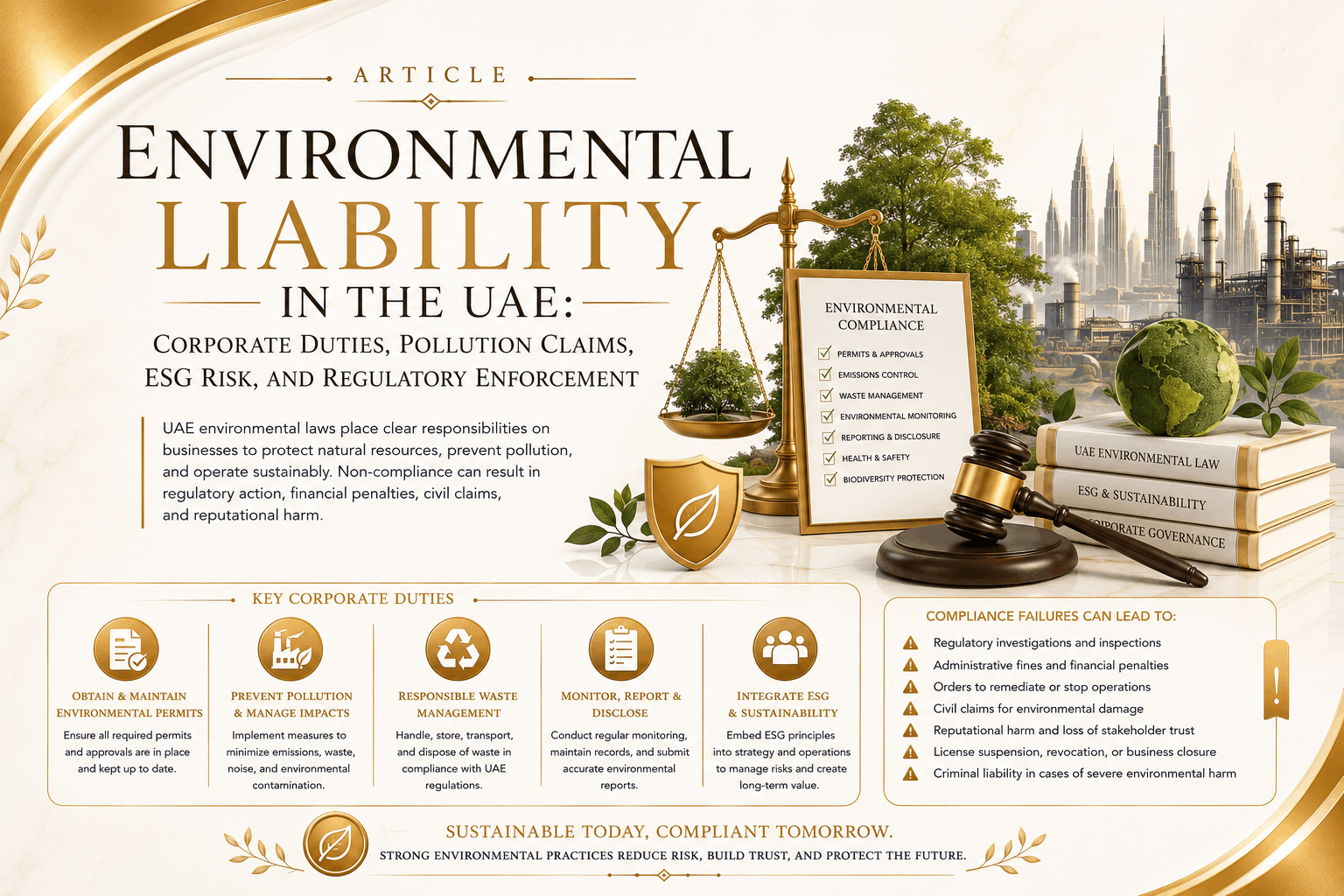 A practical guide to environmental liability in the UAE, covering corporate duties,
pollution incidents, waste management, remediation, ESG representations,
administrative enforcement, and civil liability for environmental harm.
A practical guide to environmental liability in the UAE, covering corporate duties,
pollution incidents, waste management, remediation, ESG representations,
administrative enforcement, and civil liability for environmental harm.
Environmental liability in the UAE affects companies, investors, contractors, landlords, tenants, operators, ESG teams, and affected parties where pollution, waste mismanagement, contamination, misleading sustainability claims, or regulatory breaches arise.
Key principle: Environmental risk is not only an operational issue. It can become a regulatory, civil, contractual, insurance, ESG, and reputational dispute.UAE Legal Framework for Environmental Liability
Environmental liability in the UAE may involve federal environmental protection law, integrated waste management law, executive regulations, public health rules, local emirate authority requirements, free zone conditions, environmental permits, inspections, civil liability, contract law, insurance, and ESG governance.
Official-source placeholders:Official UAE legislation portal | UAE Ministry of Climate Change and Environment | Relevant UAE authority website | Dubai Municipality | Abu Dhabi Judicial Department | DIFC Courts | ADGM Courts
Key Legal Concepts and Definitions
Important concepts include environmental liability, pollution, waste management, hazardous waste, environmental impact assessment, remediation, ESG risk, competent authority, regulatory breach, administrative enforcement, causation, and environmental damage.
Who Environmental Liability in the UAE Applies To
These rules may affect industrial companies, factories, construction contractors, developers, waste-management operators, logistics companies, warehouses, chemical suppliers, healthcare facilities, laboratories, hotels, ports, ship operators, oil and gas operators, landlords, tenants, free zone companies, mainland companies, directors, ESG officers, compliance teams, insurers, and affected neighbours.
Rights and Obligations of Companies, Directors, Operators, Contractors, Landlords, Tenants, and Affected Parties
Companies may respond to authority findings, defend unsupported allegations, and claim against contractors, but they must comply with permits, waste rules, authority notices, and recordkeeping duties. Affected parties may complain, preserve evidence, seek inspection, request remediation, and pursue compensation where legally justified.
Pollution Incidents, Waste Management, and Remediation Duties
Pollution incidents require containment, evidence preservation, authority communication, technical assessment, insurance review, and contractual analysis. Waste management must be documented through proper collection, storage, transport, treatment, recycling, and disposal records, especially where hazardous waste is involved.
ESG Risk, Sustainability Claims, and Corporate Disclosures
ESG statements should be supported by reliable records. Recycling rates, emissions claims, sustainable sourcing, carbon reduction, green-building claims, and waste-diversion statements may create legal and reputational risk if they are inaccurate, exaggerated, outdated, or unsupported.
Inspections, Administrative Enforcement, and Regulatory Notices
Environmental inspections may be routine, complaint-based, incident-based, or follow-up inspections. A regulatory notice should be answered carefully with evidence, corrective action, technical records, and legal analysis. Ignoring a notice can increase regulatory and commercial risk.
Civil Liability, Contractual Claims, Insurance, and Evidence
Environmental disputes may lead to claims between landlords and tenants, owners and contractors, buyers and sellers, insurers and policyholders, or neighbours and operators. Contract wording, expert evidence, sampling, authority records, insurance notices, and causation analysis are often decisive.
Dubai, Abu Dhabi, Other Emirates, Free Zones, DIFC, and ADGM Considerations
Federal law is important across the UAE, but emirate-level authorities, municipalities, environmental agencies, free zones, ports, industrial zones, and sector regulators may impose additional requirements. DIFC and ADGM may become relevant where the issue concerns contracts, ESG disclosure, corporate governance, investment disputes, or holding-company exposure.
Procedures in the UAE
- Classify the issue as pollution, waste breach, ESG risk, authority notice, civil claim, insurance dispute, or contractor dispute.
- Contain immediate harm where safe while preserving evidence.
- Identify the competent federal, local, free zone, municipal, environmental, or sector authority.
- Review permits, contracts, leases, waste records, ESG statements, insurance policies, and inspection history.
- Instruct technical experts where sampling, contamination mapping, or remediation planning is required.
- Prepare authority responses, complaints, corrective action plans, or legal notices with evidence.
- Negotiate remediation, payment, responsibility, insurance coverage, or settlement where appropriate.
- Consider court proceedings, expert appointment, judgment, and enforcement if settlement fails.
Required Documents and Evidence
- Environmental permits, trade licences, industrial licences, free zone approvals, and authority correspondence
- Environmental impact assessments, inspection reports, corrective action notices, and monitoring data
- Waste collection contracts, hazardous waste manifests, disposal certificates, and transporter records
- Contractor agreements, subcontractor records, leases, sale agreements, and indemnity clauses
- Site maps, drainage plans, equipment logs, maintenance records, safety data sheets, and incident reports
- Photographs, videos, CCTV, soil tests, water tests, air tests, laboratory reports, and expert reports
- Insurance policies, claim notices, ESG reports, sustainability disclosures, supplier certificates, and audit files
- Emails, WhatsApp messages, board minutes, public statements, legal notices, and settlement correspondence
Common Misunderstandings
- Environmental compliance is only for heavy industry.
- If a contractor caused the spill, the company has no risk.
- A free zone licence solves all environmental compliance issues.
- Cleaning the site quickly is enough.
- ESG statements are just marketing.
- Waste receipts are always enough.
- All emirates follow the same environmental process.
- Ignoring an authority notice buys time.
Common Mistakes to Avoid
- Starting operations before environmental approvals are checked
- Using unapproved or poorly documented waste contractors
- Mixing hazardous and ordinary waste
- Failing to preserve evidence after a spill
- Making admissions in emotional emails or WhatsApp messages
- Ignoring inspection notices or authority deadlines
- Publishing ESG claims without data support
- Signing leases or sale agreements without environmental clauses
- Waiting until enforcement action begins before seeking legal advice
Practical Examples
Construction Runoff Damages a Neighbouring Property
A contractor allows sediment and water to flow onto neighbouring property. The better approach is to preserve photos, drainage records, weather data, site logs, authority communications, and contracts before negotiating liability or remediation.
Tenant Leaves Contaminated Industrial Premises
A landlord discovers chemical residue after lease expiry. The dispute turns on handover evidence, lease clauses, inspection reports, expert testing, and whether contamination occurred during the tenant’s occupation.
Waste Contractor Dumps Material Illegally
A company hires a low-cost waste contractor and later faces questions about unlawful disposal. Proper contractor due diligence, manifests, disposal certificates, indemnities, and audit rights would strengthen the company’s position.
ESG Report Overstates Recycling Performance
A company publishes recycling claims that are not supported by waste records. A lawyer would review data sources, public statements, investor documents, approval trails, and correction strategy.
Legal Risks and Consequences
Poor environmental handling may lead to administrative penalties, corrective action orders, remediation costs, permit restrictions, operational suspension, licence non-renewal, civil compensation claims, contract termination, insurance denial, criminal complaint risk, shareholder disputes, loss of tenders, financing problems, reputational damage, project delay, and business interruption.
How a Lawyer Evaluates an Environmental Liability Matter
A lawyer reviews jurisdiction, competent authority, applicable law, permits, environmental conditions, legal capacity, contracts, lease terms, evidence strength, causation, authority notices, inspection history, insurance coverage, technical expert requirements, ESG statements, settlement options, litigation risk, enforcement possibilities, commercial impact, and client objectives.
How a Lawyer Builds a Stronger Legal Position
Legal support may include reviewing permits, organising evidence, instructing environmental experts, preserving samples and documents, preparing authority responses, drafting legal notices, reviewing waste contracts, negotiating remediation, preparing claims or defences, advising on ESG disclosures, coordinating insurance notifications, and representing the client before authorities or courts.
Settlement vs Litigation or Regulatory Complaint
Settlement may be useful for remediation cost, contractor responsibility, lease restoration, neighbour damage, insurance contribution, or ESG correction. Litigation or formal complaints may be necessary where there is serious environmental harm, refusal to remediate, repeated breach, major financial loss, or public health risk.
When Urgent Legal Action May Be Needed
- A spill, leak, fire, or discharge is ongoing
- Hazardous waste is improperly stored or transported
- Evidence may be lost through clean-up or weather
- An authority inspection or deadline is imminent
- A regulator notice requires immediate response
- A site sale or lease handover is about to close
- Insurance notification may be required
- ESG claims are being challenged publicly
- Operations may be suspended or restricted
Frequently Asked Questions
1. What is environmental liability in the UAE?
Environmental liability means legal responsibility for pollution, contamination, waste mismanagement, environmental harm, regulatory breach, remediation failure, misleading ESG claims, or non-compliance with environmental permits and authority requirements.
2. Which UAE laws are relevant?
Federal environmental law, integrated waste management law, executive regulations, public health rules, local authority requirements, free zone conditions, permits, civil liability principles, and contract law may all be relevant depending on the facts.
3. Can a company be liable for a contractor’s pollution?
Potentially, yes. A contractor may be directly responsible, but the company may still face authority scrutiny, civil claims, or contractual exposure depending on control, supervision, permits, records, and contract terms.
4. What should a company do after a pollution incident?
It should contain the incident where safe, preserve evidence, identify the material released, review permits, identify the competent authority, notify insurers where required, instruct technical experts, and avoid careless admissions.
5. Are ESG statements legally risky?
Yes. ESG statements can create legal, regulatory, investor, procurement, and reputational risk if they are inaccurate, exaggerated, outdated, or unsupported by reliable data.
6. What documents are important?
Important documents include permits, inspection reports, waste manifests, disposal certificates, contracts, leases, site maps, sampling reports, laboratory results, authority correspondence, insurance policies, ESG reports, photographs, videos, and expert reports.
7. Can environmental disputes become court cases?
Yes. Environmental issues may lead to claims for property damage, remediation costs, contractual indemnity, negligence, lease restoration, insurance disputes, or commercial loss. Expert evidence is often important.
8. Are hazardous waste duties stricter?
Usually, yes. Hazardous waste requires careful separation, handling, treatment, monitoring, transport, and disposal under the competent authority’s requirements.
9. Do free zone companies have environmental duties?
Yes. Free zone companies may need to comply with federal law, local authority requirements, free zone rules, waste-management conditions, and sector-specific approvals.
10. Why is legal advice important?
Legal advice helps identify the correct authority, preserve evidence, coordinate experts, review contracts and permits, respond to notices, protect insurance rights, negotiate remediation, and prepare claims or defences.
Conclusion
Environmental liability in the UAE requires careful understanding of federal law, waste-management duties, local authority practice, free zone requirements, permits, ESG representations, civil liability, insurance, and technical evidence.
Early legal strategy can help companies and affected parties preserve evidence, respond to authorities, manage remediation, assess responsibility, protect insurance rights, and avoid turning a manageable environmental issue into a serious enforcement dispute.
Need Advice About Environmental Liability in the UAE?
Obtain tailored advice on pollution claims, waste management, remediation, ESG risk, authority notices, inspections, civil claims, regulatory enforcement, insurance, and environmental dispute strategy.
Book a Legal ConsultationLegal Disclaimer: This article is for general information only and does not constitute legal advice. The correct legal position depends on the emirate, authority, activity, permits, documents, evidence, environmental impact, and procedural stage.
Services | Legal Consultation | Contact Us | UAE Law Articles | About Us