E-Commerce Liability in the UAE: Platform Terms, Seller Duties, Refunds, and Customer Complaints
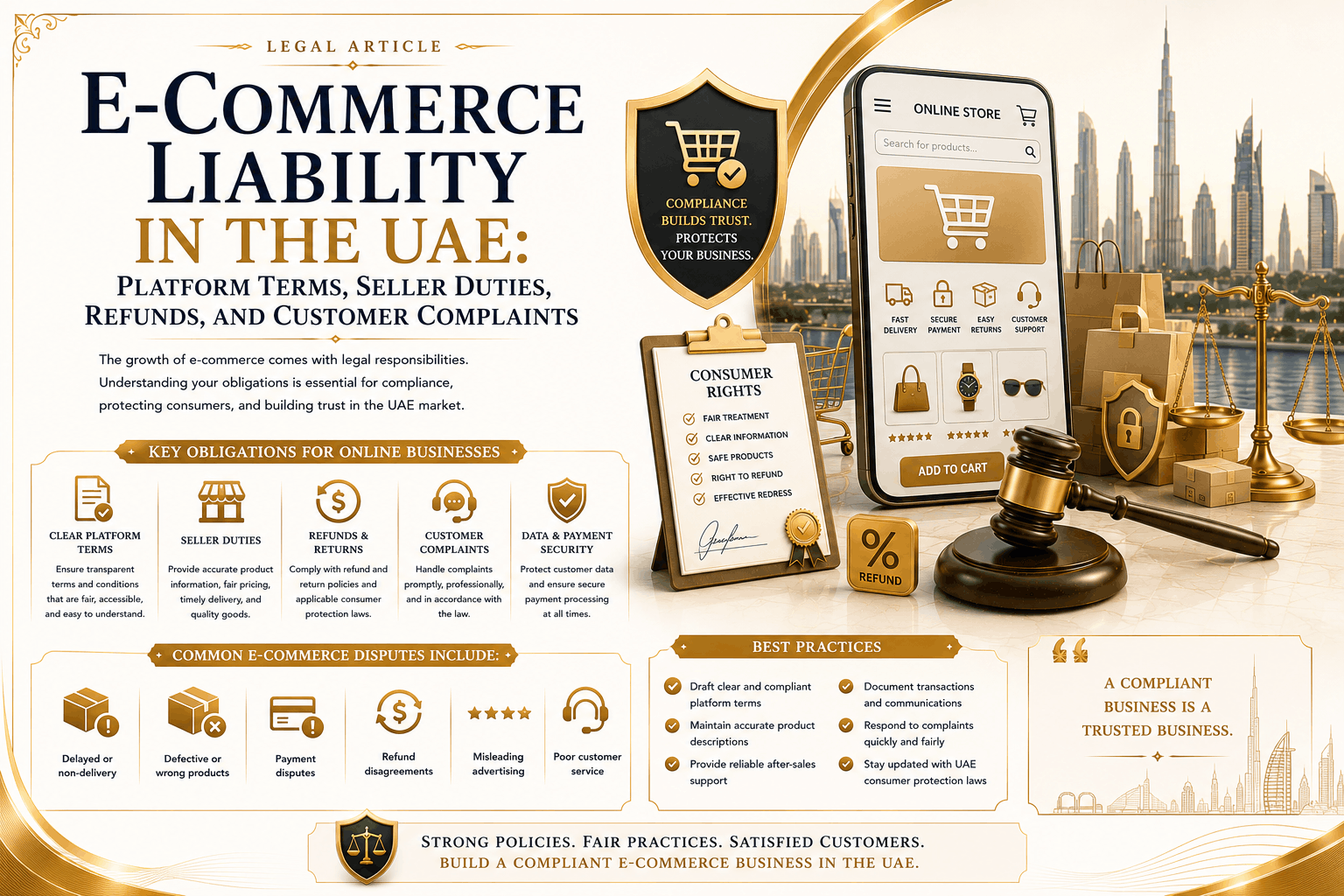
E-commerce liability in the UAE affects online stores, marketplace platforms, social media sellers, customers, payment providers, logistics partners, and businesses that sell goods or services through digital channels.
UAE Legal Framework for E-Commerce Liability
UAE e-commerce liability may involve Federal Decree-Law No. 14 of 2023 on Modern Technology-Based Trade, Federal Law No. 15 of 2020 on Consumer Protection, electronic transactions rules, personal data protection, payment regulations, advertising rules, product safety requirements, local consumer complaint channels, court procedures, and free zone or sector-specific rules.
Official UAE legislation portal | UAE Ministry of Economy | UAE Ministry of Justice | Relevant UAE authority website | Dubai Courts | Abu Dhabi Judicial Department | DIFC Courts | ADGM Courts
Key Legal Concepts and Definitions
Important concepts include e-commerce transaction, platform terms, terms of sale, seller duties, defective product, refund policy, marketplace liability, customer data, chargeback, proof of delivery, warranty, and customer complaint.
Who UAE E-Commerce Rules Apply To
These rules may affect online stores, platforms, marketplace sellers, social media sellers, dropshipping businesses, retailers, payment providers, delivery companies, fulfilment centres, software vendors, mainland companies, free zone companies, foreign sellers, and consumers.
Rights and Obligations of Online Sellers, Platforms, Customers, and Service Providers
Sellers should provide accurate information, clear prices, proper invoices, compliant goods, warranty support, and fair complaint handling. Customers may seek accurate information, delivery, warranty support, lawful refund handling, and protection of personal data.
Platform Terms and Online Store Terms of Sale
Terms should explain seller identity, products, price, VAT, payment, delivery, cancellation, returns, refunds, warranty, complaint handling, data use, liability limits, governing law, and dispute forum. Terms should be visible before checkout.
Seller Duties, Product Information, and Misleading Listings
Product listings should be accurate, supported, and consistent with the product delivered. Misleading photos, wrong specifications, unclear warranty promises, fake discounts, and hidden delivery conditions can create consumer protection risk.
Refund Policies, Returns, Exchanges, and Defective Products
Refund policies should explain return conditions, inspection process, refund method, repair or replacement options, return shipping, warranty procedure, exceptions, and escalation. A no-refund policy may not protect a seller where the product is defective or not as described.
Payment Disputes, Chargebacks, and Unauthorised Transactions
Payment disputes require organised evidence including payment records, order confirmations, delivery proof, refund logs, gateway correspondence, and customer communications. Chargeback defence depends heavily on documentation.
Delivery Failures, Logistics Issues, and Risk Allocation
Delivery terms should address timing, tracking, failed delivery, damaged goods, missing items, courier responsibility, customer address errors, proof of delivery, return logistics, and insurance where relevant.
Marketplace Liability and Third-Party Sellers
Marketplaces should define whether they are seller, intermediary, payment facilitator, fulfilment provider, or platform host. Seller onboarding, prohibited products, refund handling, listing accuracy, product safety, and customer complaints should be controlled through clear terms.
Customer Data, Privacy, and Cybersecurity
E-commerce businesses collect names, addresses, phone numbers, payment-related records, order history, delivery details, and complaint records. Privacy notices, lawful processing, retention, security, data-processing agreements, and breach response should be reviewed.
Procedures in the UAE
- Identify the order, seller, platform, product, payment, delivery record, and complaint.
- Preserve screenshots, terms, invoices, payment records, delivery proof, and messages.
- Assess whether the issue involves defect, refund, payment, delivery, listing, or data handling.
- Respond to the customer professionally and consistently.
- Offer lawful refund, repair, replacement, inspection, or rejection with reasons where appropriate.
- Prepare authority complaint response, payment dispute defence, settlement, or court strategy if needed.
Required Documents and Evidence
- Website or app terms and refund policy
- Privacy policy and customer consent records
- Product listing screenshots and price records
- Order confirmation, invoice, receipt, and payment record
- Delivery tracking, proof of delivery, and courier correspondence
- Warranty documents and inspection reports
- Customer emails, WhatsApp messages, support tickets, and call notes
- Marketplace seller dashboard records and platform terms
- Refund logs, chargeback records, and gateway correspondence
- Regulatory complaint references and authority correspondence
Customer Complaints and Regulatory Escalation
Customer complaints should be handled through a clear internal process. The business response should identify the order, product, policy, delivery evidence, complaint history, and proposed resolution. Deleting listings or changing policies after the dispute can weaken credibility.
Free Zones, DIFC, ADGM, and Cross-Border E-Commerce Structures
E-commerce structures may involve free zone entities, mainland sellers, foreign payment processors, offshore hosting, overseas fulfilment, DIFC or ADGM companies, and cross-border data transfers. The contract party, licence holder, invoice issuer, payment recipient, and platform operator should align.
Common Misunderstandings
- Online sales are less formal than store sales.
- A no-refund policy always protects the seller.
- The marketplace is always responsible.
- Delivery problems are always the courier’s fault.
- Customer data is only a technical issue.
- WhatsApp complaints are not evidence.
- Changing the policy after a complaint solves the problem.
- Foreign website terms are enough for UAE customers.
Common Mistakes to Avoid
- Copying generic website terms without UAE review
- Hiding refund rules or delivery charges
- Using misleading photos or unsupported claims
- Refusing all refunds automatically
- Failing to keep order, payment, and delivery evidence
- Giving inconsistent customer-service responses
- Deleting listings after complaints
- Mishandling chargebacks
- Collecting customer data without proper controls
Practical Examples
Defective Electronics Sold Online
A seller should preserve the listing, invoice, warranty, complaint messages, and inspection result before deciding whether repair, replacement, or refund is legally appropriate.
Marketplace Seller Sends a Different Product
The issue may involve misleading listing, seller responsibility, marketplace terms, and refund rights. Screenshots, product photos, seller identity, and payment records are essential.
Delivery Failure Before an Event
If same-day delivery was promised and the item arrived late, the seller should review whether delivery timing was an essential term and whether refund or compensation exposure arises.
Customer Data Spreadsheet Leak
A leaked order spreadsheet may require privacy review, security measures, processor checks, customer communication strategy, and regulatory risk assessment.
Legal Risks and Consequences
E-commerce failures may cause refunds, replacement obligations, warranty claims, consumer complaints, payment disputes, chargebacks, platform suspension, product recall, data protection exposure, civil claims, reputational damage, and business disruption.
How a Lawyer Evaluates an E-Commerce Liability Case
A lawyer reviews seller licence, platform role, applicable law, terms of sale, refund policy, product description, delivery promise, payment record, warranty terms, complaint history, marketplace terms, data protection issues, evidence strength, authority route, settlement options, and litigation risk.
How a Lawyer Builds a Stronger Legal Position
Legal support may include drafting terms, reviewing refund policies, preparing privacy notices, creating complaint templates, organising evidence, responding to authorities, defending chargebacks, reviewing delivery contracts, negotiating settlements, and preparing claims or defences.
Settlement vs Litigation or Regulatory Complaint
Settlement may resolve low-value disputes quickly, while regulatory complaints or litigation may be needed where the issue involves unsafe products, repeated misconduct, substantial loss, data misuse, or refusal to provide a lawful remedy.
When Urgent Legal Action May Be Needed
- A defective or unsafe product is being sold
- A misleading campaign is live
- Refund complaints are spreading online
- A payment provider freezes funds
- A marketplace suspends the seller account
- Customer data has been leaked
- A regulator contacts the business
- Evidence may be deleted
Frequently Asked Questions
1. What law regulates e-commerce in the UAE?
E-commerce is regulated through modern technology-based trade rules, consumer protection, electronic transactions, data protection, payment regulations, and sector-specific requirements.
2. Do consumer protection rules apply to online sales?
Yes, in relevant circumstances. Online sellers should not assume consumer protection rules apply only to physical stores.
3. Can an online store refuse all refunds?
A blanket refusal is risky where products are defective, unsafe, or materially different from the advertised description.
4. Who is liable if a marketplace seller sends a defective product?
Liability depends on seller identity, platform role, payment flow, fulfilment control, product listing, and customer-facing representations.
5. What evidence should a seller keep?
Sellers should keep listings, order records, invoices, payment records, delivery proof, warranty terms, refund logs, customer messages, and platform records.
6. Can customers complain about online purchases?
Yes. Depending on the emirate, seller licence, and type of dispute, customers may use consumer complaint channels, platform escalation, payment dispute routes, or court proceedings.
7. Are electronic contracts valid?
UAE electronic transactions rules support electronic documents and digital contracting, subject to the applicable legal requirements.
8. What should online terms include?
Terms should address seller identity, product information, payment, delivery, cancellation, refunds, warranty, complaints, data handling, liability limits, governing law, and dispute forum.
9. What are data risks for online sellers?
Online sellers collect personal data and should review privacy notices, lawful processing, retention, security, processor agreements, and breach response.
10. Can delivery delay create legal liability?
Yes, especially where delivery timing was promised, important to the purchase, or part of the agreed terms.
Conclusion
E-commerce liability in the UAE requires careful planning because online sales combine consumer protection, digital contracting, payment systems, delivery obligations, marketplace terms, product claims, and customer data handling.
Early legal advice can help businesses build clear terms, accurate listings, fair refund processes, strong evidence systems, secure data practices, and a practical dispute strategy before complaints become more complicated.
Need Advice About UAE E-Commerce Liability?
Obtain tailored advice on platform terms, seller duties, refunds, defective products, payment disputes, delivery failures, marketplace liability, customer data, consumer complaints, settlement, litigation, and regulatory strategy.
Book a Legal Consultation