

DIFC Courts jurisdiction | Opt-in clauses | UAE commercial contracts | English-language court | Jurisdiction challenges | Dispute resolution
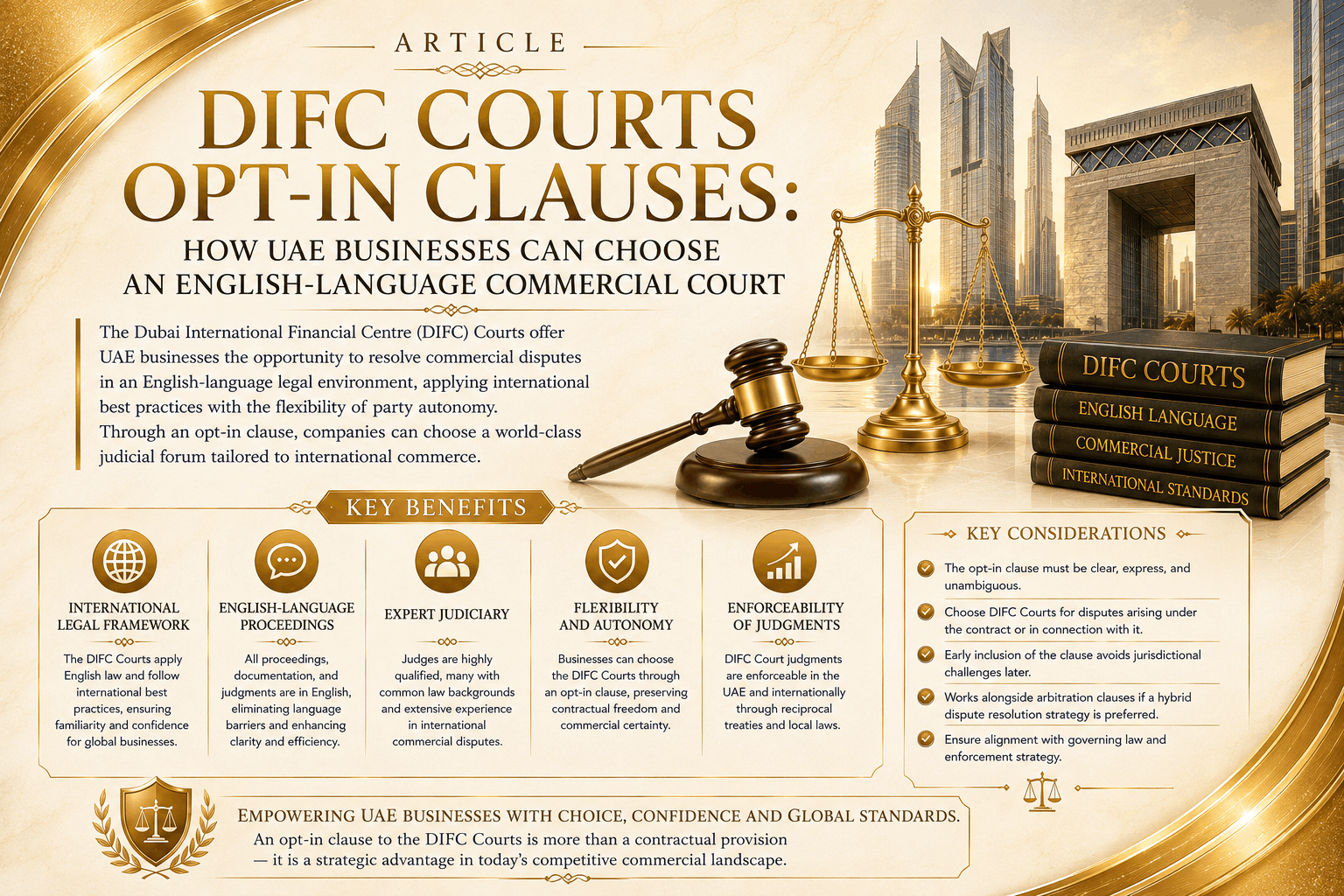 A practical guide to DIFC Courts opt-in clauses, covering written jurisdiction agreements,
exclusive and non-exclusive clauses, asymmetric drafting, jurisdiction challenges, and ambiguous
dispute-resolution provisions.
A practical guide to DIFC Courts opt-in clauses, covering written jurisdiction agreements,
exclusive and non-exclusive clauses, asymmetric drafting, jurisdiction challenges, and ambiguous
dispute-resolution provisions.
DIFC Courts opt-in clauses help UAE businesses choose an English-language commercial court for civil and commercial disputes, but the clause must be clear, written, consistent, and suitable for the transaction.
Key principle: A jurisdiction clause is not boilerplate. It decides where the dispute starts, what procedure applies, how jurisdiction may be challenged, and how enforcement strategy should be planned.UAE Legal Framework for DIFC Courts Opt-In Clauses
DIFC Courts opt-in clauses are governed by DIFC Courts legislation, DIFC procedural rules, relevant practice directions, contract-law principles, and enforcement rules. Parties may select DIFC Courts jurisdiction by written agreement for civil and commercial disputes where legally permitted. Businesses should verify the latest DIFC Courts law and procedural rules before relying on old templates.
Official-source placeholders:Official UAE legislation portal | DIFC Courts | Dubai Courts | Abu Dhabi Judicial Department | ADGM Courts | UAE Ministry of Justice | Relevant UAE authority website
Key Legal Concepts and Definitions
Important concepts include DIFC Courts, opt-in clause, jurisdiction clause, exclusive jurisdiction, non-exclusive jurisdiction, asymmetric clause, governing law, jurisdiction challenge, ambiguous dispute-resolution provision, Small Claims Tribunal, and enforcement strategy.
Who DIFC Courts Opt-In Clauses Apply To
These clauses may affect mainland companies, free zone companies, DIFC entities, ADGM entities, foreign companies, investors, lenders, borrowers, shareholders, suppliers, contractors, distributors, franchisors, service providers, landlords, tenants, and commercial parties contracting in or through the UAE.
Rights and Obligations of Contracting Parties
Parties may choose a dispute forum where the law permits, but they must draft clearly, avoid conflicting clauses, preserve evidence of agreement, and understand that jurisdiction can be challenged where the clause is unclear, not incorporated, outside scope, or signed without authority.
Clear Drafting Requirements for DIFC Courts Jurisdiction
A strong clause should name the DIFC Courts expressly, define the disputes covered, state whether jurisdiction is exclusive or non-exclusive, separate governing law from jurisdiction, explain any pre-action steps, and avoid conflict with arbitration or other court clauses.
Exclusive, Non-Exclusive, and Asymmetric DIFC Clauses
Exclusive clauses create certainty by directing disputes to the DIFC Courts only. Non-exclusive clauses preserve flexibility but may invite forum disputes. Asymmetric clauses may give one party broader forum options, but they require careful drafting and review under the governing law and likely enforcement jurisdictions.
Ambiguous Dispute-Resolution Clauses and Jurisdictional Challenges
Ambiguity may arise where a contract says “Dubai Courts,” “UAE courts,” “DIFC law,” “DIFC arbitration,” or “competent courts” without clear structure. Ambiguous clauses can lead to jurisdiction challenges, delay, parallel proceedings, and increased legal costs before the merits are heard.
DIFC Courts, Dubai Courts, ADGM Courts, Arbitration, and Mainland UAE Courts
DIFC Courts litigation may be suitable for English-language commercial disputes. Dubai Courts may be more natural for certain mainland matters. ADGM Courts may be relevant for ADGM-connected transactions. Arbitration may be preferable for private or technical disputes. The correct forum depends on contract strategy, evidence, urgency, cost, language, assets, and enforcement.
Procedures in the UAE
- Review the signed contract and all related documents.
- Assess whether the DIFC clause is written, clear, and incorporated.
- Check governing law, exclusivity, scope, and related dispute clauses.
- Review signatory authority, amendments, purchase orders, and standard terms.
- Prepare legal notice or pre-action correspondence without undermining jurisdiction.
- File the claim or respond to proceedings under the relevant DIFC Courts procedure.
- Address any jurisdiction challenge before proceeding to the merits.
- Plan judgment, appeal, settlement, and enforcement strategy.
Required Documents and Evidence
- Signed contract, dispute-resolution clause, governing law clause, amendments, and side letters
- Board approvals, powers of attorney, signatory authority documents, licences, and company records
- Purchase orders, standard terms, invoices, payment records, receipts, and bank transfers
- Emails, WhatsApp messages, negotiation correspondence, earlier drafts, and later variations
- Guarantees, security documents, related agreements, notices of default, and termination notices
- Demand letters, evidence of breach, evidence of performance, prior proceedings, and enforcement information
Common Misunderstandings
- Choosing UAE law means DIFC Courts automatically have jurisdiction.
- Writing “Dubai Courts” automatically includes DIFC Courts.
- An English-language contract automatically goes to DIFC Courts.
- The opt-in clause is just standard boilerplate.
- Any DIFC clause is enough.
- Arbitration and DIFC Courts can be combined casually.
- A jurisdiction challenge is only a technical issue.
- Settlement means the clause failed.
Common Mistakes to Avoid
- Copying clauses from old contracts without review
- Using “Dubai Courts” when DIFC Courts are intended
- Failing to state whether jurisdiction is exclusive or non-exclusive
- Mixing DIFC Courts with arbitration without a clear sequence
- Using inconsistent clauses across related transaction documents
- Failing to check signatory authority and incorporation of standard terms
- Ignoring enforcement and asset location before choosing a forum
- Waiting until a dispute arises before reviewing the clause
Practical Examples
Mainland Supplier and Foreign Buyer Choose DIFC Courts
A Dubai supplier and foreign buyer sign an English contract with an exclusive DIFC Courts clause. If the buyer fails to pay, the supplier must prove the clause, the debt, the breach, and the enforcement route.
Clause Says “Dubai Courts” but Party Files in DIFC Courts
One party argues that “Dubai Courts” includes DIFC Courts; the other argues it means ordinary Dubai Courts. Clear drafting naming DIFC Courts expressly would reduce the jurisdiction dispute.
Arbitration Clause Conflicts With DIFC Courts Clause
A master agreement selects arbitration, while purchase order terms select DIFC Courts. A lawyer must analyse contractual hierarchy, incorporation, and which clause governs the particular claim.
Standard Terms Were Never Properly Incorporated
A party relies on a DIFC clause in standard terms, but the counterparty denies accepting those terms. Emails, purchase orders, signatures, click acceptance, and prior course of dealing become important.
Legal Risks and Consequences
Poorly drafted DIFC opt-in clauses may lead to jurisdiction challenges, rejected claims, procedural delay, parallel proceedings, higher court costs, weak settlement leverage, uncertainty over governing law, enforcement difficulty, business disruption, and loss of strategic advantage.
How a Lawyer Evaluates a DIFC Opt-In Clause
A lawyer reviews clause wording, court named, exclusivity, governing law, scope, contract hierarchy, signatory authority, incorporation, related agreements, service provisions, respondent strategy, jurisdiction challenge risk, enforcement route, asset location, costs, evidence strength, settlement options, litigation risk, commercial impact, and client objectives.
How a Lawyer Builds a Stronger Legal Position
Legal support may include drafting precise DIFC Courts clauses, reviewing related documents, correcting ambiguous wording, preparing legal notices, organising jurisdiction evidence, responding to jurisdiction challenges, drafting claims or defences, negotiating settlement, advising on enforcement, and coordinating with foreign counsel where needed.
Settlement vs Litigation
Settlement may be useful where the clause is strong but the commercial relationship matters, the amount is moderate, or litigation cost is disproportionate. Litigation may be necessary where payment is refused, assets may disappear, urgent relief is needed, or a judgment is required for enforcement.
When Urgent Legal Action May Be Needed
- The opponent threatens to file in another court
- A jurisdiction challenge deadline is approaching
- Assets may be moved or dissipated
- Contract termination is imminent
- Evidence may be lost
- Parallel arbitration or court proceedings are threatened
- A limitation issue may arise
- Settlement negotiations may prejudice jurisdiction
Frequently Asked Questions
1. What is a DIFC Courts opt-in clause?
It is a written agreement in which parties choose the DIFC Courts to hear civil or commercial disputes. It should clearly identify the court, scope of disputes, and whether jurisdiction is exclusive or non-exclusive.
2. Can non-DIFC companies choose the DIFC Courts?
Yes, parties outside the DIFC may choose the DIFC Courts for civil and commercial disputes through a written jurisdiction agreement where legally permitted.
3. Does the clause need to be in writing?
Yes. The opt-in concept depends on written agreement. The parties should include a clear clause in the contract or otherwise agree in writing where legally permitted.
4. What is exclusive DIFC jurisdiction?
Exclusive jurisdiction means the parties intend only the DIFC Courts to hear the covered disputes. This can reduce forum uncertainty when drafted clearly.
5. Can a contract choose UAE law and DIFC Courts?
Potentially, yes. Governing law and jurisdiction are separate. The contract should clearly state both the law governing the contract and the court chosen to hear disputes.
6. Is “Dubai Courts” the same as “DIFC Courts”?
Not necessarily. If the parties want the DIFC Courts, the contract should say so expressly rather than relying on general references to Dubai courts or UAE courts.
7. Can a DIFC clause be challenged?
Yes. Challenges may arise where the clause is unclear, not incorporated, signed without authority, inconsistent with another clause, outside scope, or affected by mandatory jurisdiction rules.
8. Can arbitration and DIFC Courts appear in the same contract?
They can, but the drafting must explain which forum decides which issues. Ambiguous hybrid clauses can create delay and procedural disputes.
9. Are DIFC Courts proceedings in English?
Yes. DIFC Courts proceedings operate in English, which is one reason many UAE and international businesses consider DIFC jurisdiction clauses.
10. Why is legal advice important?
Legal advice helps ensure the clause is clear, consistent, enforceable, aligned with related documents, suitable for the transaction, and supported by an enforcement strategy.
Conclusion
DIFC Courts opt-in clauses give UAE businesses a valuable way to choose an English-language commercial court for civil and commercial disputes, but their value depends on precise drafting and strategic use.
Early legal strategy can help parties choose the right forum, avoid ambiguous wording, align related documents, preserve evidence of agreement, reduce jurisdiction challenge risk, and plan enforcement before a dispute becomes more complicated.
Need Advice About DIFC Courts Opt-In Clauses?
Obtain tailored advice on DIFC Courts jurisdiction clauses, governing law, arbitration conflicts, exclusive and non-exclusive drafting, asymmetric clauses, jurisdiction challenges, and commercial dispute strategy in the UAE.
Book a Legal ConsultationLegal Disclaimer: This article is for general information only and does not constitute legal advice. The correct legal position depends on the contract wording, parties, transaction documents, applicable law, evidence, dispute type, and procedural stage.
Services | Legal Consultation | Contact Us | UAE Law Articles | About Us