Developer Liability in UAE Real Estate: Construction Defects, Delivery Delays, and Specification Breaches
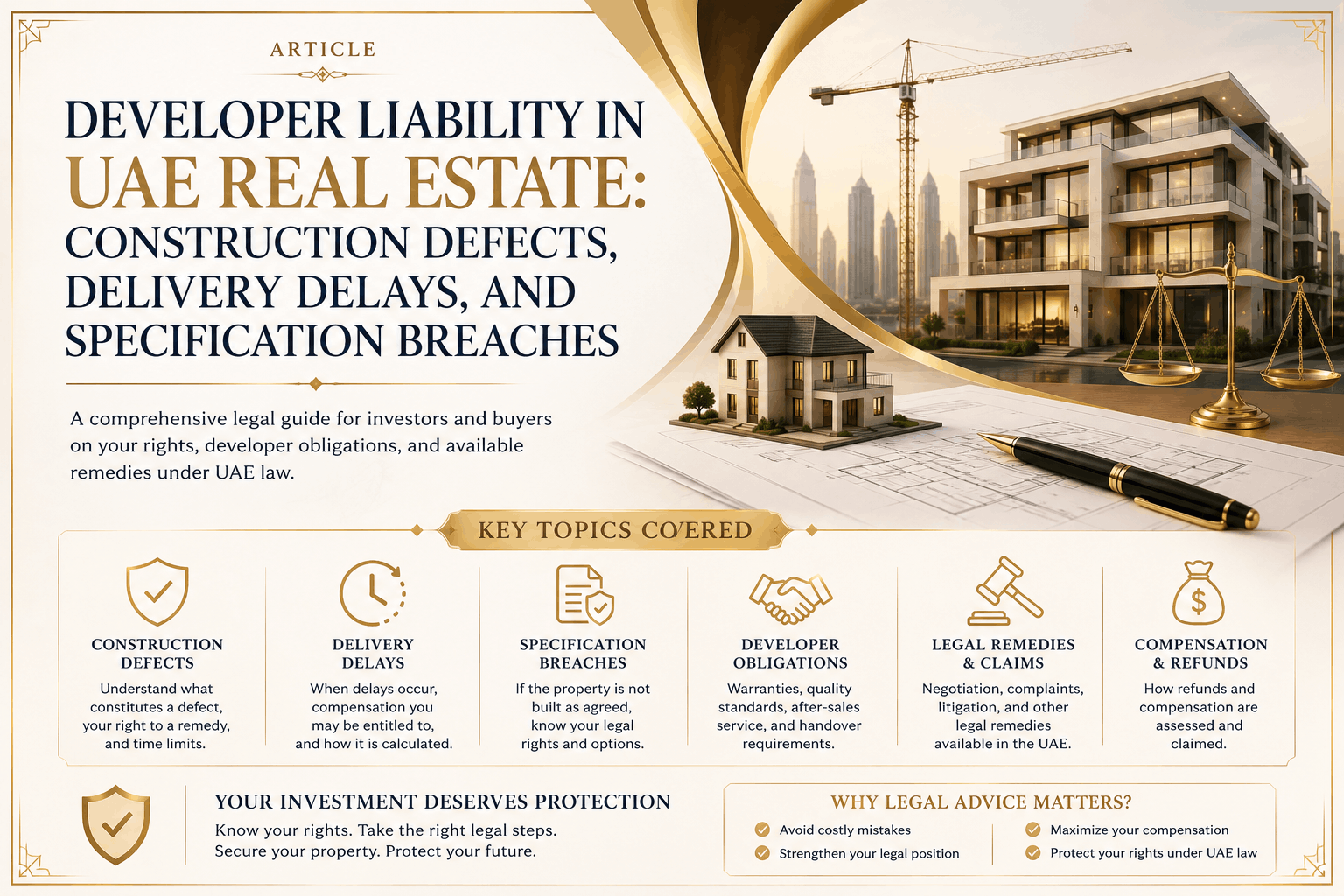
Developer liability in UAE real estate is a major issue for property buyers, investors, owners, landlords, tenants, and corporate property holders who discover defects, face delayed delivery, or receive a unit that does not match the agreed specifications.
UAE Legal Framework for Developer Liability
Developer liability in UAE real estate may involve federal contract principles, construction liability rules, Dubai off-plan registration laws, escrow regulation, court or arbitration procedure, and technical expert evidence.
Federal Contract and Civil Liability Principles
A claimant usually needs to establish a legal obligation, breach, damage, causation, and evidence supporting the value of the claim.
Decennial Liability
Decennial liability may apply to serious structural collapse or defects threatening stability or safety. It is not a general warranty for every cosmetic defect.
Dubai Real Estate Regulation
Dubai-specific rules may become relevant where the dispute concerns off-plan registration, escrow accounts, project delay, cancellation, or developer obligations.
Official UAE legislation portal | Dubai Legislation Portal | Dubai Land Department | UAE Ministry of Justice | Dubai Courts | Abu Dhabi Judicial Department | DIFC Courts | ADGM Courts
Key Legal Concepts and Definitions
Construction Defect
A flaw in workmanship, design, materials, installation, or construction that causes the property to fall below the agreed or legally required standard.
Structural Defect
A defect affecting stability, safety, integrity, or load-bearing elements of the building.
Hidden Defect
A defect that is not reasonably discoverable during ordinary inspection and appears later.
Specification Breach
Delivery of a unit that does not match agreed plans, finishes, area, facilities, parking, materials, or other binding specifications.
Who the Law Applies To
These disputes may affect buyers, owners, developers, contractors, consultants, engineers, owners' associations, facility managers, investors, landlords, tenants, banks, insurers, UAE nationals, expatriates, mainland companies, and free-zone companies.
Rights and Obligations of Buyers, Developers, Contractors, and Consultants
Buyer and Owner Rights
Buyers may seek repair, compensation, termination in serious cases, delay damages, expert inspection, regulatory complaints, or enforcement depending on contract, evidence, and applicable law.
Developer Obligations
Developers may be required to complete the project properly, deliver the unit as agreed, comply with registration and escrow obligations, address valid defects, and compensate proven loss.
Contractor and Consultant Obligations
Contractors and consultants may be responsible for workmanship, design, supervision, materials, testing, certification, and rectification depending on their role.
Construction Defects in UAE Real Estate
Defects may include water leakage, waterproofing failure, structural cracks, AC problems, electrical defects, drainage failure, façade issues, poor finishing, fire-safety concerns, mould, settlement, and incomplete amenities.
Structural Defects and Decennial Liability
Structural claims require careful engineering evidence. Potential issues may include foundation failure, unsafe cracking, façade instability, major settlement, partial collapse, or defects threatening safety.
Delivery Delays and Delayed Handover
Delay claims require review of the SPA, completion date, grace period, extension clauses, force majeure, buyer payment compliance, handover notice, project status, and proof of loss.
Specification Breaches and Material Deviations
Specification disputes may involve reduced area, different layout, missing parking, lower-quality materials, changed view, reduced amenities, changed common areas, or finishes below the agreed standard.
Developer Obligations in Off-Plan Projects
Off-plan disputes may involve project registration, interim registration, escrow payments, construction progress, delayed handover, project cancellation, and compliance with agreed specifications.
Contractor and Engineer Responsibility
Although the developer is often the buyer-facing party, technical responsibility may involve contractors, architects, structural engineers, MEP consultants, supervising consultants, project managers, and maintenance contractors.
Procedures in the UAE
- Review the SPA and project documents.
- Inspect the defect and preserve evidence.
- Obtain a technical expert report where needed.
- Issue a legal notice to the responsible party.
- Submit regulatory complaints where appropriate.
- Negotiate repair, compensation, or settlement.
- File before the competent court or arbitral tribunal.
- Participate in court or tribunal expert inspection.
- Submit comments and objections to expert findings.
- Obtain judgment or award.
- Proceed to enforcement if necessary.
Required Documents and Evidence
- SPA, reservation form, and payment plan
- Receipts and bank transfers
- Project registration and escrow records
- Handover notice and handover documents
- Snagging lists and defect notices
- Photographs and videos
- Engineering and structural reports
- Approved drawings and as-built drawings
- Specifications and brochures
- Repair quotations and invoices
- Maintenance records
- Authority correspondence
- Emails and WhatsApp messages
- Rental-loss or valuation evidence
- Legal notices and expert reports
Engineering Expert Evidence
Expert evidence may assess whether a defect exists, its cause, whether it is cosmetic or structural, repair methodology, repair cost, delay period, specification compliance, and value reduction.
Common Developer, Buyer, and Owner Defenses
Disputes may involve arguments about handover acceptance, hidden defects, misuse, poor maintenance, delay within grace period, force majeure, defective notices, contractor responsibility, specification compliance, or speculative losses.
Common Misunderstandings
- All defects are treated the same.
- Signing handover always removes all rights.
- A snagging list alone is enough to win.
- The developer is automatically liable for every problem.
- Delay automatically gives a full refund.
- Marketing brochures always control the contract.
- Waiting does not affect evidence.
Common Mistakes to Avoid
- Signing handover without recording defects
- Failing to take photos and videos
- Relying only on verbal complaints
- Repairing before preserving evidence
- Stopping payments without legal advice
- Sending emotional messages
- Ignoring arbitration or court clauses
- Failing to quantify loss
- Overclaiming without expert support
Practical Examples
Water Leakage After Handover
The buyer should document the leak, notify the developer, obtain a waterproofing report, preserve repair quotations, and avoid destructive repair before inspection.
Delayed Off-Plan Handover
The buyer should review the SPA, grace period, extension clauses, payment compliance, market rent evidence, and handover communications.
Structural Cracking
The owner should obtain structural engineering evidence, preserve photos, review drawings, and identify whether the issue relates to design, construction, maintenance, or misuse.
Area or Specification Difference
The legal approach is to compare the SPA, approved plans, permitted tolerance clauses, measurement evidence, and value impact.
Legal Risks and Consequences
Incorrect handling may cause rejected claims, evidence loss, unrecoverable repair costs, weak compensation, payment default allegations, invalid termination, expert costs, business interruption, safety exposure, insurance issues, and enforcement difficulty.
How a Lawyer Evaluates the Case
A lawyer reviews the property, contract, parties, handover documents, defect type, delay period, specification breach, payment history, notices, expert requirements, causation, repair cost, compensation, jurisdiction, limitation issues, settlement options, and enforcement prospects.
How a Lawyer Builds a Stronger Legal Position
Legal support may include document review, evidence preservation, legal notices, expert coordination, claim drafting, compensation calculation, negotiation, court or arbitration representation, expert-report challenges, and enforcement.
Settlement vs Litigation
Settlement may be suitable where the developer agrees to repair, compensate, extend warranties, replace materials, or fund an expert process. Litigation or arbitration may be necessary where liability, defect cause, cost, delay, or safety remains disputed.
When Urgent Legal Action May Be Needed
- The defect threatens safety
- Water leakage is causing rapid damage
- Evidence may disappear
- Handover documents require immediate signature
- A buyer receives a default notice
- Structural cracks are worsening
- Tenants may be affected
- The project appears stalled
- The property may become uninhabitable
Frequently Asked Questions
1. Can a buyer sue a developer for construction defects in the UAE?
Yes, where the buyer can establish a legal obligation, defect, breach, causation, and loss with proper documents and technical evidence.
2. What is the difference between snagging and a legal defect claim?
Snagging usually covers visible handover items. A legal defect claim may involve serious workmanship, material, design, hidden, functional, or structural problems.
3. What is decennial liability?
It generally relates to long-term responsibility for building collapse or defects threatening structural stability or safety.
4. Can a developer exclude structural liability by contract?
Attempts to exclude or limit serious decennial liability may be ineffective under UAE law and should be reviewed carefully.
5. Can a buyer claim compensation for delayed handover?
Potentially, if delay exceeds the permitted period and causes proven loss.
6. Can defects justify termination?
Serious defects may support stronger remedies, but minor defects usually support repair or compensation rather than cancellation.
7. Are hidden defects covered after handover?
They may be, especially where they were not reasonably discoverable and are linked to construction, design, materials, or developer breach.
8. What evidence is most important?
The SPA, specifications, handover documents, defect notices, photos, videos, expert reports, repair quotations, authority reports, and correspondence are central.
9. What if the developer offers repair only?
The buyer should assess adequacy, warranty extension, existing losses, repair timeline, and whether acceptance waives future claims.
10. Do defect disputes always go to court?
No. Many resolve through repair agreements, compensation, warranty extensions, or expert-led settlements.
Conclusion
Developer liability in UAE real estate requires careful legal and technical analysis. Construction defects, hidden defects, structural issues, delayed delivery, and specification breaches are not all treated in the same way.
Early legal strategy can help preserve evidence, obtain expert reports, identify responsible parties, quantify compensation, protect procedural rights, and choose the correct court, arbitration, or settlement route.
Need Advice About Developer Liability in UAE Real Estate?
Early legal advice can help you assess construction defects, hidden defects, delayed handover, specification breaches, technical evidence, and available remedies before the matter becomes more complicated.
Book a Legal Consultation