Cargo Damage and Maritime Claims in the UAE: Bills of Lading, Carrier Liability, and Time Limits
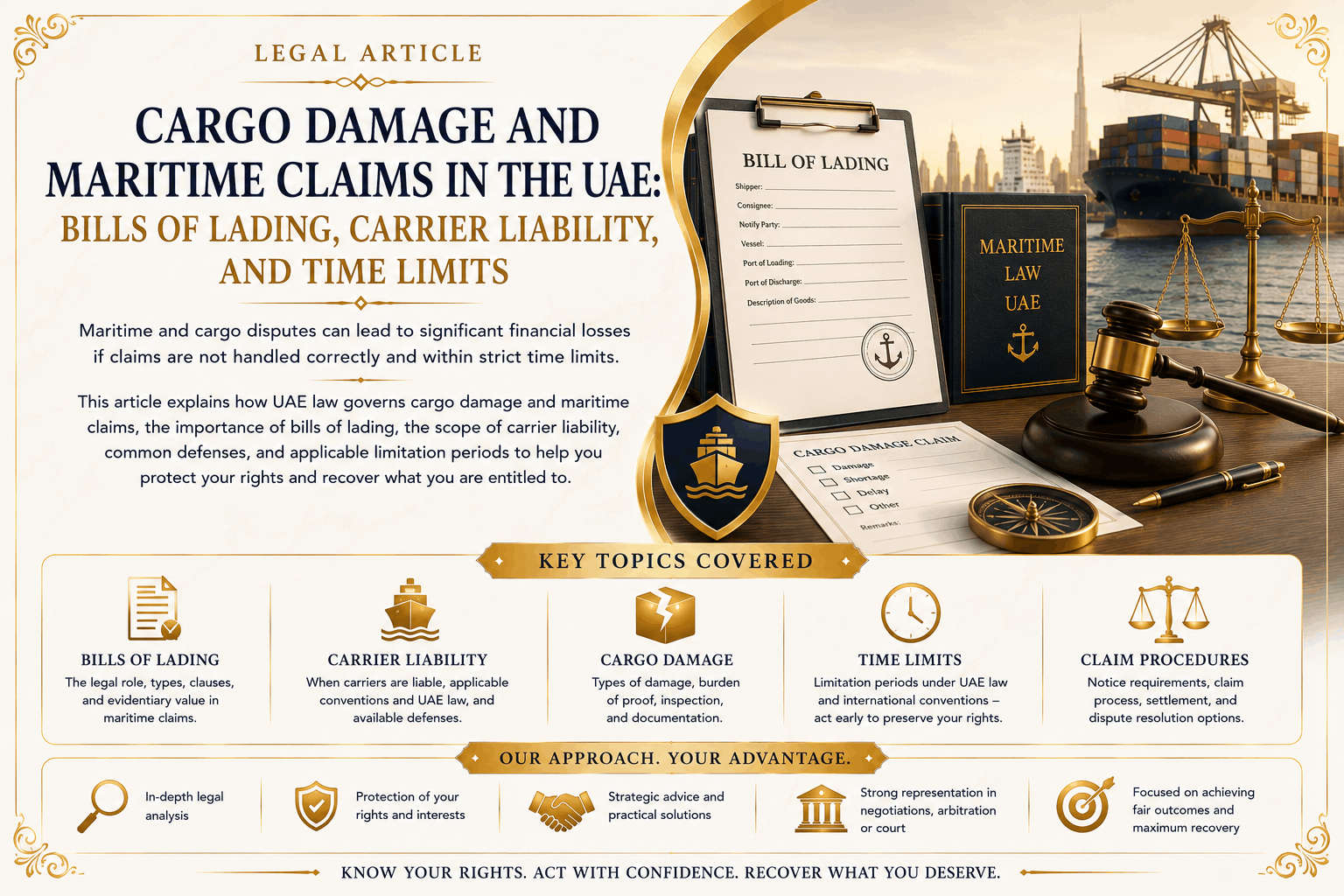
Cargo damage and maritime claims in the UAE require fast evidence preservation, careful review of bills of lading, proper written reservations, survey reports, insurance notification, and strict attention to time limits.
UAE Legal Framework for Cargo Damage and Maritime Claims
UAE maritime cargo disputes may involve Federal Decree-Law No. 43 of 2023 Concerning the Maritime Law, carriage contracts, bills of lading, carrier and actual-carrier liability, freight forwarder arrangements, port records, marine insurance, court procedures, arbitration clauses, and urgent remedies.
Official UAE legislation portal | UAE Ministry of Justice | Relevant UAE maritime authority website | Dubai Courts | Abu Dhabi Judicial Department | DIFC Courts | ADGM Courts
Key Legal Concepts and Definitions
Important concepts include cargo damage, cargo loss, bill of lading, clean bill, claused bill, carrier, actual carrier, consignee, consignor, written reservation, limitation of liability, freight forwarder, survey report, and subrogation.
Who UAE Maritime Cargo Law Applies To
Cargo claims may affect shippers, consignees, cargo owners, importers, exporters, freight forwarders, shipping lines, NVOCCs, port operators, warehouses, customs brokers, road carriers, insurers, banks, free-zone entities, and international traders.
Rights and Obligations of Cargo Interests, Carriers, and Logistics Parties
Cargo interests should inspect cargo, make written reservations, notify the carrier and insurer, preserve evidence, mitigate loss, and act within time limits. Carriers may be liable for loss or damage during the responsibility period, subject to available defences and liability limits.
The Bill of Lading and Its Legal Importance
The bill of lading can evidence the contract of carriage, the carrier’s receipt of cargo, cargo condition, delivery rights, and the person entitled to claim. Clean, claused, negotiable, non-negotiable, and electronic bills of lading may create different legal consequences.
Carrier Liability for Cargo Loss and Damage
Carrier liability depends on whether the cargo was received in good condition, whether the loss or damage occurred before delivery, whether a valid defence applies, and whether liability is limited.
Limitation of Liability and Special Drawing Rights
Carrier liability for cargo loss or damage may be limited by reference to Special Drawing Rights per package, unit, or kilogram, unless a valid higher limit applies or limitation is unavailable on the facts.
Apparent Damage, Hidden Damage, and Written Reservations
Apparent damage should be reserved in writing before or during delivery. Hidden damage should be notified promptly within the applicable statutory period. Written reservations protect the claim and reduce evidential risk.
Time Limits for Maritime Cargo Claims
Carriage-by-sea claims are subject to short time limits. Parties should not rely on negotiations alone and should obtain legal advice well before any limitation period expires.
Port-Related Disputes and Terminal Evidence
Cargo damage may occur during discharge, terminal handling, storage, customs inspection, reefer connection, warehouse handling, gate-out, or inland delivery. Port and terminal evidence should be requested quickly.
Freight Forwarder and Multimodal Transport Liability
A freight forwarder may act as an agent, contracting carrier, NVOCC, customs arranger, or multimodal transport operator. The legal role depends on the documents, invoices, house bills, and contractual commitments.
Cargo Insurance and Subrogation
Cargo insurance may provide faster recovery, but the insured must preserve evidence, notify insurers, arrange surveys, and protect the insurer’s subrogation rights against responsible parties.
Procedures in the UAE After Cargo Damage
- Inspect the cargo immediately.
- Record written reservations for visible loss or damage.
- Notify the carrier, forwarder, port party, and insurer as appropriate.
- Arrange a joint survey where possible.
- Preserve cargo, packaging, seals, samples, and photographs.
- Collect shipping, port, customs, insurance, and commercial documents.
- Quantify loss and mitigation steps.
- Review time limits, jurisdiction, and arbitration clauses.
- Negotiate, litigate, arbitrate, or seek urgent remedies where required.
Required Documents and Evidence
- Bill of lading, sea waybill, booking note, and freight invoice
- Commercial invoice, packing list, certificate of origin, and customs declaration
- Delivery order, arrival notice, outturn report, and terminal records
- Equipment interchange receipt, gate pass, and warehouse receipt
- Container seal records and reefer temperature logs
- Photographs, videos, survey reports, and inspection records
- Carrier claim letters and written reservations
- Insurance policy and insurance claim documents
- Sales contract, Incoterms, buyer rejection letters, and mitigation records
- Laboratory reports, repair estimates, salvage sale records, and disposal certificates
Survey Reports, Inspection Records, and Technical Evidence
Survey reports should identify the type of damage, quantity affected, likely cause, cargo condition, packaging, container condition, seal status, photographs, estimated loss, salvage value, and whether the damage appears pre-shipment, during carriage, or after delivery.
Container Damage, Seals, and Temperature-Controlled Cargo
Container damage claims require evidence of container condition, dents, holes, gasket failure, seal numbers, terminal handling, and delivery records. Reefer claims require temperature logs, set points, plug-in records, alarms, and commodity-specific evidence.
Misdelivery, Short Delivery, and Wrongful Release of Cargo
Misdelivery claims may arise where cargo is released to a party not entitled to receive it or without proper documents. Short delivery requires careful comparison of bill-of-lading quantities, tally records, discharge reports, and delivery evidence.
Delay Claims, Demurrage, Detention, and Storage Charges
Cargo disputes may include delay, demurrage, detention, storage, customs delay, documentation delay, refusal to take delivery, or commercial loss. Each head of loss should be separately proved and legally justified.
Court Litigation, Arbitration, and Jurisdiction Issues
Before filing, review the bill-of-lading jurisdiction clause, arbitration clause, charterparty incorporation, UAE court jurisdiction, foreign law clause, defendant location, vessel location, cargo location, insurance subrogation status, and time limit.
DIFC, ADGM, Free Zone, and International Trade Issues
Cargo disputes involving free zones, DIFC or ADGM entities, foreign buyers, foreign insurers, trade finance banks, or cross-border enforcement require careful review of governing law, jurisdiction, customs status, and contract chain.
Common Misunderstandings
- Damaged cargo automatically means the carrier pays.
- The bill of lading is only a receipt.
- Photos alone are enough.
- Insurance will handle everything.
- The port is always responsible for damage found at discharge.
- Negotiations stop the time limit.
- A clean bill of lading ends every defence.
- Hidden damage can be reported whenever it is found.
Common Mistakes to Avoid
- Failing to make written reservations
- Delaying survey
- Destroying packaging or seals
- Missing the one-year carriage claim period
- Suing the wrong party
- Ignoring liability limits
- Accepting delivery without inspection
- Settling without preserving insurance rights
- Relying on WhatsApp messages alone
Practical Examples
Wet Damage to Electronics
The claimant should preserve the container, photograph roof damage, obtain terminal records, arrange survey, compare seal numbers, request discharge reports, and notify carrier and insurer immediately.
Reefer Cargo Rejected by Buyer
The claim requires set temperature, actual temperature logs, pre-trip inspection, plug-in records, commodity requirements, survey report, lab testing, salvage records, and proof of when the deviation occurred.
Short Delivery of Steel Coils
The claimant should check tally records, discharge reports, warehouse receipts, delivery orders, seal records, and whether the shortage was noted at delivery.
Misdelivery Without Original Bill
Wrongful release may involve bill-of-lading rights, carrier and agent responsibility, trade finance bank rights, fraud, and urgent recovery measures.
Legal Risks and Consequences
Poor handling may cause a time-barred claim, loss of evidence, presumption of good delivery, rejected insurance claim, reduced recovery, wrong defendant, unrecoverable storage charges, unclear causation, buyer rejection, supply chain disruption, and litigation costs.
How a Lawyer Evaluates a Maritime Cargo Claim
A lawyer reviews the bill of lading, carrier identity, actual carrier, forwarder role, cargo owner’s standing, delivery records, written reservations, survey evidence, port documents, insurance, Incoterms, jurisdiction clause, limitation period, carrier defences, liability limits, quantum, settlement options, and enforcement prospects.
How a Lawyer Builds a Stronger Legal Position
Legal support may include claim notices, reservation letters, survey coordination, evidence preservation, time-limit protection, insurance review, port record requests, quantified claim schedules, liability-limit analysis, court or arbitration claims, settlement negotiation, and subrogation support.
Settlement vs Litigation or Arbitration
Settlement may be commercially useful where liability is arguable and fast recovery matters. Litigation or arbitration may be necessary where the carrier denies liability, the cargo value is high, misdelivery occurred, insurance is disputed, or security and enforcement are required.
When Urgent Legal Action May Be Needed
- Cargo is still at port
- Cargo is perishable or hazardous
- Survey has not been arranged
- Container or seal evidence may disappear
- The one-year period is approaching
- Cargo was released without original bill
- Insurance may be denied due to late notice
- Demurrage and storage charges are increasing
- A buyer is rejecting the goods
- Multiple parties are shifting blame
Frequently Asked Questions
1. What should I do first after discovering cargo damage in the UAE?
Inspect the cargo immediately, record written reservations, photograph the damage, preserve packaging and seals, notify the carrier and insurer, arrange a survey, and collect all shipping documents.
2. What is the role of the bill of lading?
It evidences the contract of carriage, the carrier’s receipt or shipment of cargo, cargo condition, and delivery rights.
3. How long do I have to file a cargo claim?
Carriage-by-sea claims are generally subject to a short one-year period from delivery or the date delivery should have occurred, subject to the facts and applicable law.
4. What if the damage is visible at delivery?
Written reservation should be made before or during delivery to protect the claim and avoid evidential presumptions.
5. What if the damage is hidden?
Written notice should be sent promptly and within the applicable statutory period after takeover.
6. Is the carrier always liable?
No. The carrier may raise defences such as pre-existing damage, poor packing, inherent vice, post-delivery damage, liability limitation, or time bar.
7. Can the carrier limit liability?
Yes. UAE Maritime Law provides liability limits for cargo loss or damage, subject to the facts and any valid higher liability agreement.
8. Can I claim against a freight forwarder?
Potentially, depending on whether the forwarder acted as agent, contracting carrier, NVOCC, or multimodal transport operator.
9. Do I need a survey report?
A survey report is highly recommended because it helps prove the nature, timing, cause, and value of cargo damage.
10. Can insurance recover the loss?
Cargo insurance may pay the insured and then pursue subrogation against the responsible party, but evidence and recovery rights must be preserved.
11. Can cargo be released without the original bill of lading?
This depends on the type of bill and legal circumstances. Releasing negotiable cargo without proper documents may create serious misdelivery claims.
12. Should I negotiate before filing a claim?
Negotiation may be useful, but it should not endanger statutory time limits. Legal proceedings or arbitration may be needed before time expires.
Conclusion
Cargo damage and maritime claims in the UAE are highly document-driven and time-sensitive. Bills of lading, delivery records, written reservations, survey reports, port evidence, insurance notices, and limitation periods can determine the outcome.
Early legal advice can help cargo interests preserve evidence, identify the responsible party, comply with notice requirements, coordinate survey and insurance recovery, calculate loss, avoid time-bar problems, and choose the correct court, arbitration, or settlement strategy.
Need Advice About a UAE Maritime Cargo Claim?
Obtain tailored advice on cargo damage, bills of lading, carrier liability, written reservations, survey evidence, port disputes, cargo insurance, limitation periods, settlement, court proceedings, and arbitration.
Book a Legal Consultation