Litigating in ADGM Courts: Direct Application of English Common Law and Its Commercial Impact
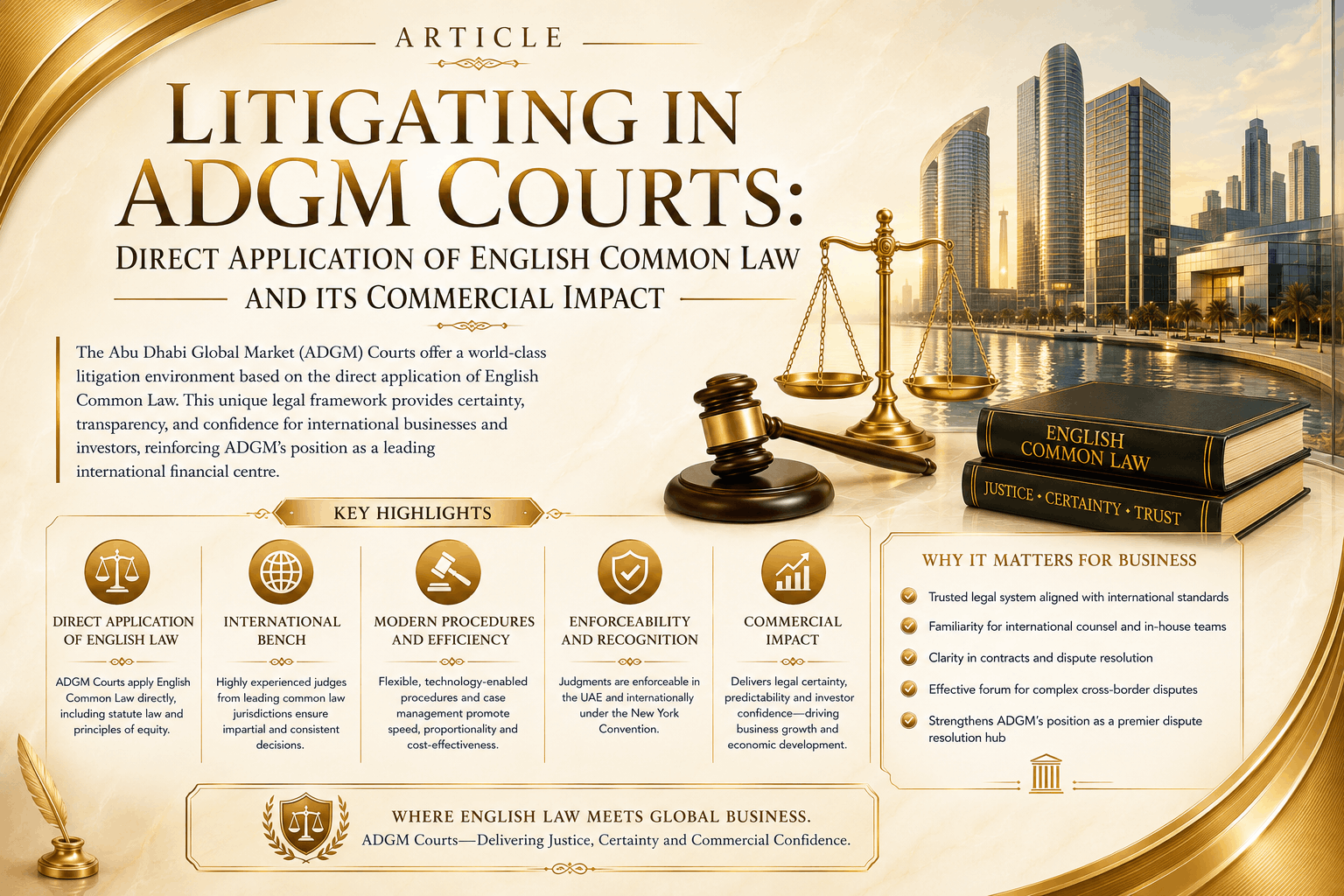
Litigating in ADGM Courts can give commercial parties access to an English-language court framework based on the direct application of English common law, but the advantages depend on careful drafting, evidence, remedies, procedure, and enforcement planning.
UAE Legal Framework for Litigating in ADGM Courts
ADGM Courts litigation may involve ADGM’s founding framework, ADGM Courts regulations, ADGM court procedure rules, direct application of English common law, applicable ADGM regulations, contract-law principles, enforcement mechanisms, and the wider UAE legal environment where recognition or execution may be needed.
Official UAE legislation portal | ADGM Courts | Abu Dhabi Judicial Department | DIFC Courts | Dubai Courts | UAE Ministry of Justice | Relevant UAE authority website
Key Legal Concepts and Definitions
Important concepts include ADGM Courts, direct application of English common law, choice-of-court clause, governing law, jurisdiction, equitable remedies, digital court, enforcement, interim relief, and commercial dispute strategy.
Who ADGM Courts Litigation Applies To
ADGM litigation may affect ADGM entities, mainland companies, free zone companies, foreign companies, investors, lenders, borrowers, shareholders, directors, officers, contractors, fintech businesses, technology companies, consultants, professional advisers, and cross-border commercial parties.
Rights and Obligations of Commercial Parties
Parties may choose ADGM Courts where legally permitted, but they should draft clearly, preserve evidence, consider jurisdiction challenges, understand the impact of English common law, and plan enforcement before filing. Defendants may challenge jurisdiction where the clause or connection is unclear.
Direct Application of English Common Law in ADGM
The direct application of English common law is a defining feature of ADGM. It may affect contract interpretation, remedies, shareholder disputes, finance documents, fiduciary duties, indemnities, warranties, and equitable relief. However, ADGM is not England; it has its own legislation, regulations, courts, and procedural framework.
ADGM Courts Jurisdiction and Choice-of-Court Clauses
A strong ADGM choice-of-court clause should identify ADGM Courts clearly, define the disputes covered, state whether jurisdiction is exclusive or non-exclusive, separate governing law from jurisdiction, address service, and avoid conflict with arbitration or other court clauses.
Equitable Remedies and Commercial Impact
Equitable remedies may be commercially important where damages are not enough. Depending on the facts and legal basis, parties may consider injunctions, specific performance, declarations, preservation orders, or other discretionary remedies. Delay and weak evidence can damage urgent applications.
Digital Court Procedures and Case Management
ADGM Courts’ digital environment requires disciplined evidence management. Parties should organise electronic files, contracts, emails, WhatsApp messages, exhibits, witness material, expert reports, bundles, and procedural deadlines carefully before proceedings begin.
Enforcement Strategy and Recognition of Judgments
Enforcement should be planned before filing. A claimant should identify where the debtor’s assets are located, whether onshore UAE enforcement will be needed, whether assets exist abroad, and whether urgent measures are needed to preserve recovery.
ADGM Courts vs Onshore UAE Courts, DIFC Courts, and Arbitration
ADGM Courts may suit English-language commercial disputes involving ADGM connection or valid choice-of-court clauses. Onshore UAE courts may be more appropriate for many local civil, rental, family, labour, criminal, and administrative matters. DIFC Courts may suit Dubai financial free zone or DIFC-selected disputes. Arbitration may suit private, technical, or international enforcement-driven matters.
Procedures in the UAE
- Assess whether ADGM Courts are the correct forum.
- Review the contract, governing law, ADGM clause, and related documents.
- Preserve evidence and prepare a chronology.
- Send a legal notice or pre-action correspondence where appropriate.
- File the claim or defence under ADGM Courts procedure.
- Consider jurisdiction challenges, interim applications, and case management requirements.
- Prepare evidence, witness material, expert reports, and hearing strategy.
- Plan judgment, appeal, settlement, recognition, and enforcement steps.
Required Documents and Evidence
- Signed contract, governing law clause, ADGM jurisdiction clause, amendments, and side letters
- Board approvals, powers of attorney, signatory authority records, constitutional documents, and licences
- Invoices, receipts, bank transfers, payment confirmations, delivery records, and performance evidence
- Emails, WhatsApp messages, meeting notes, notices of default, termination notices, and demand letters
- Expert reports, financial statements, damages calculations, witness details, and asset information
- Settlement correspondence, related proceedings documents, and translations where enforcement may require them
Common Misunderstandings
- ADGM Courts are the same as onshore Abu Dhabi courts.
- Choosing English law automatically means ADGM Courts have jurisdiction.
- Any Abu Dhabi contract can go to ADGM Courts.
- Digital court means simple court.
- English common law always helps the claimant.
- Settlement means weakness.
- A signed contract always guarantees jurisdiction.
- Enforcement can be considered only after judgment.
Common Mistakes to Avoid
- Choosing ADGM Courts without considering enforcement
- Using unclear choice-of-court wording
- Confusing governing law with jurisdiction
- Copying English-law clauses without understanding ADGM impact
- Failing to preserve electronic evidence
- Sending emotional messages or accidental admissions
- Filing in the wrong forum
- Delaying urgent applications
- Ignoring related contracts with inconsistent dispute clauses
Practical Examples
ADGM Company and Mainland Supplier
An ADGM company signs a services contract with a mainland supplier and the contract selects ADGM Courts. A lawyer reviews jurisdiction, invoices, performance evidence, notices, and asset location before filing.
Contract Says “Abu Dhabi Courts” but Party Wants ADGM
A vague clause creates uncertainty over whether onshore Abu Dhabi courts or ADGM Courts were intended. The better legal approach is to expressly name ADGM Courts in the contract.
Urgent Misuse of Confidential Information
A former partner threatens to disclose confidential information. A lawyer considers urgent relief, evidence strength, delay, damages adequacy, and commercial harm before applying to court.
Judgment but Assets Are Onshore
A claimant wins in ADGM Courts but the defendant’s assets are outside ADGM. Enforcement strategy must be planned through the appropriate recognition or execution route.
Legal Risks and Consequences
Poor handling of ADGM litigation may lead to rejected claims, jurisdiction challenges, parallel proceedings, procedural delay, higher legal costs, weak defence, missed deadlines, loss of urgent remedies, enforcement difficulty, business disruption, settlement disadvantage, reputational harm, and avoidable commercial loss.
How a Lawyer Evaluates an ADGM Courts Matter
A lawyer reviews jurisdiction, governing law, legal capacity, ADGM connection, written choice-of-court clause, contract wording, limitation issues, evidence strength, remedies, urgent relief, procedural route, settlement options, litigation risk, enforcement possibilities, commercial impact, and client objectives.
How a Lawyer Builds a Stronger Legal Position
Legal support may include drafting ADGM jurisdiction clauses, reviewing governing law wording, identifying weaknesses, preparing legal notices, organising evidence, drafting claims or defences, responding to jurisdiction challenges, seeking interim relief, negotiating settlement, coordinating expert evidence, planning enforcement, and representing the client before ADGM Courts or related enforcement authorities.
Settlement vs Litigation
Settlement may be useful where the relationship matters, evidence is mixed, enforcement risk is high, or confidentiality is important. Litigation may be necessary where payment is refused, urgent relief is required, assets may be moved, or a judgment is needed. Skilled negotiation remains important in both routes.
When Urgent Legal Action May Be Needed
- Assets may be transferred or hidden
- Confidential information may be disclosed
- Evidence may be deleted or altered
- Contract termination is imminent
- A payment default is escalating
- A jurisdiction challenge must be made promptly
- Parallel proceedings are threatened
- Enforcement planning is needed before filing
Frequently Asked Questions
1. What are ADGM Courts?
ADGM Courts are the courts of Abu Dhabi Global Market. They operate in English and handle civil and commercial disputes within their jurisdiction under ADGM’s own legal and procedural framework.
2. What does direct application of English common law mean?
It means English common law applies directly within ADGM’s legal framework, subject to ADGM legislation and applicable modifications. This can affect contracts, remedies, evidence, and commercial dispute strategy.
3. Can parties outside ADGM choose ADGM Courts?
Potentially, yes. Parties may confer jurisdiction on ADGM Courts through a written choice-of-court agreement where legally permitted. The wording should be reviewed carefully.
4. Are ADGM Courts proceedings digital?
Yes. ADGM Courts operate through a digital court environment, making electronic filing, document management, and digital evidence organisation important.
5. Are ADGM Courts the same as onshore Abu Dhabi courts?
No. ADGM Courts operate in English under ADGM’s framework, while onshore Abu Dhabi courts operate under the UAE court system and generally use Arabic procedure.
6. Can ADGM Courts grant equitable remedies?
ADGM’s common-law framework may support equitable remedies where legally available and factually justified. The court’s discretion, evidence, urgency, and governing law must be reviewed.
7. Is ADGM litigation better than arbitration?
Not always. ADGM litigation may be suitable for court-based English-language disputes, while arbitration may be preferable for confidentiality, technical issues, or certain international enforcement strategies.
8. What documents are important?
Important documents include the signed contract, ADGM jurisdiction clause, governing law clause, authority records, invoices, payment records, emails, notices, expert evidence, witness details, and asset information.
9. Can ADGM judgments be enforced outside ADGM?
Enforcement may be possible through applicable ADGM and UAE mechanisms, depending on where assets are located and what procedural steps are required.
10. Why is legal advice important?
Legal advice helps assess jurisdiction, governing law, English common law impact, evidence, remedies, urgent relief, settlement leverage, enforcement strategy, and procedural risk.
Conclusion
Litigating in ADGM Courts can provide UAE and international businesses with an English-language commercial court framework based on the direct application of English common law. Its value depends on clear jurisdiction, strong evidence, correct remedies, digital procedure management, and enforcement planning.
Early legal strategy helps businesses choose the right forum, preserve evidence, use common-law remedies properly, assess settlement, and avoid procedural mistakes before the dispute becomes more complicated.
Need Advice About Litigating in ADGM Courts?
Obtain tailored advice on ADGM jurisdiction, English common law, choice-of-court clauses, equitable remedies, digital procedures, enforcement strategy, settlement, and UAE commercial litigation.
Book a Legal Consultation