Healthcare Facility Licensing in the UAE: Regulatory Duties, Compliance Failures, and Enforcement Risk
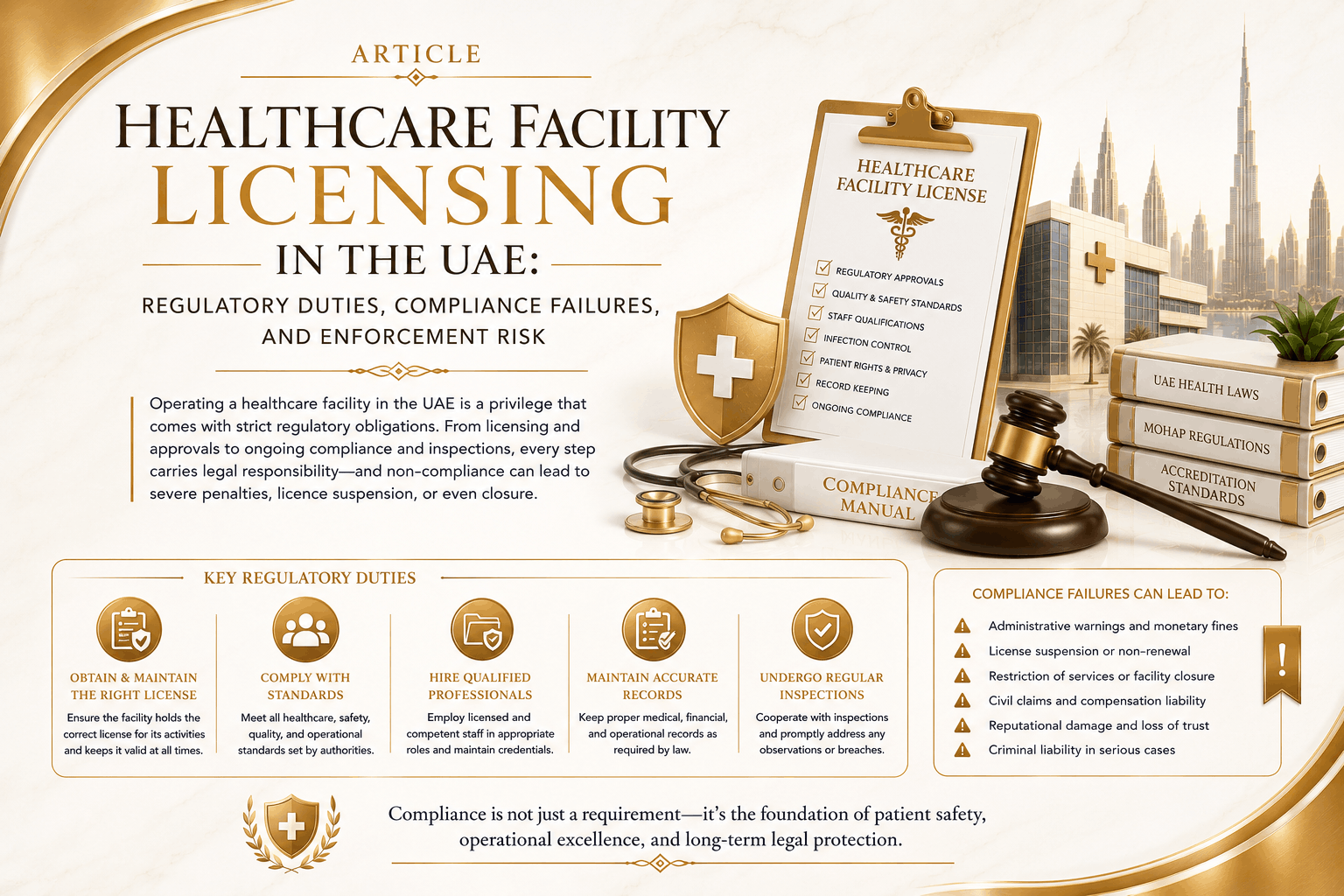
Healthcare facility licensing in the UAE is not only a pre-opening approval. It is an ongoing compliance duty affecting premises, professionals, patient safety, records, advertising, inspections, renewals, and enforcement risk.
UAE Legal Framework for Healthcare Facility Licensing
Healthcare facility licensing in the UAE may involve federal private health facility law, MOHAP rules, DHA requirements in Dubai, DOH requirements in Abu Dhabi, professional licensing rules, facility standards, health advertising requirements, patient-record obligations, inspection procedures, and enforcement practice.
Official UAE legislation portal | UAE Ministry of Health and Prevention | Dubai Health Authority | Department of Health Abu Dhabi | Dubai Courts | Abu Dhabi Judicial Department | DIFC Courts | ADGM Courts
Key Legal Concepts and Definitions
Important concepts include healthcare facility licence, private health facility, health authority, professional licence, scope of services, medical director, clinical privileging, facility standards, patient records, regulatory breach, inspection, corrective action, and enforcement risk.
Who Healthcare Facility Licensing Rules Apply To
These rules may affect investors, shareholders, facility owners, operators, medical directors, clinic managers, compliance officers, doctors, dentists, nurses, pharmacists, technicians, therapists, hospitals, clinics, diagnostic centers, rehabilitation centers, homecare providers, pharmacies, medical spas, and patients.
Rights and Obligations of Owners, Medical Directors, Professionals, Patients, and Regulators
Facility owners may apply for licences and respond to authority decisions, but they must ensure proper approvals, licensed professionals, compliant premises, accurate records, and lawful advertising. Professionals must practise within scope. Patients have an interest in safe, licensed, and properly documented healthcare services.
Facility Licensing, Professional Licensing, and Scope of Services
Facility licensing, professional licensing, and service scope are separate but connected. A facility may be licensed for specific services, while each professional must hold the correct licence and practise within approved scope and facility arrangements. Expansion of services usually requires regulatory review.
Facility Standards, Premises, Equipment, Staffing, and Medical Governance
Facility standards may include layout, clinical rooms, equipment, infection control, emergency readiness, staffing, medical director oversight, medication storage, patient flow, accessibility, records, incident reporting, and policies. A facility should be designed according to regulator standards, not only business branding.
Advertising Restrictions, Health Media, and Public Claims
Healthcare advertising should be accurate, compliant, and connected to approved services. Facilities should avoid guaranteed results, unsupported claims, patient images without consent, misleading titles, influencer claims outside approval, and marketing services that are not within the licensed facility scope.
Patient Records, Health Data, Confidentiality, and Digital Systems
Patient records are clinical, regulatory, evidential, and legal documents. Facilities should maintain accurate notes, consent forms, test results, prescriptions, treatment plans, follow-up records, complaint files, and secure electronic medical records with access controls and confidentiality protections.
Inspections, Compliance Failures, Corrective Action, and Enforcement Risk
Inspections may occur before licensing, during renewal, after complaints, or as follow-up. Facilities should respond to findings with structured corrective action, evidence, responsible staff, timelines, and prevention measures rather than informal explanations.
Dubai, Abu Dhabi, MOHAP, Free Zones, DIFC, and ADGM Considerations
Dubai facilities usually deal with DHA. Abu Dhabi facilities usually deal with DOH. Facilities in other emirates may fall under MOHAP or another competent authority. Free zone licences do not replace healthcare authority approval. DIFC and ADGM may be relevant to corporate, contract, or data issues, but health-service delivery still requires the competent healthcare regulator.
Procedures in the UAE
- Conduct an initial regulatory assessment of facility type, location, services, professionals, and authority jurisdiction.
- Review corporate structure, trade name, lease, premises suitability, fit-out plans, and shareholder documents.
- Apply for initial facility approval through the competent health authority.
- Prepare facility design, rooms, equipment, policies, and infrastructure according to regulator standards.
- Complete professional licensing, facility association, and privileging where required.
- Proceed through final approval, inspection, and licensing before operation.
- Maintain ongoing compliance, renewals, records, advertising review, and inspection readiness.
- Respond formally to complaints, inspection findings, corrective action requests, or enforcement notices.
Required Documents and Evidence
- Trade licence, trade name reservation, shareholder documents, lease, and landlord approvals
- Facility floor plans, fit-out drawings, site assessment reports, and engineering compliance documents
- Medical director appointment documents, professional licences, credentials, and staff contracts
- Malpractice insurance, facility insurance, equipment lists, maintenance records, and training logs
- Clinical policies, infection-control policies, consent forms, patient intake forms, and medical record procedures
- Electronic medical record system documentation, access-control policies, cybersecurity policies, and backup records
- Complaint logs, incident reports, inspection reports, corrective action plans, and authority correspondence
- Advertising review files, patient image consents, renewal applications, service expansion applications, and legal notices
Common Misunderstandings
- A trade licence is enough to open a clinic.
- Once licensed, the facility can offer any medical service.
- A doctor’s licence covers every procedure and every facility.
- Marketing is separate from licensing.
- Patient records are only for doctors.
- Inspections are only a formality.
- Rules are the same in every emirate.
- The medical director alone carries all risk.
Common Mistakes to Avoid
- Signing a lease before regulatory review
- Designing premises without checking facility standards
- Hiring professionals before confirming licensing route
- Advertising before approval or outside licensed scope
- Expanding services without authority approval
- Using patient images without consent
- Failing to renew licences on time
- Ignoring inspection findings or failing to document corrective action
- Allowing staff to practise outside their approved scope
Practical Examples
Investor Signs a Clinic Lease Before Regulatory Review
An investor signs a long-term lease, then discovers the premises cannot meet licensing layout requirements. The better approach is to review authority standards, lease exit rights, landlord obligations, and fit-out feasibility before committing.
Aesthetic Clinic Advertises Guaranteed Results
A clinic publishes guaranteed-result claims and patient images. The legal issue is advertising compliance, patient consent, claim substantiation, and approved scope. A lawyer would review the content and prepare corrective action where needed.
Doctor Works Before Licence Transfer Is Complete
A professional starts seeing patients before authority approval is complete. The better approach is to wait until licensing, facility association, and scope are confirmed.
Inspection Finds Repeated Non-Compliance
A facility receives the same finding during two inspections. A strong response should include evidence, responsible staff, timelines, training records, and prevention measures, not only a general apology.
Legal Risks and Consequences
Poor handling of healthcare licensing may lead to licence refusal, operational delay, failed inspections, corrective action orders, fines, licence suspension, service restrictions, facility closure, professional disciplinary action, medical liability claims, patient complaints, insurance disputes, employment disputes, shareholder disputes, contract termination, reputational damage, and business interruption.
How a Lawyer Evaluates a Healthcare Facility Licensing Matter
A lawyer reviews the regulator, emirate, facility category, ownership structure, lease, professional licensing, medical director role, authority standards, advertising practice, patient records, inspection history, evidence strength, contracts, employment issues, data protection, complaint route, settlement options, litigation risk, enforcement possibilities, commercial impact, and client objectives.
How a Lawyer Builds a Stronger Legal Position
Legal support may include pre-licensing due diligence, lease review, shareholder agreement review, authority correspondence, document organisation, professional licensing risk review, compliance policy drafting, advertising review, patient-record policy review, inspection response, corrective action planning, complaint defence, settlement negotiation, and representation before authorities or courts.
Settlement vs Litigation or Regulatory Complaint
Settlement may be useful for commercial disputes between investors, landlords, consultants, contractors, professionals, or patients. Regulatory complaint or authority process may be necessary where patient safety, unlicensed practice, misleading advertising, or facility non-compliance is involved. Litigation may be needed for financial loss, breach of contract, shareholder disputes, or negligence claims.
When Urgent Legal Action May Be Needed
- A facility is threatened with suspension or closure
- An inspection has identified serious findings
- A licence or renewal is about to expire
- A professional is accused of practising without approval
- Patient records may be lost, altered, or deleted
- A patient complaint may trigger regulatory action
- Advertising has gone viral and may breach rules
- A medical director resigns suddenly
- A regulator deadline for corrective action is approaching
Frequently Asked Questions
1. What is healthcare facility licensing in the UAE?
It is the regulatory approval process that allows a healthcare establishment to lawfully provide approved healthcare services. It is separate from ordinary company formation or trade licensing.
2. Is a trade licence enough to operate a healthcare facility?
No. A healthcare facility also needs approval from the competent health authority and may require other federal or local licences depending on its location and activity.
3. Which authority licenses healthcare facilities in the UAE?
Dubai facilities usually deal with DHA. Abu Dhabi facilities usually deal with DOH. Facilities in other emirates may deal with MOHAP or another competent health authority.
4. Can a licensed clinic add new services whenever it wants?
No. New services may require approval, equipment, staffing, professional licensing, inspection, or amended scope. Providing unapproved services can create enforcement risk.
5. Do healthcare professionals need separate licences?
Yes. Facility licensing and professional licensing are separate. Each professional must hold the correct licence and practise within approved scope and facility arrangements.
6. Why are patient records important?
Patient records support patient care, consent, insurance, regulator responses, medical liability defence, and complaint handling. Incomplete records can weaken a facility’s position.
7. Can healthcare advertising create regulatory risk?
Yes. Unsupported medical claims, patient images without consent, unapproved services, misleading titles, and exaggerated results can create regulatory and legal risk.
8. What happens if a healthcare facility fails an inspection?
Consequences depend on the findings and authority response. The facility may need corrective action, evidence, follow-up inspection, or may face enforcement steps in serious cases.
9. Can a facility challenge regulatory action?
A facility may have options to respond, submit evidence, request reconsideration, comply with corrective measures, or challenge action through available legal routes depending on the decision and procedure.
10. Why is legal advice important before opening a clinic?
Legal advice helps review the licensing route, premises, lease, corporate structure, professional approvals, advertising risks, patient-record systems, compliance duties, and allocation of licensing risk.
Conclusion
Healthcare facility licensing in the UAE is an ongoing legal and regulatory duty affecting facility operations, professional practice, patient safety, advertising, medical records, inspections, renewals, expansion, and enforcement risk.
Early legal advice can help investors avoid costly delays, help facilities reduce compliance failures, help professionals protect their licences, and help operators respond properly before a manageable issue becomes a serious enforcement matter.
Need Advice About Healthcare Facility Licensing in the UAE?
Obtain tailored advice on facility licensing, professional approvals, healthcare advertising, patient records, inspection findings, corrective action, regulatory complaints, enforcement risk, and healthcare business strategy.
Book a Legal Consultation