Private Education Disputes in the UAE: Fees, Enrollment Contracts, Academic Services, and Parent Claims
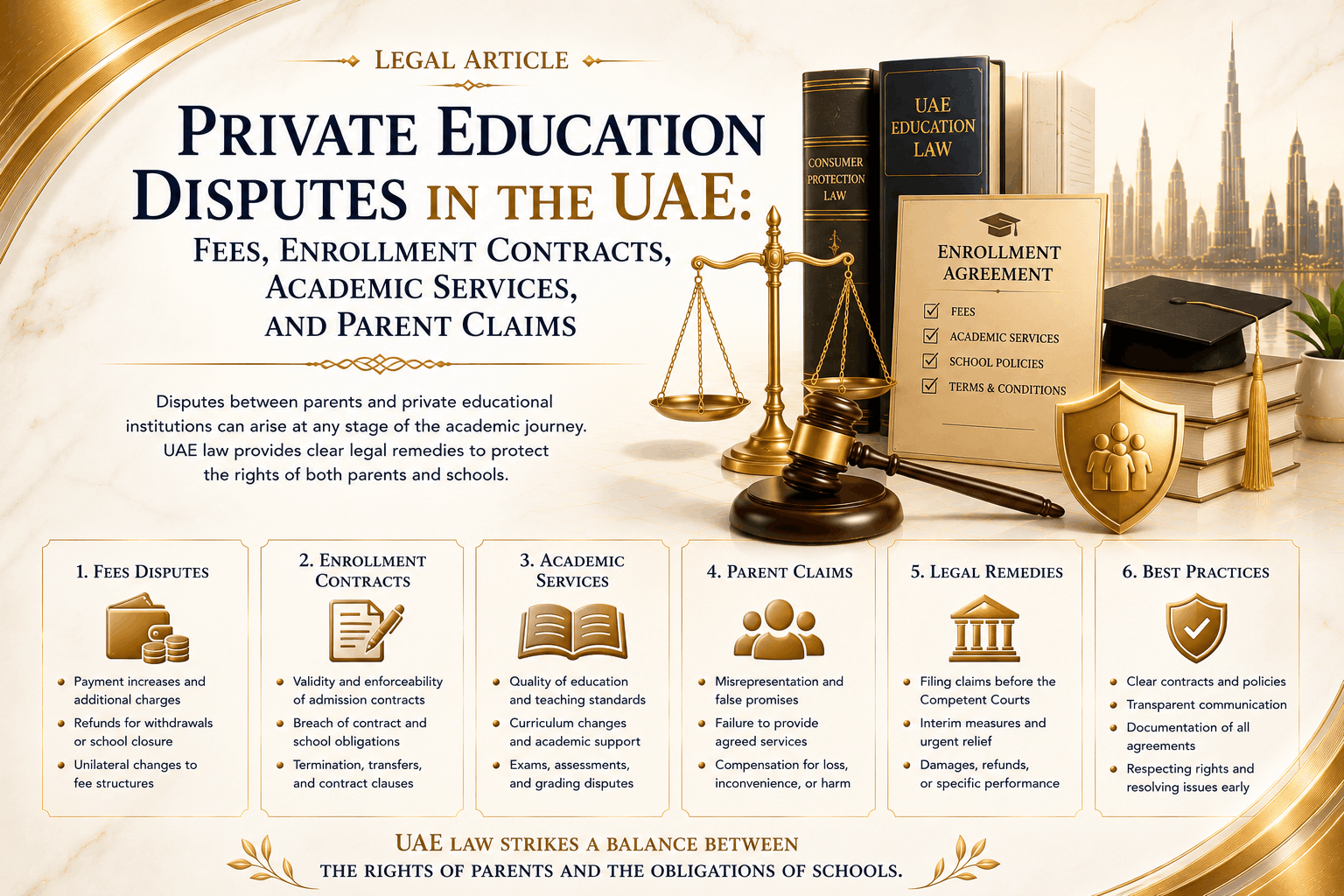
Private education disputes in the UAE can involve school fees, refunds, enrollment contracts, academic services, records, disciplinary decisions, and parent claims that affect both legal rights and a child’s education.
UAE Legal Framework for Private Education Disputes
Private education disputes may involve federal education principles, emirate-level education authorities, KHDA, ADEK, Ministry of Education supervision in relevant emirates, school fee rules, enrollment contracts, civil contractual remedies, complaint procedures, and local court practice.
Official UAE legislation portal | UAE Ministry of Education | KHDA | ADEK | Dubai Courts | Abu Dhabi Judicial Department | DIFC Courts | ADGM Courts
Key Legal Concepts and Definitions
Important concepts include private education dispute, enrollment contract, school fees fact sheet, tuition fees, refund policy, academic services, parent claim, disciplinary decision, academic records, regulator complaint, and civil claim.
Who Private Education Dispute Rules Apply To
These rules may affect parents, guardians, students, private schools, nurseries, early childhood centers, school owners, principals, admissions teams, finance departments, transport providers, special education departments, teachers, school operators, education investors, regulators, and third-party service providers.
Rights and Obligations of Parents, Students, Schools, and Education Providers
Parents may request clear fee information, records, refund review, complaint handling, and remedies where services were not delivered. Schools may enforce approved fees and policies, but they should communicate transparently, keep records, handle complaints properly, and apply policies consistently.
Enrollment Contracts, Fee Fact Sheets, and School Policies
The enrollment contract, school-parent contract, fee fact sheet, refund policy, parent handbook, and school policies are usually the core documents. They help determine what was promised, what was payable, what was refundable, and whether either side complied with the agreed procedure.
School Fees, Refunds, Deposits, and Withdrawal Disputes
Fee disputes may involve unpaid tuition, refund requests, application fees, registration deposits, re-enrollment deposits, transport fees, books, activities, exams, discounts, and withdrawal timing. The answer depends on the contract, payment type, timing, regulator rules, and evidence.
Promised Academic Services, Curriculum, Support, and Quality Issues
Legal disputes may arise where a school promised specific academic services, curriculum pathways, learning support, exam preparation, or facilities and failed to deliver them. The stronger position is built on written representations, reports, timetables, emails, and complaint records.
Disciplinary Decisions, Student Records, and Transfer Issues
Disciplinary and record disputes should be reviewed against school policies, evidence, regulator expectations, student welfare, and proportionality. Parents should request written decisions and preserve all records, while schools should document investigations and reasons carefully.
Dubai, Abu Dhabi, Other Emirates, Free Zones, DIFC, and ADGM Considerations
Dubai disputes commonly involve KHDA. Abu Dhabi disputes commonly involve ADEK. Other emirates may involve the Ministry of Education or local authority. DIFC and ADGM may be relevant only where the provider, contract, company, or dispute structure connects to those jurisdictions.
Procedures in the UAE
- Classify the dispute as fee, refund, academic service, disciplinary, records, transfer, or contract related.
- Review the enrollment contract, fee fact sheet, policies, invoices, receipts, emails, and reports.
- Submit a clear written complaint to the school with evidence and requested remedy.
- Escalate to the relevant education authority where appropriate.
- Send a legal notice if the dispute involves substantial rights, refund, records, or repeated non-response.
- Negotiate settlement where a practical solution can protect the child and reduce costs.
- Consider civil court action if the dispute cannot be resolved through school or regulator channels.
- Proceed with judgment and enforcement where a court claim becomes necessary.
Required Documents and Evidence
- Enrollment contract, School/Parent Contract, School Fees Fact Sheet, and fee schedule
- Refund policy, parent handbook, school policies, admission offer, and re-enrollment form
- Invoices, receipts, bank transfers, cheques, payment-plan correspondence, and discount approvals
- Withdrawal notice, transfer request, academic reports, attendance records, and learning support reports
- Disciplinary letters, incident reports, bullying complaint records, and meeting minutes
- Emails, WhatsApp messages, complaint forms, regulator complaints, website screenshots, and brochures
- Exam documents, transport agreements, activity terms, parent and student identification documents
- Legal notices, settlement correspondence, translations, and court documents where relevant
Common Misunderstandings
- A verbal promise from admissions is enough.
- All school fees are automatically refundable.
- The school can change services without consequence.
- Parents can stop paying until the school fixes the problem.
- A regulator complaint always gives compensation.
- WhatsApp messages are always decisive.
- Disciplinary decisions cannot be challenged.
- Ignoring the issue will protect the child.
Common Mistakes to Avoid
- Signing enrollment documents without reading refund terms
- Not keeping the School Fees Fact Sheet and fee schedule
- Paying cash without receipts
- Relying on verbal promises
- Delaying withdrawal notice
- Sending emotional messages or posting accusations online
- Refusing all payment without legal advice
- Escalating to the wrong authority
- Waiting until records are urgently needed before raising the dispute
Practical Examples
Parent Withdraws Before Term Starts
A parent requests a refund after relocation. The legal issue is the refund policy, withdrawal timing, type of fee, and seat reservation. A lawyer would review the contract, fee fact sheet, receipts, and withdrawal notice before negotiating or filing a complaint.
Promised Learning Support Is Not Delivered
A school promised support during admission, but the child did not receive it. The issue is proving the promise and the service gap through emails, reports, meeting notes, invoices, and school plans.
Disciplinary Exclusion After Incident
A student is suspended or excluded after an incident. Parents should request the written decision, policy basis, incident evidence, and appeal route before challenging the decision.
School Withholds Transfer Records
A family needs records for a new school, but fees are disputed. A lawyer would assess the regulator rules, payment history, disputed amount, urgency, and possible settlement or complaint route.
Legal Risks and Consequences
Poor handling may cause financial loss, rejected refund claims, unpaid-fee claims, delayed transfer, withheld or disputed records, weak evidence, damaged parent-school relationship, student disruption, missed enrollment deadlines, regulator complaints, civil litigation, court costs, reputational damage, defamation exposure, and enforcement action after judgment.
How a Lawyer Evaluates a Private Education Dispute
A lawyer reviews the emirate, regulator, school licence, student status, parent contract, fee fact sheet, refund policy, payment records, withdrawal timing, academic-service promises, disciplinary process, records requested, complaint history, evidence strength, procedural route, settlement options, litigation risk, enforcement possibilities, commercial impact, and the child’s practical needs.
How a Lawyer Builds a Stronger Legal Position
Legal support may include reviewing contracts, identifying weaknesses, preparing complaints, responding to school demands, drafting legal notices, organising evidence, checking regulator guidance, negotiating refund or payment settlement, requesting records, challenging disciplinary decisions, drafting civil claims or defences, and protecting the client from procedural mistakes.
Settlement vs Litigation or Regulator Complaint
Settlement may resolve disputes through partial refund, fee waiver, payment plan, transfer-record release, corrected record, service credit, or withdrawal agreement. A regulator complaint may be useful for compliance issues. Litigation may be necessary for substantial financial claims or unresolved contractual breaches.
When Urgent Legal Action May Be Needed
- A transfer certificate or academic record is urgently required
- A student may lose a school place
- Withdrawal or refund deadlines are approaching
- A disciplinary exclusion is imminent
- Exams or assessments may be missed
- Promised learning support is not being delivered
- The school threatens legal action for unpaid fees
- Evidence may be deleted or lost
Frequently Asked Questions
1. What are private education disputes in the UAE?
They are disagreements between parents, students, guardians, and private education providers involving fees, refunds, enrollment contracts, academic services, discipline, records, transfer documents, or complaints.
2. Which authority handles Dubai private school disputes?
Dubai private school matters commonly involve KHDA. Parents should review the contract, fee fact sheet, refund policy, school communications, and KHDA guidance before escalating.
3. Which authority handles Abu Dhabi private school disputes?
Abu Dhabi private school matters commonly involve ADEK. Parents should review school documents, ADEK policy materials, and complaint routes before taking formal action.
4. Can parents get a refund after withdrawal?
It depends on the withdrawal timing, type of fee, enrollment contract, refund policy, emirate rules, and whether the school delivered the service.
5. Can a school claim unpaid fees?
Yes, where fees are due under the contract and applicable policy. Parents should respond in writing with evidence if the amount is disputed.
6. Can promised academic services be challenged?
Potentially, yes. The parent must show what was promised, how they relied on it, what was not delivered, and what remedy is requested.
7. Can disciplinary decisions be challenged?
A disciplinary decision may be challenged if it appears unsupported, disproportionate, inconsistent with policy, or procedurally unfair.
8. Are WhatsApp messages useful evidence?
They can be useful, especially for admissions promises, fee agreements, withdrawal notices, or complaint responses, but they should be preserved in full context.
9. Should parents post complaints online?
Parents should be careful because public accusations may create defamation or cybercrime risk. Written complaints, regulator channels, and legal advice are safer.
10. Why is legal advice important?
Legal advice helps identify the correct regulator, interpret the contract, assess refund rights, organise evidence, draft complaints or notices, protect records, negotiate settlement, and avoid mistakes.
Conclusion
Private education disputes in the UAE require careful handling because they combine contract law, education regulation, school policies, fee schedules, academic services, student welfare, and parent communication.
Early legal advice can help parents protect their children’s education and help schools manage compliance, evidence, settlement, and contractual risk before the dispute becomes more complicated.
Need Advice About a Private Education Dispute in the UAE?
Obtain tailored advice on school fees, refunds, enrollment contracts, academic services, disciplinary decisions, transfer records, parent complaints, regulator routes, settlement, and court strategy.
Book a Legal Consultation