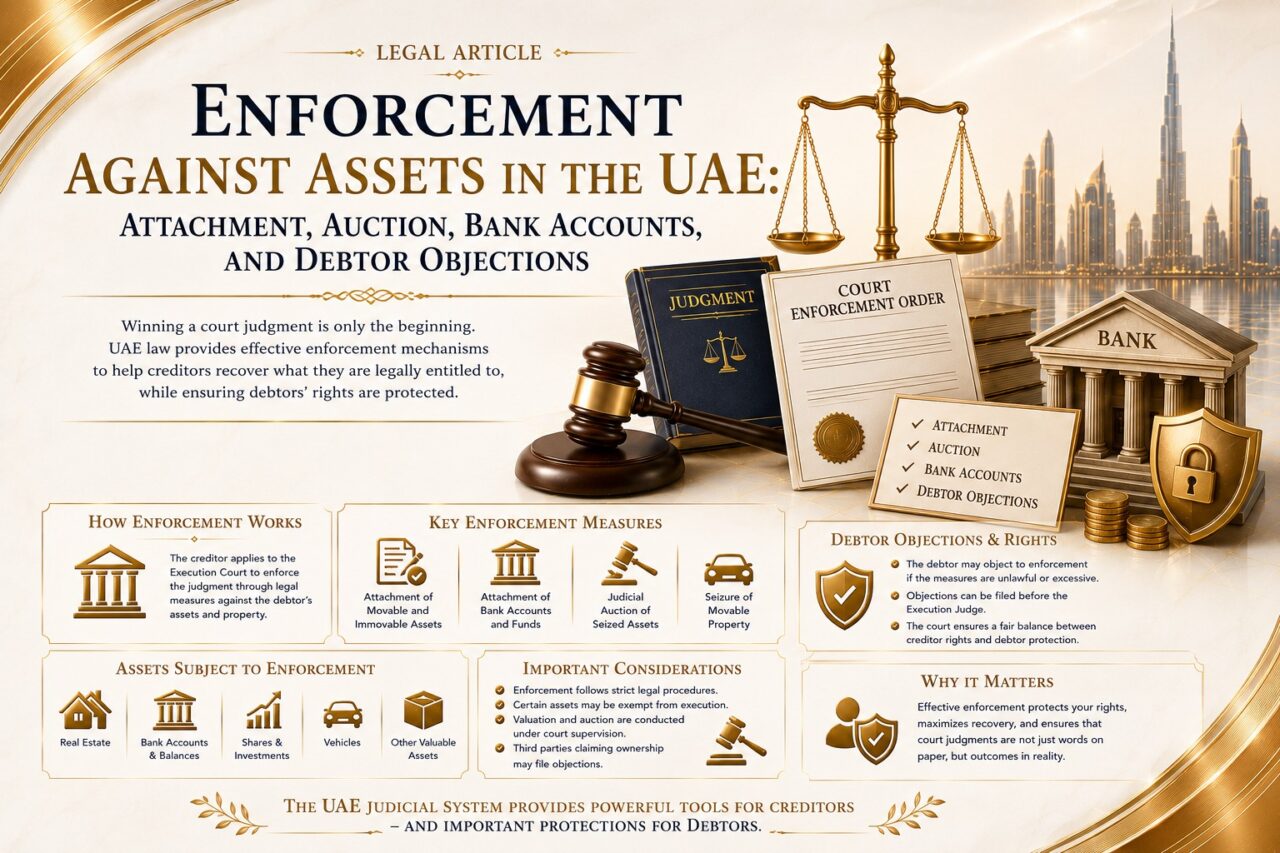
Enforcement Against Assets in the UAE: Attachment, Auction, Bank Accounts, and Debtor Objections

real estate execution, vehicle seizure, auctions, debtor objections, and execution-stage strategy.
Enforcement against assets in the UAE is the stage where a judgment creditor
uses court execution procedures to recover from bank accounts, real estate, vehicles, receivables,
shares, and other attachable assets.
depends on enforceability, asset identification, execution strategy, debtor objections, and proper
use of the competent court or enforcement forum.
UAE Legal Framework for Enforcement Against Assets
Enforcement against assets in the UAE may involve Federal Decree-Law No. 42 of 2022 promulgating
the Civil Procedure Code, local execution court practice, execution judge supervision, attachment,
auction, debtor objections, DIFC enforcement rules, ADGM court procedures, and free zone or registry
implementation requirements.
Official UAE legislation portal |
UAE Ministry of Justice |
Relevant UAE authority website |
Dubai Courts |
Abu Dhabi Judicial Department |
DIFC Courts |
ADGM Courts
Key Legal Concepts and Definitions
Important concepts include enforcement, execution file, judgment creditor, judgment debtor,
attachment, bank account attachment, real estate execution, auction, debtor objection,
third-party claim, execution judge, and enforceable instrument.
Who Enforcement Against Assets in the UAE Applies To
These rules may affect judgment creditors, debtors, landlords, tenants, suppliers, contractors,
employers, employees, banks, finance companies, shareholders, investors, guarantors, family members,
heirs, mainland companies, free zone entities, DIFC entities, ADGM entities, and foreign parties with
assets or enforceable judgments in the UAE.
Rights and Obligations of Judgment Creditors, Debtors, Banks, Asset Holders, and Third Parties
Creditors may request attachment, auction, and other enforcement measures where legally available.
Debtors may object, prove payment, request instalments, or challenge excessive enforcement. Banks,
registries, free zones, employers, and other asset holders may need to comply with court orders.
Bank Account Attachment and Financial Asset Enforcement
Bank account attachment may allow recovery from funds held by banks. The creditor should provide debtor
identification, bank details where available, transfer evidence, and a clear calculation of the judgment
debt. If the account has insufficient funds, the creditor may need to continue enforcement against other assets.
Real Estate Execution and Auction Procedures
Real estate execution may involve attachment, notification, valuation, auction, sale approval, transfer,
and distribution of proceeds. Mortgage rights, co-ownership, debtor objections, valuation disputes, and
local registry procedures can affect the outcome.
Vehicle Seizure, Movable Assets, Shares, Receivables, and Business Assets
Enforcement may target vehicles, equipment, inventory, company shares, receivables, rental income,
and other movable or intangible assets. The creditor should identify ownership, location, value,
finance status, and third-party rights before choosing the enforcement measure.
Travel-Related Measures and Debtor Pressure Tools
Travel-related measures may be relevant in certain enforcement contexts, depending on the debtor,
amount, procedural stage, and applicable law. These measures require careful legal review because they
affect mobility and should be connected to a proper enforcement strategy.
Debtor Objections, Instalment Requests, and Challenges to Execution
Debtors may object based on payment, calculation error, lack of enforceability, defective notification,
excessive attachment, third-party ownership, valuation disputes, prior mortgages, or instalment requests.
Objections should be supported by evidence and should focus on execution-stage issues.
DIFC, ADGM, Mainland Courts, Free Zones, and Local Emirate Differences
Mainland courts apply UAE federal civil procedure through local court systems. DIFC Courts and ADGM Courts
have separate procedural rules and enforcement mechanisms. Free zone assets may require coordination with
the relevant authority, registry, bank, or court.
Procedures in the UAE
- Confirm that the judgment, order, award, or instrument is enforceable.
- Open the execution file before the competent court or enforcement forum.
- Notify the debtor according to the applicable procedure.
- Identify bank accounts, real estate, vehicles, shares, receivables, or other assets.
- Request attachment, seizure, inquiry, auction, or other enforcement measures.
- Respond to debtor objections, instalment requests, or third-party claims.
- Proceed with valuation, auction, sale approval, and distribution of proceeds where needed.
- Continue enforcement against other assets until payment, settlement, or closure.
Required Documents and Evidence
- Final judgment, order, payment order, arbitral award, or enforceable instrument
- Proof of finality, enforceability, recognition, ratification, or executory formula where required
- Calculation of principal, interest, costs, and fees
- Debtor passport, Emirates ID, address, trade licence, and company documents where available
- Bank transfers, cheques, receipts, invoices, settlement agreements, and payment schedules
- Real estate title details, vehicle registration records, company share records, and free zone documents
- Third-party receivable evidence, tenancy contracts, valuation reports, and auction documents
- Debtor objection documents, proof of payment, Arabic translations, and powers of attorney
Common Misunderstandings
- Winning the case means the money will be paid automatically.
- The court will find every asset for the creditor.
- A debtor can stop enforcement just by objecting.
- Bank account attachment always recovers the full debt.
- Real estate auction is immediate.
- The debtor can reargue the whole case during execution.
- All UAE courts follow the same practical process.
- Settlement during enforcement is weakness.
Common Mistakes to Avoid
- Delaying execution after judgment
- Failing to calculate the judgment amount correctly
- Opening enforcement in the wrong forum
- Failing to identify assets
- Relying only on one bank account
- Accepting vague instalment promises without security
- Not responding to debtor objections
- Not translating documents properly
- Failing to document settlement terms during execution
Practical Examples
Supplier Wins Judgment but Debtor Refuses to Pay
The creditor should open execution, calculate the debt, identify bank accounts from prior transfers,
seek attachment, and consider vehicles, receivables, or business assets if bank recovery fails.
Debtor Owns Real Estate but Claims No Cash
The creditor may seek real estate attachment and auction, but should check title details, mortgage status,
valuation, co-ownership, and the likely net recovery.
Company Bank Account Is Empty
If bank attachment recovers nothing, the creditor should reassess asset strategy and consider receivables,
vehicles, equipment, shares, or other assets rather than closing the file too early.
Debtor Objects Based on Partial Payment
If the debtor proves partial payment, the calculation may need correction. Enforcement may continue for
the remaining balance if the judgment is still unsatisfied.
Legal Risks and Consequences
Poor enforcement strategy may lead to delayed recovery, asset loss, rejected applications, failed auctions,
wasted fees, weak settlement leverage, business disruption, bank restrictions, travel-related pressure,
third-party claims, and continued non-payment despite winning the case.
How a Lawyer Evaluates an Enforcement Matter
A lawyer reviews enforceability, jurisdiction, appeal status, debtor identity, asset location, bank accounts,
real estate, vehicles, receivables, third-party rights, priority creditors, calculation accuracy, debtor
objections, settlement options, litigation risk, enforcement possibilities, commercial impact, and client objectives.
How a Lawyer Builds a Stronger Legal Position
Legal support may include opening the execution file, calculating the debt, identifying assets, preparing
attachment requests, pursuing bank accounts, real estate, vehicles, shares, or receivables, responding to
objections, negotiating settlement, and coordinating cross-jurisdiction enforcement.
Settlement vs Litigation During Enforcement
Settlement may be useful where it gives the creditor faster and more certain recovery through payment,
security, or staged instalments. Continued enforcement may be necessary where the debtor is evasive,
offers unsupported instalments, or transfers assets. Settlement terms should be written clearly and linked
to the execution file.
When Urgent Legal Action May Be Needed
- The debtor is moving funds out of bank accounts
- A property sale is imminent
- Vehicles or equipment are being transferred
- The debtor is closing or liquidating a company
- A debtor objection deadline is approaching
- An auction date is scheduled
- A settlement default occurs
- A creditor discovers new assets
Frequently Asked Questions
1. What does enforcement against assets in the UAE mean?
It means using court execution procedures to recover money or satisfy a judgment through assets such as
bank accounts, real estate, vehicles, receivables, shares, and other attachable property.
2. Does winning a UAE court case mean automatic payment?
No. If the debtor does not pay voluntarily, the creditor usually needs to open an execution file and
request enforcement measures.
3. Can UAE courts attach bank accounts?
Yes, where there is an enforceable judgment and the legal requirements are met. The creditor should
provide debtor details and bank information where available.
4. Can real estate be sold by auction?
Real estate execution may be possible where the debtor owns attachable property. The process may involve
attachment, valuation, auction, sale approval, and distribution of proceeds.
5. Can vehicles be seized?
Vehicles may be seized if they belong to the debtor and are legally attachable. Ownership, finance status,
and market value should be checked.
6. What objections can a debtor raise?
A debtor may object based on payment, wrong calculation, lack of enforceability, improper notification,
excessive attachment, third-party ownership, valuation issues, or instalment requests.
7. What happens if bank attachment finds no money?
The creditor may need to continue enforcement against other assets, such as real estate, vehicles, shares,
receivables, business assets, or future funds.
8. Are DIFC enforcement procedures different?
Yes. DIFC Courts have their own enforcement rules, including rules for attachment of assets and
third-party debt orders.
9. Can settlement happen after enforcement starts?
Yes. Settlement may be practical if it provides faster recovery, security, or clear instalment terms.
It should explain whether enforcement is paused, continued, or released.
10. Why is legal advice important?
Legal advice helps identify assets, choose the correct forum, prepare attachment requests, respond to
debtor objections, manage auction procedures, and negotiate enforceable settlement terms.
Conclusion
Enforcement against assets in the UAE is the practical stage where a judgment creditor
turns a legal win into recovery through attachment, auction, bank account enforcement, vehicle seizure,
and other execution measures.
Early legal advice can help creditors preserve recovery value and help debtors respond properly to excessive,
incorrect, or unsupported enforcement before the matter becomes more complicated.
Need Advice About Enforcement Against Assets in the UAE?
Obtain tailored advice on judgment enforcement, bank account attachment, real estate execution, vehicle
seizure, auction procedures, debtor objections, instalment requests, settlement, and execution strategy.
