Managing Minor Assets in the UAE: Guardianship, Court Oversight, and Protection of Children’s Property
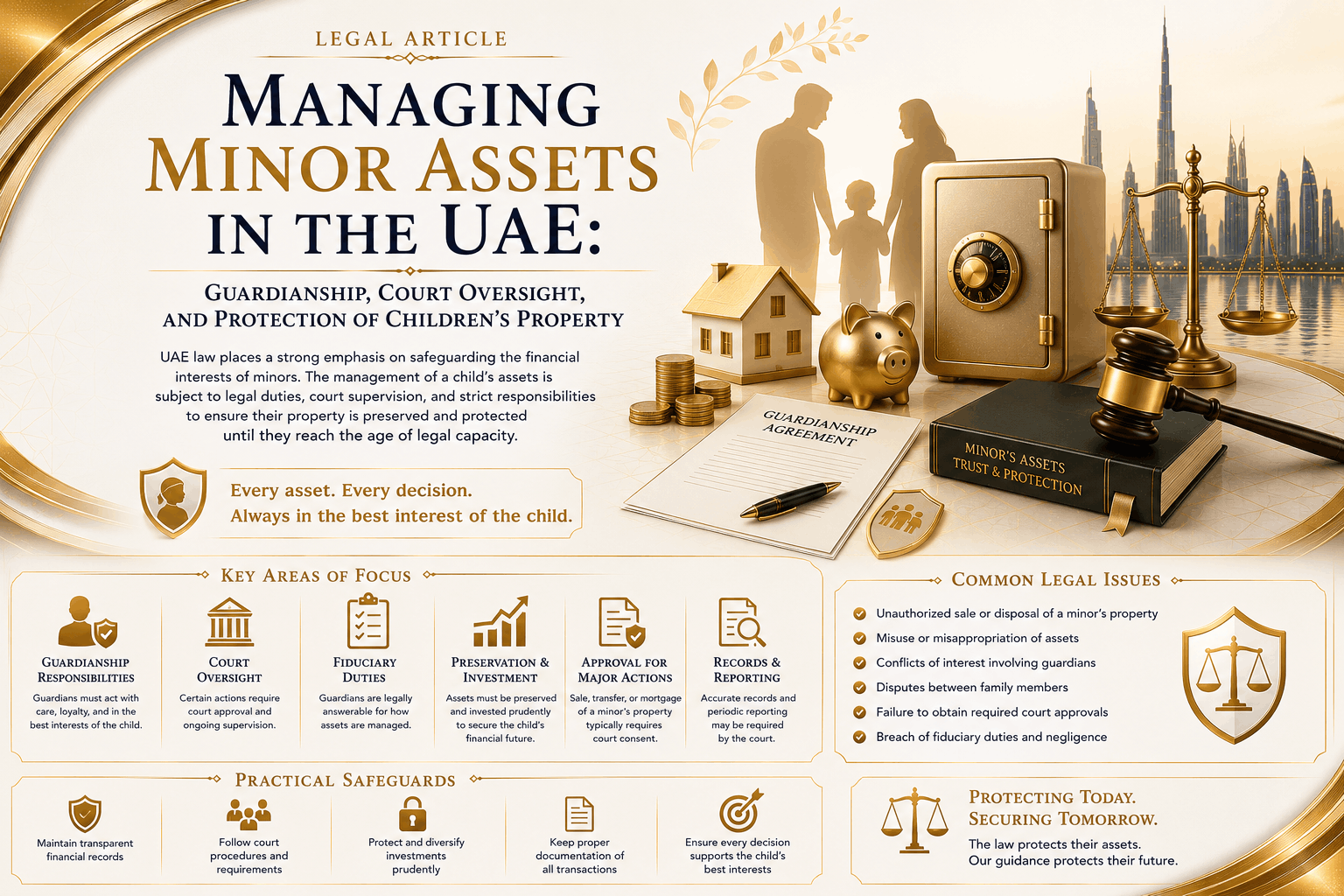
Managing minor assets in the UAE requires careful legal handling because children’s property must be protected, documented, and administered through the correct authority.
UAE Legal Framework for Managing Minor Assets
Managing minors’ property in the UAE may involve personal status law, guardianship rules, family court oversight, inheritance procedures, local emirate authorities, Dubai minors’ trust mechanisms, bank policies, real estate registry rules, DIFC or ADGM planning tools, and court applications.
Official UAE legislation portal | UAE Ministry of Justice | Relevant UAE authority website | Dubai Courts | Abu Dhabi Judicial Department | DIFC Courts | ADGM Courts
Key Legal Concepts and Definitions
Important concepts include minor, minor assets, guardian, guardianship over the person, guardianship over property, trustee, court-appointed representative, court approval, conflict of interest, inherited property, protected funds, and sale proceeds.
Who UAE Minor Asset Rules Apply To
These rules may affect parents, guardians, custodians, heirs, trustees, executors, surviving spouses, divorced parents, grandparents, banks, property buyers, real estate registries, insurers, investment advisers, and anyone holding or managing property that belongs to a child.
Rights and Obligations of Guardians, Parents, Trustees, Heirs, and Minors
The minor’s property must be protected. Guardians may seek authority to manage assets, but they should preserve records, avoid conflicts of interest, seek approvals where required, and use the assets only for the child’s benefit and according to lawful authority.
Guardianship Over the Minor’s Person vs Guardianship Over Property
Custody or day-to-day care of a child is not always the same as authority over property. Banks, courts, and registries may require proof of specific authority to withdraw funds, sell property, invest money, or settle claims involving a minor.
Inherited Property, Estate Shares, and Minor Heirs
Where a child inherits property, the child’s share must be identified and protected. The estate process may require heirship documents, guardianship confirmation, court approval, bank procedures, registry filings, and safeguards for the child’s share.
Bank Accounts, Cash, Sale Proceeds, and Investment Funds
Minor funds should be kept separate and properly documented. Withdrawals may require authority documents, expense evidence, and court or bank approval. Speculative investments, unsecured family loans, and mixing minor funds with personal funds create serious risk.
Real Estate Owned by Minors
Selling, renting, transferring, or managing real estate owned by a minor may require legal approval and evidence that the transaction protects the child. Valuation, sale terms, conflict checks, and safeguarding of proceeds are especially important.
Court Oversight, Approvals, and Accountability
Court oversight protects the child’s assets. Applications should clearly explain the asset, requested action, benefit to the child, supporting evidence, and how the proceeds or property will be protected.
Conflict of Interest and Misuse of Children’s Property
Conflict may arise where a guardian benefits personally from a transaction involving the child’s property. Related-party sales, use of minor funds for adult debts, family business investments, and undocumented withdrawals should be reviewed carefully.
Dubai, Abu Dhabi, Other Emirates, DIFC, ADGM, and Expat Considerations
Procedures can differ depending on the emirate, asset, court, bank, registry, will, nationality, religion, and residence. DIFC or ADGM planning tools may be relevant for some expat families, but implementation may still require UAE court or authority steps.
Procedures in the UAE
- Identify the minor, asset type, asset source, emirate, urgency, and whether a dispute exists.
- Review birth certificates, passports, Emirates IDs, death certificates, inheritance documents, court orders, wills, bank statements, and title deeds.
- Confirm who has authority over the child’s person and who has authority over the child’s property.
- Prepare court or authority applications where approval is needed.
- Support the application with valuations, expense records, bank documents, and evidence of benefit to the minor.
- Implement the approved transaction through the bank, land registry, court, or relevant authority.
- Maintain accounting records and follow-up reports where required.
Required Documents and Evidence
- Minor’s birth certificate, passport, and Emirates ID where available
- Parent or guardian passport, Emirates ID, family book where relevant, and guardianship order
- Custody judgment, death certificate, heirship or succession certificate, and will documents where relevant
- Bank statements, account documents, source-of-funds evidence, and expense invoices
- Title deeds, ownership certificates, property valuation reports, sale agreements, and rental records
- Insurance documents, compensation settlement documents, company share records, and board resolutions where relevant
- Emails, WhatsApp messages, receipts, bank transfers, official correspondence, and expert reports
- Arabic translations, legal notices, settlement correspondence, and court filings where required
Common Misunderstandings
- The parent can automatically use the child’s money.
- Custody means full control over property.
- Inherited money can be used for general family expenses.
- Banks are being difficult for no reason.
- A verbal family agreement is enough.
- A will solves everything automatically.
- The minor’s share can be sold like adult shares.
- Delay is harmless.
Common Mistakes to Avoid
- Using minor funds without proper authority or court approval
- Mixing child money with personal funds
- Selling property without proper valuation and safeguards
- Failing to keep receipts and bank records
- Treating custody as financial authority
- Ignoring bank, land registry, or court requirements
- Signing settlements involving minors without approval
- Failing to disclose conflicts of interest
- Using the child’s money for speculative investments
Practical Examples
Minor Inherits a Share in a Dubai Apartment
Adult heirs want to sell, but the minor’s share requires protection. A lawyer would review guardianship, valuation, sale approval, and safeguarding of the child’s proceeds.
Parent Needs Access to Inherited Bank Funds
The bank may refuse informal withdrawal. A lawyer would prepare guardianship documents, inheritance evidence, expense records, and the proper court or bank submission.
Divorced Parents Disagree Over Rental Income
If one parent controls rental income from a child’s property, accounting records, bank statements, tenancy contracts, and court direction may be needed.
Foreign Guardianship Document Presented Locally
A foreign document may require legalisation, translation, recognition, or local court steps before a UAE bank or registry accepts it.
Legal Risks and Consequences
Incorrect handling of minor assets may lead to blocked bank withdrawals, rejected real estate transfers, delayed inheritance distribution, family disputes, allegations of misuse, accounting claims, replacement of guardian, civil liability, urgent court orders, and loss of child assets.
How a Lawyer Evaluates a Minor Asset Matter
A lawyer reviews the minor’s age, parents’ status, guardianship documents, asset type, asset location, source of ownership, applicable law, jurisdiction, court requirements, inheritance position, will status, evidence strength, conflict-of-interest risk, urgency, settlement options, litigation risk, enforcement possibilities, and the child’s best financial interest.
How a Lawyer Builds a Stronger Legal Position
Legal support may include reviewing guardianship and custody documents, preparing court applications, organising evidence, obtaining valuations, drafting legal notices, communicating with banks or registries, preparing settlement documents, arranging translations, coordinating with foreign counsel where needed, and representing the minor’s interests before the competent court or authority.
Settlement vs Litigation or Family Court Applications
Settlement may resolve family disagreement over a minor’s share, but it must protect the child’s rights and may still require court approval. Court applications may be needed where a guardian misuses funds, refuses to account, or where banks and registries require formal authority.
When Urgent Legal Action May Be Needed
- A minor’s inherited property may be sold improperly
- A guardian is spending child funds without authority
- Bank funds are frozen and urgent child expenses are due
- Rental income from a child’s property is not being accounted for
- A parent or relative is hiding documents
- Real estate sale deadlines are approaching
- A guardian dies, loses capacity, or disappears
- Evidence of misuse may be deleted
Frequently Asked Questions
1. Who manages a minor’s assets in the UAE?
A legally recognised guardian, trustee, or court-appointed representative may manage a minor’s assets, depending on the asset and circumstances.
2. Can a parent withdraw money from a child’s inherited bank account?
Not automatically. Banks may require guardianship documents, inheritance documents, court approval, and proof that the withdrawal is for the child’s benefit.
3. Can a minor’s real estate share be sold?
It may be possible, but it usually requires careful legal handling, valuation evidence, safeguards, and possibly court or authority approval.
4. What happens if a child inherits property after a parent dies?
The child’s share must be identified and protected through the inheritance process. Court, bank, land registry, and guardianship procedures may be required.
5. Is custody the same as guardianship over property?
No. Custody concerns care of the child, while property guardianship concerns management of the child’s assets and may require separate authority.
6. Can minor funds be used for school fees or medical expenses?
They may be used where legally authorised and documented. Invoices, receipts, bank records, and court or bank approvals should be preserved.
7. Can a foreign guardianship order be used in the UAE?
It may help, but it may need legalisation, certified translation, UAE recognition, or a local court order before banks or registries accept it.
8. What if a guardian misuses a child’s property?
The matter should be assessed urgently. Possible steps include requesting accounts, preserving evidence, applying to court, restricting authority, replacing the guardian, or claiming recovery where justified.
9. Does a will remove the need for court approval?
Not always. A will can help with planning, but court, registry, bank, or authority steps may still be required where minors’ assets are involved.
10. Why is early legal advice important?
Early legal advice helps identify the correct guardian, court, documents, approval route, evidence, conflict-of-interest risk, and safeguards before the matter becomes more complicated.
Conclusion
Managing minor assets in the UAE requires careful attention to guardianship, court oversight, asset protection, evidence, and the child’s best financial interests.
Early legal advice can help families protect bank funds, inherited property, real estate shares, sale proceeds, compensation payments, and investment assets through the correct legal route.
Need Advice About Managing Minor Assets in the UAE?
Obtain tailored advice on guardianship, inherited property, bank-account issues, real estate sales, court approvals, conflict-of-interest risks, settlement, and child asset protection.
Book a Legal Consultation