Free Zone Companies in the UAE: Licensing, Substance, Governance, and Cross-Border Risk
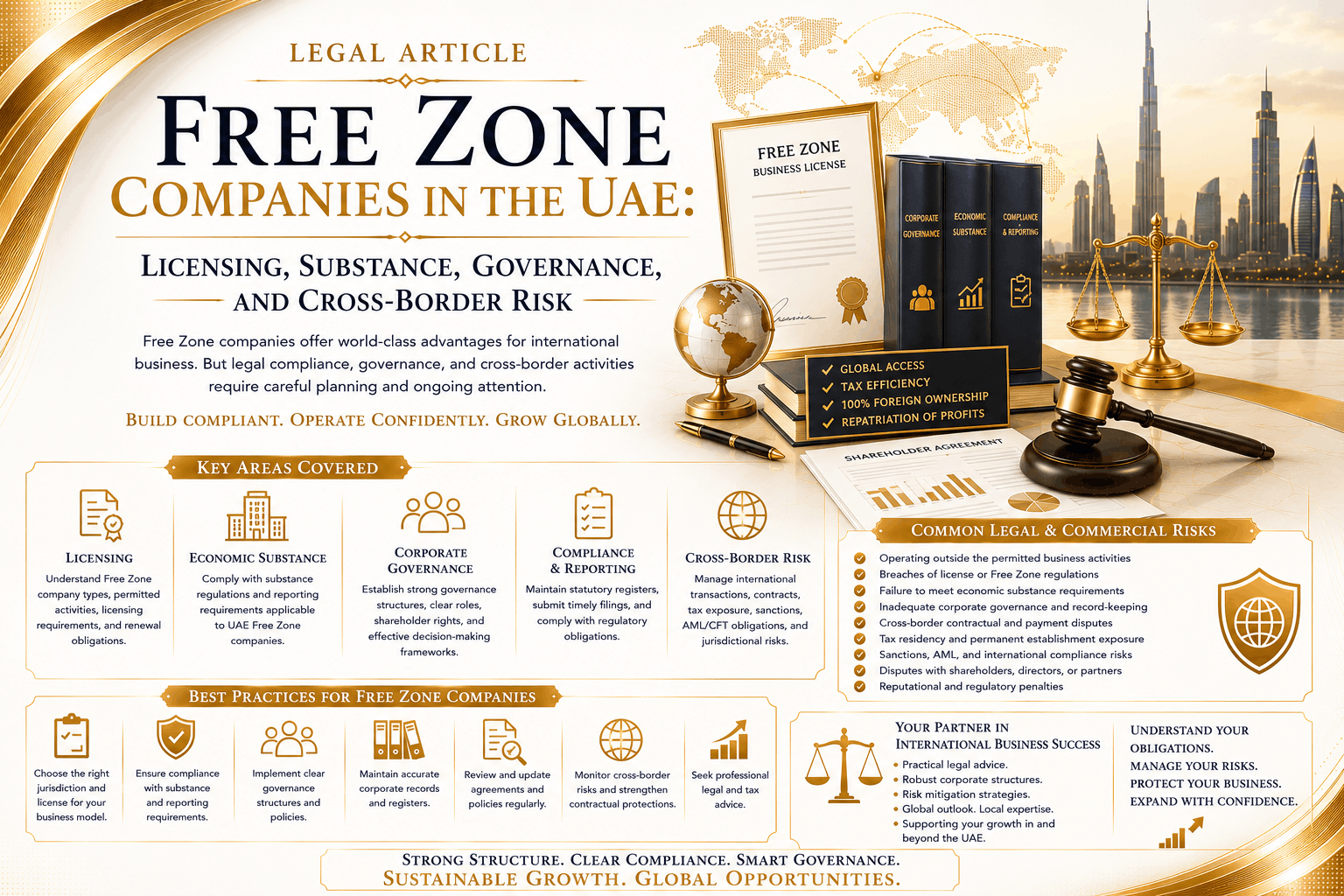
Free zone companies in the UAE can be powerful business vehicles, but they require careful legal planning around licence scope, substance, governance, beneficial ownership, mainland activity, tax, contracts, and cross-border risk.
UAE Legal Framework for Free Zone Companies
Free zone companies are governed by the relevant free zone authority, federal UAE laws where applicable, corporate tax rules, beneficial ownership procedures, economic substance requirements where relevant, employment and immigration rules, contract law, banking compliance, and dispute resolution clauses.
Official UAE legislation portal | UAE Ministry of Economy | UAE Ministry of Finance | Federal Tax Authority | UAE Ministry of Justice | Relevant UAE authority website | Dubai Courts | Abu Dhabi Judicial Department | DIFC Courts | ADGM Courts
Key Legal Concepts and Definitions
Important concepts include free zone company, free zone authority, licensed activity, mainland activity, branch, representative office, substance, beneficial owner, authorised signatory, corporate governance, Qualifying Free Zone Person, and cross-border risk.
Who UAE Free Zone Company Rules Apply To
These rules may affect founders, shareholders, directors, managers, authorised signatories, ultimate beneficial owners, investors, foreign parent companies, free zone entities, DIFC and ADGM entities, branches, holding companies, startups, trading companies, consultants, e-commerce businesses, employees, banks, landlords, customers, suppliers, and mainland counterparties.
Rights and Obligations of Free Zone Companies, Shareholders, Directors, Managers, and Counterparties
Free zone companies may conduct licensed activities and enter contracts, but they must comply with licence scope, renewal obligations, governance records, beneficial ownership filings, tax rules, employment procedures, banking compliance, and free zone requirements. Shareholders and managers should ensure authority, ownership, and operational decisions are properly documented.
Licensing Scope and Activity Restrictions
The licence should match actual operations. A consultancy licence does not automatically allow trading goods, a trading licence does not automatically permit regulated services, and a free zone licence does not automatically allow physical operations from a mainland office or shop.
Activities Outside the Free Zone and Mainland Risk
Free zone companies should carefully review whether their business model involves mainland activity. Selling goods or services locally may require a mainland distributor, branch, mainland company, permit, dual licence route where available, or another approved structure depending on the facts.
Substance Requirements and Economic Presence
Substance may include premises, employees, decision-making, expenditure, contracts, records, core income-generating activity, and management evidence. Substance can matter for ESR, corporate tax, banking, tax residency, transfer pricing, and investor due diligence.
Corporate Tax and Qualifying Free Zone Person Risk
A free zone company should not assume automatic 0% corporate tax treatment. The company should assess whether it is a Qualifying Free Zone Person, whether its income is qualifying income, whether mainland activity exists, whether substance is met, and whether transfer pricing and accounting records support the position.
Beneficial Ownership, AML, and Transparency Obligations
Free zone companies should maintain accurate beneficial ownership records, ownership charts, shareholder documents, source-of-funds evidence where needed, and bank compliance files. Nominee and informal ownership structures should be reviewed carefully.
Governance, Shareholder Records, and Internal Approvals
Good governance includes updated registers, resolutions, powers of attorney, authority matrices, bank mandates, shareholder agreements, accounting records, tax files, employment records, and clear approval procedures for major contracts and transactions.
Contracts, Invoicing, and Cross-Border Commercial Risk
Contracts should identify the correct entity, authorised signatory, governing law, dispute forum, payment terms, tax treatment, delivery obligations, confidentiality, intellectual property, termination, and compliance duties. Invoices and bank records should match the actual licensed activity and legal structure.
DIFC, ADGM, and Financial Free Zone Considerations
DIFC and ADGM entities may be subject to specialised company regulations, employment rules, courts, financial services controls, data protection obligations, and regulatory approval requirements. They should not be treated the same as ordinary commercial free zone companies.
Procedures in the UAE
- Review the trade licence, permitted activities, registered office, and actual business model.
- Check corporate documents, shareholder records, manager authority, resolutions, and beneficial ownership filings.
- Review contracts, invoices, customer locations, payment records, and delivery or service model.
- Analyse mainland activity and whether a distributor, branch, mainland company, or permit is required.
- Review corporate tax, VAT, ESR, substance, and transfer pricing evidence with tax specialists where needed.
- Correct gaps through amendments, resolutions, filings, contract updates, or restructuring.
- Prepare legal notices, settlement documents, free zone filings, court claims, arbitration requests, or authority responses where disputes arise.
Required Documents and Evidence
- Trade licence, incorporation certificate, constitutional documents, and activity list
- Shareholder register, manager register, board resolutions, shareholder resolutions, and powers of attorney
- Beneficial ownership register, ownership chart, passports, Emirates IDs, and source-of-funds evidence where needed
- Office lease, flexi-desk agreement, visa records, employment contracts, and salary records
- Contracts, invoices, purchase orders, delivery notes, bank statements, and payment confirmations
- VAT and corporate tax registrations, financial statements, audit reports, accounting ledgers, and tax files
- ESR notifications and reports where applicable, transfer pricing files, and substance evidence
- Free zone authority correspondence, licence amendment records, legal notices, settlement correspondence, and court or arbitration documents
Common Misunderstandings
- A free zone licence allows business anywhere in the UAE.
- Free zone means no tax.
- Substance does not matter for small companies.
- Beneficial ownership is only a bank requirement.
- The free zone authority handles every legal issue.
- A shareholder agreement is not needed between friends.
- DIFC and ADGM are the same as other free zones.
- If the bank opened the account, the structure must be legally safe.
Common Mistakes to Avoid
- Choosing a free zone only based on cost
- Selecting the wrong licensed activity
- Operating in the mainland without proper structure
- Failing to update beneficial ownership records
- Ignoring corporate tax conditions and substance evidence
- Using contracts that identify the wrong entity
- Allowing unauthorised persons to sign
- Mixing personal and company funds
- Relying on verbal shareholder promises
Practical Examples
Consulting Company Serving Mainland Clients
A free zone consultancy that places staff at mainland client offices should review whether its licence, contracts, and staffing model support the actual activity or whether additional structure is required.
Trading Company Selling Goods Directly in the UAE
A free zone trading company selling directly to mainland retailers may need to review distributor, branch, mainland company, logistics, customs, tax, and invoicing options.
Automatic 0% Corporate Tax Assumption
A free zone company should support its corporate tax position with activity analysis, contracts, accounting segmentation, substance records, and qualifying income review.
Shareholder Dispute Without Proper Records
If verbal ownership does not match the share register, the dispute may require emails, bank transfers, side agreements, resolutions, and filings to reconstruct the parties’ true position.
Legal Risks and Consequences
Free zone company mistakes may lead to licence suspension, refusal of renewal, bank account restrictions, tax exposure, beneficial ownership compliance issues, employment disputes, shareholder disputes, rejected contracts, unpaid invoices, regulatory inquiries, failed due diligence, court proceedings, arbitration, and business disruption.
How a Lawyer Evaluates a Free Zone Company Matter
A lawyer reviews the free zone jurisdiction, licence activity, corporate records, shareholder structure, beneficial ownership, manager authority, contracts, actual operations, mainland activity, tax position, ESR exposure, banking records, employment structure, dispute forum, evidence strength, settlement options, litigation risk, enforcement possibilities, commercial impact, and client objectives.
How a Lawyer Builds a Stronger Legal Position
Legal support may include licence review, mainland expansion advice, shareholder agreements, board resolutions, beneficial ownership corrections, contract drafting, invoicing restructuring, corporate tax and substance coordination, legal notices, settlement negotiation, free zone authority responses, court claims, arbitration strategy, and regulatory risk reduction.
Settlement vs Litigation or Regulatory Resolution
Settlement may help resolve shareholder exits, unpaid invoices, contract amendments, ownership records, or restructuring. Litigation or arbitration may be necessary for fraud, misuse of funds, refusal to transfer shares, unauthorised signing, or serious contractual breach. Regulatory resolution may be needed for licensing, tax, ESR, or beneficial ownership gaps.
When Urgent Legal Action May Be Needed
- A licence is about to expire or has been suspended
- A bank account is frozen or restricted
- A shareholder is removing funds without approval
- A manager signs contracts without authority
- Beneficial ownership records are inaccurate
- A corporate tax position is under review
- A free zone or mainland authority sends a compliance notice
- A business sale or investor due diligence is at risk
Frequently Asked Questions
1. Can a free zone company do business in the UAE mainland?
It depends on the activity, free zone, emirate, and structure. The company may need a mainland distributor, branch, mainland company, permit, or other approved structure depending on the facts.
2. Does a free zone company automatically pay 0% corporate tax?
No. A Free Zone Person must satisfy the applicable qualifying conditions, and the 0% rate applies only to qualifying income.
3. What happens if a free zone company operates outside its licensed activity?
It may face licensing, contractual, banking, tax, and regulatory risk. The company may need a licence amendment, branch, distributor, permit, or restructuring.
4. Are free zone companies subject to economic substance rules?
They may be, depending on their activities. Relevant activities should be reviewed carefully with supporting records and filings where applicable.
5. What is beneficial ownership?
Beneficial ownership identifies the natural person who ultimately owns or controls the company, directly or indirectly.
6. Are DIFC and ADGM companies the same as other free zone companies?
No. DIFC and ADGM have specialised legal systems, courts, company regulations, employment rules, data protection frameworks, and regulatory controls.
7. What documents should a free zone company keep?
It should keep licence records, incorporation documents, registers, resolutions, beneficial ownership records, contracts, invoices, bank statements, tax records, employment files, leases, and authority correspondence.
8. Can a free zone company sign contracts with foreign clients?
Yes, but contracts should clearly identify the correct company, governing law, jurisdiction, payment terms, tax treatment, compliance obligations, and authorised signatory.
9. What are common shareholder risks?
Common risks include undocumented ownership, nominee arrangements, unclear profit-sharing, no shareholder agreement, unauthorised bank access, deadlock, and disputes over exit rights.
10. Why is legal advice important?
Legal advice helps align licence scope, ownership structure, contracts, mainland activity, tax position, governance records, beneficial ownership filings, and dispute forum before mistakes become expensive.
Conclusion
Free zone companies in the UAE can be highly effective business vehicles, but they require proper licensing, governance, substance, tax analysis, beneficial ownership transparency, contract discipline, and regulatory awareness.
Early legal advice can help founders, shareholders, managers, investors, and counterparties understand the real legal position, correct weaknesses, preserve evidence, avoid costly disputes, and choose the right strategy before the matter becomes more complicated.
Need Advice About UAE Free Zone Companies?
Obtain tailored advice on licensing scope, mainland activity, shareholder structures, beneficial ownership, substance, corporate tax position, governance, contracts, regulatory exposure, settlement, litigation, and cross-border risk.
Book a Legal Consultation