Government Procurement Disputes in the UAE: Tender Rules, Contract Performance, and Payment Claims
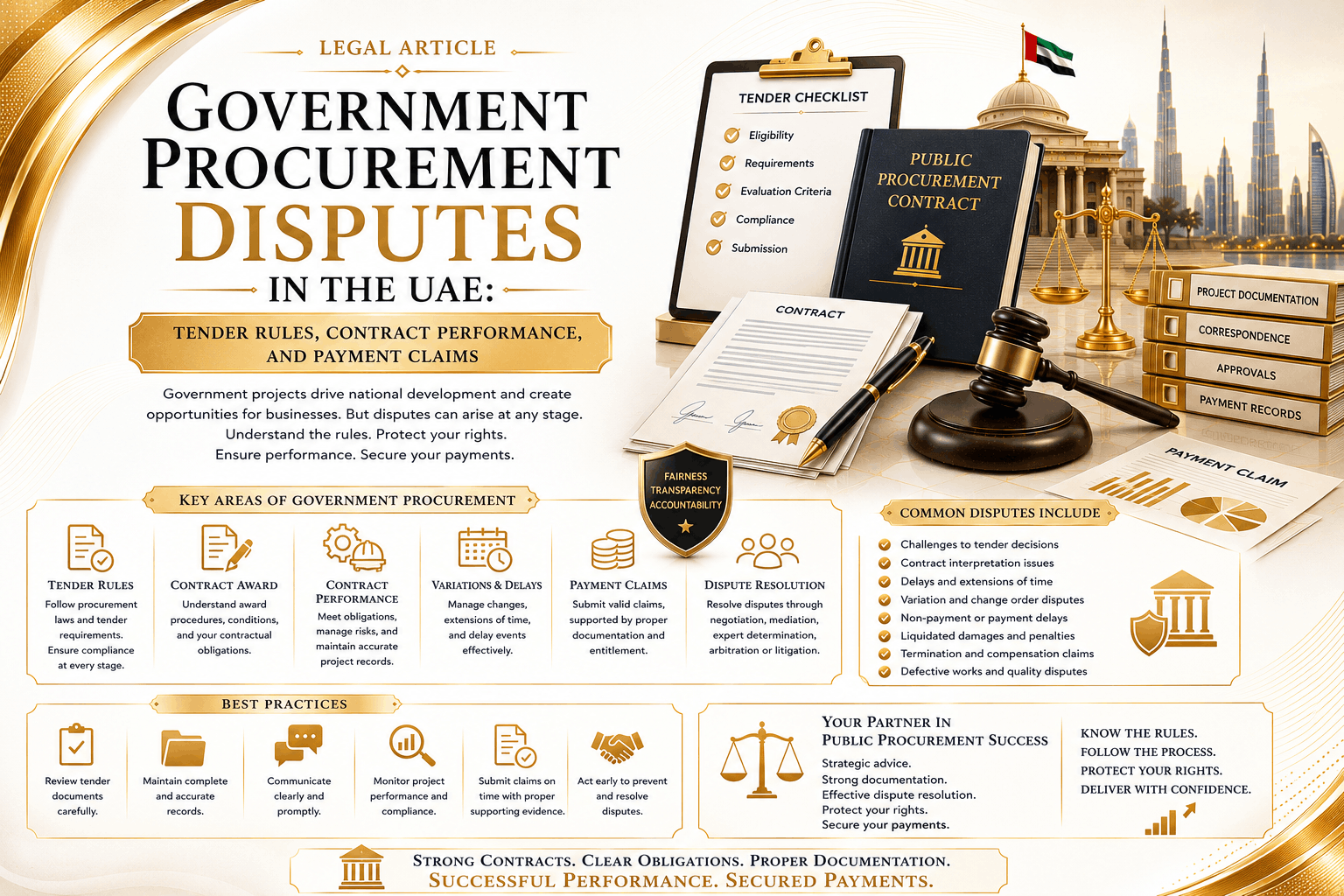
Government procurement disputes in the UAE can arise from tender compliance, bid rejection, contract award, performance obligations, delays, change orders, payment certification, performance bonds, termination, and final account disputes.
UAE Legal Framework for Government Procurement Disputes
UAE government procurement disputes may involve federal procurement law, executive regulations, federal supplier registration, local emirate procurement rules, Dubai government contract laws, entity-specific tender documents, free zone procurement terms, civil and commercial law, court procedure, arbitration clauses, and technical expert evidence.
Official UAE legislation portal | UAE Ministry of Finance | UAE Ministry of Justice | Relevant UAE authority website | Dubai Courts | Abu Dhabi Judicial Department | DIFC Courts | ADGM Courts
Key Legal Concepts and Definitions
Important concepts include government procurement, public tender, limited tender, direct agreement, bid bond, performance bond, payment certificate, variation, change order, delay claim, final account, retention, liquidated damages, and authorised instruction.
Who Government Procurement Rules Apply To
These rules may affect federal and local government entities, contractors, suppliers, consultants, construction companies, technology vendors, service providers, subcontractors, consortium members, foreign bidders, free zone companies, banks issuing bonds, insurers, and investors in public-sector contractors.
Rights and Obligations of Bidders, Contractors, Consultants, Suppliers, and Government Entities
Bidders should comply exactly with tender requirements and may challenge procedural defects where legally available. Contractors may claim certified payment, approved variations, extensions of time, and final account sums where proven. Government entities may enforce performance, reject non-compliance, apply contractual remedies, and protect public funds.
Tender Rules, Bid Compliance, and Disqualification Risks
Tender compliance is often decisive. Missing licences, expired registrations, defective bid bonds, incomplete technical forms, late portal submission, failure to attend a mandatory site visit, or submitting prices in the wrong format can lead to rejection even where the commercial offer is attractive.
Bid Challenges and Procurement Complaints
Bid challenges may arise from disqualification, scoring errors, inconsistent application of tender criteria, conflicts of interest, unfair clarification processes, or award to a non-compliant bidder. The bidder should act quickly, preserve portal evidence, and verify the correct complaint or court route.
Contract Award, Signing, Bonds, Guarantees, and Mobilisation
After award, the successful bidder may need to sign within a required period, submit a performance bond, provide insurance, mobilise resources, and comply with award conditions. Failure to handle this stage properly can create serious bond, termination, or disqualification consequences.
Contract Performance, Delay, Variations, and Change Orders
Performance disputes may involve late access, delayed approvals, changed scope, defective work, late delivery, interface issues, authority inspections, and unapproved extra work. Contractors should preserve notices, programmes, daily records, variation requests, and authorisation evidence.
Payment Claims, Payment Certification, Retention, and Final Accounts
Payment claims should connect the claimed amount to the contract, approved scope, completed work, certificates, invoices, inspection approvals, delivery evidence, variation approvals, and final account records. Weak certification or missing documents can delay or defeat a claim.
Performance Bonds, Liquidated Damages, Suspension, and Termination
Performance bond calls, liquidated damages, suspension, and termination require urgent review of contract clauses, notices, default evidence, delay causation, extension-of-time submissions, bond wording, and available protective measures.
Federal, Dubai, Abu Dhabi, Free Zone, DIFC, and ADGM Differences
Federal procurement, Dubai procurement, Abu Dhabi procurement, free zone procurement, and government-owned company procurement may follow different rules and portals. DIFC and ADGM may be relevant only where the contract, entity structure, or dispute forum supports that route.
Procedures in the UAE
- Identify the procuring authority and applicable procurement framework.
- Review tender documents, award letter, contract conditions, specifications, and dispute clause.
- Preserve portal records, bid files, correspondence, payment documents, and project records.
- Prepare contractual notices for delay, variations, payment default, or termination risk.
- Attempt internal escalation, negotiation, amicable settlement, or contractually required dispute steps.
- Use technical, delay, quantity surveying, accounting, or IT experts where required.
- Proceed through court, arbitration, or the contract’s dispute route where settlement fails.
- Enforce judgment, award, settlement, payment agreement, bond release, or final account closure.
Required Documents and Evidence
- Tender invitation, instructions to bidders, clarifications, and bid submission confirmation
- Technical proposal, commercial proposal, bid bond, award letter, and contract
- Scope of work, specifications, drawings, bill of quantities, and programme
- Progress reports, daily reports, meeting minutes, inspection requests, and test reports
- Delivery notes, completion certificates, payment applications, certificates, invoices, and retention records
- Variation instructions, change order requests, approved change orders, and delay notices
- Performance bond, insurance, guarantees, defect notices, snag lists, and final account submissions
- Emails, WhatsApp messages, photos, videos, expert reports, legal notices, and settlement correspondence
Common Misunderstandings
- The lowest bid always wins.
- A government verbal instruction is enough.
- If the work was done, payment is automatic.
- All UAE government tenders follow the same rules.
- A tender rejection is always challengeable.
- Performance bonds are only formalities.
- Settlement means weakness.
- Ignoring a government notice will make the dispute go away.
Common Mistakes to Avoid
- Submitting incomplete tender documents
- Ignoring portal instructions or mandatory site visits
- Starting extra work without authorised change orders
- Failing to issue delay notices
- Treating all emails as authorised instructions
- Failing to maintain daily records and payment evidence
- Ignoring performance bond risk
- Choosing the wrong dispute forum
- Waiting until payment or termination risk becomes urgent
Practical Examples
Bid Disqualified for Missing Document
A bidder may lose the tender if a mandatory licence, bond, or form is missing. The better approach is to use a tender compliance checklist and preserve portal submission evidence.
Late Site Access
A contractor delayed by late site access should issue notices, update programmes, preserve meeting minutes, and prove causation rather than waiting until final account stage.
Extra Work Without Change Order
A verbal instruction for extra work may be difficult to enforce without written authority. The contractor should confirm the instruction and follow the contract variation process.
Payment Certificate Delayed
A supplier claiming payment should prove delivery, acceptance, invoice compliance, warranty documents, and any required technical approvals.
Legal Risks and Consequences
Government procurement disputes may lead to tender rejection, lost opportunity, bond calls, delayed payment, rejected variations, retention disputes, termination, liquidated damages, poor supplier evaluation, court costs, expert costs, business disruption, cash-flow pressure, and reputational harm.
How a Lawyer Evaluates a Government Procurement Dispute
A lawyer reviews the procuring authority, applicable law, tender rules, bid compliance, authority matrix, contract wording, dispute clause, payment conditions, variation procedure, delay notices, bond wording, evidence strength, expert requirements, settlement options, litigation risk, enforcement possibilities, commercial impact, and client objectives.
How a Lawyer Builds a Stronger Legal Position
Legal support may include tender review, bid compliance checks, risk review of government terms, notice drafting, payment claim organisation, variation claim preparation, delay evidence preservation, bond-risk review, expert coordination, settlement negotiation, and court or arbitration strategy.
Settlement vs Litigation or Arbitration
Settlement may help resolve payment, final account, programme, variation, or close-out issues. Litigation or arbitration may be necessary where the amount is substantial, a bond call is threatened, termination occurs, or the authority refuses certification or payment.
When Urgent Legal Action May Be Needed
- A tender rejection must be challenged quickly
- An award is about to be signed with another bidder
- A performance bond call is threatened
- A termination notice is issued
- Payment certification is blocked
- Project records may be lost
- Liquidated damages are being deducted
- A court, arbitration, or authority deadline applies
Frequently Asked Questions
1. What is the main federal procurement law in the UAE?
Federal Decree-Law No. 11 of 2023 is the key federal procurement framework for federal government procurement.
2. Are Dubai government procurement rules different from federal rules?
Yes. Dubai has its own framework for government contracts and procurement, including Law No. 12 of 2020.
3. Can a bidder challenge tender disqualification?
Potentially, but the bidder must identify a real procedural issue, preserve evidence, and act through the correct route.
4. Is the lowest bid always required to win?
No. Evaluation may consider technical compliance, qualification, methodology, quality, risk, and other criteria.
5. Can a contractor claim payment for verbal variation instructions?
This is risky because government contracts often require written approval from an authorised person.
6. What evidence is important in a payment claim?
Evidence includes the contract, payment applications, certificates, invoices, delivery notes, approvals, and correspondence.
7. What should a contractor do if a performance bond call is threatened?
The contractor should urgently review the bond, contract notices, default evidence, delay records, and protective options.
8. Can government contract disputes go to arbitration?
It depends on the contract and applicable government rules. Some public contracts restrict arbitration or require specific approvals.
9. Do electronic procurement documents have evidential value?
In Dubai’s government procurement framework, electronic records processed through the electronic system may have evidential value equivalent to official written documents.
10. Why is legal advice important before submitting a government tender?
Legal advice can identify mandatory requirements, disqualification risks, bond exposure, payment conditions, variation procedures, and dispute forum issues before submission.
Conclusion
Government procurement disputes in the UAE require careful analysis of the procuring authority, tender rules, contract wording, performance records, payment evidence, notices, bonds, and dispute forum.
Early legal advice can help bidders, contractors, consultants, suppliers, and government entities preserve evidence, issue proper notices, manage payment claims, reduce termination and bond risk, and choose the correct legal strategy before the dispute becomes more complicated.
Need Advice About UAE Government Procurement Disputes?
Obtain tailored advice on tender compliance, bid challenges, government contracts, payment claims, delay, change orders, performance bonds, termination, settlement, litigation, and arbitration strategy.
Book a Legal Consultation