Commercial Agency and Distribution Disputes in the UAE: Termination, Exclusivity, and Compensation
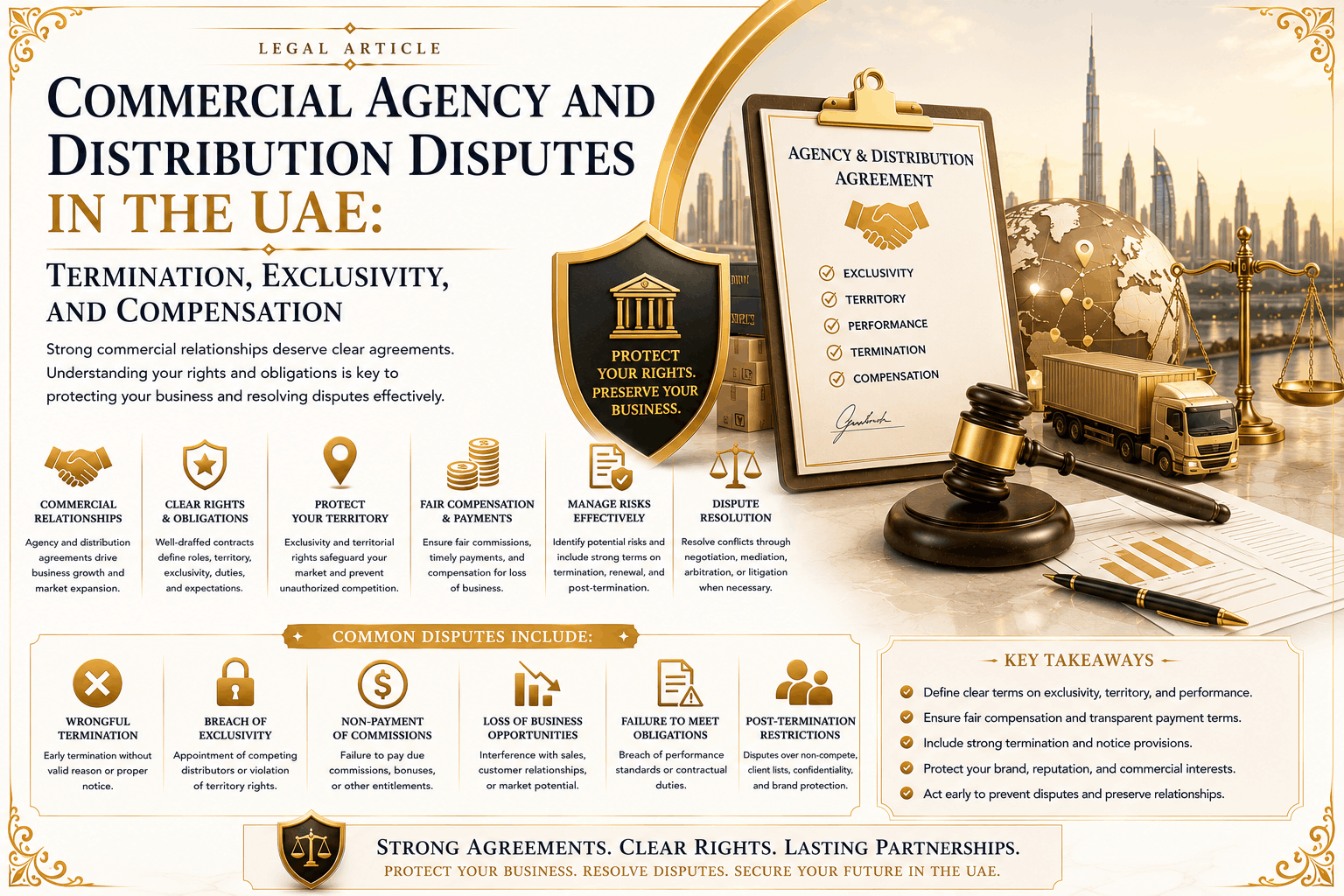
Commercial agency and distribution disputes in the UAE can affect market access, supply continuity, compensation exposure, brand control, customer relationships, and the ability of principals, agents, and distributors to continue operating.
UAE Legal Framework for Commercial Agency and Distribution Disputes
UAE commercial agency and distribution disputes may involve Federal Law No. 3 of 2022 concerning the Regulation of Commercial Agencies, Ministry of Economy procedures, the Commercial Agencies Committee, commercial transactions law, contract law, customs rules, competition law, trademark law, product regulations, court proceedings, and arbitration.
Official UAE legislation portal | UAE Ministry of Economy | UAE Ministry of Justice | Relevant UAE authority website | Dubai Courts | Abu Dhabi Judicial Department | DIFC Courts | ADGM Courts
Key Legal Concepts and Definitions
Important concepts include principal, commercial agent, distributor, registered commercial agency, exclusivity, territory, termination, non-renewal, compensation, temporary entry of goods or services, parallel imports, and dispute forum.
Who UAE Commercial Agency and Distribution Rules Apply To
These rules may affect principals, agents, distributors, suppliers, manufacturers, importers, exporters, brand owners, franchise operators, dealers, service providers, free zone companies, mainland companies, foreign suppliers, investors, retailers, wholesalers, and commercial managers.
Rights and Obligations of Principals, Agents, Distributors, and Suppliers
Principals may seek brand control, performance, payment, lawful termination, and market restructuring. Agents and distributors may seek exclusivity protection, supply continuity, commissions, compensation, payment, and protection against wrongful termination or parallel channels.
Registered Commercial Agency vs Ordinary Distribution Agreement
A registered commercial agency may trigger specific statutory procedures and committee jurisdiction, while ordinary distribution disputes depend mainly on contract wording, commercial law, court or arbitration clauses, and evidence of breach.
Exclusivity, Territory Rights, and Market Protection
Exclusivity clauses should define territory, products, customers, channels, online sales, free zone sales, re-export, spare parts, government tenders, key accounts, performance conditions, and consequences of underperformance.
Termination, Expiry, Non-Renewal, and Compensation Exposure
Termination risk depends on registration status, contract wording, notice, reason for termination, evidence of breach, investment evidence, compensation exposure, and whether the Commercial Agencies Committee or another forum has jurisdiction.
Supply Interruption and Temporary Entry of Goods or Services
Supply interruption may affect customers, warranties, spare parts, essential services, and market continuity. During registered agency disputes, temporary entry rules may become relevant and should be reviewed carefully.
Commercial Agencies Committee and Dispute Management
Registered agency disputes may be brought before the Commercial Agencies Committee. Complaints and defences should be supported by registration records, contract evidence, investment evidence, breach evidence, supply history, and compensation analysis.
Distribution Agreements Outside the Registered Agency Framework
Ordinary distribution disputes may involve unpaid invoices, failure to supply, exclusivity breach, parallel channels, warranty disputes, defective goods, minimum purchase obligations, stock buyback, termination notice, and post-termination trademark use.
Franchise, Dealer, Reseller, and Hybrid Structures
A business relationship may combine franchise, dealer, reseller, commercial agency, distribution, service, and trademark-licensing features. Correct classification is essential before termination, new appointments, or claims.
Competition Law and Parallel Channel Issues
Exclusive distribution, territorial restrictions, resale pricing, customer allocation, supply refusals, restrictions on online sales, and parallel channel control should be reviewed against UAE competition principles where they may affect market access.
Procedures in the UAE
- Assess the relationship type and Ministry registration status.
- Review agreements, amendments, side letters, notices, and conduct.
- Preserve evidence of supply, performance, investment, and breach.
- Assess termination rights, compensation exposure, and supply interruption risk.
- Prepare legal notice or cure notice where required.
- File or defend a Committee complaint, court claim, or arbitration where applicable.
- Consider urgent measures where supply, evidence, or market access is at risk.
- Negotiate settlement, transition, de-registration, stock, and customer communication.
- Enforce judgment, award, committee outcome, or settlement terms.
Required Documents and Evidence
- Commercial agency, distribution, dealer, franchise, or reseller agreements
- Side letters, amendments, and renewal correspondence
- Ministry registration certificate and commercial agency register extracts
- Commercial licences and company documents
- Product registration, import approval, and customs records
- Invoices, purchase orders, bills of lading, delivery notes, and stock records
- Sales reports, commission statements, rebate calculations, and payment records
- Emails, WhatsApp messages, meeting minutes, and legal notices
- Marketing spend, staff, showrooms, service centres, and investment evidence
- Evidence of underperformance, breach, parallel channels, or supply interruption
- Customer complaints, warranty files, expert reports, and settlement correspondence
Free Zones, DIFC, ADGM, and Cross-Border Structures
Cross-border agency and distribution structures may involve foreign principals, UAE registered agents, free zone distributors, mainland importers, regional hubs, DIFC or ADGM entities, offshore holding companies, customs routes, and international arbitration clauses.
Common Misunderstandings
- A distributor is always the same as a registered commercial agent.
- Contract expiry always ends the relationship without risk.
- The principal can appoint another distributor immediately.
- Only the written contract matters.
- Compensation is automatic.
- Arbitration avoids all UAE agency issues.
- Supply can be stopped without consequences.
- Settlement means weakness.
Common Mistakes to Avoid
- Signing without checking commercial agency registration risk
- Using foreign templates without UAE review
- Granting broad exclusivity without performance conditions
- Failing to define territory, products, channels, and online sales
- Ignoring Ministry registration status
- Terminating without proper notice or evidence
- Suspending supply abruptly
- Failing to document underperformance or investment
- Appointing another distributor too early
Practical Examples
Foreign Principal Wants to Terminate a Registered Agent
The principal should review registration, termination grounds, notice, performance records, warnings, customer complaints, investment evidence, compensation exposure, and committee route before acting.
Distributor Claims Exclusive UAE Rights
The lawyer should compare the contract with actual conduct, online channels, government tenders, side letters, invoices, and communications before advising on breach or defence.
Supply Suspended During a Dispute
The strategy should assess customer harm, warranty needs, temporary entry issues, registered agency status, and whether the principal had lawful grounds for suspension.
Agent Claims Compensation After Non-Renewal
The key evidence may include investment in showrooms, service centres, marketing, staff, spare parts, sales history, notices, performance, and causation of loss.
Legal Risks and Consequences
Agency and distribution disputes may cause compensation claims, blocked termination, supply interruption, inability to appoint a new partner, customer complaints, warranty disruption, customs complications, product-registration issues, unpaid invoices, committee proceedings, litigation, arbitration, and reputational damage.
How a Lawyer Evaluates a Commercial Agency or Distribution Case
A lawyer reviews registration status, applicable law, contract type, parties, territory, exclusivity, duration, renewal, termination, notice, breach evidence, investment evidence, compensation exposure, supply history, committee jurisdiction, court or arbitration clauses, customs, product registration, competition law, settlement options, and commercial objectives.
How a Lawyer Builds a Stronger Legal Position
Legal support may include registration checks, contract review, termination planning, notice drafting, compensation analysis, evidence organisation, committee complaint preparation, court or arbitration strategy, supply-continuity planning, settlement negotiation, de-registration strategy, and transition management.
Settlement vs Litigation, Committee Proceedings, or Arbitration
Settlement may protect supply, compensate fairly where justified, de-register an agency, transfer customers, and avoid market disruption. Committee proceedings, litigation, or arbitration may be needed where rights are disputed, compensation is substantial, or urgent protection is required.
When Urgent Legal Action May Be Needed
- A principal intends to terminate a registered agent
- An agent blocks market entry or supply
- Goods are stuck at customs or port
- A new distributor is about to be appointed
- A termination or non-renewal deadline is approaching
- Customer warranties are at risk
- Stock may be moved or hidden
- Product registration may expire
- Evidence may be deleted
Frequently Asked Questions
1. What is the main commercial agency law in the UAE?
The main law is Federal Law No. 3 of 2022 concerning the Regulation of Commercial Agencies. It governs registered commercial agencies and related issues such as registration, disputes, termination, and compensation exposure.
2. Is every distributor a registered commercial agent?
No. A distributor is not automatically a registered commercial agent. The contract, Ministry registration status, actual role, exclusivity, and business structure must be reviewed.
3. Why does registration matter?
Registration can affect dispute route, exclusivity, termination, compensation, importation issues, and the competence of the Commercial Agencies Committee.
4. Can a principal terminate a UAE commercial agent?
Termination may be possible, but it depends on agency status, contract wording, applicable law, reason for termination, notice, evidence, and compensation risk.
5. Can an agent claim compensation after termination?
Potentially, yes. Compensation depends on damage, causation, evidence, registration status, and the applicable commercial agency or contractual framework.
6. What is the Commercial Agencies Committee?
It is the specialised committee for disputes arising between parties to registered commercial agencies.
7. Can goods continue entering the UAE during an agency dispute?
UAE rules address temporary entry of goods or services bound by commercial agencies during disputes. This should be reviewed where supply continuity is important.
8. What evidence is important in agency termination disputes?
Important evidence includes the agency agreement, registration certificate, Ministry records, sales reports, invoices, payment records, supply history, notices, investment evidence, customer complaints, emails, WhatsApp messages, and expert reports.
9. Are free zone distributors treated differently?
Free zone involvement may affect licensing, customs, importation, contract party identity, and dispute forum, but it does not automatically remove UAE agency or distribution risk where the UAE market is affected.
10. Can a principal appoint another distributor during a dispute?
This can be risky where exclusivity or registered agency rights may apply. The principal should review registration, contract wording, temporary entry rules, committee risk, compensation exposure, and supply-continuity issues first.
Conclusion
Commercial agency and distribution disputes in the UAE require careful legal analysis because registration status, exclusivity, termination wording, compensation exposure, supply continuity, Ministry procedures, and dispute forum can change the entire strategy.
Early legal advice can help principals, agents, and distributors preserve evidence, prepare stronger notices, assess compensation risk, manage supply interruption, choose the correct forum, and resolve the dispute before it causes wider market damage.
Need Advice About UAE Commercial Agency or Distribution Disputes?
Obtain tailored advice on registered agency issues, distribution agreements, termination, exclusivity, compensation exposure, supply interruption, Ministry procedures, committee disputes, arbitration, litigation, and settlement strategy.
Book a Legal Consultation