Franchise Agreements in the UAE: Territory Rights, Brand Control, Fees, and Termination Risks
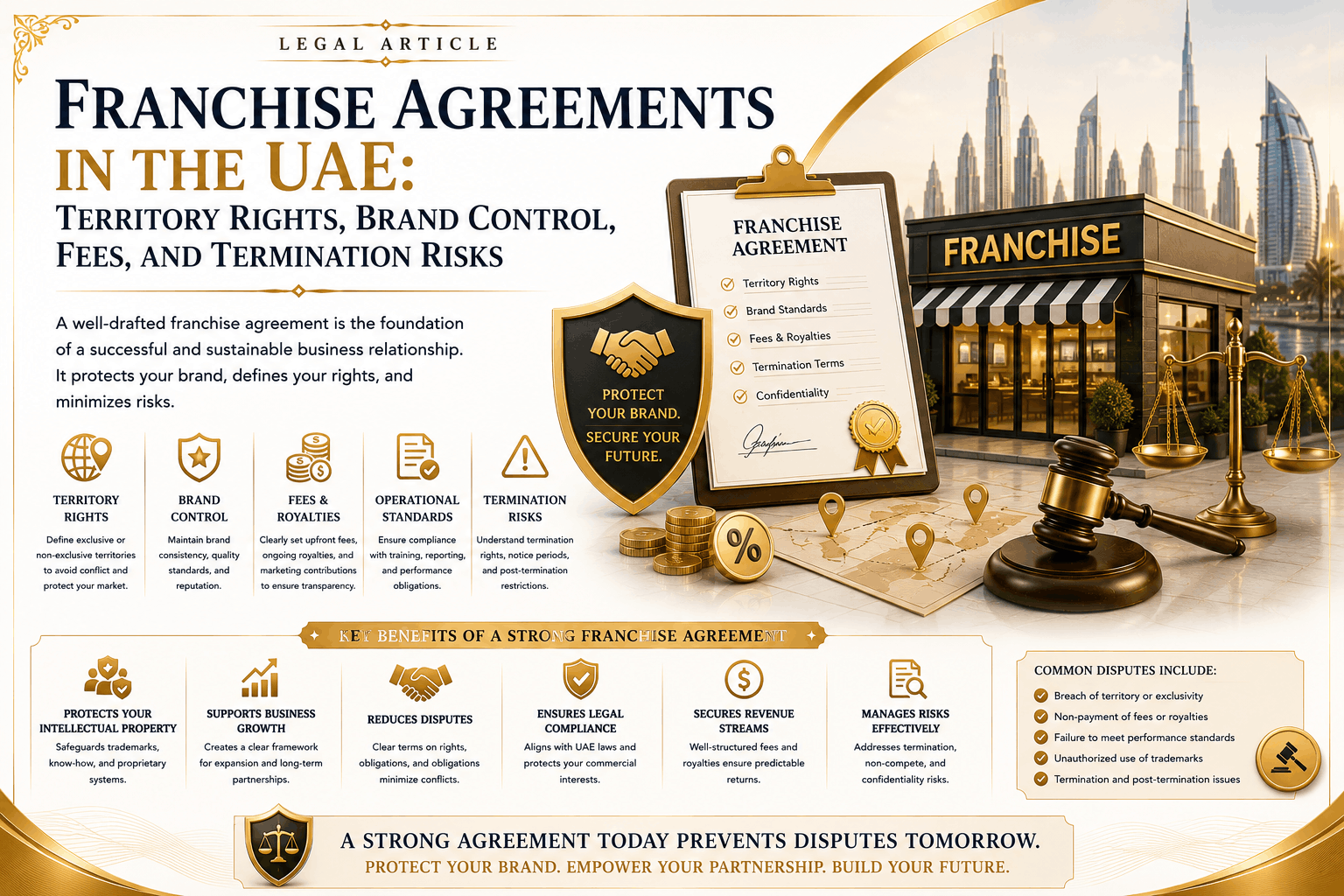
Franchise agreements in the UAE help brands expand and help franchisees operate established business models, but they also create legal risk around territory, fees, standards, renewal, termination, and post-termination brand use.
UAE Legal Framework for Franchise Agreements
UAE franchise agreements are mainly contract-driven and may involve civil law, commercial law, trademark law, commercial agency law, competition law, company law, licensing rules, lease arrangements, free zone regulations, and arbitration or court procedures.
Official UAE legislation portal | UAE Ministry of Economy | UAE Ministry of Justice | Relevant UAE authority website | Dubai Courts | Abu Dhabi Judicial Department | DIFC Courts | ADGM Courts
Key Legal Concepts and Definitions
Important concepts include franchisor, franchisee, master franchise, area development, territory, exclusivity, brand standards, royalty, marketing fee, non-compete clause, renewal, termination, de-branding, trademark licence, and commercial agency risk.
Who UAE Franchise Agreements Apply To
Franchise agreements may affect franchisors, franchisees, master franchisees, sub-franchisees, investors, brand owners, retail operators, F&B businesses, education brands, beauty and wellness concepts, healthcare-related brands, landlords, suppliers, employees, mainland companies, free zone companies, and foreign parent companies.
Rights and Obligations of Franchisors, Franchisees, Investors, and Operators
Franchisors may control brand standards, receive royalties, audit records, protect confidential know-how, and stop unauthorized use. Franchisees may seek clear territory rights, operational support, renewal certainty, fair standards, and predictable fee obligations.
Territory Rights and Exclusivity
Territory clauses should define whether the franchisee has exclusive or non-exclusive rights, whether online sales are reserved, whether delivery apps are included, whether corporate accounts are excluded, and whether missed performance targets reduce territory.
Brand Control, Standards, Manuals, and Operational Compliance
Brand standards protect customer trust. They may cover store design, signage, menus, products, suppliers, uniforms, staff training, marketing, software, packaging, complaint handling, and social media conduct.
Franchise Fees, Royalties, Marketing Contributions, and Audit Rights
Franchise fees may include initial fees, royalties, marketing fund contributions, training fees, technology fees, renewal fees, transfer fees, and audit costs. Royalty definitions should address gross sales, net sales, VAT, refunds, discounts, delivery platform revenue, and related-party transactions.
Performance Obligations, KPIs, and Development Schedules
Performance obligations should be realistic, measurable, and linked to clear consequences. They may include opening milestones, sales targets, quality scores, marketing spend, and training completion.
Renewal Rights, Expansion Rights, and Non-Renewal Risk
Renewal may be automatic, conditional, or discretionary depending on the agreement. Renewal clauses should address notice periods, renewal fees, compliance, renovations, updated franchise terms, payment of outstanding fees, and non-renewal consequences.
Termination Risks and Post-Termination Obligations
Termination clauses should define default events, cure periods, immediate termination rights, unpaid royalties, de-branding, return of manuals, removal of signage, social media control, customer data, and post-termination non-use obligations.
Non-Compete, Non-Solicitation, and Confidentiality Clauses
Restrictive clauses should protect legitimate interests such as know-how, goodwill, staff, customers, suppliers, and brand standards. Overbroad restrictions may create enforceability and competition concerns.
Trademark Licensing, Brand Ownership, and IP Protection
The agreement should state that the franchisor owns the trademarks, logos, manuals, brand goodwill, marketing assets, and business system, and that the franchisee’s use is limited, conditional, and usually ends on termination.
Commercial Agency, Distribution, and Franchise Classification
Franchise structures should be reviewed for commercial agency risk, especially where the franchisee also acts as exclusive distributor or representative. Classification can affect termination, compensation, registration, and dispute strategy.
Competition Law and Exclusivity Issues
Exclusivity, pricing controls, territory restrictions, approved supplier rules, and non-compete clauses should be reviewed against UAE competition law where they may restrict market access or competition beyond legitimate franchise protection.
Procedures in the UAE
- Review the franchise agreement, side letters, manuals, and notices.
- Preserve evidence of payment, performance, brand standards, and breach.
- Issue legal notice or cure notice where required.
- Conduct audit or inspection where allowed by the contract.
- Negotiate cure plan, restructuring, transfer, renewal, or settlement.
- Prepare arbitration or court claim depending on the dispute clause.
- Seek urgent relief where brand misuse or evidence loss creates immediate risk.
- Enforce judgment or award and monitor post-termination compliance.
Required Documents and Evidence
- Franchise, master franchise, and area development agreements
- Trademark licence, brand manual, and operating standards
- Renewal, termination, and cure notices
- Royalty reports, sales records, POS data, and audit reports
- Invoices, bank transfers, and marketing fund records
- Commercial licences, leases, mall approvals, and supplier agreements
- Emails, WhatsApp messages, meeting minutes, and inspection reports
- Customer complaints, photos, videos, and social media records
- Trademark certificates and commercial agency records if relevant
Free Zones, DIFC, ADGM, and Cross-Border Franchise Structures
Franchise structures may involve foreign franchisors, UAE operating entities, free zone companies, DIFC or ADGM investment vehicles, mall leases, local licences, and offshore holding companies. Governing law, forum, licensing, payment flow, and enforcement should be aligned.
Common Misunderstandings
- A franchise agreement is just a standard template.
- Exclusive territory means no competition at all.
- The brand manual can change anything.
- Royalty is easy to calculate.
- Termination is simple if the franchisee breaches.
- Non-compete clauses always work.
- A franchise is never a commercial agency.
- Settlement means weakness.
Common Mistakes to Avoid
- Signing a foreign template without UAE review
- Relying on verbal exclusivity promises
- Failing to define online, delivery, and reserved channels
- Using unclear royalty definitions
- Failing to audit sales records
- Ignoring trademark and commercial agency risk
- Terminating without proper notice
- Ignoring lease and de-branding consequences
- Not preserving operational evidence
Practical Examples
Exclusive Dubai Territory Dispute
A franchisee relies on verbal exclusivity, but the contract reserves delivery and airport channels. The better approach is to define territory, reserved rights, and channel exceptions before signing.
Royalty Underreporting
A franchisor suspects that delivery-platform revenue and cash sales are excluded from reports. A strong agreement would define sales and allow audits of POS records, bank statements, platform reports, and invoices.
Brand Standards Breach
A franchisee changes suppliers and uses unapproved packaging. The franchisor should collect inspection reports, warnings, photos, customer complaints, and cure notices before termination.
Former Franchisee Continues Using the Brand
After termination, the franchisee keeps the signboard and social media account. Urgent legal action may be required to stop trademark misuse and customer confusion.
Legal Risks and Consequences
Franchise disputes may lead to unpaid royalties, brand damage, customer confusion, loss of territory, termination, non-renewal, injunctions, damages claims, arbitration, court proceedings, lease disputes, supplier disruption, trademark infringement claims, and reputational harm.
How a Lawyer Evaluates a Franchise Agreement or Dispute
A lawyer reviews applicable law, contract structure, parties, authority, classification, commercial agency risk, trademarks, territory, exclusivity, standards, fees, audit rights, renewal, termination, restrictive covenants, leases, licensing, dispute forum, evidence, settlement options, and commercial objectives.
How a Lawyer Builds a Stronger Legal Position
Legal support may include contract review, UAE-specific drafting, territory clarification, royalty structuring, audit rights, commercial agency analysis, trademark protection, legal notices, breach documentation, cure plans, settlement drafting, arbitration or court claims, and post-termination de-branding strategy.
Settlement vs Litigation or Arbitration
Settlement may help preserve or restructure the relationship, while litigation or arbitration may be necessary for serious non-payment, brand misuse, refusal to de-brand, disputed termination, or urgent protection of rights.
When Urgent Legal Action May Be Needed
- A franchisee continues using the brand after termination
- A franchisor threatens immediate termination
- Royalty records may be deleted or altered
- Consumer safety or brand reputation is at risk
- A disputed outlet opens in an exclusive territory
- Social media accounts or websites are being misused
- Confidential manuals or recipes are being shared
- A renewal or termination deadline is approaching
Frequently Asked Questions
1. Is there a specific franchise law in the UAE?
The UAE does not have one single comprehensive franchise law governing every franchise issue. Contract terms and related UAE laws usually determine the parties’ rights.
2. Can a franchise agreement be treated as a commercial agency?
Potentially, depending on the structure, representation, distribution rights, exclusivity, registration, and facts. This should be reviewed before signing.
3. What should territory rights include?
Territory clauses should cover geography, exclusivity, reserved rights, online sales, delivery apps, institutional accounts, airports, hotels, malls, and performance-linked consequences.
4. Can the franchisor control brand standards?
Yes. Brand control is central to franchising, but standards should be clear, reasonable, documented, and consistently applied.
5. How are royalties usually calculated?
Royalties may be based on gross sales, net sales, fixed fees, per-unit amounts, minimum guarantees, or hybrid formulas. Definitions and audit rights are essential.
6. Can a franchisee renew automatically?
Only if the contract provides automatic renewal. Many agreements make renewal conditional on compliance, notice, fees, renovation, training, or franchisor approval.
7. Can a franchisor terminate immediately?
Immediate termination depends on the contract and the seriousness of the breach. Some breaches require notice and cure period.
8. Are non-compete clauses enforceable?
They may be enforceable depending on wording, scope, duration, territory, legitimate interest, and applicable law. Overbroad restrictions may be challenged.
9. What evidence is important?
Important evidence includes agreements, manuals, notices, royalty reports, sales records, audit reports, payment records, communications, inspection reports, photos, videos, customer complaints, trademark records, leases, and supplier documents.
10. Should franchise disputes go to court or arbitration?
The answer depends on the dispute resolution clause, urgency, trademark misuse, commercial agency risk, evidence, enforcement needs, and commercial objectives.
Conclusion
Franchise agreements in the UAE can create major commercial opportunity, but they require careful legal planning around territory, brand control, fees, performance, renewal, termination, trademarks, commercial agency risk, and dispute resolution.
Early legal advice can help franchisors and franchisees identify hidden risks, preserve evidence, negotiate stronger terms, prevent disputes, and choose the right legal strategy before the matter becomes more complicated.
Need Advice About UAE Franchise Agreements?
Obtain tailored advice on territory rights, brand standards, franchise fees, royalties, renewal, termination, non-compete clauses, commercial agency risk, trademark protection, settlement, litigation, and arbitration.
Book a Legal Consultation