Copyright Protection for Digital Content in the UAE: Websites, Videos, Software, and Social Media Assets
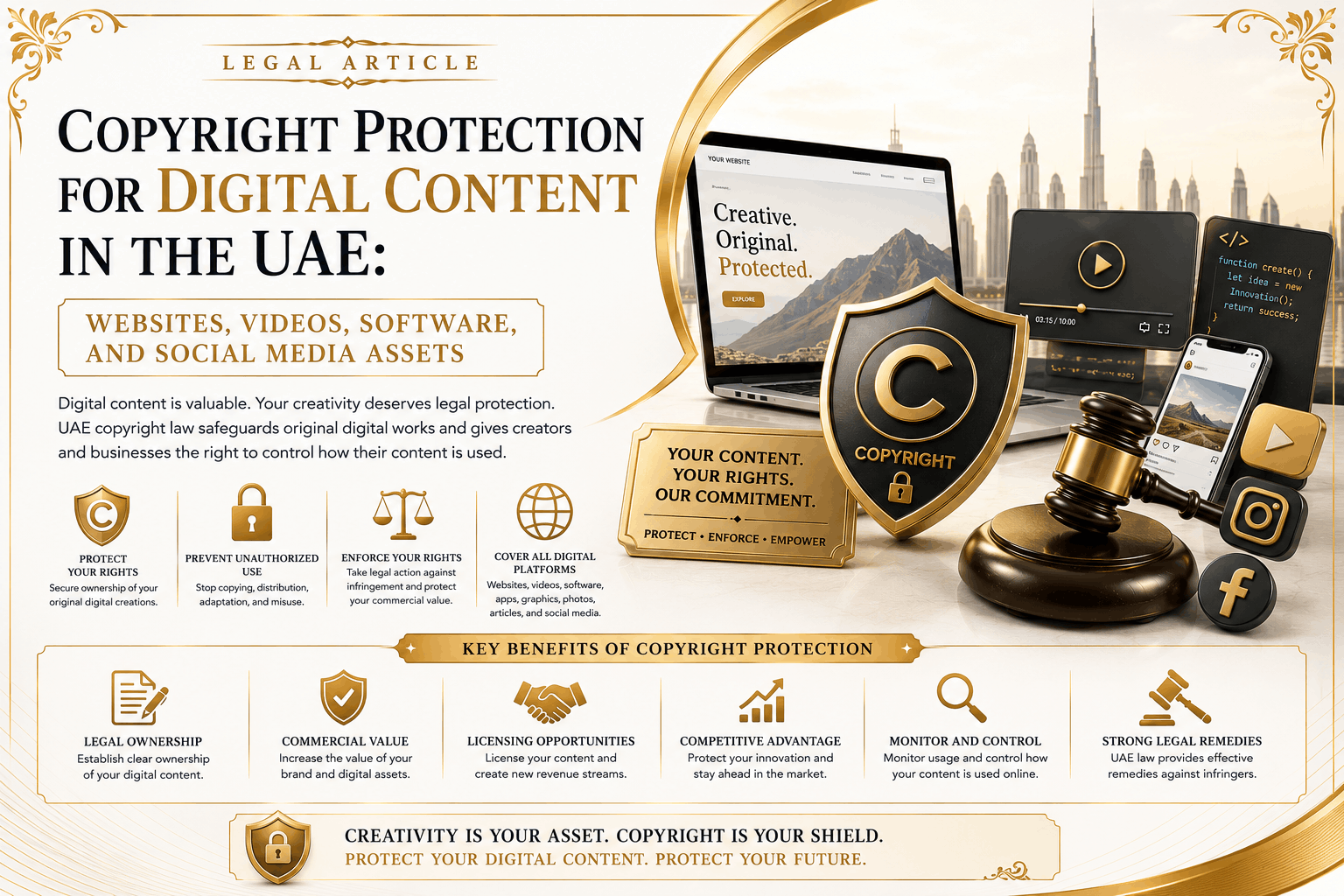
Copyright protection for digital content in the UAE is essential for businesses, creators, agencies, developers, educators, and online brands that rely on websites, videos, software, photography, social media posts, and digital materials.
UAE Legal Framework for Digital Copyright
UAE digital copyright protection is primarily based on Federal Decree-Law No. 38 of 2021 on Copyright and Neighboring Rights, supported by Cabinet Resolution No. 47 of 2022 as the Executive Regulations. The framework protects original intellectual works and supports registration, complaints, licensing, civil remedies, and enforcement.
Official UAE legislation portal | UAE Ministry of Economy | UAE Ministry of Justice | Relevant UAE authority website | Dubai Courts | Abu Dhabi Judicial Department | DIFC Courts | ADGM Courts
Key Legal Concepts and Definitions
Important concepts include copyright, author, right holder, moral rights, economic rights, licence, assignment, infringement, derivative work, digital asset, source code, database, platform takedown, and unauthorized commercial use.
Who UAE Copyright Law Applies To
UAE copyright law may affect individuals, creators, employees, employers, companies, freelancers, agencies, developers, photographers, videographers, influencers, schools, training centres, e-commerce businesses, free zone companies, mainland companies, and foreign businesses whose content is used or infringed in the UAE.
Rights and Obligations of Creators, Businesses, Employers, Employees, and Platforms
Creators should keep proof of authorship. Businesses should verify ownership before using content commercially. Employers should include clear IP clauses. Agencies and freelancers should define assignment, licence scope, source files, revisions, and future usage.
Website Content and SEO Copy Protection
Website text, service pages, product descriptions, landing pages, legal articles, images, videos, graphics, and downloadable PDFs may be valuable protected assets. Copying them may create SEO harm, customer confusion, and commercial damage.
Photography, Videos, Reels, and Audiovisual Content
Photography and videos should not be reused simply because they appear online. Commercial use should be supported by written permission or a valid licence covering platform, duration, territory, paid ads, editing, and attribution.
Software, Applications, Code, Databases, and Digital Products
Software disputes may involve source code, object code, databases, mobile apps, SaaS products, developer contracts, open-source components, confidentiality, maintenance rights, and source-code access after termination.
Online Courses, Training Materials, and Educational Content
Course videos, slides, worksheets, question banks, scripts, recorded lectures, workbooks, and digital certificates may be protected. Watermarks, access logs, student terms, and platform controls can strengthen enforcement.
Employment, Freelance, Agency, and Commissioned Work Issues
Many copyright disputes arise from unclear contracts. Employers, freelancers, agencies, and clients should define ownership, licence scope, source files, moral rights, portfolio use, subcontractors, and rights after termination.
Copyright Registration and Ministry of Economy Services
Copyright registration can be valuable evidence in ownership and infringement disputes. Ministry services may assist with registration of intellectual works and copyright infringement complaints.
Unauthorized Copying, Commercial Use, and Online Infringement
Unauthorized copying may involve website scraping, video reposting, unlicensed photography, software copying, database scraping, course piracy, template resale, translation without permission, or use beyond licence scope.
Procedures in the UAE
- Preserve screenshots, files, metadata, URLs, and publication evidence.
- Review authorship, ownership, contracts, licence scope, and registration.
- Assess whether the copied material is protected and whether use was unauthorized.
- Consider platform takedown, legal notice, Ministry complaint, or settlement.
- Prepare civil claim or criminal complaint strategy where justified.
- Use expert comparison reports for software, design, or technical content where needed.
- Negotiate undertakings, removal, compensation, and future-use restrictions.
- Monitor for repeat infringement or re-uploading.
Required Documents and Evidence
- Copyright registration certificate
- Original files, drafts, project files, and source files
- Source code repositories and version history
- Metadata, screenshots, URLs, and website archive evidence
- Contracts, licences, employment agreements, and freelancer agreements
- Invoices, payment records, briefs, and approvals
- Stock licence documents and third-party asset licences
- Access logs, download logs, watermarked files, and platform records
- Expert comparison reports and proof of commercial harm
- Takedown correspondence, Ministry complaint records, and platform responses
Platform Takedowns, Notices, and Digital Enforcement
Platform takedowns can be effective for social media, marketplaces, hosting providers, video platforms, app stores, and search engines. Notices should accurately identify the protected work, infringing content, ownership basis, URLs, screenshots, and requested action.
Civil Claims, Criminal Complaints, and Administrative Complaints
Copyright enforcement may involve civil claims for compensation or injunctions, Ministry complaints, platform takedowns, legal notices, settlement agreements, or criminal complaints in serious cases involving commercial piracy or deliberate unauthorized exploitation.
Free Zones, DIFC, ADGM, and Cross-Border Digital Content Issues
Digital disputes may involve UAE mainland, free zone, DIFC, ADGM, offshore, or foreign parties. Jurisdiction, contract wording, hosting location, commercial targeting, platform rules, and enforcement options should be reviewed early.
Common Misunderstandings
- If content is online, it is free to use.
- Giving credit is enough.
- Paying a freelancer automatically transfers all rights.
- Small edits avoid infringement.
- Only registered copyright is protected.
- Social media reposting is always allowed.
- Software is only protected by patents.
- Employee-created content is always personal.
Common Mistakes to Avoid
- Failing to sign written IP clauses
- Not keeping source files and metadata
- Using stock assets outside licence scope
- Copying competitor content
- Allowing employees to store company work only in personal accounts
- Not preserving screenshots before contacting the infringer
- Sending emotional public accusations
- Using weak or inaccurate takedown notices
- Ignoring cross-border jurisdiction and platform rules
Practical Examples
Competitor Copies Website Articles
The business should preserve dated screenshots, compare the text, collect publication evidence, review ownership, send a structured notice, and consider platform or court action.
Freelancer Claims Ownership of a Brand Video
A lawyer would review the contract, invoice, brief, messages, usage history, and whether the brand had paid-ad rights or only limited campaign usage.
Former Employee Reuses Course Materials
The legal analysis includes employment contract, job role, company resources, metadata, source files, and whether the work was created within the employer’s business.
Software Developer Reuses Source Code
The claim may depend on repository history, code similarity, third-party components, open-source licences, and the contract’s ownership clauses.
Legal Risks and Consequences
Copyright disputes may lead to financial loss, takedowns, platform suspension, SEO harm, software disputes, loss of source code, injunctions, compensation claims, criminal complaints, administrative complaints, reputational damage, and business interruption.
How a Lawyer Evaluates a Digital Copyright Case
A lawyer reviews originality, authorship, ownership, registration, contracts, licence scope, employment status, source files, metadata, platform evidence, copying similarity, commercial use, jurisdiction, urgency, damages, and enforcement options.
How a Lawyer Builds a Stronger Legal Position
Legal support may include copyright audits, registration strategy, contract drafting, employee IP clauses, software ownership clauses, takedown notices, evidence preservation, legal notices, Ministry complaints, civil claims, settlement drafting, expert reports, and compliance training.
Settlement vs Litigation or Regulatory Complaint
Settlement may be useful where removal and compensation can be achieved quickly. Litigation or formal complaints may be necessary where infringement is repeated, commercial, damaging, deliberate, or where a formal order is needed.
When Urgent Legal Action May Be Needed
- Copied content is live and spreading
- A digital course is being resold
- Source code has been taken
- A former employee is using company materials
- An app is about to launch using disputed code
- A competitor copied SEO content
- Infringing ads are running
- Evidence may be deleted
- A platform counter-notice deadline is approaching
Frequently Asked Questions
1. What law protects digital copyright in the UAE?
Federal Decree-Law No. 38 of 2021 on Copyright and Neighboring Rights is the main law, supported by Cabinet Resolution No. 47 of 2022.
2. Are websites protected by copyright?
Website text, images, videos, graphics, original layouts, and downloadable materials may be protected if they are original intellectual works.
3. Is software protected by copyright?
Yes. Software, smart device applications, databases, and similar digital works may be protected.
4. Do I need to register copyright?
Registration is useful evidence, especially in ownership and enforcement disputes, even where protection may arise from creation.
5. Does paying a freelancer mean I own the copyright?
Not always. The contract should clearly state whether rights are assigned or licensed and define usage scope.
6. Can I use photos from social media if I give credit?
Credit alone does not automatically give permission. Written permission or a valid licence should be obtained for commercial use.
7. Can an employer own employee-created content?
Potentially, depending on the work, job role, employer mandate, tools used, and applicable legal conditions.
8. What should I do if my website content is copied?
Preserve evidence, capture screenshots and URLs, collect original drafts, review ownership, and seek advice on takedown, legal notice, complaint, or civil claim.
9. Can copyright infringement lead to penalties?
Yes, in certain cases. Serious or commercial unauthorized use may lead to administrative, civil, or criminal consequences depending on the facts.
10. Can I stop someone from reselling my online course?
Potentially, yes. Preserve course files, access logs, payment records, infringing links, user accounts, and watermark evidence before taking action.
Conclusion
Copyright protection for digital content in the UAE is essential for protecting websites, videos, software, social media assets, online courses, photography, and commercial digital materials.
Early legal advice helps right holders preserve evidence, confirm ownership, review contracts, prepare takedowns, pursue complaints, negotiate settlements, and choose the correct enforcement strategy before infringement spreads.
Need Advice About UAE Digital Copyright?
Obtain tailored advice on website copying, software ownership, source code, social media assets, online course piracy, photography, videos, licensing, takedowns, Ministry complaints, settlement, and legal enforcement.
Book a Legal Consultation
Social Media Assets, Influencer Content, and Brand Campaigns
Social media ownership should be clarified in influencer and agency contracts. Brands should define whether content can be reused, edited, boosted as paid ads, reposted, sublicensed, or used after campaign expiry.