Aviation Liability in the UAE: Passenger Claims, Air Cargo Loss, and Airline Obligations
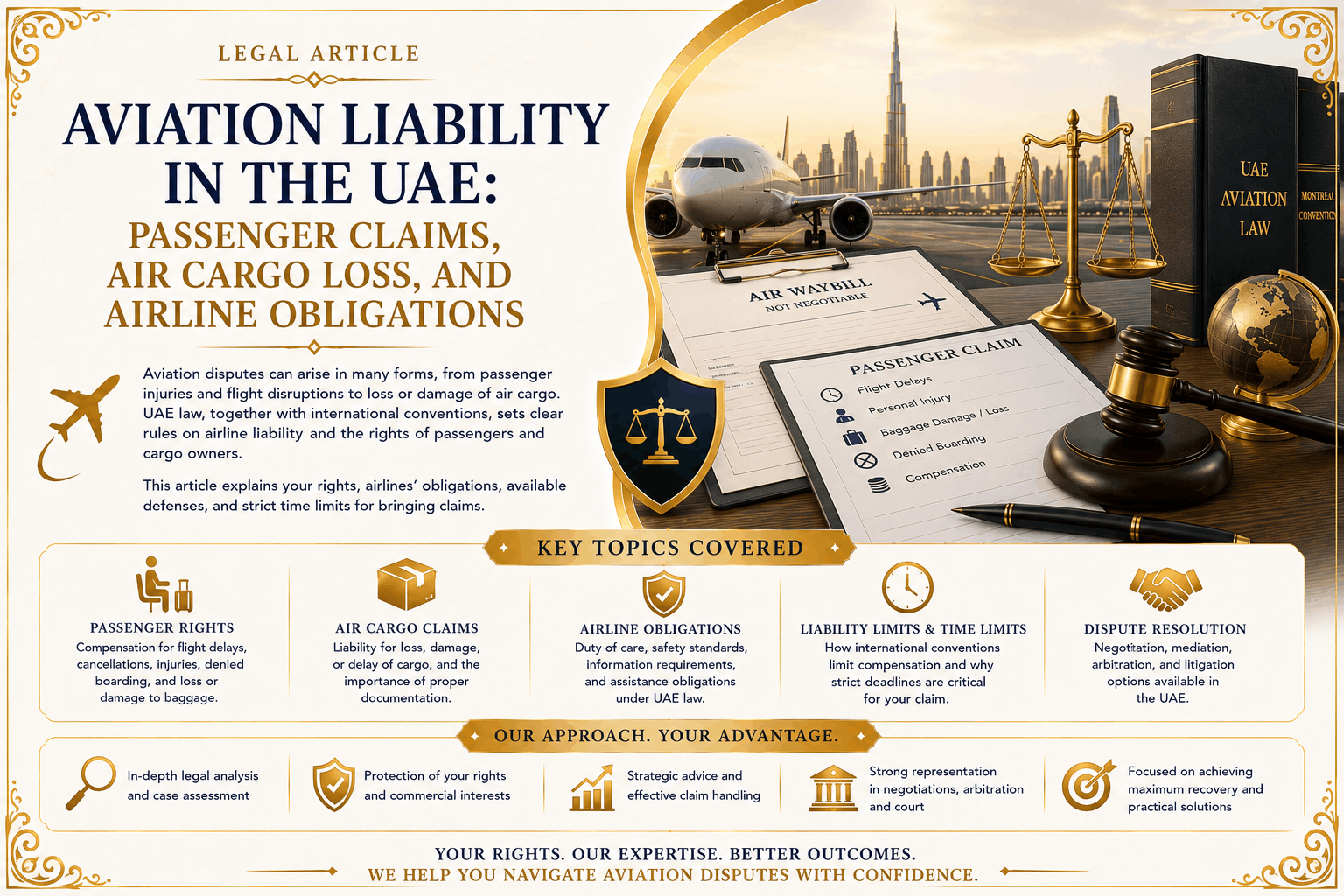
Aviation liability in the UAE requires careful review of the ticket, air waybill, airline obligations, international carriage rules, passenger welfare requirements, evidence, jurisdiction, and limitation periods.
UAE Legal Framework for Aviation Liability
UAE aviation liability may involve the Civil Aviation Act, Commercial Transactions Law air-carriage provisions, international conventions, GCAA passenger welfare rules, airline conditions of carriage, insurance policies, UAE court procedures, and international jurisdiction rules.
Official UAE legislation portal | UAE Ministry of Justice | General Civil Aviation Authority | Relevant UAE authority website | Dubai Courts | Abu Dhabi Judicial Department | DIFC Courts | ADGM Courts
Key Legal Concepts and Definitions
Important concepts include air carrier, contract of carriage, checked baggage, cabin baggage, air waybill, delay, Special Drawing Rights, operating carrier, contracting carrier, actual carrier, jurisdiction, and limitation period.
Who Aviation Liability Law Applies To
Aviation disputes may affect passengers, families, airlines, travel agents, cargo owners, shippers, consignees, importers, exporters, freight forwarders, cargo handlers, insurers, free zone companies, and international businesses.
Passenger Rights and Airline Obligations
Passengers may have rights to safe carriage, baggage handling, information, care during qualifying disruption, refund or rerouting where applicable, and compensation where liability and damage are proved. Airlines must comply with contract terms, aviation regulations, passenger welfare requirements, and applicable liability rules.
Passenger Injury and Death Claims
Passenger injury claims may involve boarding accidents, disembarkation incidents, cabin injuries, turbulence, falling luggage, wet stairs, emergency evacuation, wheelchair assistance issues, or in-flight service incidents.
Baggage Loss, Delay, and Damage
Baggage claims require proof of checked baggage, timely notice, baggage tag, Property Irregularity Report, photographs, repair estimates, receipts, delivery records, and airline response.
Air Cargo Loss, Damage, and Delay
Air cargo claims may involve loss, shortage, temperature damage, misdelivery, customs-related delay, mishandling, crushed cargo, contamination, or buyer rejection. The air waybill, delivery records, survey evidence, and insurance documents are central.
Flight Disruption, Cancellation, Denied Boarding, and Diversion
Flight disruption claims should separate care and assistance, refund, rerouting, missed connection, proven financial loss, and compensation. Weather, airspace closure, security events, technical issues, and airline operational decisions may create different legal consequences.
Carrier Liability and Available Defences
Airlines may rely on passenger fault, third-party fault, notice failure, time bar, liability limits, inherent defect of goods, circumstances beyond control, wrong carrier, or wrong forum. Each defence must be tested against the evidence and applicable law.
Liability Limits and Special Declarations
Airline liability may be limited under UAE law or international conventions. Special declarations of value, additional charges, and international SDR limits may affect recoverable compensation.
Jurisdiction in Aviation Claims
Jurisdiction may depend on carrier domicile, head office, place of contract, place of destination, applicable convention, airline terms, air waybill clauses, and whether the dispute involves passenger, baggage, or cargo carriage.
Procedures in the UAE
- Preserve tickets, baggage tags, air waybills, and evidence.
- File the airline complaint in writing.
- Submit baggage or cargo notice within the applicable period.
- Notify travel or cargo insurers promptly.
- Request incident, airport, or cargo records where available.
- Obtain medical, technical, or cargo expert evidence if needed.
- Review jurisdiction, limitation periods, and applicable law.
- Negotiate, settle, litigate, or use the relevant regulatory route.
Required Documents and Evidence
- Ticket confirmation, itinerary, and boarding pass
- Baggage tag and Property Irregularity Report
- Airline complaint reference and written response
- Airport incident report and witness details
- Medical reports, invoices, prescriptions, and sick leave
- Photographs, videos, and receipts
- Air waybill, cargo invoice, packing list, and customs documents
- Delivery records, warehouse records, and survey report
- Travel insurance, cargo insurance, and subrogation documents
- Freight forwarder and travel agency correspondence
Medical, Baggage, Cargo, and Delay Evidence
Medical claims require injury and causation evidence. Baggage claims require baggage records and timely notice. Cargo claims require air waybill, custody timeline, damage report, and value proof. Delay claims require actual loss, expenses, cause, and airline communications.
Airline Complaint Process and Regulatory Routes
Airline complaints should identify flight number, date, route, ticket or air waybill number, claim type, timeline, evidence, amount claimed, and request for written response. Passenger welfare issues may involve UAE aviation regulatory considerations where the disruption occurred at a UAE airport.
Insurance, Subrogation, and Travel Policies
Travel and cargo insurance may assist recovery, but policy conditions, notice requirements, exclusions, receipts, and subrogation rights must be protected.
Freight Forwarders, Agents, and Consecutive Carriage
Claims may involve travel agents, freight forwarders, commission agents, marketing carriers, operating carriers, and successive carriers. The legal role of each party depends on the contract and documents.
DIFC, ADGM, Free Zone, and International Carriage Issues
International tickets, cargo contracts, DIFC or ADGM companies, foreign insurers, free zone logistics companies, arbitration clauses, and foreign court clauses may affect jurisdiction and enforcement.
Common Misunderstandings
- Any delay means automatic compensation.
- The airline is always responsible for cabin baggage items.
- A verbal airport complaint is enough.
- Baggage claims can be filed anytime.
- Cargo insurance means the airline does not matter.
- The travel agent is always liable.
- International flights always follow UAE domestic limits.
- Settlement means weakness.
Common Mistakes to Avoid
- Missing baggage or cargo notice periods
- Not keeping receipts
- Discarding damaged baggage or cargo
- Failing to file a Property Irregularity Report
- Suing the wrong carrier
- Ignoring jurisdiction clauses
- Not calculating loss properly
- Accepting vouchers without reviewing waiver language
- Waiting until the limitation period is near
Practical Examples
Passenger Injured During Boarding
The legal analysis should review boarding records, airport incident reports, medical records, CCTV availability, witness evidence, airline and ground handler roles, and whether the incident occurred during boarding.
Delayed Baggage During Business Travel
The passenger should keep baggage tags, PIR, delivery date, receipts, itinerary, airline correspondence, and written notice evidence.
Damaged Air Cargo
The cargo owner should preserve packaging, notify airline and forwarder, obtain survey report, collect air waybill and delivery records, notify insurer, and calculate repair or replacement cost.
Codeshare Confusion
A lawyer should identify the contracting carrier, operating carrier, baggage handling route, applicable convention, jurisdiction, and notice requirements.
Legal Risks and Consequences
Poor handling may lead to rejected passenger claims, missed baggage notice periods, lost cargo recovery, time-barred litigation, weak medical evidence, wrong defendant, wrong jurisdiction, insurance denial, settlement waiver risk, and increased legal costs.
How a Lawyer Evaluates an Aviation Liability Case
A lawyer reviews the route, ticket, air waybill, carrier identity, operating carrier, applicable UAE law, international convention, baggage or cargo custody period, notice compliance, limitation period, jurisdiction, liability limits, evidence, insurance, settlement prospects, and enforcement.
How a Lawyer Builds a Stronger Legal Position
Legal support may include reviewing contracts, identifying the correct defendant, drafting notices, preparing airline complaints, preserving evidence, requesting airport or cargo records, coordinating experts, calculating loss, reviewing insurance, negotiating settlement, and filing court claims.
Settlement vs Litigation
Settlement may be useful where recovery can be achieved quickly and costs should be controlled. Litigation may be necessary where injury is serious, cargo value is high, the airline rejects liability, limitation is approaching, insurance is denied, or multiple carriers blame each other.
When Urgent Legal Action May Be Needed
- Passenger injury is serious
- CCTV or airport records may be deleted
- Baggage notice period is running
- Cargo is perishable or damaged
- Insurance notice is required
- The limitation period is approaching
- Multiple airlines or forwarders are involved
- A settlement voucher or release is offered
Frequently Asked Questions
1. What is aviation liability in the UAE?
It is legal responsibility for passenger injury, baggage loss, cargo damage, delay, flight disruption, airline obligations, and related claims.
2. Can I claim compensation for passenger injury?
Potentially, depending on where the injury occurred, medical evidence, airline responsibility, applicable law, and time limits.
3. What should I do if my baggage is damaged?
Report it immediately, obtain a PIR, photograph the damage, preserve the baggage, keep baggage tags and boarding passes, and submit written notice.
4. What if air cargo arrives damaged?
Preserve the goods, packaging, delivery records, air waybill, photographs, and arrange a survey while notifying the carrier, forwarder, and insurer.
5. Does the Montreal Convention apply?
It may apply to international carriage depending on the route, ticket, contracting carrier, destination, and other facts.
6. Are airlines required to provide care during disruption?
UAE passenger welfare rules apply to qualifying denied boarding, cancellation, delay, and diversion at UAE airports.
7. Can airlines limit liability?
Yes. UAE law and international conventions may limit liability depending on the claim type and facts.
8. Who is liable in a codeshare flight?
The contracting carrier, operating carrier, and handling parties should be identified through the ticket, route, baggage records, and applicable law.
9. Should I accept an airline voucher?
Only after checking whether it includes a waiver or final settlement wording that may affect further rights.
10. When should I seek legal advice?
As soon as injury, baggage loss, cargo damage, flight disruption, insurance denial, or airline rejection occurs.
Conclusion
Aviation liability in the UAE requires careful analysis of the ticket, air waybill, carrier identity, UAE law, international conventions, GCAA passenger welfare rules, evidence, jurisdiction, and time limits.
Early legal advice can help passengers, cargo owners, insurers, and businesses preserve evidence, issue timely notices, identify the correct carrier, calculate loss, avoid limitation problems, and choose the correct settlement, court, or regulatory strategy.
Need Advice About a UAE Aviation Claim?
Obtain tailored advice on passenger injury, baggage loss, air cargo damage, flight disruption, airline obligations, insurance, jurisdiction, limitation periods, settlement, and litigation strategy.
Book a Legal Consultation