UAE Personal Status Law: Family Rights from Marriage and Divorce to Custody and Maintenance
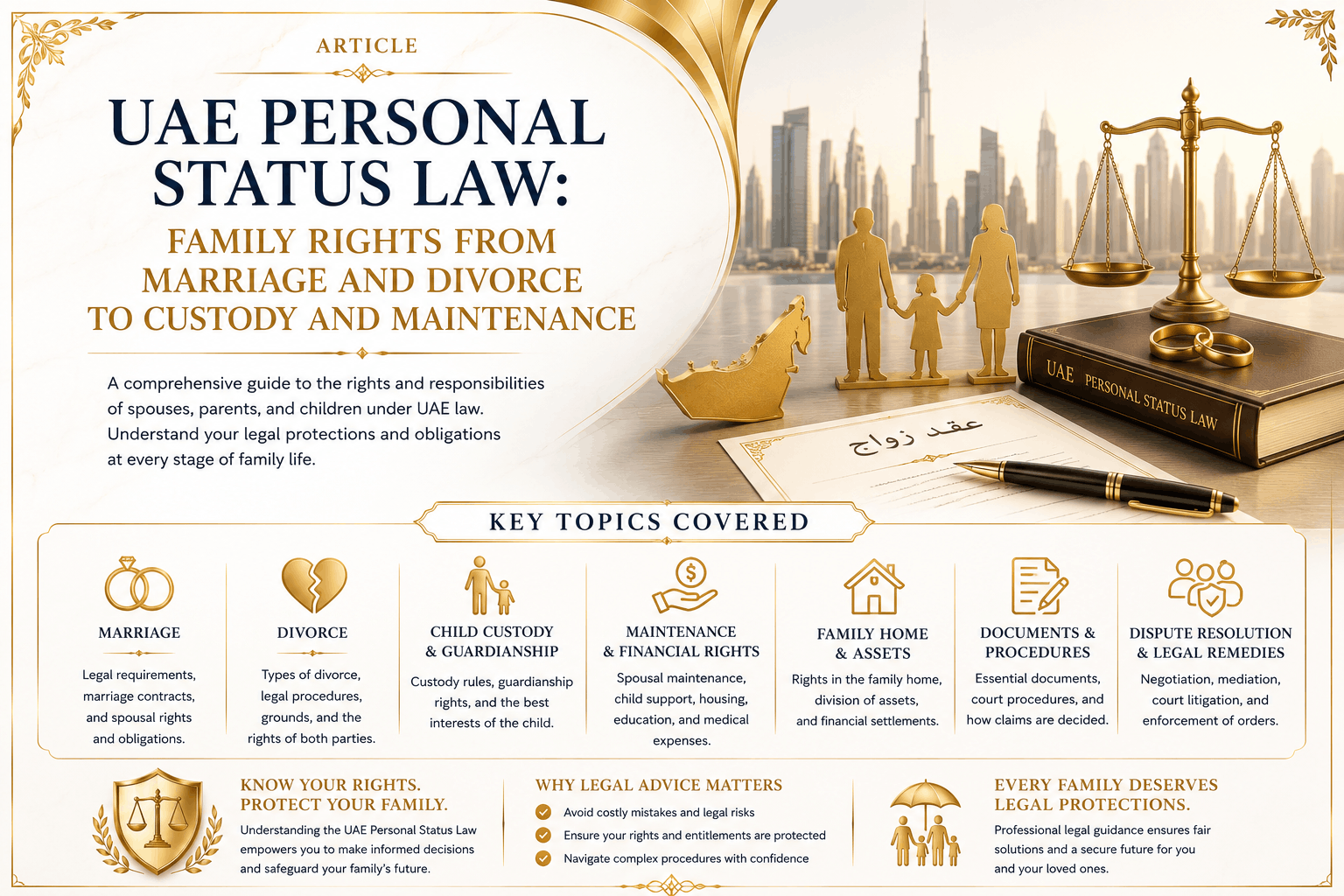
The UAE Personal Status Law regulates marriage, divorce, financial support, child custody, guardianship, visitation, family reconciliation, and enforcement within its legal scope.
UAE Legal Framework for Personal Status Matters
Federal Personal Status Law
The federal framework governs marriage, divorce, maintenance, custody, guardianship, parentage, and related family rights within its scope.
Civil Personal Status for Non-Muslims
Qualifying non-Muslim citizens and residents may use the federal civil personal-status framework, subject to its application and choice-of-law rules.
Abu Dhabi Civil Family Court
Abu Dhabi operates a specialised civil-family system for eligible non-Muslims, including civil marriage, no-fault divorce, financial orders, and joint-custody disputes.
Official UAE legislation portal | UAE Ministry of Justice | Dubai Courts | Abu Dhabi Judicial Department | Abu Dhabi Civil Family Court
Key Legal Concepts and Definitions
Maintenance
Financial support legally owed to a spouse, former spouse, child, or other qualifying family member.
Custody
Responsibility for the child’s daily care, residence, protection, and upbringing.
Guardianship
Legal authority over major decisions, documentation, travel, education, healthcare, or financial affairs.
Visitation
Arrangements allowing the child to maintain contact with the parent who does not provide primary daily care.
Who the Law Applies To
Personal-status rules may affect UAE nationals, expatriates, Muslims, non-Muslims, civil-marriage couples, foreign spouses, parents, children, custodians, guardians, and parties relying on foreign judgments.
Marriage Rights and Legal Requirements
Marriage requires legal capacity, consent, appropriate documentation, and compliance with the applicable personal-status framework. Foreign marriage documents may require attestation and legal Arabic translation.
Marital Rights and Obligations
Marital obligations may include support, housing, proper treatment, cooperation, child care, and good-faith performance of family duties, depending on the applicable law.
Divorce and Separation in the UAE
Divorce may be consensual or contested. Qualifying civil personal-status systems may also permit no-fault divorce. Financial and child-related issues may require separate orders even where the divorce itself is uncontested.
Financial Rights Following Divorce
Potential claims may include unpaid maintenance, waiting-period support, deferred dowry, child support, custodial housing, school fees, medical expenses, transport, and compensation where legally available.
Spousal Maintenance
The court may review entitlement, income, housing, existing support, reasonable expenses, and the circumstances of the parties.
Child Maintenance
Child support may include food, clothing, housing, education, medical care, transport, and other necessary expenses proportionate to the child’s needs and the payer’s ability.
Child Custody
Custody decisions consider the child’s welfare, safety, stability, health, education, care arrangements, and the suitability of the proposed custodian.
Guardianship
Guardianship may concern education, medical treatment, passports, travel, legal representation, financial affairs, and other major decisions.
Visitation and Parenting Contact
Contact orders may regulate weekdays, weekends, school holidays, overnight stays, transportation, video calls, supervision, and handover arrangements.
Child Travel, Passports, and Relocation
International travel and relocation may require consent or judicial approval depending on guardianship, custody, existing orders, destination, duration, and risk of non-return.
Non-Muslim Civil Personal Status
Qualifying non-Muslims may have access to civil marriage, no-fault divorce, joint custody, financial orders, and related civil-family procedures, depending on status and jurisdiction.
Family Guidance and Reconciliation
Family guidance may help parties negotiate divorce, maintenance, custody, visitation, housing, travel, school fees, medical expenses, dowry, and personal-property issues before contested litigation.
UAE Family Court Procedures
- Determine the applicable law and jurisdiction.
- Review marriage, child, and financial documents.
- Begin family guidance or the applicable direct procedure.
- Attempt settlement.
- File the family claim.
- Serve the other party.
- Submit evidence and responses.
- Seek interim relief where required.
- Obtain judgment.
- Appeal where legally available.
- Open execution proceedings if necessary.
Urgent and Interim Applications
Interim relief may address maintenance, custody, visitation, passports, travel, medical decisions, housing, documents, or another urgent issue while the main case is pending.
Required Documents and Evidence
- Marriage and birth certificates
- Passports and Emirates IDs
- Residency documents
- Foreign judgments and attestations
- Salary certificates and bank statements
- Employment and company records
- Tenancy and housing documents
- School invoices and medical records
- Proof of maintenance payments
- Emails and WhatsApp messages
- Travel and passport evidence
- Existing orders and settlement agreements
Enforcement of Family Judgments
Execution may be required for maintenance arrears, periodic support, visitation, custody transfer, document delivery, dowry, compensation, or settlement obligations.
Common Misunderstandings
- Custody is always awarded automatically to one parent.
- Custody and guardianship mean the same thing.
- Maintenance may stop when visitation is denied.
- A foreign divorce is automatically enforceable.
- Custody always permits permanent relocation.
- A private settlement is automatically enforceable.
- All non-Muslim families follow the same legal regime.
Common Mistakes to Avoid
- Removing a child without consent or an order
- Signing broad financial waivers
- Hiding income or assets
- Using children as messengers
- Blocking contact without evidence of risk
- Stopping maintenance unilaterally
- Failing to attest and translate foreign documents
- Sending threatening or emotional messages
- Waiting until the problem becomes urgent
Practical Examples
Maintenance After Separation
The claimant should document marriage, prior support, present expenses, housing, children’s costs, and the other spouse’s financial capacity.
Repeated Denial of Visitation
The parent should document missed contact neutrally and seek enforcement rather than using confrontation or withholding support.
International Relocation
The court may examine education, housing, contact arrangements, travel costs, the reason for relocation, and the risk of non-return.
Foreign Marriage and UAE Divorce
The parties should review attestation, nationality, residence, religion, possible foreign-law application, and the appropriate UAE procedure.
Legal Risks and Consequences
Incorrect handling may cause loss of financial rights, maintenance arrears, unenforceable agreements, custody complications, travel restrictions, delayed divorce, repeated proceedings, enforcement action, and emotional harm to children.
How a Lawyer Evaluates a Family Case
A lawyer examines jurisdiction, applicable law, nationality, religion, marriage type, child circumstances, finances, custody, guardianship, travel risks, foreign judgments, evidence, settlement prospects, and enforcement.
How a Lawyer Builds a Stronger Legal Position
Legal support may include document review, maintenance calculations, evidence organisation, family-guidance representation, settlement drafting, custody and visitation applications, urgent relief, foreign-document preparation, appeals, and enforcement.
Settlement vs Litigation
Settlement may protect privacy, reduce conflict, and provide detailed arrangements. Litigation may be necessary where safety, financial disclosure, child travel, custody, maintenance, or enforcement remains disputed.
When Urgent Legal Action May Be Needed
- A child may be taken abroad
- Passports are withheld
- Maintenance suddenly stops
- Medical treatment is blocked
- Visitation is completely denied
- A parent plans permanent relocation
- A foreign case has been filed
- A spouse is pressured to sign a waiver
Frequently Asked Questions
1. Which law applies to my family dispute?
The answer depends on nationality, religion, residence, marriage type, emirate, choice-of-law rules, and the relevant personal-status regime.
2. Is family guidance required before divorce?
Many matters begin through family guidance, although certain civil or urgent procedures may follow another route.
3. Can maintenance be claimed before divorce?
Potentially, depending on the applicable law and evidence.
4. How is child support calculated?
The court assesses the child’s needs, the payer’s means, housing, education, healthcare, and family circumstances.
5. Is custody automatically awarded to the mother?
No universal rule decides every case. The applicable law and child’s welfare are central.
6. What is the difference between custody and guardianship?
Custody usually concerns daily care, while guardianship concerns legal authority and major decisions.
7. Can a parent travel abroad with a child?
Consent or a court order may be necessary depending on custody, guardianship, passports, and existing judgments.
8. Can maintenance stop if visitation is denied?
No private suspension should be assumed. Each obligation should be enforced separately.
9. Can a foreign divorce be recognised?
Potentially, if jurisdiction, service, finality, translation, attestation, and public-order requirements are satisfied.
10. Can non-Muslims obtain a civil divorce?
Qualifying parties may use the federal civil personal-status framework or Abu Dhabi’s specialised civil-family system.
Conclusion
The UAE Personal Status Law provides a structured framework for marriage, divorce, maintenance, custody, guardianship, visitation, and family rights.
Early legal advice can identify the applicable law, protect children, calculate financial claims, preserve evidence, support settlement, and help enforce the final outcome.
Need Advice About a UAE Family-Law Matter?
Obtain tailored advice on marriage, divorce, maintenance, custody, guardianship, visitation, child travel, foreign judgments, and family-court procedures.
Book a Legal Consultation