Rental Disputes in Dubai: When Can a Landlord Evict and When Can a Tenant Claim Compensation?
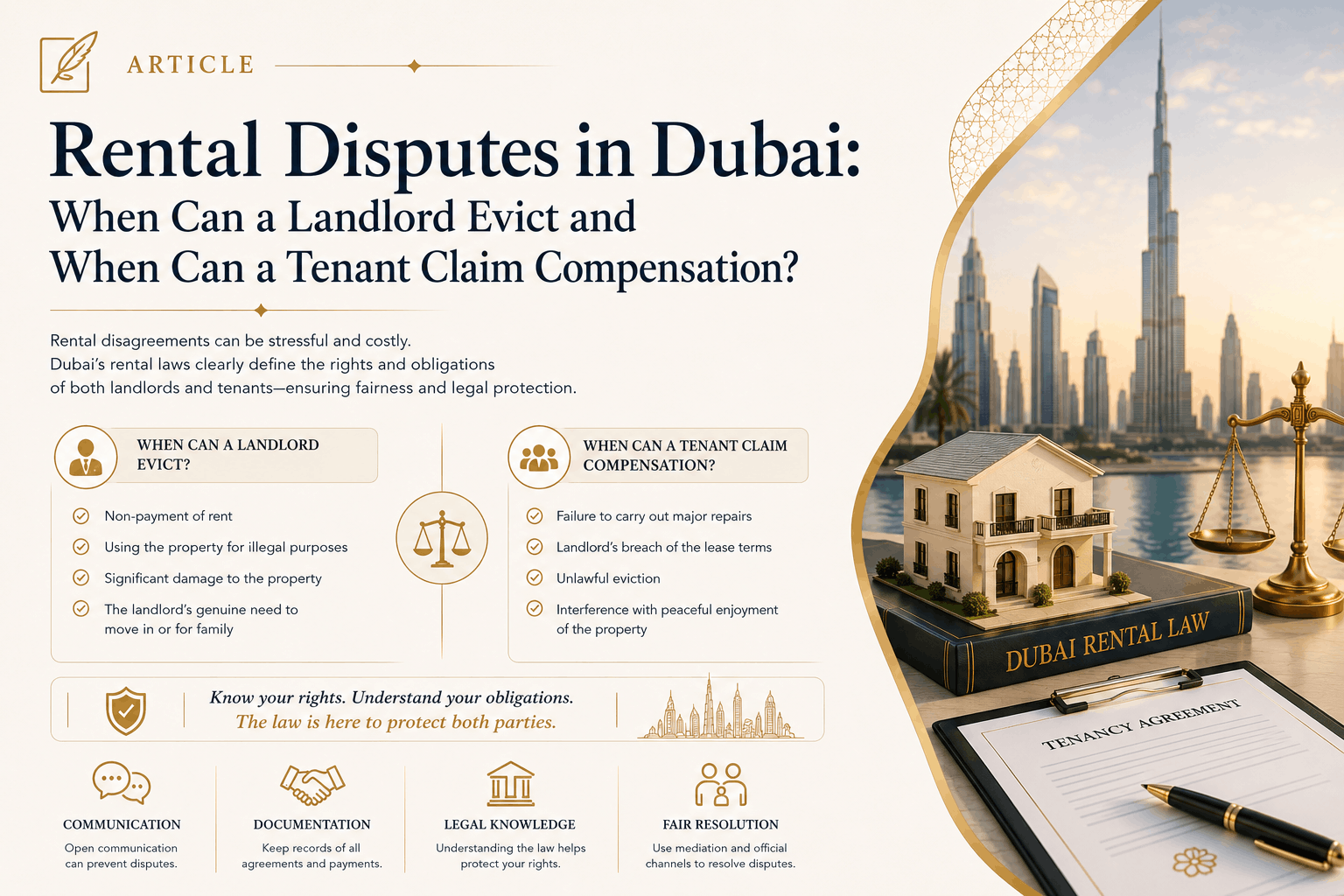
Rental disputes in Dubai frequently arise when a landlord wants possession, a tenant disputes a rent increase, maintenance remains unresolved, rent is refused, or one party alleges breach of the tenancy.
Dubai Legal Framework for Rental Disputes
The principal framework is Law No. 26 of 2007, as amended by Law No. 33 of 2008. Lease contracts should be registered through Ejari where applicable, and qualifying disputes are handled by the Rental Disputes Center.
Dubai Legislation Portal | Dubai Land Department | Rental Disputes Center | Official UAE legislation portal | Dubai Courts
Key Legal Concepts and Definitions
Eviction
Lawful termination of the tenant's right to occupy, based on a recognised ground and proper process.
Ejari
Dubai's system for registering tenancy contracts and rental information.
Compensation
Financial relief for loss caused by a legally established breach.
Offer and Deposit
A procedure allowing rent or keys to be formally offered where acceptance is refused.
Who Dubai Tenancy Law Applies To
The framework may cover residential and commercial landlords and tenants, individuals, companies, property managers, investors, UAE nationals, expatriates, offices, shops, warehouses, villas, and apartments.
Landlord and Tenant Rights and Obligations
Landlord Rights
A landlord may receive rent, enforce lawful use, object to unauthorised subletting, claim for damage, and seek eviction on recognised grounds.
Landlord Obligations
The landlord should deliver usable premises, perform responsible maintenance, respect possession, avoid unlawful self-help, and follow the correct notice and RDC process.
Tenant Rights and Duties
The tenant may occupy the premises, challenge unlawful increases or eviction, request necessary maintenance, and claim compensation where legally justified. The tenant must pay rent, use the property properly, avoid unauthorised subletting, and return possession correctly.
Eviction During the Tenancy Term
Eviction during the lease may be sought for qualifying non-payment, unauthorised subletting, illegal use, dangerous alteration, serious damage, prohibited use, condemned premises, or another substantial breach after proper notice.
Eviction at the End of the Tenancy
Recognised grounds include sale, personal or qualifying family use, demolition and reconstruction, or major renovation that cannot be performed while the tenant remains.
The Twelve-Month Eviction Notice
For specified end-of-tenancy grounds, the landlord should serve at least twelve months' notice through notary public or registered mail. The notice must identify the tenancy, property, ground, and requested vacation date.
Eviction for Non-Payment of Rent
The landlord should establish the amount due, contractual payment date, proper payment notice, expiry of the cure period, and absence of payment or a valid deposit.
Eviction for Sale or Personal Use
The asserted purpose should be genuine. Personal-use claims may require proof of intended occupation and compliance with restrictions after the tenant vacates.
Tenant Compensation After Improper Eviction
A tenant may seek compensation where a personal-use eviction is followed by prohibited re-letting or where unlawful interference causes provable loss.
Rent Increases and Renewal Disputes
Proposed changes should generally be notified at least 90 days before expiry unless otherwise agreed. A rent increase should also be supported by the applicable official Smart Rent Index.
Maintenance and Repair Obligations
Unless validly agreed otherwise, the landlord is generally responsible for major maintenance needed to preserve agreed use, while the tenant remains responsible for ordinary care, misuse, and assigned minor maintenance.
Quiet Enjoyment and Utility Disconnection
Locks, utilities, access cards, and essential services should not be used to force payment or eviction. Legal notices and RDC proceedings are the proper remedies.
Subletting and Unauthorised Use
Unauthorised subletting or use contrary to the tenancy may support eviction, but the landlord must prove the actual conduct and lack of approval.
Procedures Before the Rental Disputes Center
- Review the tenancy, Ejari, payments, and notices.
- Identify the correct claim or defense.
- Serve the required formal notice.
- Attempt settlement where appropriate.
- File the RDC claim with supporting evidence.
- Attend hearings and submit memoranda.
- Participate in any expert process.
- Obtain judgment.
- Appeal where legally available.
- Open execution proceedings if required.
Required Documents and Evidence
- Ejari and tenancy agreement
- Title deed and ownership authority
- Identification or company licences
- Rent cheques and bank transfers
- Notarised notices and registered-mail receipts
- Payment statements
- Maintenance requests and technical reports
- Photos and videos
- Emails and WhatsApp messages
- Rent-index results
- Replacement tenancy and moving receipts
- Key-handover and condition reports
Offer and Deposit of Rent or Keys
Where lawful rent or keys are refused, an official offer-and-deposit application may help protect the tenant and establish attempted compliance.
Common Landlord and Tenant Defenses
Disputes may involve payment, defective service, false eviction grounds, unauthorised subletting, misuse, maintenance access, rent-index eligibility, offer and deposit, waiver, compensation, or the genuineness of personal use.
Common Misunderstandings
- Ownership alone permits immediate eviction.
- Every eviction requires the same notice.
- A WhatsApp message always satisfies formal notice rules.
- A tenant may stop rent whenever maintenance is delayed.
- A landlord may disconnect utilities for non-payment.
- Leaving the property automatically ends all liability.
Common Mistakes to Avoid
- Serving the wrong notice
- Using an incorrect address
- Filing before the notice period expires
- Refusing lawful rent
- Making undocumented cash payments
- Ignoring Ejari registration
- Disconnecting utilities
- Vacating without handing over keys
- Failing to document damage or condition
- Re-letting contrary to a personal-use eviction
Practical Examples
Unpaid Rent
Informal reminders may be insufficient. The landlord should serve the correct payment notice before seeking eviction.
Eviction for Sale
A short email notice may not satisfy the required twelve-month period and service method.
Improper Re-Letting
A former tenant may use a new advertisement, Ejari, moving costs, and replacement rent to support compensation.
Landlord Refuses Renewal Rent
The tenant should document the offer and consider an official offer-and-deposit application.
Legal Risks and Consequences
Incorrect handling may lead to rejected eviction, eviction judgment, continuing rent liability, compensation, execution, deposit disputes, expert costs, appeal expenses, or delayed possession.
How a Lawyer Evaluates a Rental Dispute
A lawyer reviews jurisdiction, Ejari, rent, notices, service, ownership, payments, maintenance, use, subletting, interference, compensation, the eviction ground, evidence, settlement, and execution prospects.
How a Lawyer Builds a Stronger Legal Position
Legal support may include drafting notices, calculating rent, organising payment evidence, filing offer and deposit, preparing RDC claims and defenses, quantifying compensation, negotiating surrender, coordinating experts, appealing, and executing judgments.
Settlement Versus Rental Litigation
Settlement may address vacation dates, arrears, maintenance, deposits, moving compensation, renewal rent, and keys. Litigation may be required where payment, access, eviction grounds, or compensation remain disputed.
When Urgent Legal Action May Be Needed
- Utilities are disconnected
- Locks are changed
- A payment notice is expiring
- Rent is refused
- Serious damage is occurring
- The property is unsafe
- A judgment requires execution
- Improper re-letting is suspected
Frequently Asked Questions
1. Can a landlord evict before lease expiry?
Only on a recognised legal ground and after complying with the applicable notice and evidence requirements.
2. How much notice is required for sale?
The landlord generally must provide at least twelve months' notice through the prescribed method.
3. Can a landlord evict for personal use?
Potentially, subject to genuine intention, legal conditions, and proper notice.
4. Can a tenant claim compensation?
Potentially, where the landlord breaches the law and the tenant proves resulting loss, including improper re-letting after personal-use eviction.
5. Can rent be increased at renewal?
Only where supported by the official index and properly notified in advance.
6. Who pays major maintenance?
Unless validly agreed otherwise, major maintenance necessary for the property's agreed use is generally the landlord's responsibility.
7. Can the tenant withhold rent?
Withholding rent without legal advice is risky and may create eviction exposure.
8. Can utilities be disconnected?
Utilities should not be used as a self-help method to force payment or vacation.
9. What if the landlord refuses rent?
The tenant should preserve the offer and consider an RDC offer-and-deposit application.
10. What evidence is needed?
The tenancy, Ejari, notices, proof of service, payment records, ownership documents, and evidence supporting the claim or defense are central.
Conclusion
Rental disputes in Dubai require careful review of the tenancy agreement, Ejari, payments, rent index, eviction ground, formal notices, and evidence.
Landlords must use lawful eviction procedures, while tenants must continue to protect payment and contractual obligations even when asserting valid defenses or compensation claims.
Need Advice About a Dubai Rental Dispute?
Early legal advice can help you review an eviction notice, rent increase, maintenance dispute, compensation claim, or RDC procedure before your position becomes more complicated.
Book a Legal Consultation