Commercial Arbitration in the UAE: When Is It Better Than Court Litigation?
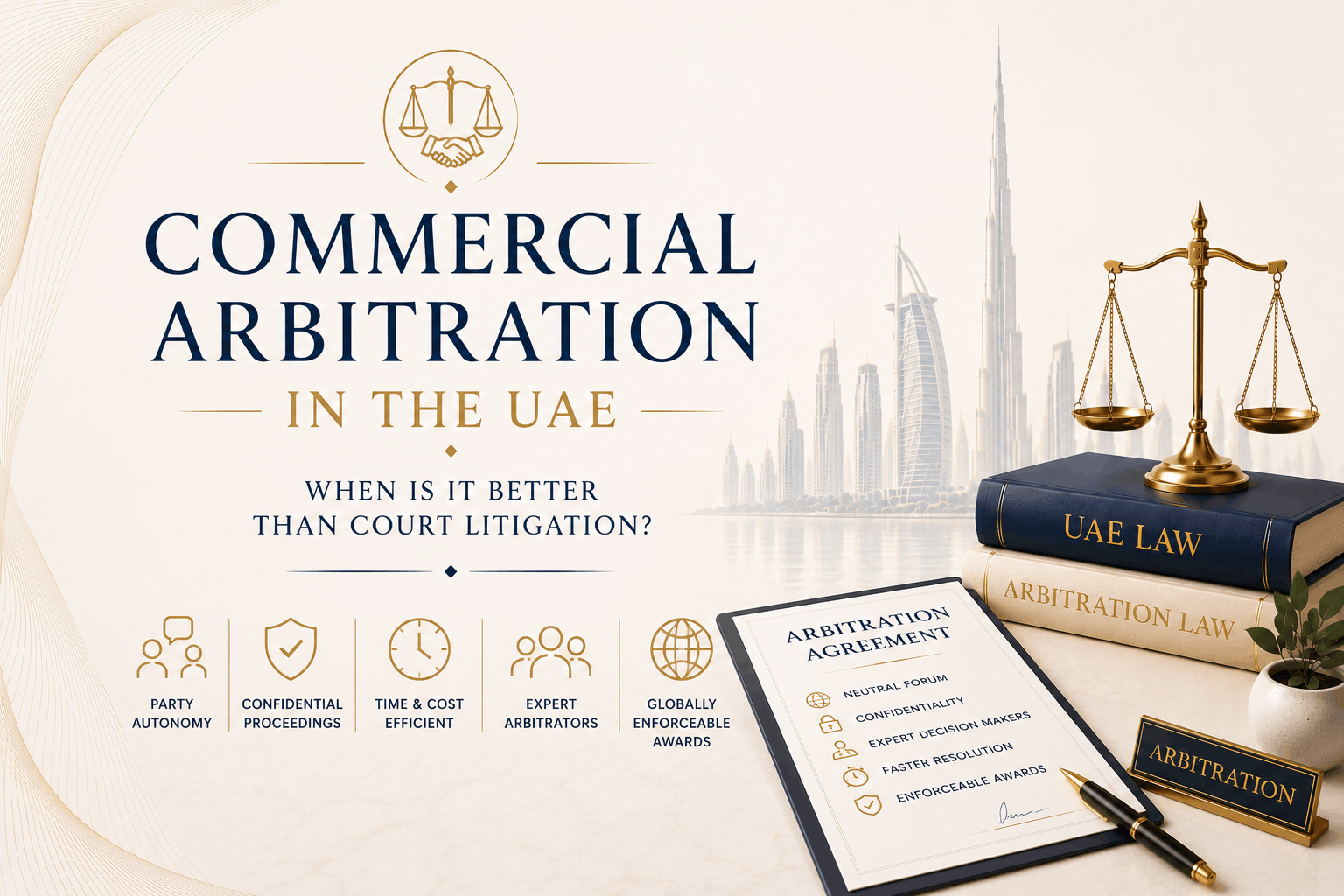
Commercial arbitration in the UAE is one of the most important dispute-resolution options available to companies, investors, contractors, developers, consultants, suppliers, and international businesses.
UAE Legal Framework for Commercial Arbitration
Commercial arbitration in the UAE is principally governed at federal level by Federal Law No. 6 of 2018. The law regulates arbitration agreements, tribunal formation, procedure, awards, challenges, recognition, and enforcement in matters falling within its scope.
Arbitration Agreement and Authority
Arbitration is based on consent. The agreement should be written clearly, signed by authorised persons, and broad enough to cover the intended disputes and parties.
DIAC, DIFC, and ADGM
DIAC administers cases under its institutional rules. DIFC and ADGM may provide separate arbitration and court frameworks when selected as the legal seat.
New York Convention
UAE participation in the New York Convention supports potential recognition and enforcement of qualifying awards in other Convention jurisdictions, subject to local procedures.
Official UAE legislation portal | UAE Ministry of Justice | Relevant UAE authority website | Dubai Courts | Abu Dhabi Judicial Department | DIFC Courts | ADGM Courts
Key Legal Concepts and Definitions
Arbitration
A private adjudicative process in which arbitrators issue a binding award.
Seat
The juridical home of the arbitration, usually determining the procedural law and supervisory court.
Governing Law
The substantive law applied to the contract or dispute.
Award
The tribunal’s binding decision, subject to limited challenge and recognition or enforcement requirements.
Who Commercial Arbitration Applies To
Arbitration may be used by mainland companies, free-zone entities, international businesses, investors, contractors, developers, consultants, technology providers, financial institutions, shareholders, manufacturers, distributors, and logistics or energy businesses.
Rights and Obligations of the Parties
Parties may agree on rules, seat, language, tribunal size, and appointment procedure. They must preserve evidence, pay required deposits, comply with procedural orders, and receive a fair opportunity to present their cases.
Commercial Arbitration and Court Litigation Compared
| Factor | Arbitration | Court Litigation |
|---|---|---|
| Legal foundation | Party agreement | Court jurisdiction |
| Privacy | Generally more private | Often less private |
| Decision-maker | Selected or appointed arbitrator | Judicially appointed judge |
| Technical expertise | Specialist arbitrators may be selected | Experts may be court-appointed |
| Appeal | Limited challenge grounds | Structured appeals may exist |
| International enforcement | Convention framework may assist | Depends on recognition arrangements |
| Cost | Institution, tribunal, experts, lawyers | Court fees, experts, lawyers |
Commercial Arbitration Procedures in the UAE
A typical arbitration involves clause review, contractual notices, a request for arbitration, response and counterclaims, tribunal appointment, case management, pleadings, document production, witness and expert evidence, hearing, award, and post-award enforcement.
Initial Assessment
Counsel reviews jurisdiction, authority, seat, rules, governing law, claim value, evidence, defences, assets, and settlement prospects.
Tribunal Formation
A sole arbitrator can reduce costs, while three arbitrators may suit major or technically complex disputes.
Evidence and Hearing
The parties submit documents, factual witnesses, experts, and legal arguments. Hearings may be physical, virtual, or hybrid.
Required Documents and Evidence
- Contracts and arbitration clauses
- Contract amendments
- Purchase orders and specifications
- Invoices and bank records
- Delivery and completion documents
- Variations and claim notices
- Emails and WhatsApp messages
- Meeting minutes
- Technical and inspection reports
- Financial and accounting records
- Witness statements
- Expert reports
- Settlement correspondence
- Asset information
Evidence should be organised through a chronology, document index, contractual-issues matrix, damages calculation, witness plan, and expert strategy.
Confidentiality and Commercial Privacy
Arbitration may protect pricing, customer data, trade secrets, source code, financial records, technical designs, and shareholder information. Confidentiality should still be addressed in the contract because disclosure may be required for enforcement, regulatory, audit, or insurance purposes.
Costs and Financial Proportionality
Costs may include institutional fees, arbitrator fees, lawyers, experts, translation, transcription, hearings, technology, document hosting, and enforcement. The total should be compared with claim value, complexity, recovery prospects, privacy, and cross-border enforcement needs.
Speed and Procedural Efficiency
Arbitration may be efficient where the clause is clear and issues are focused. It may be delayed by jurisdictional challenges, multiple experts, large document volumes, tribunal schedules, consolidation requests, or post-award proceedings.
Technical and Complex Commercial Disputes
Arbitration may be particularly useful for construction, engineering, technology, shareholder, joint-venture, energy, infrastructure, shipping, and valuation disputes where specialist expertise and privacy matter.
Arbitration Clauses and Contract Drafting
A strong clause should identify the scope, institution, rules, seat, governing law, language, tribunal size, appointment procedure, confidentiality, interim measures, multi-contract issues, and required negotiation or mediation steps.
Recognition and Enforcement of Awards
An award does not collect itself. The creditor must identify assets and seek recognition and enforcement in the appropriate jurisdiction. Enforcement planning should begin before the arbitration is filed.
Common Misunderstandings
“Arbitration is always faster and cheaper.”
Complexity, experts, tribunal fees, and preliminary objections can increase both time and cost.
“Arbitration is completely confidential.”
It is generally more private, but confidentiality is not necessarily absolute.
“An award guarantees recovery.”
The award must still be enforced against reachable assets.
“Any manager can agree to arbitration.”
Signatory authority must be verified carefully.
Common Mistakes to Avoid
- Copying an unsuitable model clause
- Failing to specify the seat
- Confusing seat and governing law
- Choosing three arbitrators for a small claim
- Ignoring pre-arbitration steps
- Failing to preserve evidence
- Selecting an unsuitable expert
- Starting court proceedings despite a valid clause
- Ignoring enforcement planning
Practical Examples
Construction Delay Claim
Arbitration may suit a dispute requiring programme, engineering, delay, variation, and quantum analysis.
Unpaid Supply Invoice
Court litigation may be more proportionate where the debt is modest, clear, and supported by signed delivery records.
International Joint Venture
Arbitration may provide neutrality, chosen language, privacy, valuation expertise, and cross-border enforcement.
Software Implementation Failure
Arbitration may protect source code and technical information while allowing specialist expert evidence.
Legal Risks and Consequences
Poor planning may cause invalid clauses, jurisdictional objections, parallel proceedings, increased cost, delay, inability to join parties, conflicting outcomes, loss of evidence, annulment risk, enforcement resistance, or an uncollectable award.
How a Lawyer Evaluates the Case
A lawyer reviews clause validity, authority, scope, seat, rules, governing law, language, arbitrability, notices, limitation issues, evidence, witnesses, experts, counterclaims, interim relief, costs, settlement, assets, and commercial objectives.
How a Lawyer Builds a Stronger Legal Position
Legal support may include drafting the clause, preserving evidence, preparing notices, assessing jurisdiction, building the chronology, selecting arbitrators, coordinating experts, drafting submissions, preparing witnesses, conducting hearings, negotiating settlement, and enforcing the award.
Settlement, Mediation, Arbitration, or Litigation
Settlement may resolve payment, performance, termination, or exit issues. Mediation may assist compromise. Arbitration may suit private, technical, and international disputes. Litigation may suit straightforward, lower-value, or procedurally local claims.
When Urgent Legal Action May Be Needed
Urgent advice may be required where assets may move, guarantees may be called, evidence may disappear, termination is threatened, deadlines are approaching, parallel proceedings have begun, or an award must be challenged or enforced.
Frequently Asked Questions
1. What law governs commercial arbitration in the UAE?
Federal Law No. 6 of 2018 is the principal federal framework. DIFC- or ADGM-seated arbitrations may involve separate regimes.
2. Is arbitration better than UAE court litigation?
It depends on value, complexity, privacy, international elements, technical evidence, costs, and enforcement needs.
3. Is arbitration confidential?
It is generally more private, but confidentiality depends on the clause, rules, law, tribunal directions, and enforcement process.
4. Is arbitration faster?
Not necessarily. Experts, scheduling, large documents, and preliminary objections may extend the process.
5. Is arbitration more expensive?
It can be because the parties fund the institution, tribunal, experts, and legal representation.
6. What should an arbitration clause include?
It should identify the rules, seat, governing law, language, tribunal size, appointment process, and scope.
7. Can UAE awards be enforced abroad?
Potentially, yes, particularly in New York Convention jurisdictions, subject to local enforcement procedures.
8. Can foreign awards be enforced in the UAE?
Potentially, yes, subject to UAE procedural requirements and permitted objections.
9. Can an award be appealed?
Ordinary merits appeals are generally unavailable. Challenges are limited to recognised legal grounds.
10. Should the tribunal have one or three arbitrators?
A sole arbitrator may reduce cost. Three arbitrators may suit particularly complex or high-value disputes.
Conclusion
Commercial arbitration in the UAE may be better than court litigation where privacy, specialist expertise, neutrality, flexibility, finality, and international enforcement are especially important.
The benefits must be balanced against tribunal fees, institutional costs, limited appeals, jurisdictional complexity, and the need for enforcement after the award.
Need Advice on UAE Arbitration or Court Litigation?
Early legal advice can help you review the arbitration clause, compare available forums, preserve evidence, control procedural risk, and build an effective enforcement strategy.
Book a Legal Consultation